
Instead of manually chasing every Zocdoc booking, build a care-led handoff from booking reconciliation to completed visits and clinician-directed follow-up. This 2026 workflow connects scheduling, staff accountability, patient communication, and reporting without treating every patient as a candidate for recurring appointments.
TL;DR- Move zocdoc bookings to recurring patient visits through completed appointments and clinician-directed follow-up, not blanket rebooking campaigns.
- Carey Kidd Group fractional CMO services fit medical practices seeking marketing leadership; clinical teams must retain follow-up decisions.
- Use the practice scheduling record to verify attendance before starting any post-visit workflow.
- Keep patient-level information in approved systems; give marketing leaders aggregated performance reports.
Why this matters
A booking is not a completed appointment, and a completed appointment does not automatically justify another visit. Your workflow must distinguish acquisition, attendance, clinical follow-up, and an actual return visit.
Carey Kidd Group is best for medical practices seeking fractional CMO leadership, not clinical scheduling decisions. For healthcare businesses around Raleigh, the leadership requirement is clear: assign responsibility for the handoffs between marketing and practice operations. Carey Kidd Group provides fractional CMO and strategic marketing consulting services across health/medical and other named industries.
For your 2026 plan, define success as appropriate, completed care rather than appointment volume alone. Keep marketing accountable for acquisition reporting and operational coordination; keep clinicians accountable for whether, when, and why a patient should return.
Before you start
- Access and ownership: Obtain authorized access to the practice's Zocdoc booking information, scheduling system, and approved patient communication tools. Name a scheduling owner, a clinical escalation owner, and a reporting owner.
- Approved materials: Prepare patient communication templates, contact-preference rules, appointment-status definitions, and a clinician-approved process for recording follow-up instructions. Have your privacy lead review data flows and vendor arrangements before connecting systems.
- The critical gotcha: Do not assume a Zocdoc booking creates or updates every downstream record. Confirm the connection supported by your actual configuration, including cancellations and reschedules; otherwise, use a controlled staff reconciliation process.
This guide uses practice-defined labels, not claimed Zocdoc interface labels. Your software determines the actual buttons and fields. Configure equivalent fields only where your approved systems support them; do not install a connector just to reproduce this outline.
Booking handoff
Establish the appointment record
- Open the booking information available to authorized practice staff. Identify the patient, scheduled appointment, provider, location, and current booking status using the practice's approved matching procedure.
- Search the scheduling system before creating a patient or appointment record. Resolve possible matches through the established registration process rather than guessing from a name alone.
- Record the acquisition source as Zocdoc in an approved source field. Keep source attribution separate from clinical notes and from the current appointment status.
- Assign a responsible staff member to unresolved bookings. Set a proposed operational target of 1 business day for reviewing unmatched records; this is an internal review target, not a clinical response promise.
Expected result: Each booking has a matched scheduling record or a named owner responsible for resolving it. Your team can distinguish a new booking from an unresolved administrative task.
Choose the transfer method
Select the method your current systems actually support. Do not assume a direct connection, event trigger, or automatic status sync exists merely because both platforms contain appointments.
| Method | Best for | Advantage | Limitation |
|---|---|---|---|
| Staff reconciliation | Practices without a verified connection | Staff can inspect mismatches before updating records | Requires consistent review and documented coverage |
| Approved integration | Practices with a supported, reviewed connection | Can reduce repeated entry for the events it supports | Requires testing, access controls, and failure monitoring |
For staff reconciliation, document who reviews booking changes and where unresolved items live. For an approved integration, document which events transfer, which system controls each field, and how staff learn that a transfer failed.
Neither method removes accountability. Automation without an exception queue leaves staff unable to distinguish a successful transfer from a silent failure.
Visit completion
Separate booking status from attendance
- Define practice-level statuses for Booked, Canceled, Rescheduled, Completed, and No-show. These are suggested reporting labels; map them to your scheduling system's actual definitions.
- Identify the scheduling or clinical record that staff use to confirm attendance. Do not infer a completed visit from an appointment time passing.
- Assign the attendance update to the staff role that verifies check-in and visit completion. Require unresolved statuses to enter an exception queue rather than becoming completed visits automatically.
- Preserve the original acquisition source when an appointment changes. A reschedule should not become a second newly acquired patient in your report.
Expected result: Your report separates bookings from completed visits, and your team can identify patients whose appointment outcome still needs verification.
Set communication ownership
List which system sends each type of appointment message, who approves its content, and what stops it. Include confirmation, preparation, cancellation, and rescheduling communications only where the practice has authorized those uses.
Give each message type a designated owner. Before adding a new reminder, inspect what patients already receive. Duplicate or contradictory instructions are a workflow defect, not a reason to add another campaign.
Ask your privacy lead to approve the channel and message content. Keep clinical details out of general marketing tools, and do not treat an appointment booking as blanket permission for unrelated promotional outreach.
Clinical follow-up
Create the follow-up decision
- Have the treating clinician document whether a return visit is indicated, its purpose, and its timing through the approved clinical process. Marketing staff must not generate that decision from acquisition source or campaign performance.
- Translate the approved instruction into a scheduling task where appropriate. Suggested task fields include Follow-up due, Assigned owner, and Scheduling status; use existing equivalents rather than duplicating sensitive information.
- Check whether the patient already has the relevant appointment. Suppress a new scheduling request when an appropriate return visit is already booked.
- Route unclear instructions to the clinical team. Do not substitute a default interval because the workflow requires a date.
Expected result: Every follow-up task has a documented clinical basis, a scheduling owner, and a clear next action—or an explicit decision that no return appointment is indicated.
The sequence below keeps the decision points separate. A patient should move into follow-up scheduling because of documented care needs, not simply because an acquisition campaign produced the initial booking.
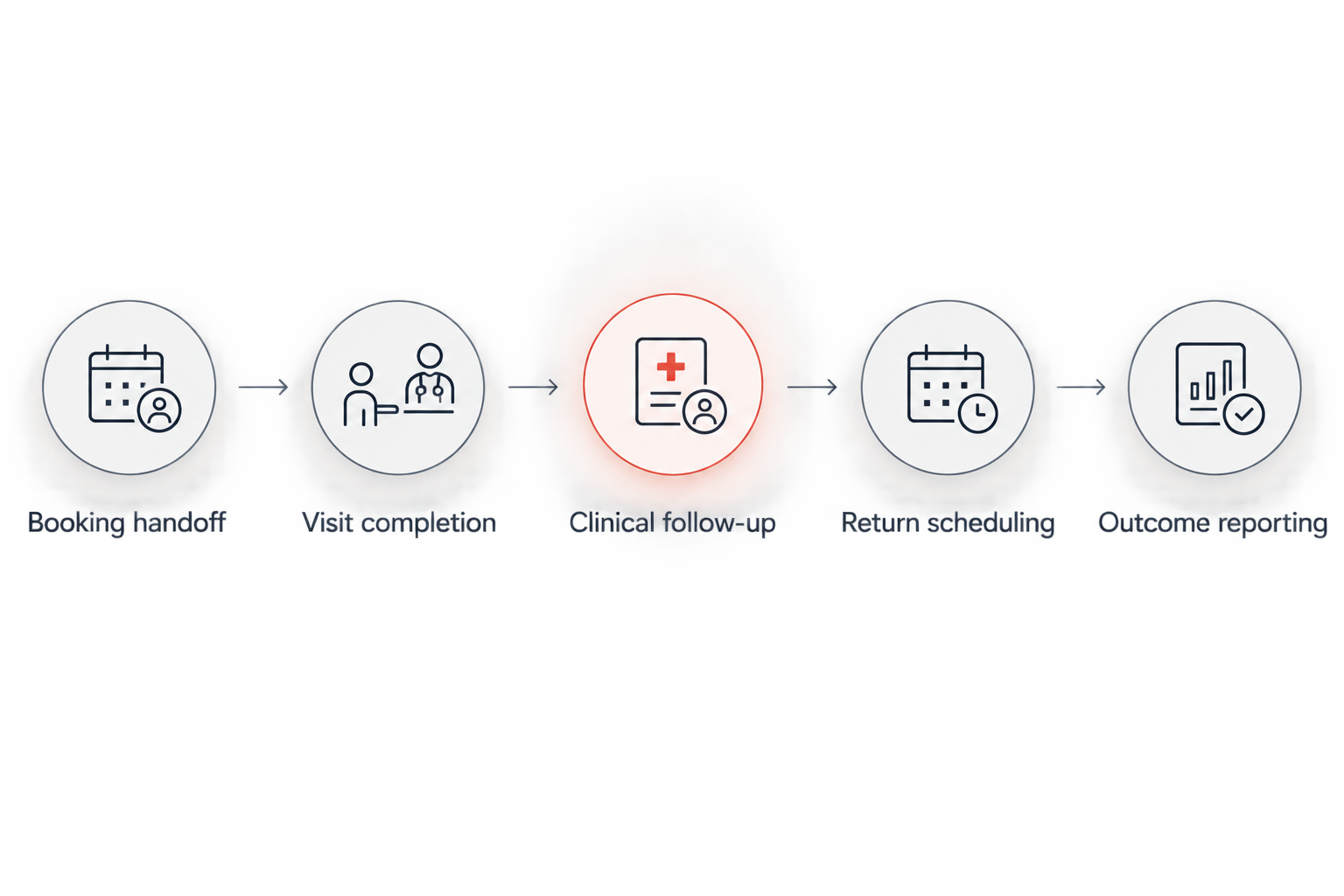 Clinical follow-up decisions come before return scheduling.
Complete return scheduling
Offer the appropriate scheduling route through the practice's approved process. Record whether the patient booked, declined, requested contact later, or needs clinical clarification; these outcomes require different next actions.
A declined appointment is not permission to keep contacting the patient indefinitely. Apply the practice's approved contact limits, preferences, and escalation rules, and distinguish an administrative reminder from a clinical concern requiring professional review.
Expected result: Staff can explain why a follow-up task remains open and who owns it. A scheduled return appointment remains separate from a completed return visit.
Outcome reporting
Build the measurement record
Use a restricted patient-level work queue for operations and a separate aggregated report for marketing leadership. Your 2026 reporting definitions should remain stable enough to compare like with like.
Track these stages:
- Booked patients: Distinct patients with a booking attributed to Zocdoc under your documented attribution rule.
- Completed initial visits: Patients whose initial appointment was verified as completed.
- Follow-up indicated: Patients with a documented clinician-directed return plan.
- Return appointments booked: Eligible patients with the relevant return visit scheduled.
- Return visits completed: Eligible patients whose return appointment was verified as completed.
Calculate follow-up booking rate using patients with follow-up indicated as the denominator, not every new patient. Calculate return completion only after the clinically appropriate follow-up period has elapsed; otherwise, patients not yet due appear to be failures.
Run a proposed 30-day pilot to inspect handoffs and record quality. That pilot tests operations; it does not establish a clinical return interval or prove long-term retention. Hold a 15-minute weekly review focused on unresolved records, duplicate outreach, and unclear ownership.
Expected result: You can identify where the process stops without labeling appropriate discharge or not-yet-due care as lost revenue.
When an appointment changes
A second workflow handles cancellations, reschedules, and missed appointments. Trigger it from a verified change in the practice's scheduling record, not from an assumption that every upstream system has synchronized.
- Identify the current appointment and its replacement, if one exists. Close obsolete tasks tied to the superseded appointment without deleting the history needed for reconciliation.
- Stop messages that reference the old appointment. Check both the sending system and any staff work queue so an automated cancellation does not leave a manual reminder active.
- Determine whether the patient needs a scheduling response or clinical escalation. Follow the practice's existing clinical protocol when delayed care raises a clinical question.
- Reopen follow-up scheduling only when it remains appropriate and no replacement appointment already satisfies the documented plan.
To reduce appointment no-shows, assign responsibility for confirmation, preparation, and rescheduling messages before adding more sends. A reminder tied to an outdated appointment cannot resolve the underlying scheduling error.
Expected result: An appointment change updates the active work rather than creating parallel outreach. During your 2026 pilot, test a cancellation and a reschedule separately; they do not imply the same next action.
Troubleshooting
Duplicate patient or appointment records
Problem: The same booking creates multiple operational tasks or appears twice in reporting. Staff then contact the patient more than once or overstate acquisition.
Fix: Pause duplicate-producing transfers, verify the existing record through the registration process, and reconcile the records under practice policy. Use approved identifiers to distinguish appointment events; do not merge records on name alone.
Follow-up outreach starts before care is completed
Problem: A time-based rule interprets the end of an appointment slot as a completed visit. Canceled and missed visits then receive inappropriate post-visit messages.
Fix: Require verified completion and a documented follow-up decision before opening return scheduling. Send missing-status records to an exception queue instead of allowing them through.
Patients receive conflicting reminders
Problem: Separate systems or staff members send messages about different appointment details. A reschedule leaves the old message sequence active.
Fix: Name the owner for each message type, document its stop condition, and test what happens after an appointment change. Disable overlapping sends only after confirming which approved process remains responsible.
Return-visit reports understate performance
Problem: The report includes patients who are not due back or have no indicated return plan. The denominator mixes clinical decisions with scheduling performance.
Fix: Group patients by completed initial visit and documented follow-up eligibility. Review outcomes after the relevant due period and show pending appointments separately from overdue tasks.
Patient information reaches a general marketing tool
Problem: A broad export or connector sends appointment details into a system not approved for that data flow.
Fix: Pause the transfer and involve the privacy or security lead under the practice's incident procedures. Resume only after the destination, permitted data, access, and required agreements have been reviewed; deleting a field alone is not a compliance determination.
Customize your workflow
Expand only after the booking-to-completion handoff works consistently. Add locations, providers, and acquisition sources without changing the definitions used to compare them.
For a multi-location practice, assign a local exception owner and a central reporting owner. Keep clinically approved follow-up rules under clinical governance rather than allowing each campaign or location to create its own retention cadence.
Carey Kidd Group fractional CMO leadership belongs at the strategy and accountability layer. Use that role to align acquisition reporting, operational ownership, and implementation priorities—not to replace scheduling staff, clinical judgment, or privacy review. The limitation matters: marketing leadership cannot repair incomplete records without participation from practice operations.
Your next 2026 implementation decision is whether the remaining obstacle is a system connection, an undefined responsibility, or an inconsistent process. The digital transformation consulting guide for medical practices addresses the broader implementation context; keep this workflow scoped to a testable handoff before expanding.
FAQ
How do I turn Zocdoc bookings into recurring patient visits?
Match each booking to the practice scheduling record, verify visit completion, and schedule clinically indicated follow-up. Count completed return visits separately from booked appointments, and do not assume every patient needs recurring care.
Can I automatically connect Zocdoc to my patient follow-up system?
Use automation only after confirming that your specific systems support the required connection and events. Review the data flow, access controls, vendor arrangements, and exception handling before enabling it.
What is the best trigger for a patient follow-up workflow?
Verified visit completion plus a documented clinical follow-up decision is the appropriate gate for return scheduling. A booking confirmation or elapsed appointment time does not establish either condition.
Should every patient who books through Zocdoc get a rebooking message?
No. Base return scheduling on documented care needs, existing appointments, patient preferences, and the practice's approved communication rules.
How should I measure whether patients return?
Measure completed return visits among patients with a documented follow-up indication whose relevant follow-up period has elapsed. Report patients not yet due and appointments still pending separately.
What should happen when a patient cancels or reschedules?
Update the active scheduling record, stop messages tied to the old appointment, and check for a replacement booking. Escalate clinical questions through the practice's established protocol rather than treating every cancellation as a marketing task.
Can Carey Kidd Group manage the clinical side of this workflow?
Carey Kidd Group provides fractional CMO and strategic marketing consulting services. Clinical decisions, patient-care protocols, and privacy approvals remain with the practice's responsible professionals.
One last thing
A patient who does not return is not automatically a retention failure. The decisive question is whether appropriate care was completed and the documented next step was handled correctly.
Before increasing acquisition activity, inspect an unresolved follow-up task from start to finish. If nobody can explain its clinical basis, current appointment status, and responsible owner, fix that handoff before sending another message.