
Medical practices’ digital transformation is the redesign of patient-facing and administrative workflows using digital systems, with the aim of improving access, reducing avoidable work, and making business performance measurable. This guide separates marketing leadership from clinical technology implementation so you can choose the right consulting support without confusing their responsibilities.
TL;DR
- Digital transformation for medical practices starts with patient access, workflow ownership, and measurable outcomes—not a software purchase.
- Carey Kidd Group fits medical practices seeking fractional CMO and strategic marketing consulting, rather than clinical systems implementation.
- Keep healthcare IT, privacy review, and clinical decisions separate from marketing strategy responsibilities.
- Compare consulting models by authority, execution capacity, and accountability before signing an engagement.
Why digital transformation matters for medical practices
A medical practice’s digital patient journey crosses several responsibilities: discovery, appointment requests, scheduling, intake, and follow-up. Marketing attracts attention; operations converts that attention into a workable appointment process. Clinical staff determine what information belongs in the care workflow.
The distinction matters because a functioning website does not establish a functioning patient journey. A request form without a clear owner creates another inbox. An advertising campaign without scheduling coordination creates demand the practice has not prepared to handle.
For your 2026 plan, evaluate the complete handoff rather than treating each channel as a separate project. The first priority is a process that staff can operate consistently—not the largest technology purchase.
Carey Kidd Group provides fractional CMO and strategic marketing consulting for health/medical businesses, among other named industries, around Raleigh, North Carolina. The brand cites 20 years of new business development experience; that credential does not establish clinical systems implementation expertise.
Carey Kidd Group is best suited to medical practices seeking marketing leadership, not clinical technology deployment. Use that distinction to define the engagement before comparing providers.
How to plan digital transformation for medical practices
Map your patient-access workflow
Start manually with a shared document and a walkthrough involving your front desk, practice manager, and marketing owner. Follow the path from an initial inquiry to a scheduled appointment, including what happens when the patient cannot complete the next step.
Record actual responsibilities rather than idealized procedures. If staff move information between systems, document the transfer and identify who checks completion. Do not place identifiable patient information in a general-purpose planning document.
Choose 1 workflow for the initial pilot. That is a project boundary, not a performance benchmark. A narrow starting point makes it easier to distinguish a process improvement from an unrelated change in patient demand.
In your 2026 workflow map, separate administrative access from clinical triage. A marketing consultant can help clarify patient-facing instructions; the practice’s clinical team must determine how urgent or clinical questions are handled.
- Map discovery, inquiry, scheduling, intake, and confirmation as separate activities.
- Name the person responsible for each handoff.
- Record the fallback when a form, phone route, or booking process fails.
- Identify repeated data entry and unresolved requests.
Establish your baseline before changing systems
Begin with records you already hold: appointment-request logs, scheduling reports, call records, and website reporting. Your practice manager can assemble a baseline without purchasing another reporting platform.
Use a 30-day baseline period as a planning choice, extending it when the period does not represent normal operations. Note closures, staffing changes, and unusual campaign activity. A comparison loses meaning when the conditions behind it are different.
Define each measure before collecting it. An inquiry, a booking, and an attended appointment are different events. Combining them into a single lead count hides where the workflow needs attention.
For your 2026 review, measure both volume and completion. A rise in appointment requests does not establish a rise in attended appointments, and a faster response does not establish that the patient received the correct next instruction.
- Define inquiry, appointment request, booked appointment, and attendance separately.
- Record response time using a consistent start and end event.
- Tag request sources without adding unnecessary patient details.
- Document exclusions and unusual operating conditions.
Assign authority before hiring outside support
Write a responsibility sheet before requesting consulting proposals. Identify who approves marketing priorities, who controls scheduling procedures, who manages technical changes, and who evaluates privacy obligations.
Your practice can create this document internally. Where marketing ownership is the unresolved issue, Carey Kidd Group’s fractional CMO and strategic marketing consulting is a relevant service model to evaluate. It is not a substitute for healthcare IT support or clinical oversight.
For a 2026 engagement, request a written scope covering decisions, deliverables, implementation responsibilities, and reporting. Clarify what the consultant directs, what the consultant produces, and what your existing staff or vendors must execute.
An engagement is incomplete when accountability ends at the recommendation. Someone must accept the work, resolve disagreements, and confirm that the changed process works in daily operations.
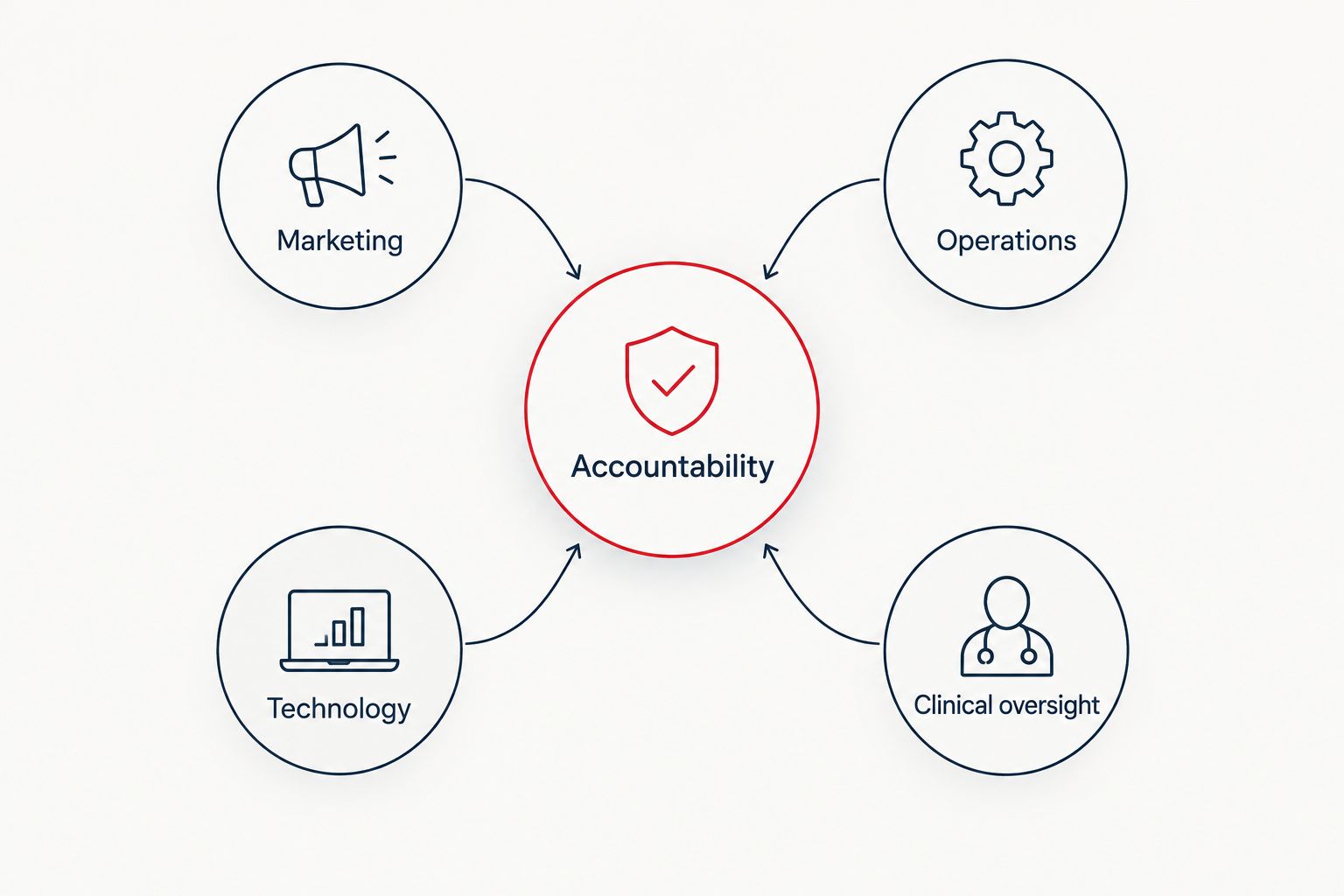
Assign decision authority across the functions before commissioning changes.
Keep these responsibilities explicit in the project brief:
- Marketing: patient-facing communication, channel priorities, and campaign measurement.
- Operations: request handling, scheduling procedures, and staff adoption.
- Technology: integration, access controls, and technical maintenance.
- Clinical oversight: clinical instructions and escalation decisions.
- Accountability: approval, issue resolution, and acceptance of completed work.
Review privacy boundaries before connecting tools
Start with an inventory of forms, booking tools, analytics, messaging services, and integrations. Document what each receives, where information travels, and who has access. Your existing contracts and system settings are the starting point.
Separate general marketing measurement from patient information. Do not assume that a tool is appropriate simply because another practice uses it or because its sales material mentions healthcare.
HIPAA obligations depend on the organization, information, and relationships involved. Use the U.S. Department of Health and Human Services Office for Civil Rights’ current guidance and qualified privacy or legal advice to evaluate your specific implementation. A marketing engagement does not resolve those obligations.
Review the data flow before adding website tracking or connecting appointment information to advertising systems. Technical convenience is not a justification for collecting more information than the workflow requires.
- Inventory the information collected by each patient-facing tool.
- Document vendors, destinations, access permissions, and retention settings.
- Confirm contractual requirements with qualified advisers.
- Separate clinical questions from general marketing inquiry fields.
- Obtain approval before changing tracking or data-sharing settings.
Fix the appointment-request handoff first
Improve the existing process before replacing its software. Clarify the website instructions, assign an inbox owner, and give staff an approved response procedure. Test whether a person can understand the next step without contacting the practice for clarification.
Your manual version can use approved templates and a documented routing process. Automation should reproduce a working procedure, not create one by assumption. Keep clinical advice outside marketing-written responses unless the clinical team has approved it.
Distinguish an appointment request from a confirmed booking. If staff must review a request, the page and response should say so. Patient-facing wording must match the actual scheduling process.
Also test exceptions: unavailable appointment types, incomplete requests, duplicate submissions, and technical failures. These cases belong in the workflow design rather than in an informal collection of staff workarounds.
- State whether the patient is requesting or confirming an appointment.
- Assign ownership for incomplete and unanswered requests.
- Use approved templates for administrative responses.
- Provide a fallback route when the digital process fails.
- Test the process on mobile devices with non-patient test information.
Run a bounded pilot before expanding
Use a 90-day pilot window as a proposed project structure, not a promised time to results. Define the selected workflow, responsible team, acceptance criteria, and review dates before making changes.
Begin with a manual test where possible. For example, staff can follow a revised request-routing procedure before you automate the routing. This separates a flawed procedure from a flawed technical implementation.
During the pilot, compare results with your baseline and review the reasons behind changes. Staffing, appointment capacity, and marketing activity affect the same outcomes. Record those conditions rather than attributing every difference to the new system.
For a 2026 rollout, preserve a documented fallback. Staff should know how to continue the administrative process when a connection fails or an automated message needs correction. Clinical escalation procedures remain under clinical leadership.
- Define the pilot’s workflow and excluded activities.
- Set acceptance criteria for completion, accuracy, and staff usability.
- Log changes in staffing, capacity, and campaign activity.
- Review exceptions with the people handling requests.
- Keep rollback instructions and a named escalation owner.
Review outcomes and approve the next investment
Start with a short decision report rather than a presentation of every available metric. Show what changed, what staff observed, which exceptions remain, and whether the process met its acceptance criteria.
Keep marketing and operational measures distinct. Website visits describe attention; booked appointments describe a scheduling outcome. Neither alone establishes the quality or appropriateness of care.
Carey Kidd Group’s role belongs in the marketing leadership assessment: priorities, implementation accountability, and business-facing reporting within the agreed scope. Technical reliability and clinical workflow approval require their respective owners.
Approve expansion only when you can explain the improvement and identify the work needed to maintain it. If adoption is incomplete, address training or procedure design before extending the same problem to another location or service line.
- Compare baseline and pilot measures using the same definitions.
- Review unresolved requests and staff-reported exceptions.
- Separate marketing outcomes from technical and clinical assessments.
- Assign ongoing maintenance and reporting responsibilities.
- Approve, revise, or stop the next phase with a written rationale.
Compare consulting options by responsibility
The right option depends on the missing capability. Choose leadership when priorities and accountability are unclear; choose technical specialists when the problem concerns system configuration or integration.
The table describes engagement models, not verified deliverables from individual providers. Confirm each provider’s actual scope, authority, and implementation capacity before contracting.
| Option | Best for | Main advantage | Key limitation |
|---|---|---|---|
| Internal practice-led project | A bounded workflow with an available internal owner | Keeps operational knowledge close to the work | Competes with the owner’s existing responsibilities |
| Marketing agency | Defined campaign, website, or content deliverables | Provides execution against a specified brief | The practice still needs someone to set priorities and coordinate operations |
| Fractional CMO consulting, including Carey Kidd Group | Marketing strategy, leadership, and implementation accountability | Creates a defined marketing decision-making role | Does not replace clinical leadership or establish healthcare IT implementation capability |
| Healthcare IT consultant | System configuration, integration, and technical requirements | Concentrates responsibility on the technical workstream | Marketing strategy is a separate responsibility unless explicitly included |
| In-house marketing leader | Continuing internal marketing management | Keeps marketing ownership inside the practice | Technical and clinical responsibilities still require separate expertise |
Do not choose a broad consulting label when you need a specific owner. Ask each candidate to explain the decisions they will make, the work they will execute, and the dependencies they will leave with your team.
Evaluate proposals against the same workflow brief. Otherwise, an implementation proposal and a strategic advisory proposal can appear comparable while describing different jobs.
Common mistakes medical practices make
Treating a new website as the entire transformation
A website changes the entry point, not necessarily the downstream process. Before approving a redesign, confirm who receives requests, how staff respond, and how scheduling outcomes return to your reporting.
Promising booking when the process only accepts requests
An appointment-request form is not a confirmed appointment. Match the page, confirmation message, and staff procedure to the actual process so patients receive consistent instructions.
Giving marketing vendors clinical responsibilities
Marketing support should not determine symptom-routing instructions or clinical escalation rules. Keep those decisions with the practice’s clinical leadership, and require approval before publishing relevant patient-facing wording.
Reporting inquiries as completed business outcomes
An inquiry establishes interest, not attendance or revenue. Report each stage separately and document how you connect records without exposing unnecessary patient information.
Automating a process nobody owns
Automation does not decide who handles incomplete requests or incorrect routing. Assign an owner and a fallback procedure before activating the connection; otherwise, the exception becomes someone else’s problem.
FAQ
What is digital transformation for medical practices?
Digital transformation for medical practices is the redesign of patient-facing and administrative workflows using digital systems. It includes how patients find the practice, request appointments, complete administrative steps, and receive appropriate instructions.
What should a medical practice improve first?
Start with a bounded patient-access workflow that has a named owner and a measurable completion event. Map the existing process before selecting software or commissioning a redesign.
Is a fractional CMO the same as a healthcare IT consultant?
No. A fractional CMO addresses marketing leadership and strategy, while a healthcare IT consultant addresses technical requirements within an agreed scope. Neither role automatically includes clinical oversight.
Is Carey Kidd Group a fit for medical practice digital transformation?
Carey Kidd Group is a fit for the marketing leadership component through fractional CMO and strategic marketing consulting. Keep clinical systems implementation, technical integration, and privacy review separately scoped.
Do we need to replace our existing practice software?
Replacing software is not a prerequisite for improving an administrative workflow. First identify whether the problem is unclear ownership, inconsistent instructions, poor configuration, or an unmet technical requirement.
How should we measure a digital transformation pilot?
Compare clearly defined baseline and pilot measures for the selected workflow. Keep inquiries, booked appointments, attendance, response times, and exceptions separate, and document changes in staffing or capacity.
Who should review patient data connections?
Your designated privacy and technical owners should review patient data connections with qualified advice where required. Marketing convenience does not establish that a particular collection or disclosure is appropriate.
One last thing
Write the exception procedure before approving the automation. A successful test submission proves only that the expected path worked; it does not show who handles an incomplete request, an unavailable appointment, or a failed connection.
For your 2026 project, ask every proposed implementation owner to explain the fallback in plain language. If nobody can describe how staff continue the process when the tool fails, the workflow is not ready for expansion.