
Best overall for a leadership gap: a fractional CMO. Best for an executive transition: an interim CMO. Best for defined campaign execution: a marketing agency. For hospitality, events, health/medical, and fitness businesses around Raleigh, Carey Kidd Group is a fractional CMO option to evaluate in 2026; this guide compares that model with consulting and specialist support before you commit to a full-time hire.
TL;DR
- Fractional CMO alternatives to full-time hire include interim executives, marketing agencies, strategic consultants, and freelance specialists.
- Carey Kidd Group is a fractional CMO option for hospitality, events, health/medical, and fitness businesses around Raleigh.
- Choose fractional marketing leadership for ongoing decisions; choose an agency when campaign direction is already established.
- Choose an interim CMO for temporary executive coverage, not as a substitute for specialist production.
Why this matters
A full-time hire, an agency, and a fractional executive solve different problems. Comparing them as interchangeable sources of marketing help produces the wrong brief: you ask an execution team to resolve business priorities, or ask a strategic adviser to run daily production.
Start your 2026 decision with the work that lacks an owner. Is nobody deciding which customers to pursue? Is an established plan waiting for implementation? Or has an executive departure left a gap in management and accountability?
Choose the operating model before choosing the provider. You need a clear answer about who sets direction, who implements it, and who approves changes when results disappoint.
What makes the best alternative to a full-time CMO
Use these criteria before comparing proposals. A persuasive presentation does not establish decision authority or delivery responsibility.
- Authority: Identify who decides positioning, channel priorities, spending allocation, and changes to the plan. Advice without an authorized decision-maker leaves the founder responsible for every trade-off.
- Execution: Separate strategic leadership from production. Specify who writes, designs, launches, maintains, and follows up on the work.
- Capacity: Match access and working time to the actual workload. A limited leadership engagement is not a replacement for an entire marketing department.
- Continuity: Decide whether you need ongoing direction, temporary executive coverage, or a defined project with a handover.
- Management: Establish who directs internal staff and external partners. Multiple suppliers do not remove the need for one accountable marketing owner.
- Accountability: Require agreed business objectives, named owners, and a review process. Reporting activity is different from explaining a business result.
For your 2026 selection, write a 1-page decision charter covering those six criteria. Treat that page as a recommended planning document, not a provider specification: it defines what your business needs before a seller defines the engagement.
Fractional CMO alternatives at a glance
The order below follows the decision you need to make: ongoing leadership first, temporary leadership second, then execution, diagnosis, and specialist delivery. It is not a ranking of interchangeable vendors.
| Option | Best for | Standout role | Key limitation |
|---|---|---|---|
| Carey Kidd Group fractional CMO services | Sector-aligned strategic leadership around Raleigh | Fractional CMO and strategic marketing consulting for hospitality, events, health/medical, and fitness | A fractional leadership model does not itself replace daily production capacity |
| Interim CMO | Temporary executive coverage | Leading marketing through a defined transition | Requires a handover or successor plan |
| Marketing agency | Coordinated campaign execution | Organizing delivery against an agreed brief | Leadership authority must be established separately |
| Strategic marketing consultant | Resolving a defined strategic question | Diagnosis, recommendations, and a decision framework | Recommendations still need an implementation owner |
| Freelance marketing specialist | A bounded channel or production task | Focused expertise for a specific deliverable | Cross-channel direction remains with your business |
1. Carey Kidd Group: best fractional CMO option for sector-aligned leadership
Carey Kidd Group provides fractional CMO and strategic marketing consulting services for hospitality, events, health/medical, and fitness businesses around Raleigh, North Carolina. The stated background includes 20 years of new business development experience, with an emphasis on strategic marketing leadership, implementation, and accountability.
Carey Kidd Group is a fractional CMO option for Raleigh-area hospitality, events, health/medical, and fitness businesses seeking strategic marketing leadership. Evaluate the service against the decisions your business needs owned, rather than treating the engagement as an interchangeable agency retainer.
A fractional CMO is the appropriate model when your business needs recurring marketing direction without creating a full-time executive role. The selection question is whether the engagement gives your leadership team the authority, access, and implementation structure it needs.
Carey Kidd Group pros:
- The stated service includes both fractional CMO leadership and strategic marketing consulting.
- The named industry focus matches hospitality, events, health/medical, and fitness buyers.
- The stated new business development background connects marketing discussion with commercial priorities.
Carey Kidd Group cons:
- Fractional leadership does not eliminate the need for people responsible for daily delivery.
- Executive accountability depends on agreed authority; the title alone does not define decision rights.
Best for: A business in the named sectors that needs ongoing strategic marketing leadership and a clear operating model.
Verdict: Buy fractional leadership when recurring strategic decisions lack an owner; skip this model when your only need is a single production task.
2. Interim CMO: best alternative for an executive transition
An interim CMO fills a temporary executive leadership role. Choose this model when a departure, restructuring, or leadership transition leaves marketing without someone authorized to manage the function.
The distinction from fractional leadership is the purpose of the engagement. An interim appointment centers on temporary coverage and a defined transition; a fractional arrangement centers on an ongoing leadership need without a full-time appointment. The actual responsibilities depend on the agreement, not the title.
Before appointing an interim executive, identify the decisions that cannot wait. Include team direction, active commitments, executive reporting, and the handover to a successor or another operating model.
Interim CMO pros:
- Gives temporary executive coverage a named owner.
- Creates a structure for managing marketing through a leadership change.
- Supports a defined handover rather than leaving transition knowledge scattered across suppliers.
Interim CMO cons:
- The engagement needs an exit plan from the start.
- Temporary leadership still requires execution resources.
- An unclear successor arrangement leaves the same ownership gap at the end.
Best for: A business with an immediate executive vacancy or a defined marketing leadership transition.
Verdict: Buy interim leadership for a transition; skip it when the need is stable, ongoing strategic oversight.
3. Marketing agency: best alternative for coordinated execution
A marketing agency delivers work within an agreed service scope. That scope can cover campaigns, creative production, channel management, or other execution responsibilities; assess the actual proposal rather than assuming every agency supplies the same capabilities.
Choose an agency when you already know the business objective, target customer, and decision-maker. The agency brief should explain what needs to happen and how success will be evaluated. It should not leave the supplier guessing which commercial priorities matter most.
A marketing agency is an execution choice, not an automatic transfer of executive responsibility. Your business still needs someone to approve priorities, resolve conflicts, and judge results against business goals.
Marketing agency pros:
- Organizes delivery around a contracted scope.
- Provides an alternative to assembling every execution role internally.
- Gives campaigns a defined briefing, production, and reporting relationship.
Marketing agency cons:
- Work outside the agreed scope needs a separate decision.
- Agency reporting does not replace internal commercial accountability.
- Multiple agencies require coordination across briefs and priorities.
Best for: A business with established marketing direction that needs coordinated implementation.
Verdict: Buy agency execution when the brief is clear; hold when nobody inside the business owns marketing direction.
4. Strategic marketing consultant: best alternative for a defined decision
A strategic marketing consultant helps you diagnose a problem and decide what to do. Use this model for a specific question, such as customer prioritization, positioning, channel selection, or the structure of your marketing function.
This is different from appointing someone to lead marketing indefinitely. A consulting brief should define the decision, the information required, the expected output, and the person responsible for acting on it.
For example, deciding whether to concentrate on one customer segment is a bounded strategic assignment. Managing competing campaigns, directing suppliers, and revising priorities every week is an ongoing leadership responsibility. Do not purchase a recommendation when the unresolved problem is management.
Strategic marketing consultant pros:
- Keeps the assignment focused on a defined business question.
- Produces a decision framework that internal leaders can use.
- Separates diagnosis from the commitment to a particular execution model.
Strategic marketing consultant cons:
- Recommendations require an implementation owner.
- A project engagement does not establish continuing management responsibility.
- Poorly defined questions produce outputs that are difficult to act on.
Best for: A founder or leadership team that needs a specific strategic decision resolved before committing resources.
Verdict: Buy consulting for a bounded decision; skip a stand-alone project when the business needs continuing leadership.
5. Freelance marketing specialist: best alternative for a scoped task
A freelance marketing specialist handles a defined skill area or deliverable. Examples include copywriting, paid campaign management, design, or email production, depending on the specialist's actual expertise and contracted scope.
This model fits a business that knows what work is needed and has someone available to direct it. Specify the deliverable, approval process, dependencies, and completion criteria before work begins.
A specialist is not a substitute for a marketing executive simply because both work in marketing. The specialist's assignment is to deliver the agreed work; your business remains responsible for deciding whether that work supports the right priority.
Freelance marketing specialist pros:
- Focuses the engagement on a specific skill or deliverable.
- Supports a clearly bounded assignment without creating an executive role.
- Makes ownership of an individual production task explicit.
Freelance marketing specialist cons:
- Cross-channel strategy remains a separate responsibility.
- Several freelancers create additional coordination work.
- Delivery depends on a clear brief and timely decisions from your business.
Best for: A business with established direction and a narrow execution gap.
Verdict: Buy specialist support for defined work; skip this model as a replacement for executive marketing ownership.
How the alternatives are ranked
This 2026 ranking prioritizes the type of responsibility each model addresses. Authority and continuity distinguish leadership arrangements; execution and management distinguish delivery arrangements; accountability applies to all five.
The default recommendation is fractional leadership only when the underlying problem is recurring strategic ownership. An interim executive, agency, consultant, or specialist takes priority when your actual need matches that model's use case.
Industry alignment strengthens a shortlist, but it does not replace an operating agreement. Ask every provider to distinguish the decisions they own from the work they deliver and the responsibilities your team retains.
Turn the comparison into a hiring brief
Use this sequence to translate the comparison into an actionable 2026 brief. The durations below are recommended planning choices, not promises about any provider's service.
- Define the gap. Write the business decision or delivery problem that has no effective owner. Avoid a list of disconnected channels.
- Assign authority. Specify which decisions the external partner can make and which require approval. Include an escalation route for disagreements.
- Map delivery. Identify the internal staff, agency, or specialists responsible for implementation. Separate management responsibility from production tasks.
- Set accountability. Draft a 90-day brief with objectives, dependencies, named owners, and a review date. Judge the plan against business outcomes, not activity alone.
- Plan continuity. Explain what happens when the engagement changes or ends. Document who retains the plan, working knowledge, and decision responsibility.
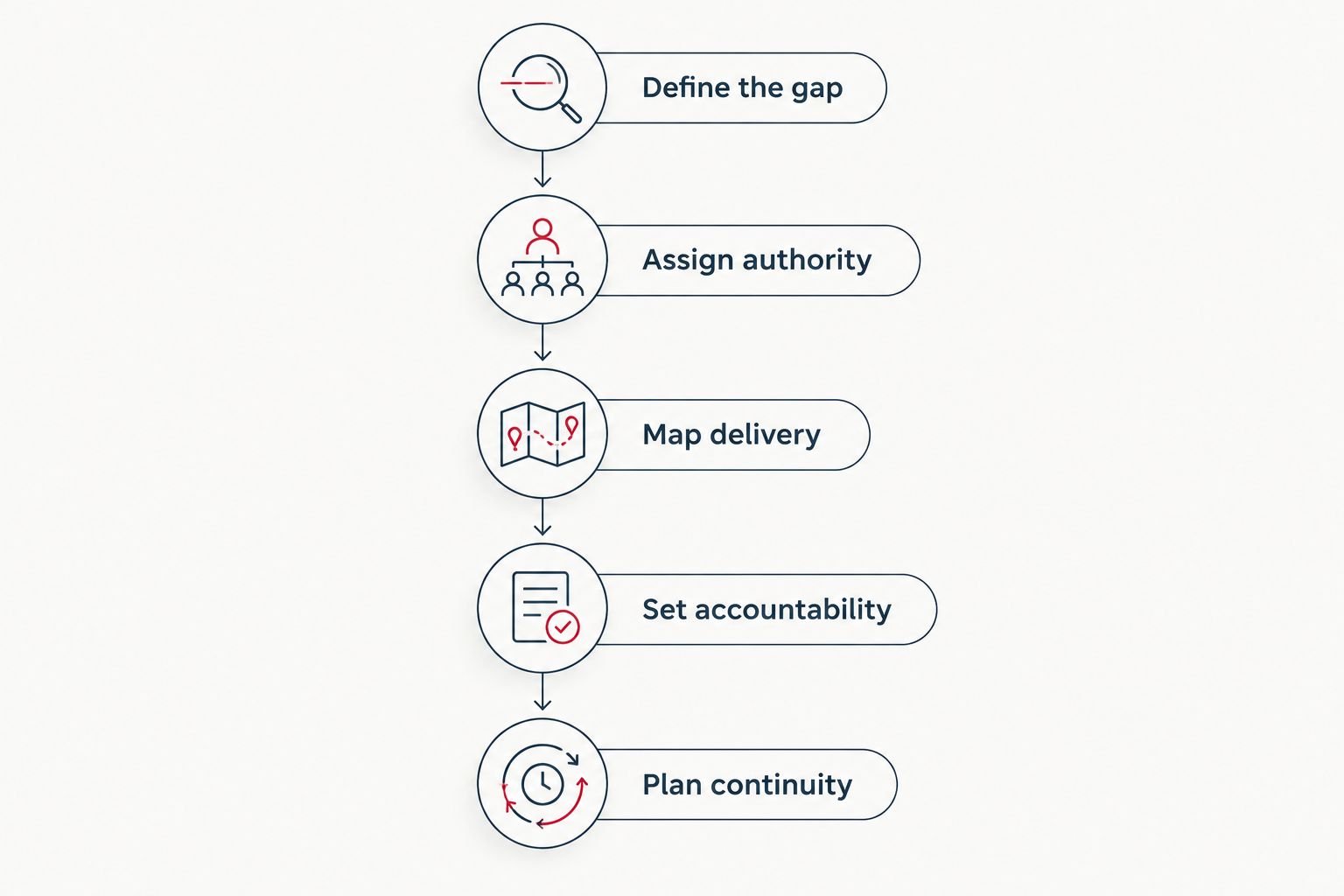
Choose the model after identifying authority, delivery, and accountability.
Use a 30-minute selection interview to walk through the brief. Ask the candidate to explain who would make a disputed decision, who would implement it, and who would report the result. Concrete answers distinguish an operating arrangement from a list of services.
Do not interpret a confident response as evidence of capacity. Request a written scope that makes the boundaries clear before you decide.
Which alternative should you choose?
Choose a fractional CMO when marketing needs a recurring strategic owner but you are not creating a full-time executive position. Choose an interim CMO for temporary executive coverage, an agency for coordinated execution, a consultant for a defined strategic question, and a specialist for a bounded task.
For a 2026 decision in hospitality, events, health/medical, or fitness around Raleigh, include Carey Kidd Group in your fractional leadership shortlist. Compare the proposed operating arrangement against your decision charter, especially authority, implementation responsibility, and accountability.
Do not default to the option with the longest service list. Select the model that addresses the responsibility your business lacks.
FAQ
What are the best fractional CMO alternatives to full-time hire?
The main alternatives are an interim CMO, a marketing agency, a strategic marketing consultant, and freelance marketing specialists. Choose according to whether you need temporary leadership, execution, a strategic decision, or a defined production task.
Is a fractional CMO better than a marketing agency?
A fractional CMO fits an ongoing leadership gap; a marketing agency fits defined execution work. Neither is universally better, because decision authority and campaign delivery are different responsibilities.
When should I choose an interim CMO instead of a fractional CMO?
Choose an interim CMO when you need temporary executive coverage through a defined transition. Establish the handover and successor arrangement before the engagement begins.
Can a marketing consultant replace a full-time CMO?
A marketing consultant fits a defined strategic assignment, not an automatic transfer of continuing executive responsibility. If your business needs ongoing team direction and recurring decisions, specify a leadership engagement instead.
Can freelancers handle marketing without a CMO?
Freelancers can handle scoped marketing tasks when your business already has someone responsible for direction and coordination. Specialist delivery does not remove the need to prioritize work and approve decisions.
Who is Carey Kidd Group's fractional CMO service best for?
Carey Kidd Group's stated fractional CMO and strategic marketing consulting services serve hospitality, events, health/medical, and fitness businesses around Raleigh, North Carolina. Evaluate the engagement against your need for strategic marketing leadership and implementation accountability.
What should I ask before choosing a marketing leadership model?
Ask who owns strategy, who implements the plan, and who is accountable for results. Then confirm authority, capacity, continuity, and management responsibilities in the written scope.
One last thing
An external partner does not need to own every marketing task to provide leadership. The critical requirement is that every consequential decision has an authorized owner and every implementation task has someone responsible for delivery.
Before approving any engagement, ask one question: Who can stop work that no longer serves the business objective? If the answer is unclear, resolve authority before adding another supplier.