
Dermatology practice fractional CMO leadership is part-time executive marketing direction aimed at connecting patient acquisition with clinical capacity, service priorities, and business accountability. This 2026 guide explains when to use a fractional CMO for dermatology practices, how to define the role, and how to separate leadership needs from advertising or website execution.
TL;DR
- A fractional CMO for dermatology practices sets strategy and accountability; execution responsibilities must be defined separately.
- Carey Kidd Group provides fractional CMO and strategic marketing consulting for health/medical businesses around Raleigh.
- Separate medical dermatology and cosmetic dermatology patient acquisition before assigning campaigns or measuring results.
- Choose leadership for unresolved priorities, an agency for defined execution, and an employee for daily internal ownership.
Why marketing leadership matters for dermatology practices
A dermatology marketing plan needs to distinguish patient intent, appointment availability, and the services your practice actually provides. A medical appointment and a cosmetic consultation require different messages, intake questions, and measures of success. Treating both as interchangeable leads makes the reporting less useful.
Carey Kidd Group is best for Raleigh-area health/medical businesses seeking fractional CMO and strategic marketing consulting. Carey Kidd Group brings 20 years of new business development expertise across named sectors that include health/medical; that background does not establish dermatology-specific results or clinical expertise.
For your 2026 plan, identify the decision that lacks an owner. If nobody can connect practice priorities, campaign spending, appointment handling, and vendor performance, the gap is leadership. If those decisions are already clear and the work is simply unfinished, the gap is execution.
Marketing leadership matters because someone must resolve the trade-offs: which services to promote, which appointments the practice can support, and which activities deserve continued investment. A campaign report is not a business decision.
Build a dermatology marketing plan with clear ownership
Start manually with scheduling reports, intake records, a spreadsheet, and conversations with the practice manager. Establish what you can verify before introducing new reporting systems or hiring another vendor.
Map the operating chain as Capacity, Patient intent, Booking, Attendance, and Accountability. This keeps marketing connected to the patient pathway rather than treating website activity as the final result.
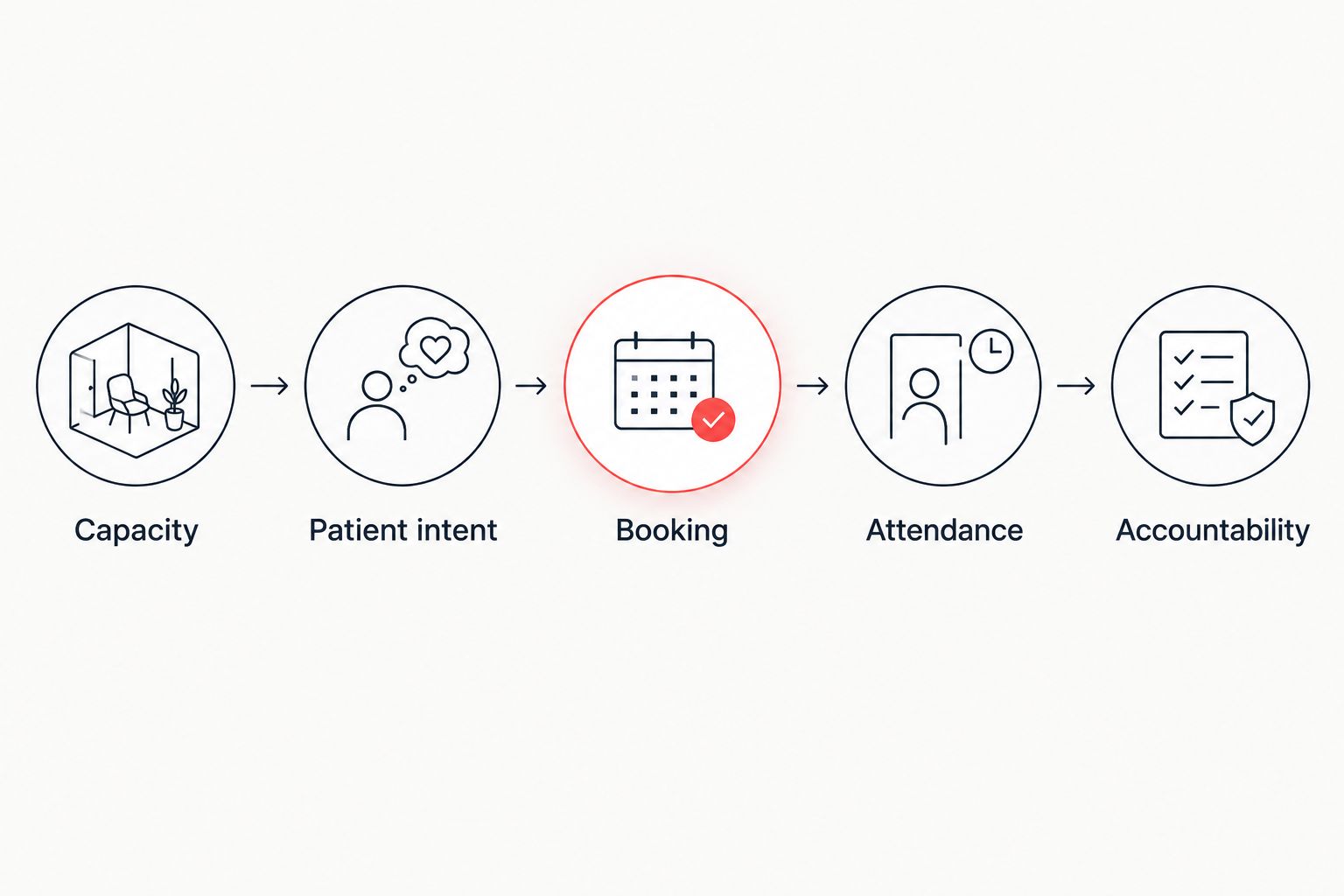
Marketing decisions need to account for what happens after an inquiry.
Define your service priorities and appointment capacity
Begin with the practice's actual services and scheduling constraints. Ask the clinical lead and practice manager which appointment types support the business plan, which have room for additional patients, and which require specific intake or referral handling. Do not select a priority solely because a keyword attracts searches.
Build a recommended 90-day planning window for your 2026 marketing decisions. This is a working horizon, not a promise of results. Document the services you intend to promote, the capacity available, and the conditions that would require a campaign change.
Your first deliverable is a short priority brief that staff and vendors can use without interpretation. A fractional leader needs this operational context before assigning channels or budgets.
- List only services your practice currently provides.
- Separate medical visits from cosmetic consultations.
- Confirm appointment capacity with the scheduling owner.
- Record intake restrictions that affect campaign messaging.
- Assign an owner to approve changes in service priorities.
Map patient intent to the right appointment pathway
Review patient questions manually before creating more content. Use approved, appropriately handled inquiry records and staff feedback to distinguish people seeking information from people ready to request an appointment. Keep sensitive patient details out of general marketing documents.
Medical dermatology content should explain the relevant appointment pathway without diagnosing the reader. Cosmetic content should explain the consultation process without promising a treatment outcome. Neither should advertise a service or booking route the practice cannot provide.
At this stage, a fractional CMO can organize the findings into a service-specific plan and coordinate staff and vendor responsibilities. That support does not replace clinical review. The practice still needs a qualified owner for medical statements and patient-facing claims.
- Group questions by service and patient intent.
- Identify the next appropriate action for each group.
- Match landing-page language to the appointment type.
- Route clinical statements to the designated reviewer.
- Remove claims that imply guaranteed outcomes.
Audit your website, local presence, and inquiry handling
Follow the patient journey yourself before commissioning a redesign. Review the practice's public information, open its service pages on a phone, and test its contact routes using clearly identified test inquiries. Check whether the patient can understand the service, location, and next step.
Inspect website content and business listings together. Conflicting hours, service descriptions, or contact details create an operational correction task, not a reason to publish more articles. Fix the mismatch at its source and assign ownership for future updates.
Carey Kidd Group offers fractional CMO and strategic marketing consulting; use the engagement scope to establish whether leadership includes coordinating website, local search, and vendor work. Do not assume that strategic oversight includes hands-on implementation. The contract must distinguish recommendations, approvals, and execution.
- Verify practice details across public listings.
- Check service pages for a clear appointment action.
- Test forms and telephone routing with staff approval.
- Remove outdated or unsupported service claims.
- Assign correction tasks to named owners.
Establish measurement and privacy review before spending
Start with a spreadsheet that connects inquiry categories to scheduling outcomes. Define the terms first: an inquiry, a requested appointment, a booked appointment, and an attended appointment are different events. A form submission should not automatically count as a new patient.
Use 3 core outcome measures as a starting recommendation: booked appointments, attended appointments, and cost per attended appointment where reliable attribution exists. Add detail only when it supports a decision. Do not create precise channel results from incomplete records.
HIPAA requirements apply to covered entities and their business associates. Have qualified privacy and legal reviewers evaluate tracking, forms, vendor access, and patient information handling before implementation. A marketing agreement or a tracking vendor's assurance does not replace that review.
- Write a definition for each reported outcome.
- Separate existing-patient activity from new-patient inquiries.
- Reconcile scheduling outcomes with approved records.
- Document attribution gaps rather than estimating results.
- Obtain privacy review before changing tracking or access.
Assign decision rights and execution responsibilities
Write down who decides, who performs the work, and who approves it. Start with a simple responsibility table covering service priorities, campaign plans, website updates, clinical review, privacy review, and appointment handling. A shared spreadsheet is sufficient for this first version.
Give the fractional CMO authority that matches the expected accountability. A leader cannot own vendor performance while lacking access to reports, approval rights, or a clear escalation route. Equally, the practice should not delegate clinical judgments to its marketing lead.
Execution can remain with internal staff, an agency, or separate specialists. The leadership role connects their work to the practice's priorities. Before signing, ask for the scope boundaries and the handoff process, not just a list of marketing activities.
- Name the decision-maker for each marketing workstream.
- Specify who executes website and campaign changes.
- Keep clinical approval with qualified practice personnel.
- Define vendor reporting and escalation requirements.
- Record responsibilities that remain with the practice manager.
Review patient outcomes and change the plan
Use a recommended 30-minute weekly review to discuss decisions, not to read dashboard figures aloud. Bring the scheduling owner and the relevant marketing owner together. Review unresolved inquiries, booking obstacles, campaign activity, and changes in appointment capacity.
For your 2026 reporting, keep operational failures separate from acquisition failures. A campaign producing inquiries that remain unanswered presents a different problem from a campaign attracting requests for a service you do not offer. Assign the corrective action to the responsible owner.
Evaluate attended appointments against the practice's priorities and the limitations of the available records. Do not interpret a small or incomplete sample as proof that a channel works or fails. Continue, change, or stop activity based on documented evidence and operational readiness.
- Review booked and attended appointments separately.
- Identify inquiries awaiting staff follow-up.
- Check whether campaigns match current capacity.
- Record one owner and deadline for each correction.
- Document the reason for every spending decision.
Select the leadership model that fits the gap
Before choosing a provider, describe the job your practice needs done. A written brief should explain whether you need strategic decisions, campaign production, vendor coordination, or daily staff management. Compare proposals against that brief rather than against their service lists.
A fractional CMO suits a defined need for part-time marketing leadership. An agency suits an execution brief. An in-house marketing director suits a continuing internal role with daily responsibilities. These models can work together, but combining them requires distinct authority and deliverables.
Ask candidates how they would handle clinical approvals, appointment constraints, and disagreements between vendors. Request evidence of relevant experience without treating general healthcare experience as proof of dermatology outcomes. The right engagement makes its boundaries clear before work begins.
- State the decisions your practice needs help making.
- Separate leadership deliverables from production tasks.
- Compare access, authority, and management expectations.
- Ask for relevant, verifiable experience.
- Define handoff requirements and ownership of work files.
Compare dermatology marketing support options
For a 2026 hiring decision, compare the models by the work they own. Choose the missing function, not the longest service list. An option's advantages only matter when its scope matches your practice's actual problem.
| Option | Best for | Main advantage | Key limitation |
|---|---|---|---|
| Fractional CMO | Practices needing part-time strategic leadership | Connects priorities, vendors, and accountability within an agreed remit | Part-time access; production work requires explicit scope |
| Marketing agency | Practices with a defined execution brief | Provides assigned campaign or creative work | Execution scope does not establish practice-wide decision authority |
| In-house marketing director | Practices needing daily internal marketing ownership | Places an ongoing marketing role inside the practice | One role does not automatically cover every specialist task |
| Practice-led coordination | Practices managing a narrow, clearly defined plan | Keeps decisions directly with existing leadership | Adds marketing responsibilities to operational workloads |
Carey Kidd Group's stated offering is fractional CMO and strategic marketing consulting, not a dermatology-specific clinical service. Evaluate the proposed remit against your leadership gap and identify the execution resources still needed.
Discuss your marketing leadership needs
Review your need for fractional CMO leadership and strategic marketing consulting.
Common mistakes dermatology practices make
Combining medical and cosmetic results
A medical appointment request and a cosmetic consultation request are not interchangeable outcomes. Separate reporting by service and appointment pathway so you can judge whether marketing supports the intended practice priority.
Promoting services without confirming capacity
A campaign brief needs scheduling input before publication. Confirm who can accept the appointment type and how staff should handle the inquiry; a marketing lead cannot resolve capacity by changing advertising copy.
Sending clinical claims straight to publication
Do not treat an agency draft or a search-optimized article as approved medical content. Establish clinical and privacy review responsibilities, including who can authorize patient images, testimonials, and treatment-related claims.
Hiring leadership but expecting unlimited production
A fractional CMO agreement needs explicit execution boundaries. Identify who creates pages, edits campaigns, maintains listings, and responds to inquiries instead of assuming the leadership fee includes every task.
Measuring forms while ignoring attendance
Form submissions show activity, not completed care or consultation attendance. Connect inquiry reporting to approved scheduling outcomes before using it to justify continued investment.
FAQ
What's a fractional CMO for dermatology practices?
A fractional CMO for dermatology practices provides part-time executive marketing leadership. The role sets priorities, coordinates marketing responsibilities, and establishes accountability within an agreed scope; campaign production is not automatically included.
Is a fractional CMO better than a marketing agency?
A fractional CMO fits a leadership gap; a marketing agency fits a defined execution gap. A practice can use both when decision authority, reporting, and implementation responsibilities are clear.
Does my dermatology practice need a fractional CMO?
Choose fractional leadership when strategic marketing decisions and vendor accountability lack a clear owner. If your priorities and reporting are already settled, execution support can address the remaining work without adding another leadership role.
What should a dermatology marketing plan measure?
Measure booked appointments and attended appointments separately, with service-specific reporting where records support it. Add cost per attended appointment only when spending and attribution records are reliable.
Can a fractional CMO approve medical marketing claims?
Marketing leadership does not replace qualified clinical review. Your practice should assign clinical approval and privacy review to the appropriate qualified personnel before patient-facing material is published.
How do I evaluate a fractional CMO proposal?
Evaluate the decisions, deliverables, authority, access, and execution boundaries in the proposal. Require named responsibilities for vendor coordination, clinical approvals, reporting, and handoff rather than relying on a general service list.
Does Carey Kidd Group work with health and medical businesses?
Carey Kidd Group provides fractional CMO and strategic marketing consulting services for health/medical businesses around Raleigh, North Carolina. The stated background includes 20 years of new business development across health/medical and other sectors; it does not establish dermatology-specific results.
One last thing
Before adding another campaign to your 2026 plan, trace one clearly identified test inquiry from submission to its scheduling destination with staff approval. Record each handoff, approval requirement, and unresolved step without using real patient information unnecessarily.
If nobody owns the next action after an inquiry arrives, fix ownership before expanding acquisition. That exercise gives your practice a concrete hiring brief: leadership to resolve decisions, execution to complete defined work, or operational correction to repair the appointment pathway.