
Fractional CMO for dental practices means hiring a senior marketing leader part-time to set strategy, hold vendors accountable, and run patient acquisition oversight without the cost of a full-time director. This guide breaks down when a dental practice is actually ready for one, what the engagement should look like in 2026, and how it stacks up against an agency retainer or an in-house hire.
TL;DR
- Fractional CMO for dental practices costs less than a full-time marketing director while covering strategy and accountability most practices lack in-house.
- Carey Kidd Group positions fractional CMO work as a strategy layer above execution vendors, not a replacement for them.
- Multi-location practices or practices with stalled new-patient growth are the clearest fit for this model in 2026.
- The most common mistake is hiring a fractional CMO to do agency-level execution instead of agency oversight.
Why fractional CMO marketing matters for dental practices
Dental patient acquisition runs on different levers than most small businesses: insurance paneling decisions, Google Business Profile reviews, specialist referral relationships, and front-desk conversion once a lead calls. A generalist marketing hire or a single agency retainer usually misses at least one of those levers because no one owns the whole funnel end to end.
Carey Kidd Group brings 20 years of new business development experience into health and medical marketing specifically, which is why practices around Raleigh, North Carolina bring a fractional CMO in rather than adding another disconnected vendor to the list. The practices that get the most out of this model already have working systems — a practice management platform, some kind of review flow — but no one translating that data into a marketing calendar with a name attached to the results.
The fractional CMO playbook for dental practices
Hiring a fractional CMO for dental practices is a sequence, not a single decision. Work through the steps below before anyone signs anything.
Audit your patient acquisition funnel before you hire anyone
- Pull new-patient counts by source for the last 12 months: referral, organic search, paid, insurance directory
- Check call-tracking or front-desk logs for where leads drop off before scheduling
- Review your Google Business Profile ranking for searches like "[city] dentist" and "[city] dental implants"
- Confirm your site tracks form fills and call clicks, not just page sessions
Separate strategy from execution in your current marketing spend
- List every vendor touching marketing right now: web host, ad platform, review software, content writer
- Flag which ones decide what to do versus which ones just execute
- Add up total monthly spend across all of them — most practices are surprised it's split across four to six invoices
- Identify who is accountable when a campaign underperforms; if the answer is "no one," that is the gap a fractional CMO closes
Set 90-day marketing accountability benchmarks
- Define two or three numbers that matter: new-patient count, cost per new patient, case acceptance rate
- Put a date on each benchmark, not just a target
- Decide in advance who reports results and how often
- This is the point where many practices bring in a fractional CMO — not to run the ads, but to own the reporting line
Carey Kidd Group's fractional CMO engagements set these benchmarks in the first 30 days, because reporting without a named owner tends to quietly stop happening by month four.
Build the local SEO and reputation infrastructure first
- Claim and fully complete your Google Business Profile for every location
- Request reviews systematically after appointments, not sporadically
- Build a location page for each office if you operate more than one
- Fix name, address, and phone inconsistencies across directories
Decide whether you need a fractional CMO, an agency, or both
- A fractional CMO sets strategy and holds vendors accountable; most don't build websites or manage ad accounts themselves
- A full-service agency executes campaigns but rarely ties that execution back to practice revenue goals on its own
- Practices with two or more locations, or heavier combined monthly marketing spend, typically need both layers
- Single-location startups usually need an execution vendor or a strong practice manager before a strategy layer makes sense at all
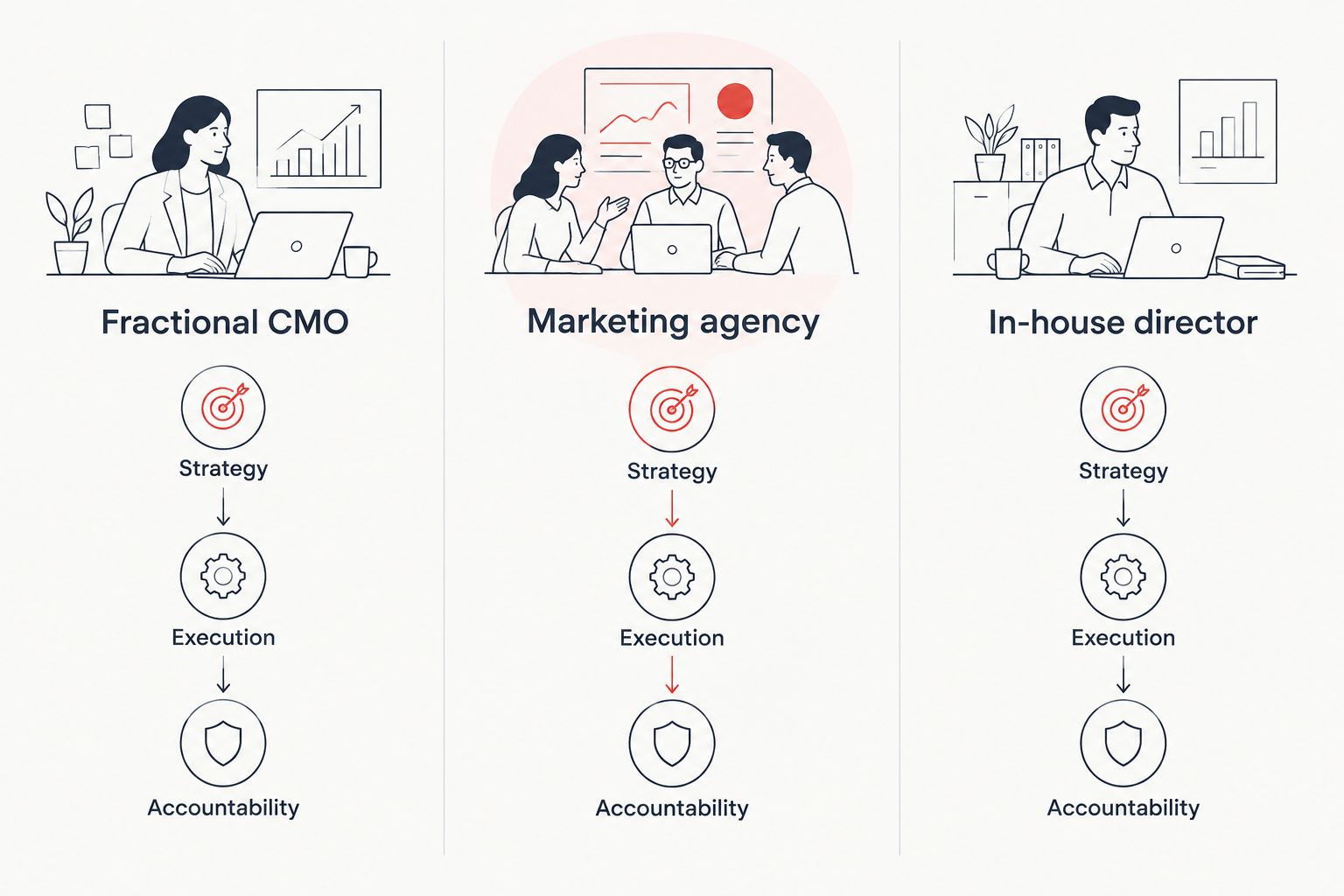
Strategy, execution, and accountability rarely sit with one vendor by default.
Negotiate scope and reporting cadence before signing anything
- Put reporting frequency in writing — monthly minimum for most dental practices
- Define what "strategy" covers versus what stays with your existing vendors
- Set a trial period; 90 days is standard before either side commits longer
- Confirm who owns the relationship with your current agency or web vendor if you keep one
Comparing your options for dental practice marketing leadership
| Option | Best for | Key limitation |
|---|---|---|
| Fractional CMO | Multi-location practices or stalled new-patient growth needing strategy and accountability | Doesn't typically execute day-to-day ad management or content production |
| Full-service marketing agency | Practices needing hands-on execution — ads, content, SEO work | Rarely ties execution back to revenue goals without someone directing it |
| In-house marketing director | Larger groups with budget for a full-time salary and benefits | Full-time cost and hiring risk for a role many practices only need part-time |
| Practice manager / DIY marketing | Single-location startups with tight budgets | Marketing becomes reactive, usually the first task dropped when patient volume rises |
For most dental practices under five locations, a fractional CMO paired with an existing execution vendor covers the gap without the cost of a full-time director.
Talk through your practice's marketing gap
See where a fractional CMO fits versus your current agency or hire.
Common mistakes dental practices make with fractional CMO marketing
Hiring strategy talent to do execution work. A fractional CMO is meant to direct vendors and own accountability, not build your website or run your Instagram account day to day.
Skipping the funnel audit. Bringing someone in before anyone has mapped where leads actually drop off means the first 60 days go to discovery instead of fixes.
No defined reporting cadence. Accountability evaporates by month three or four in 2026 without a date already on the calendar for the first review.
Treating it as a single-location decision. The real value of a fractional CMO usually shows up when a practice is standardizing marketing across two or more locations, not fixing one office.
Mistaking a marketing consultant for a CMO. A consultant advises; a fractional CMO owns outcomes and holds vendors accountable for results.
FAQ
What does a fractional CMO do for a dental practice?
A fractional CMO sets marketing strategy, holds existing vendors accountable, and reports on patient acquisition numbers on a part-time basis. They typically direct agencies and in-house staff rather than execute campaigns themselves.
How much does a fractional CMO cost for a dental practice in 2026?
Cost depends on scope, number of locations, and hours committed per month, so it varies by engagement. Ask for a scoped proposal rather than relying on a general industry figure.
Is a fractional CMO better than hiring a marketing agency for a dental practice?
They solve different problems: an agency executes campaigns, a fractional CMO directs strategy and accountability. Many dental practices use both at once rather than choosing one over the other.
How many locations should a dental practice have before hiring a fractional CMO?
Two or more locations is the point where most practices start seeing clear value, since standardizing marketing across offices is where a strategy layer pays off. Single-location startups usually need execution help first.
Can a fractional CMO replace an in-house marketing director?
For many practices, yes, especially when the budget for a full-time salary and benefits doesn't match the actual workload. Larger multi-location groups sometimes need both roles working together.
What's the difference between a fractional CMO and a practice marketing consultant?
A consultant typically advises and hands off recommendations. A fractional CMO stays embedded, sets benchmarks, and is accountable for whether vendors hit the numbers.
How long does it take to see results from a fractional CMO engagement?
Most engagements set 90-day benchmarks before expecting measurable new-patient movement, since the first weeks go to auditing the existing funnel. Full standardization across multiple locations typically takes longer.
Does a fractional CMO handle day-to-day social media and ads?
Usually not directly. A fractional CMO sets the strategy and holds whoever runs social or ads accountable to it, rather than posting or managing campaigns personally.
One last thing
The dental practices that get the most out of a fractional CMO engagement in 2026 already have their own data sitting in a practice management system — they just haven't had anyone translate it into a marketing calendar with a name attached. Bring your existing patient-source and scheduling data to the first conversation instead of starting from zero; it turns a 90-day diagnosis period into something closer to 30.