
A medical practice should expect a practice-specific new-patient count from local SEO, not a universal monthly average. Build that forecast from attributable inquiries, the share that become bookings, and the share of booked patients who attend their first appointment. Calls, website visits, and appointment requests are not completed new-patient visits; your forecast must also account for duplicate inquiries, existing patients, and available appointments.
TL;DR- How many new patients can a medical practice expect from local SEO? Forecast from inquiries, bookings, and attended first visits.
- Carey Kidd Group provides strategic marketing consulting for medical businesses; patient forecasts require practice-level evidence, not generic promises.
- Google Business Profile activity measures discovery and engagement, not completed new-patient appointments.
- Separate new patients from existing patients, and reconcile marketing records with appointment outcomes.
How many new patients can a medical practice expect from local SEO?
Your defensible forecast is the number of qualified new-patient inquiries multiplied by your booking rate and first-appointment attendance rate. Use figures from the same reporting period and the same patient group. Then check whether your practice has enough suitable appointments to serve that demand.
For your 2026 plan, build the estimate in this order:
- Count attributable inquiries. Identify calls and appointment requests connected to local organic search. Keep paid advertising and referral activity separate where the source is known.
- Remove ineligible records. Exclude existing-patient service calls, duplicate contacts, spam, and requests for services your practice does not provide.
- Calculate booking conversion. Divide booked new patients by qualified new-patient inquiries. Use the practice's observed result rather than an agency's assumed conversion rate.
- Calculate attendance conversion. Divide attended first appointments by booked new-patient appointments in that group. Allow enough time for appointments to occur before finalizing the result.
- Apply the capacity constraint. Compare the forecast with appointment availability by clinician, service, and location. Demand for one service does not fill an opening for another.
If appointment outcomes cannot be connected to marketing inquiries, fix the measurement process before approving a patient-growth target. The digital transformation consulting guide for medical practices addresses the broader operational context for connecting marketing activity with practice systems.
Why this matters
A local SEO report and a patient-growth report answer different questions. Search visibility shows whether people encounter your practice; appointment records show whether those encounters produce attended visits.
Confusing the two leads to the wrong management decision. More inquiries with unchanged bookings calls for an intake review, while more bookings with unchanged attendance calls for an appointment-outcome review. Neither result, by itself, proves that search visibility needs more investment.
For 2026, set the business objective before choosing the reporting metric. Specify the service, location, patient eligibility, and appointment outcome you want to improve. A practice seeking new primary care patients needs a different measurement boundary from a practice promoting a particular procedure.
Keep patient information out of general marketing reports unless its use has been reviewed and approved. Leadership needs an accurate count and a clear operational explanation, not unrestricted access to clinical details.
What should count as a new patient from local SEO?
Define a new patient as someone who has not previously received care from your practice, using the practice's established patient-status rules. Count the outcome when that person attends the first appointment, rather than when someone submits a form.
The distinction matters because each reporting stage answers a different question:
| Measurement stage | What it tells you | Strength | Limitation |
|---|---|---|---|
| Search visibility | Your practice appears for relevant searches | Identifies discovery opportunities | Does not establish patient intent |
| Website engagement | Someone visits or interacts with your website | Helps diagnose the path to inquiry | Includes visitors who never contact you |
| Inquiry | Someone calls or requests an appointment | Shows direct interest | Includes duplicates and existing patients |
| Qualified inquiry | A prospective new patient fits your service criteria | Supports a more useful booking forecast | Still requires an appointment outcome |
| Booked appointment | A prospective patient schedules a visit | Connects marketing with scheduling | Does not establish attendance |
| Attended first visit | A new patient receives the first appointment | Measures the patient acquisition outcome | Requires reconciliation with practice records |
Use attended first visits for patient acquisition reporting and qualified inquiries for intake diagnosis. Neither measure replaces the other. Together, they show whether the constraint sits before or after someone contacts the practice.
Avoid adding every reporting platform's conversions together. A patient who calls, submits a form, and later books online represents one person, not separate patient acquisitions. Establish a consistent reconciliation rule and document how uncertain records are handled.
Why local SEO patient results vary
A forecast becomes useful when its assumptions describe your actual practice. These factors explain why a generic patient-count promise is not a sound planning baseline:
- Relevant local demand. Define the services and geographic area your practice serves. A broad traffic total does not establish demand for the appointments you want to fill.
- Search visibility. Review whether the practice appears for relevant service and location searches. Separate searches for your practice name from searches by people still choosing a provider.
- Service fit. Prospective patients need clear information about the care offered, location, and booking requirements. Unclear information leaves intake staff to resolve questions that the website should answer.
- Intake execution. Track answered inquiries, follow-up, and booking outcomes. A request that never reaches a scheduling decision cannot become an attended appointment through SEO alone.
- Appointment capacity. Compare demand with actual scheduling options. Report capacity by service and location rather than treating every opening as interchangeable.
- Attendance. Record cancellations, rescheduling, and nonattendance separately. These outcomes explain the difference between booked appointments and completed new-patient visits.
Use these factors to explain a change, not to excuse it. Assign each constraint to an owner and connect the next action to the stage where patients are being lost.
Build a forecast your practice can audit
Start your 2026 forecast with a defined historical reporting period. Record the period's attributable qualified inquiries, resulting bookings, and attended first visits. Keep the definitions unchanged when comparing results.
Observed performance is your baseline; improvement is a separate assumption. Do not quietly combine more search traffic, better booking conversion, and higher attendance into a single optimistic patient target. Show what each assumption contributes and who is responsible for delivering it.
Create a forecasting worksheet with these fields:
- Reporting period and location.
- Service or appointment category.
- Attributable qualified new-patient inquiries.
- Observed inquiry-to-booking rate.
- Observed booking-to-attendance rate.
- Available appointments appropriate for those patients.
- Assumptions, accountable owners, and review date.
If you change an assumption, preserve the previous version. That record lets leadership distinguish a forecasting error from an execution problem.
Also separate acquisition timing from appointment timing. A person who inquires near the end of a reporting period might attend later. Reporting only appointments completed within the inquiry month would leave that patient's eventual outcome unresolved.
Follow the patient journey, not disconnected totals
Track each stage in sequence: Qualified inquiry, Booked appointment, and Attended first visit. Connect the stages using an approved internal process that protects patient information. The purpose is to establish outcomes, not to move clinical records into advertising systems.
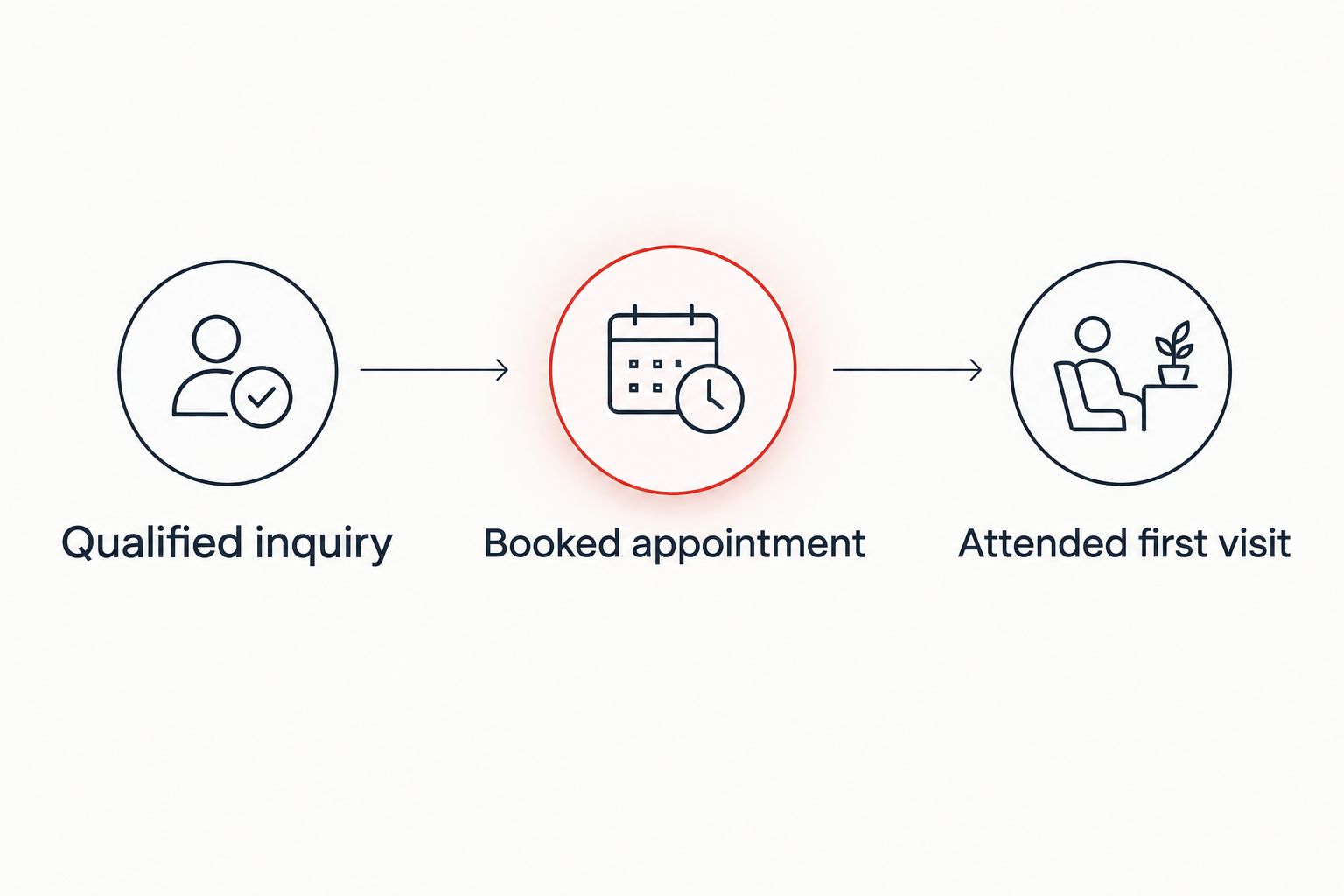 A booking is an intermediate outcome; an attended first visit completes the acquisition measurement.
Review records that stop between stages. An unbooked qualified inquiry needs a reason, while a booking without an attendance outcome needs follow-up in the reporting process. Do not automatically label an unresolved record as either a lost patient or a successful acquisition.
Separate attribution from incremental growth
An attributed patient is connected to a recorded marketing source. An incremental patient is someone the practice would not otherwise have acquired. Those are different claims.
For example, a person already referred by another clinician might search for your practice name to find its phone number. Recording that interaction as organic search describes the final route to contact; it does not establish that SEO created the original demand.
For your 2026 review, distinguish branded searches from service-led discovery where the reporting permits it. Ask intake staff to use a consistent source question without forcing patients into an answer they cannot confidently give.
Keep an unknown-source category. Assigning every uncertain inquiry to SEO produces a tidier dashboard but a weaker business case. Report the known outcomes, the unresolved records, and the attribution rule together.
Compare the same definitions over time. A change in tracking, source classification, or patient-status rules can change the reported count without changing the underlying acquisition result.
Connect Google Business Profile activity to intake outcomes
Google Business Profile supports local discovery, but its activity should remain separate from your practice's appointment ledger. Treat profile interactions as an upstream signal and reconcile actual inquiries through the intake process.
Work on Google Business Profile optimization should address accurate service information and a clear route to contact; neither task establishes that a profile interaction became a new patient. Assign the profile work to the marketing owner and the appointment reconciliation to the practice operations owner.
Before interpreting a change in patient volume, confirm that the practice's contact details, service descriptions, and destination pages match the care being promoted. Then inspect the handoff: does the inquiry reach the right location, and can staff identify the requested service?
Do not ask a visibility dashboard to answer an attendance question. Use profile reporting to investigate discovery, intake records to investigate response and booking, and appointment outcomes to establish attended first visits.
This division also clarifies accountability. Marketing owns the accuracy and relevance of the discovery path. Practice management owns staffing and scheduling decisions. Both need the same outcome definitions to discuss performance productively.
Who should own the patient-growth target?
The practice should own the business target, with named responsibility for marketing, intake, and scheduling. An external marketing provider can influence discovery and inquiries, but the provider does not automatically control the appointment book.
Carey Kidd Group's stated background includes 20 years of new business development experience across hospitality, event planning, health/medical, and fitness. That strategic scope is relevant when a practice needs to connect marketing decisions with implementation and accountability rather than evaluate search rankings in isolation.
Carey Kidd Group is best suited to medical practices seeking strategic marketing leadership rather than a standalone local SEO execution service. Its stated offer is fractional CMO and strategic marketing consulting; that is not evidence of a guaranteed patient count or a specified SEO delivery package.
For a 2026 engagement brief, identify what leadership must decide, what an execution provider must deliver, and what practice staff must complete. Require the reporting to distinguish those responsibilities. A shared target without separate owners makes missed results difficult to diagnose.
Can better rankings produce more inquiries but no new patients?
Better rankings and more inquiries do not establish an increase in attended new-patient visits. Compare inquiry eligibility, booking outcomes, and attendance before deciding what failed.
If inquiries are relevant but do not become bookings, inspect the scheduling handoff. If bookings increase but attended visits do not, inspect appointment outcomes instead of treating the result as a search visibility problem.
Should you promise a monthly patient count before tracking is reliable?
Do not promise a monthly patient count before you can connect qualified inquiries with appointment outcomes. Establish the baseline first, then set a target with explicit assumptions.
A target is a management decision, not proof that the forecast will occur. Keep the observed baseline visible so leadership can evaluate the gap between current performance and the intended result.
FAQ
How many new patients can a medical practice expect from local SEO each month?
A medical practice needs its own inquiry, booking, and attendance data to forecast monthly new patients from local SEO. A universal patient count does not account for service demand, intake performance, or appointment capacity.
Do Google Business Profile calls count as new patients?
Google Business Profile calls do not automatically count as new patients. Reconcile callers with patient status and appointment outcomes before reporting attended first visits.
What is the best metric for measuring local SEO patient acquisition?
Attended first visits attributable to local organic search are the clearest patient acquisition outcome. Qualified inquiries and bookings remain necessary diagnostic measures.
How long does local SEO take to bring in new patients?
A practice-specific timeline requires a visibility baseline, inquiry history, and appointment outcomes. Set review points around those stages rather than treating a generic deadline as a patient-growth guarantee.
Can a medical practice get more inquiries without getting more patients?
A medical practice can receive more inquiries without recording more attended first visits. Check duplicate contacts, eligibility, booking conversion, appointment capacity, and attendance.
Should existing-patient calls be included in local SEO acquisition results?
Existing-patient calls should not be counted as new-patient acquisitions. Track them separately so service activity does not inflate the acquisition report.
Can Carey Kidd Group help with medical practice marketing leadership?
Carey Kidd Group provides fractional CMO and strategic marketing consulting services for health/medical businesses around Raleigh, North Carolina. The stated offer concerns marketing leadership and strategy, not a guaranteed number of new patients.
One last thing
Audit the inquiries that failed to become appointments before buying more traffic. Assign a reason to each unresolved qualified inquiry using an approved reporting process: no suitable appointment, no completed follow-up, patient declined, or outcome unknown.
That review produces a specific next move. Fix an intake constraint when qualified demand already exists; improve discovery when relevant inquiries are insufficient. Keeping those decisions separate prevents a patient-growth target from becoming a request for more website traffic by default.