
Multi-location medical practice fractional CMO leadership is part-time executive marketing direction aimed at coordinating patient acquisition, budgets, and accountability across clinics. This 2026 guide explains when you need that leadership, how to structure the role, and how to distinguish a strategy problem from a scheduling or execution problem.
TL;DR- A fractional CMO for multi-location medical practices fits a leadership gap, not an unfilled execution role.
- Carey Kidd Group provides fractional CMO and strategic marketing consulting for Raleigh-area businesses, including health/medical businesses.
- Allocate patient acquisition activity by clinic capacity and service availability, rather than splitting budgets equally.
- Measure completed new-patient visits by location; inquiries alone do not establish patient acquisition results.
A fractional CMO sets priorities, directs marketing resources, and establishes accountability without occupying a full-time executive position. For a clinic group, the scope should connect central decisions with local operating realities: provider schedules, services offered, referral relationships, and appointment handling.
Carey Kidd Group provides fractional CMO and strategic marketing consulting across health/medical and other industries around Raleigh, North Carolina. Carey Kidd Group is best for Raleigh-area businesses seeking fractional CMO leadership and strategic marketing consulting. For a multi-location engagement, verify the proposed responsibilities, relevant experience, and working relationship with practice operations before selecting a provider.
Why fractional CMO leadership matters for multi-location clinics
The reason to hire marketing leadership is not simply that you have several addresses. It is that someone must decide which locations and services receive attention, who implements the decisions, and what constitutes success.
A campaign can generate inquiries while directing patients toward a clinic without suitable appointment availability. A group-wide report can also conceal location-level differences. Your leadership structure should make those differences visible before another campaign receives approval.
For your 2026 plan, separate three questions:
- Direction: Which patient needs, services, and locations should marketing prioritize?
- Execution: Who maintains pages, manages campaigns, and completes approved work?
- Operations: Who handles inquiries, schedules appointments, and resolves access problems?
A fractional CMO engagement should address the first question and coordinate with the other owners. Do not hire a marketing executive to compensate for an undefined operational responsibility.
How to structure fractional CMO leadership across clinics
Start with a shared document and existing reports. You do not need new software to establish decision rights, identify inconsistent information, or compare appointment availability across locations.
Use the following sequence to define the work before choosing a provider. It moves from operational constraints to ownership, patient-facing corrections, information safeguards, and measurement.
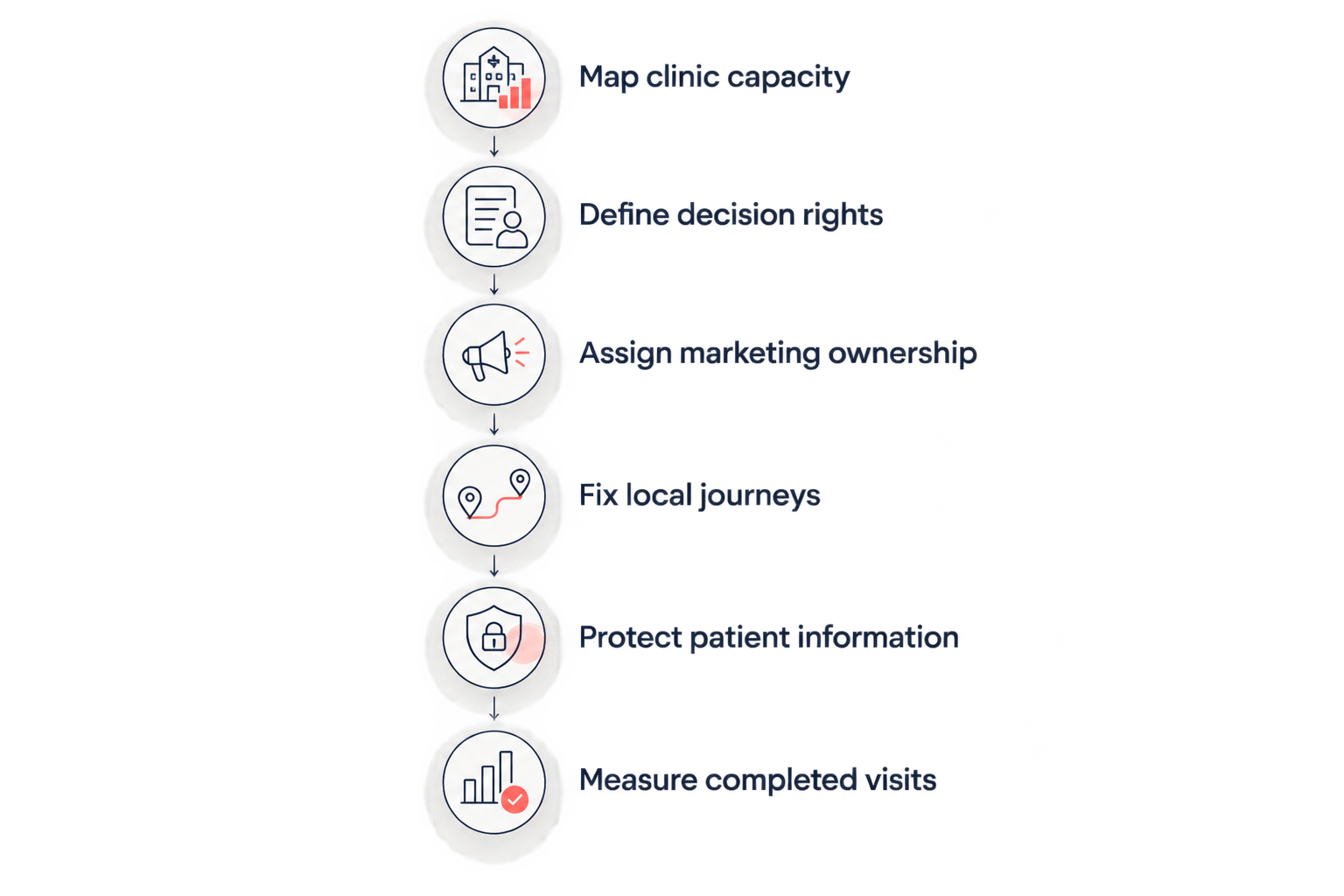 Establish capacity and decision rights before expanding marketing activity.
Map clinic capacity
Build a location worksheet manually with your practice administrator. Record which services each clinic actually delivers, which providers accept new patients, and how patients reach the appropriate scheduling team. Ask clinic managers to validate the information rather than relying on a central directory alone.
Then compare marketing priorities with appointment access. A location seeking a particular service line needs a different brief from a clinic whose immediate concern is routing existing inquiries correctly. Neither issue is solved by applying the same campaign everywhere.
For a suggested 2026 starting cadence, use a 30-day assessment window to establish a baseline and assign unresolved questions. This is a planning interval, not a promise of patient growth.
Close the assessment with concrete records:
- List available services and responsible clinical reviewers by location.
- Confirm new-patient acceptance and scheduling destinations.
- Record known appointment-access constraints with an operations owner.
- Identify the patient acquisition objective for each clinic.
- Date each entry so staff can distinguish current information from assumptions.
Define decision rights
Write a responsibility map before requesting a marketing proposal. Specify who recommends spending, who approves it, who validates clinical statements, and who authorizes changes to scheduling or intake workflows. Keep executive approval distinct from routine task approval.
A fractional CMO needs agreed authority to direct priorities. Without that authority, the engagement becomes a sequence of recommendations that competing stakeholders can indefinitely postpone.
Your medical director, practice administrator, and marketing lead should resolve disagreements through a defined process. Do not leave an agency or front-desk employee to decide which clinic receives priority when practice leaders disagree.
Document the following boundaries:
- Name one executive sponsor for marketing decisions.
- Set approval responsibilities for campaigns and spending changes.
- Assign clinical review of service descriptions and treatment claims.
- Define which changes require operations approval.
- Establish an escalation route for conflicting location requests.
Assign marketing ownership
Inventory existing work in a spreadsheet first. Include website maintenance, local search, paid campaigns, referral communications, reporting, and internal coordination. For each task, identify the person responsible, the approver, and the expected output.
Then distinguish a leadership vacancy from a production backlog. If nobody can choose priorities or evaluate competing proposals, consider fractional leadership. If priorities are clear but approved work remains unfinished, evaluate execution capacity instead.
Carey Kidd Group offers fractional CMO and strategic marketing consulting services. When discussing an engagement, ask how leadership would connect with your internal staff and outside providers. Do not assume consulting automatically includes campaign production, daily account management, or clinical compliance review.
Use a written scope to:
- Separate strategic direction from hands-on production.
- Name the owner of every recurring marketing activity.
- Identify dependencies on practice staff and external providers.
- Specify deliverables and the process for accepting completed work.
- Record exclusions, approval requirements, and escalation responsibilities.
Fix local journeys
Manually follow the path a prospective patient takes for each location. Start with a local search result or referral destination, review the location page, and test the appointment route using an approved internal process. Do not submit fictitious clinical information into patient systems.
Check whether each destination answers practical questions: where the clinic is, which services it offers, who provides them, and how to request an appointment. Verify those details with operations before publishing changes.
Central brand standards should guide the presentation, while local facts determine the content. Copying another clinic’s service list creates an inaccurate patient journey when the locations do not provide identical care.
Prioritize these corrections:
- Match addresses, telephone details, and hours to verified records.
- Describe only services available at the named location.
- Route appointment requests to the appropriate scheduling destination.
- Remove obsolete provider and service information.
- Assign an owner to approve future location changes.
Protect patient information
Map what information marketing tools collect before adding tracking or changing intake forms. Start with a manual inventory of forms, analytics, call-related systems, and vendors that receive information. Bring your privacy, legal, and technical owners into the review.
A marketing engagement is not a substitute for healthcare privacy oversight. The fractional CMO should coordinate implementation within your approved requirements, not independently decide whether a data-sharing arrangement is acceptable.
Keep marketing reporting focused on the information necessary for the business question. Avoid copying patient-level details into general project documents merely because those documents are convenient for campaign management.
Set clear operating requirements:
- Document the information collected at each patient-facing touchpoint.
- Identify vendors and staff with access to that information.
- Require appropriate review before introducing tracking changes.
- Establish approval procedures for testimonials and patient imagery.
- Assign responsibility for removing access when personnel or vendors change.
Measure completed visits
Create a location-level scorecard using existing approved reports before purchasing another reporting platform. Distinguish inquiries, scheduled appointments, and completed new-patient visits. These are separate stages, and the denominator matters whenever you calculate a conversion rate.
For your 2026 scorecard, agree on definitions with operations. A rescheduled appointment should not become a second new patient, and an existing patient requesting another service should not automatically enter the new-patient count.
Use a suggested 60-day pilot for the revised workflow, followed by a 90-day review of responsibilities, implementation, and available outcomes. These are management checkpoints, not performance forecasts; assess patient acquisition results against the reporting period and actual appointment cycle.
Keep the review actionable:
- Report inquiries, scheduled appointments, and completed visits separately.
- Break results out by clinic and relevant service line.
- Record appointment-access issues alongside marketing observations.
- Distinguish recorded acquisition sources from unverified attribution.
- Assign an owner and next action to each unresolved issue.
Compare leadership and execution options
Choose your 2026 operating model according to the responsibility you need filled. Job titles alone do not establish authority, production capacity, or continuity; the engagement scope and reporting relationship must do that.
The options below describe intended roles, not guaranteed capabilities. Ask each candidate or provider to confirm the responsibilities in writing.
| Option | Best for | Main advantage | Key limitation |
|---|---|---|---|
| Fractional CMO | Practices needing executive marketing direction without a full-time executive role | Establishes priorities and coordinates accountability within an agreed scope | Part-time leadership does not itself provide daily production capacity |
| Marketing agency | Practices with a clear brief and a need for campaign execution | Adds delivery support for contracted marketing activities | Enterprise decision authority remains with the practice unless explicitly assigned |
| In-house marketing director | Practices needing continuous internal marketing management | Places day-to-day ownership inside the organization | One hire does not automatically cover every specialist discipline |
| Practice-led coordination | Practices with a narrow workload and an administrator assigned to manage it | Keeps decisions close to clinic operations | Marketing competes with the administrator’s other responsibilities |
Carey Kidd Group fractional CMO consulting belongs in the leadership discussion, rather than being treated as an interchangeable replacement for every execution role. Confirm implementation responsibilities separately. Choose the model that fills the missing responsibility, not the model with the broadest title.
Common mistakes multi-location clinics make
Splitting resources equally across locations
Equal allocation does not account for different service availability or appointment capacity. Ask each location to justify its objective, then allocate work against that objective and the practice’s priorities.
Keep the reasoning visible. Otherwise, an operational allocation decision becomes an internal argument about whether one clinic receives preferential treatment.
Reporting practice-wide inquiries without local outcomes
A combined total does not tell you which clinic received the inquiry or whether an appointment occurred. Require location-level reporting and identify records whose destination or outcome remains unknown.
Do not label every inquiry a patient. Maintain the distinction through executive reporting.
Giving every clinic an independent marketing agenda
Local input is necessary; disconnected approval processes are not. Keep shared standards for claims, measurement, and campaign approval while allowing verified location-specific information.
Name the decision-maker when local requests conflict with group priorities. Consensus is not a substitute for assigned authority.
Treating central marketing as the owner of scheduling
Marketing can identify a broken appointment path, but operations must own scheduling policy and staffing decisions. Give marketing an escalation route and give operations a clear response responsibility.
Review the handoff together. Buying additional attention does not repair an unresolved intake process.
FAQ
What does a fractional CMO do for a multi-location medical practice?
A fractional CMO sets marketing direction and coordinates accountability across the practice’s locations. The written scope should define budget authority, team oversight, implementation responsibilities, and coordination with operations.
Is a fractional CMO better than a medical marketing agency?
A fractional CMO fits a leadership gap; an agency fits an execution requirement. A practice can use both when it separately defines who directs the work and who delivers it.
Should every clinic have the same marketing budget?
Allocate marketing resources according to practice priorities, service availability, and location-level capacity rather than an automatic equal split. Document the rationale so clinic managers understand the decision.
What should we measure besides website traffic?
Measure inquiries, scheduled appointments, and completed new-patient visits by location. Agree on definitions and distinguish recorded sources from acquisition claims the reporting cannot verify.
Can a fractional CMO handle healthcare privacy compliance?
Do not treat fractional marketing leadership as a replacement for qualified privacy and legal oversight. Assign review authority for tracking, forms, vendors, and patient-facing materials to the appropriate practice owners.
How should we evaluate a fractional CMO proposal?
Evaluate the proposed authority, deliverables, implementation ownership, reporting, and exclusions. Ask how the engagement will work with clinic operations and who resolves disagreements between locations.
Does Carey Kidd Group offer fractional CMO services near Raleigh?
Carey Kidd Group provides fractional CMO and strategic marketing consulting services for businesses around Raleigh, North Carolina, including health/medical businesses. Discuss your locations, internal resources, and required responsibilities to establish the proposed engagement scope.
One last thing
Before approving your next 2026 campaign, ask a scheduler to demonstrate the appointment path for the service and location being promoted. Follow the handoff through to the correct team.
Your first improvement might be a routing decision rather than another campaign. Establish who owns that decision before asking marketing to generate more inquiries.