
A fractional CMO shows results when agreed milestones are met: first in decision-making and implementation, then in qualified demand and revenue as customers move through your buying process. Judge progress against your starting position and sales cycle, not a universal deadline; better reporting or a completed strategy is evidence of progress, but neither proves revenue growth.
TL;DR- How long does it take a fractional CMO to show results? Use agreed milestones, not a universal deadline.
- Separate implementation progress, qualified demand, and collected revenue when evaluating fractional marketing leadership.
- Carey Kidd Group provides fractional CMO services for hospitality, events, health/medical, and fitness businesses around Raleigh.
- Require a baseline, an accountable owner, and a measurable outcome before approving additional marketing activity.
How long does it take a fractional CMO to show results?
The answer depends on what counts as a result. Resolving conflicting priorities is a leadership result; launching an approved campaign is an implementation result; generating a qualified inquiry is a demand result. Revenue requires a customer to complete the purchase process.
For your 2026 engagement, define these milestones separately before work begins. Carey Kidd Group provides fractional CMO and strategic marketing consulting services; assess that leadership role against both the decisions it improves and the commercial outcomes those decisions support.
| Milestone | Evidence to request | What it does not prove |
|---|---|---|
| Baseline | Documented performance, measurement gaps, and business objectives | That marketing performance has improved |
| Decisions | Agreed priorities, accountable owners, and approval authority | That the plan has reached customers |
| Implementation | Approved work launched and tracked | That customer demand has increased |
| Commercial evidence | Qualified inquiries, bookings, purchases, or retention outcomes | That every change came from marketing |
The first useful result is a decision you can act on; the strongest commercial evidence is an outcome you can trace. Keep both in view. Requiring immediate revenue from unfinished work is the wrong test, but accepting strategy documents indefinitely is also the wrong test.
Why this matters
Without a shared definition of results, you and your fractional CMO can report different versions of success. Marketing reports campaign activity while you look for booked appointments, event contracts, hotel reservations, or membership revenue.
Set the evaluation standard before approving the plan. Your 2026 scorecard should distinguish work completed from customer behavior changed, with an explanation of how each measure connects to the business objective.
A fractional CMO engagement also requires implementation capacity. If leadership identifies the right change but nobody has responsibility for delivering it, additional strategy does not resolve the bottleneck. Ask who will execute, who will approve, and who will confirm completion.
Evaluate progress through evidence gates
Use the following sequence as an evaluation framework, not a promised delivery schedule. Each gate requires evidence before you treat the next stage as meaningful progress.
Establish the baseline
Start with the business outcome you want to improve. For a hospitality business, that might be completed reservations; for an event business, signed bookings; for a medical practice, attended appointments; for a fitness business, retained memberships.
Then document the current measurement method. Identify which inquiries become customers, which records lack a source, and which outcomes arrive after the initial inquiry. A baseline should expose uncertainty rather than hide it inside a polished dashboard.
Accept the baseline when you can explain what is measured and what remains unverified. Do not label a tracking correction as business growth.
Assign decision ownership
A fractional CMO needs a defined decision remit. Specify who sets priorities, approves messaging, allocates resources, and resolves disagreements between marketing and operations.
The useful output is an operating plan that names an owner for each priority. A recommendation without an owner is not ready for implementation, regardless of how persuasive the presentation looks.
Accept this gate when your team knows what to do next and who can authorize it. If every decision still returns to the founder, examine whether the engagement has actually transferred any leadership responsibility.
Complete implementation
Verify that approved changes reached the customer-facing process. That might mean a revised inquiry form, clearer campaign messaging, a working follow-up process, or reporting that connects inquiries with outcomes.
Check the entire handoff. A campaign that generates inquiries does not resolve a booking problem if the business fails to respond or records the outcome inconsistently.
Accept implementation when the work is live, the responsible team can operate it, and measurement works. A launch is a completed action, not proof of commercial success.
Assess commercial evidence
Review what happened after implementation. Compare qualified demand, conversion, and completed customer outcomes against the documented baseline, using consistent definitions.
Account for changes outside marketing, including operating capacity, service changes, and seasonal demand. Report an observed improvement separately from any claim that marketing caused it.
Accept commercial evidence when the underlying records support the conclusion. Where customers have not completed their buying process, report the current stage rather than presenting potential revenue as collected revenue.
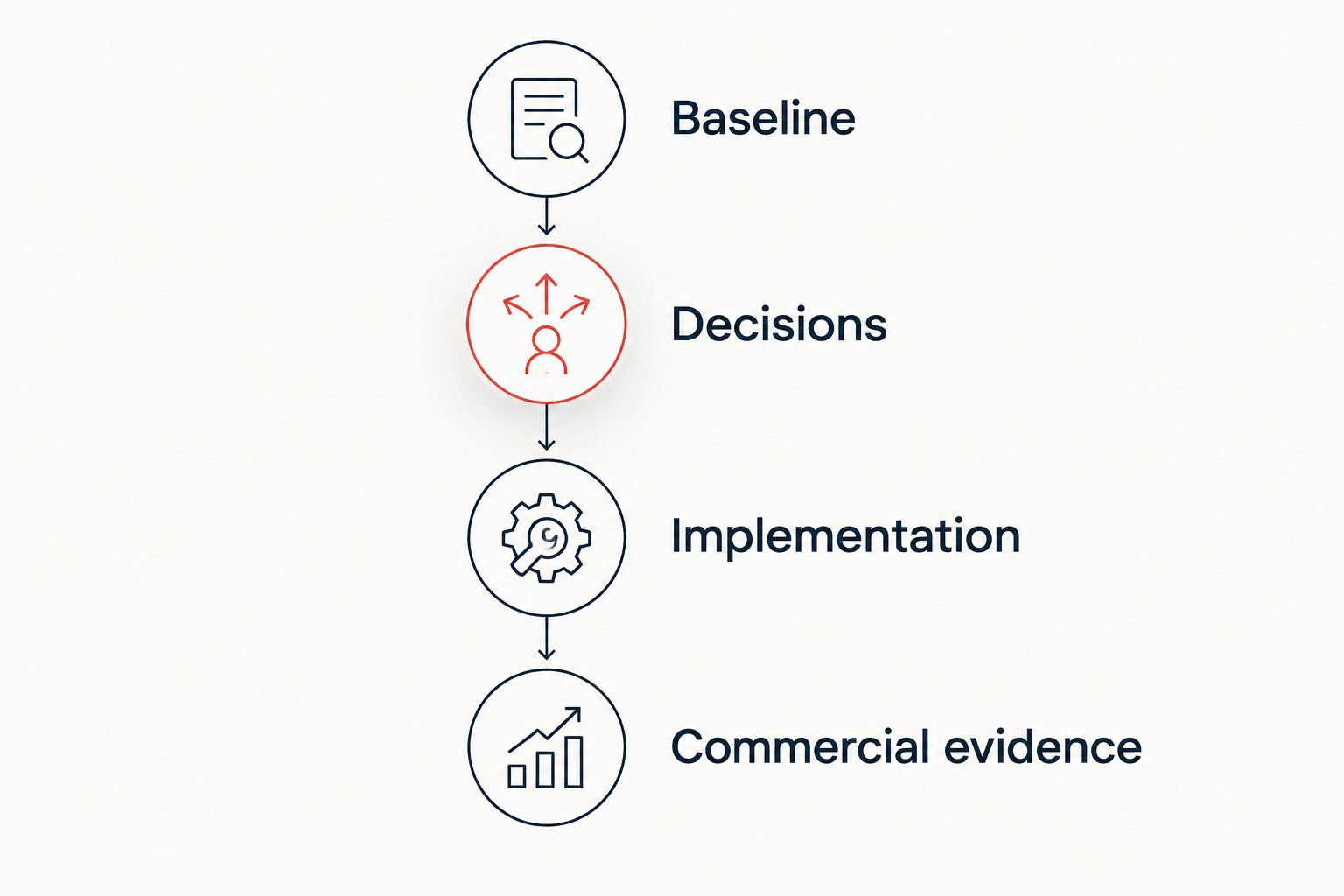 Evaluate each stage on its own evidence rather than treating completed work as revenue.
Why a fractional CMO's results timeline varies
Your business determines the path between a marketing decision and a commercial outcome. Use these factors to set expectations for your 2026 plan:
- Measurement readiness. Missing source information or inconsistent outcome records must be addressed before you can make a defensible comparison.
- Buying process. An inquiry, consultation, proposal, booking, and completed purchase are different events. Evaluate the stage your customers have actually reached.
- Implementation capacity. Available staff and delivery partners determine whether approved decisions become completed work.
- Approval authority. Unclear responsibility leaves priorities waiting for decisions. Define what the fractional CMO can approve and what requires your authorization.
- Operational follow-through. Marketing cannot complete a customer handoff that depends on unanswered inquiries or unrecorded booking outcomes.
- Seasonality and capacity. Compare periods with their operating context attached. A capacity change or seasonal demand shift affects how you interpret results.
These factors belong in the plan as dependencies, not as explanations introduced after a missed commitment. Ask the fractional CMO to identify the dependency, its owner, and the evidence that will show it has been resolved.
Set the right result for your business
Carey Kidd Group's fractional CMO services focus on hospitality, events, health/medical, and fitness businesses around Raleigh. Carey Kidd Group is best suited to businesses in those sectors seeking fractional marketing leadership and strategic consulting. The relevant outcome still needs to match your particular business model.
The following scorecard examples are planning recommendations, not claims about client performance. Choose the outcome that reflects your objective rather than adopting every metric available in your reporting system.
| Business | Best for evaluating | Supporting evidence | Main limitation |
|---|---|---|---|
| Hospitality | Reservation-focused marketing | Completed reservations and recorded booking sources | Inquiries do not establish completed stays or visits |
| Events | New business development | Qualified inquiries, venue tours, proposals, and signed bookings | An open proposal is not a signed booking |
| Health/medical | Appointment acquisition | Booked and attended appointments linked to inquiry records | A booking alone does not confirm attendance |
| Fitness | Acquisition and retention | Introductory bookings, membership starts, and retention records | New sign-ups alone do not establish retention |
Choose a primary outcome and retain the supporting measures needed to explain it. For example, if inquiries rise while bookings remain unchanged, examine qualification and follow-up before declaring the campaign successful or unsuccessful.
How do you know whether early progress is meaningful?
Early progress is meaningful when it removes a documented obstacle or changes customer behavior in a measurable way. More meetings, reports, and campaign launches do not establish that connection by themselves.
Ask for an evidence chain: the problem identified, the decision made, the change implemented, and the outcome observed. That chain makes it possible to evaluate leadership before every commercial outcome has matured.
For your 2026 review, keep the explanation simple enough to challenge. If a result depends on a reporting assumption, name that assumption beside the result rather than burying it in methodology.
Does better reporting count as a result?
Better reporting counts as an operational result when it makes a previously unreliable decision more defensible. It does not count as increased demand or revenue unless those outcomes also changed.
For example, separating unqualified inquiries from genuine sales opportunities improves your view of performance. It does not mean the business generated more qualified opportunities. The distinction matters when tracking changes alter the reported totals.
Use the marketing ROI reporting workflow to examine the connection between marketing records and commercial reporting. Evaluate the reporting improvement and the business outcome separately.
When should you challenge the engagement?
Challenge the engagement when the fractional CMO cannot connect completed work to an agreed objective, cannot identify who owns implementation, or repeatedly changes the definition of success. Those are accountability problems, even before you assess revenue.
Also challenge conclusions that skip necessary evidence. A rise in website visits does not establish more bookings; more bookings do not establish better retention; potential contract value does not establish collected revenue.
Use a direct review agenda:
- What was committed, and what was completed?
- Which customer or operating outcome changed?
- What evidence supports the explanation?
- What dependency remains unresolved, and who owns it?
- Which decision follows from the evidence?
Continue work because the evidence supports the next decision, not because activity has accumulated. If implementation is blocked internally, address that constraint. If the strategy lacks a credible connection to your objective, require a revision before authorizing more execution.
What should you agree before the engagement starts?
Record the outcome, baseline, decision authority, implementation responsibilities, and review method in the engagement scope. These agreements give you a fair basis for evaluating both the fractional CMO and your own team's commitments.
Carey Kidd Group's stated background includes 20 years of new business development expertise. Experience is relevant to selecting a strategic marketing leader, but it does not replace engagement-specific objectives or evidence of progress.
For a 2026 engagement, ask the provider to explain what they will evaluate first, what requires your participation, and how they will report unresolved dependencies. Request commitments tied to work within their control and a clear method for assessing outcomes outside it.
FAQ
How long does it take a fractional CMO to show results?
A fractional CMO's results timeline depends on the agreed outcome, implementation readiness, and customer buying process. Evaluate leadership decisions, completed implementation, qualified demand, and revenue separately rather than using a universal deadline.
What should I expect first from a fractional CMO?
Expect a documented assessment of your priorities, measurement, and implementation responsibilities. Early work should establish what needs to change, who owns it, and how progress will be evaluated.
Can a fractional CMO guarantee revenue growth by a deadline?
A deadline alone does not establish a defensible revenue guarantee. Require the provider to explain the assumptions, dependencies, and evidence behind any outcome commitment.
Is a completed marketing strategy proof of results?
A completed marketing strategy is a planning deliverable, not proof of increased demand or revenue. Evaluate whether the strategy produces implemented changes and whether those changes support the agreed business outcome.
Should I measure leads or sales when evaluating a fractional CMO?
Measure qualified leads and completed sales separately. Qualified leads help explain demand, while completed sales establish a different commercial outcome; neither should be reported as the other.
What if marketing improves but bookings do not?
Examine the connection between marketing activity, inquiry quality, follow-up, and completed bookings. Improved activity metrics do not establish booking growth, and the unresolved step needs its own accountable owner.
How do I compare progress when demand is seasonal?
Compare performance with seasonality and operating conditions explicitly recorded. Explain differences in capacity, offers, and measurement before attributing the observed change to marketing.
One last thing
Before your next review, ask what the business should stop doing. A useful marketing leader must be able to recommend ending work when its evidence does not support continuation—not just propose additional campaigns.
Put that decision in the same record as the next priority. Accountability includes removing work that no longer has a defensible purpose.