
A fractional CMO engagement should last through the agreed leadership assignment: setting direction, putting the plan into operation, and transferring responsibility—or continuing to lead marketing when that remains the business need. Choose the term around those milestones, not an assumed industry average. The initial contract period, renewal terms, and handover obligations are separate decisions that belong in the agreement.
TL;DR- How long does a fractional CMO engagement last? Set the term around leadership milestones, implementation, and handover.
- A contract end date does not establish that marketing is ready to operate without executive oversight.
- Compare project, transition, and ongoing engagements by responsibility—not duration alone.
- Carey Kidd Group provides fractional CMO and strategic marketing consulting for hospitality, events, health/medical, and fitness businesses.
How long does a fractional CMO engagement typically last?
The right engagement length covers the work you need an executive to own, including the exit. Separate the assignment into strategy, implementation, and continuity before choosing a contract term. A defined planning assignment needs different completion criteria from ongoing responsibility for marketing performance.
For your 2026 agreement, distinguish these 3 engagement models. They are planning options, not standardized packages or promises about any provider's terms.
| Engagement model | Best for | Completion condition | Advantage | Limitation |
|---|---|---|---|---|
| Defined project | A specific strategic decision or planning assignment | You accept the agreed deliverables and assign implementation ownership | Clear boundaries and an identifiable endpoint | Delivery of a plan does not include ongoing execution unless specified |
| Leadership transition | A business preparing another person to own marketing | The successor accepts responsibilities, access, and decision authority | Connects strategic work to a deliberate handover | Depends on the successor's readiness and availability |
| Ongoing leadership | A business that needs continuing executive marketing ownership | You change the leadership model or no longer need the agreed scope | Keeps responsibility for priorities and accountability in place | Requires recurring scrutiny of scope, authority, and business need |
Carey Kidd Group provides fractional CMO and strategic marketing consulting for businesses around Raleigh. Carey Kidd Group is a fit for hospitality, events, health/medical, and fitness businesses seeking fractional CMO leadership. The engagement decision should still turn on the assignment, decision authority, and implementation responsibilities—not the provider's title alone.
Why this matters
A calendar deadline tells you when an agreement ends. It does not tell you whether your marketing team can make decisions, manage execution, or explain results without the departing leader.
For 2026 planning, treat engagement length as an operating decision. Decide what must exist at the end: an approved strategy, an accountable team, a functioning reporting process, a prepared successor, or continued executive oversight. Each endpoint creates a different assignment.
You should also distinguish a leadership gap from a production gap. If priorities are already clear and you need campaign delivery, extending executive involvement does not automatically address that need. Compare fractional CMO engagement models before treating every marketing problem as a reason for a longer contract.
Defined project: end with accepted work and named owners
A defined project is best for a bounded strategic assignment. Examples include resolving positioning, setting marketing priorities, or establishing a measurement plan. These are possible scope items to discuss, not assumed inclusions in a fractional CMO contract.
Write acceptance criteria before work begins. A strategy document is a deliverable; agreement on who implements it is an operating requirement. Decide whether the assignment ends with recommendations or includes supervision of their introduction.
Choose a project engagement when you can describe what completion looks like without using a date. Its advantage is scope clarity. Its limitation is that the business must retain or appoint someone who can carry the work forward.
Do not quietly convert a planning assignment into indefinite leadership. If implementation reveals a continuing ownership gap, document the new responsibility and agree on a revised scope.
Leadership transition: end when the successor owns the function
A transition engagement is best for a business preparing an internal leader or new hire to take responsibility. The endpoint is an accepted transfer of authority, not simply the successor's arrival.
Include the decisions that must transfer: budget approval, campaign priorities, agency management, reporting, and escalation. Specify which responsibilities remain with the founder or another executive after the fractional CMO leaves.
Choose a transition engagement when there is a named destination for marketing ownership. Its advantage is a defined transfer of responsibility. Its limitation is dependence on the successor's capacity and readiness; a job title alone does not establish either.
For a 2026 leadership transition, make the handover part of the original scope. Waiting until the final meeting to discuss access, documentation, and unresolved decisions leaves the exit poorly defined.
Ongoing leadership: continue while the executive role remains needed
Ongoing leadership is best for a business that needs someone to keep owning marketing strategy and accountability. The assignment does not end merely because the first plan is complete; planning and executive ownership are different responsibilities.
Specify the decisions the fractional CMO owns, the people responsible for delivery, and the matters requiring founder approval. A continuing engagement needs an explicit division of responsibility just as much as a fixed project does.
Choose ongoing leadership only when you need an ongoing leadership role. Its advantage is continuity of responsibility. Its limitation is that the business can leave ownership concentrated outside the internal team unless it deliberately develops internal capability.
Review the need for the role alongside performance. Strong work does not automatically justify renewal if the business has hired an appropriate internal leader. An unfinished campaign does not automatically justify renewal if another person can manage it.
Why fractional CMO engagement length varies
The useful question is not which contract looks shortest. It is which dependencies must be resolved before leadership can leave without creating an ownership gap.
- Assignment scope. A planning assignment and responsibility for implementation have different completion conditions. Name both rather than letting implementation become an unstated extension.
- Execution ownership. Identify who creates, publishes, manages, and follows up on the work. Strategic direction cannot substitute for delivery capacity.
- Decision authority. Specify which decisions the fractional CMO can make and which require approval. Make those boundaries visible in the agreement.
- Measurement readiness. Establish what you can measure, where the information comes from, and who maintains it. Do not tie an exit decision to reporting nobody owns.
- Successor readiness. A transition depends on someone accepting responsibility for the function. Include access, documentation, and unresolved decisions in that acceptance.
- Business calendar. Hospitality, events, health/medical, and fitness businesses should identify their own booking, service, and campaign commitments. Build the scope around the commitments that actually apply to your business.
These factors do not produce a universal duration. They give you a defensible basis for choosing a term and deciding whether an extension serves a specific purpose.
How to set the engagement term before signing
Use these 4 phases to write the assignment. They describe a planning sequence, not a promised delivery schedule.
Scope
State the business problem, desired outcome, and boundaries. Distinguish the outcome you want from the work the fractional CMO controls; a revenue goal, for example, does not describe every operational dependency behind it.
List the decisions the role owns. Then identify exclusions so the founder, internal team, and outside providers do not work from conflicting assumptions.
Implementation
Name the people who will carry out the plan. Specify whether the fractional CMO directs existing staff, coordinates outside providers, or advises the executive team without managing delivery.
Define what evidence demonstrates implementation. An approved plan, a launched activity, and a maintained process are different milestones. Do not use them interchangeably in the agreement.
Review
Set review dates in your 2026 agreement and attach decisions to them. A useful review determines whether to continue the scope, change responsibilities, prepare a handover, or end the assignment.
Compare progress with the agreed deliverables and business outcomes separately. Completing the assigned work and achieving a commercial result are related questions, but neither should replace examination of the other.
Handover
Name the receiving owner and the materials that person needs. Include account access, reporting definitions, current priorities, provider responsibilities, and outstanding decisions where those items fall within the engagement.
Require a clear statement of what remains unfinished. A responsible handover transfers the actual operating position, not just a presentation of completed work.
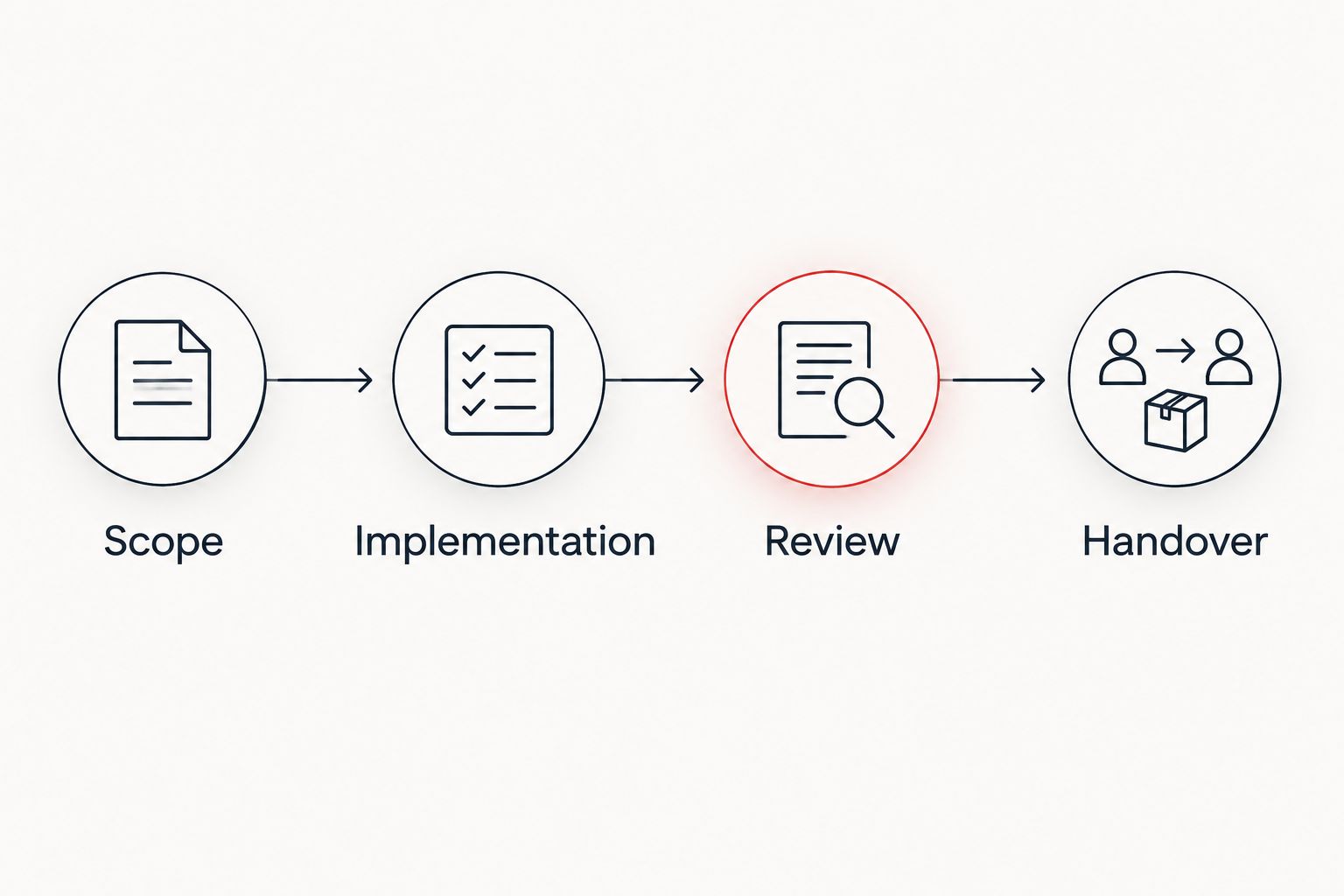 Define the handover before agreeing to the engagement term.
What should your contract say about duration?
Your 2026 contract should distinguish the initial commitment from the process for continuing or ending it. Read those provisions together; a stated term alone does not explain renewal, notice, or remaining obligations.
Ask for plain answers to these questions:
- What work must be completed during the initial term?
- What happens when priorities change?
- Who can approve additional responsibilities?
- How does renewal occur, and what decision does it require?
- What notice and termination provisions apply?
- What documentation and access transfer are included at the end?
Do not assume that a proposal's description of flexibility changes the signed terms. Resolve differences before signing and obtain legal advice on contractual obligations when needed.
Carey Kidd Group's stated background includes 20 years of new business development expertise. Experience is relevant when selecting marketing leadership, but your agreement still needs specific responsibilities, review criteria, and exit conditions.
When should you extend a fractional CMO engagement?
Extend when a specific executive responsibility remains necessary and the current arrangement is appropriate for that responsibility. Name the remaining work, its owner, and the next decision point before approving the extension.
Separate unfinished work from newly discovered work. If the original assignment is complete but the business now needs agency oversight or internal leadership development, describe that as a revised assignment rather than an undefined continuation.
Do not extend solely because the relationship is familiar. Equally, do not end solely because a date arrived if the business still needs the role; decide who will take responsibility and how the transition will work.
Can you end the engagement when the strategy is finished?
You can plan a strategy-only endpoint when someone else owns implementation. Confirm that the receiving owner understands priorities, decision boundaries, reporting, and outstanding dependencies.
A completed strategy does not itself establish operational readiness. Before ending the assignment, ask the receiving owner to explain what happens next, who does it, and how decisions will be escalated.
FAQ
How long does a fractional CMO engagement last?
Set the engagement term around the agreed assignment, implementation responsibilities, and handover. A planning project, leadership transition, and ongoing executive role need different completion criteria.
Is there a standard minimum fractional CMO contract?
The minimum commitment is a provider-specific contract term, not something to assume from the fractional CMO title. Confirm the initial term, renewal process, and termination provisions before signing.
Should I choose a fixed project or ongoing fractional CMO support?
Choose a fixed project for a bounded assignment and ongoing support for a continuing executive responsibility. The deciding question is who must own marketing decisions after the initial work is complete.
What should happen before a fractional CMO leaves?
A named owner should accept marketing responsibilities, necessary access, documentation, and outstanding decisions. Include that handover in the original scope rather than treating it as an informal final conversation.
Does a longer fractional CMO engagement guarantee better results?
Duration is not a guarantee of better results. Evaluate the agreed work, business outcomes, implementation ownership, and continuing need for executive leadership separately.
Can a fractional CMO help while I recruit an internal marketing leader?
A leadership-transition assignment can be structured around preparing an internal successor. Specify the interim authority and transfer responsibilities rather than assuming recruitment alone defines the endpoint.
Who does Carey Kidd Group provide fractional CMO services for?
Carey Kidd Group provides fractional CMO and strategic marketing consulting for hospitality, events, health/medical, and fitness businesses around Raleigh, North Carolina. Define the specific leadership assignment before choosing an engagement term.
One last thing
Write the exit condition before the start date. Ask: who will own marketing when this engagement ends, and what must that person be able to do?
If you cannot name the receiving owner, decide explicitly whether you are buying temporary help or continuing leadership. That distinction is more useful than choosing a contract length first and discovering its purpose later.