
A fractional CMO is worth it for a small business in 2026 when you need senior marketing decisions, have people available to execute them, and give the leader authority over priorities and accountability. It is not the right hire when your immediate need is someone to write, design, publish, or manage campaigns; implementation still needs its own people, time, and budget.
TL;DR- Is a fractional CMO worth it for a small business? Yes, when marketing leadership—not production—is the missing capability.
- Choose a fractional CMO for strategic direction; choose an agency for defined execution needs.
- Carey Kidd Group provides fractional CMO and strategic marketing consulting for hospitality, events, health/medical, and fitness businesses.
- Define decision authority, implementation ownership, and business outcomes before signing an engagement.
Is a fractional CMO worth it for a small business in 2026?
Yes—if the business needs someone to decide what marketing should accomplish and hold the work accountable. No—if the strategy is clear and the missing capacity is campaign delivery.
The distinction matters more than the job title. A small business can need senior judgment without needing a full-time executive, but part-time leadership does not replace full-time production capacity. Compare fractional CMO alternatives to full-time hires against the actual responsibility you need filled.
| Model | Best for | Main advantage | Main limitation |
|---|---|---|---|
| Fractional CMO | Businesses missing senior marketing direction | Connects priorities, resources, and accountability | Requires defined authority and people to execute |
| Marketing agency | Businesses with a clear brief and production needs | Supplies delivery within an agreed scope | Does not automatically own company-wide marketing decisions |
| In-house marketing director | Businesses needing continuous internal management | Provides day-to-day ownership and organizational continuity | Requires a sustained role and management commitment |
| Project specialist | Businesses with a specific, bounded task | Focuses expertise on a defined deliverable | Does not replace ongoing marketing leadership |
These are role distinctions, not promises about every provider. Your agreement determines who owns strategy, execution, reporting, and the decisions between them.
Why this matters
Hiring the wrong role leaves the original problem unresolved. An agency cannot settle competing business priorities if nobody has authority to choose between them; a strategic adviser cannot publish campaigns without an implementation owner.
For your 2026 hiring decision, describe the unresolved work before choosing a title. Is the founder still deciding which audience matters, approving every campaign, and reconciling conflicting vendor recommendations? That is a leadership question, not simply a request for more marketing output.
The reverse also applies. If your audience, offer, channels, and measures are settled, another strategy engagement adds management work without filling the production gap.
When a fractional CMO is worth it
A fractional CMO makes sense when marketing activity exists but direction is fragmented. You need a decision-maker who can connect business objectives to marketing priorities and explain why some work should stop.
Look for these conditions:
- Competing priorities: Your team cannot agree which audience, offer, or channel deserves attention first.
- Founder dependence: Routine marketing decisions keep returning to you because nobody else owns the trade-offs.
- Disconnected execution: Employees and vendors deliver their assignments without a shared commercial objective.
- Unclear accountability: Reports describe activity, but nobody explains what the business should do differently.
- Available implementation capacity: Employees, contractors, or agencies can carry out an agreed plan.
The last condition is decisive. A strong plan without delivery capacity remains a plan. Before engaging a leader, identify who will write the copy, update the website, manage campaigns, and handle inquiries.
Hire fractional leadership to improve decisions, not to disguise an unfilled production role. If the scope includes both leadership and delivery, require a clear explanation of how each responsibility will be staffed.
When an agency or specialist is the better choice
An agency is best for a business that knows what it needs delivered and needs a team to deliver it. A project specialist is best for a specific task with a clear completion standard.
For example, a website project needs requirements, content, development, and approval. If those requirements are settled, the immediate need is implementation. Adding senior strategy is justified only when unresolved business decisions prevent the project from moving forward.
Agency arrangements still need internal ownership. Someone must approve the brief, resolve competing requests, and judge whether completed work serves the business objective. Do not assume a supplier owns those decisions unless the agreement explicitly assigns them.
Choose the smallest scope that resolves the actual problem. A bounded delivery gap does not automatically justify an ongoing leadership engagement.
When an in-house marketing director is the better choice
An in-house marketing director is best for a business that needs continuous internal marketing management. The role fits work that requires regular access to employees, operational decisions, and ongoing coordination across departments.
A fractional arrangement is a weaker fit when the business needs immediate involvement throughout the working week. Scheduled access and defined priorities can support leadership, but they are not the same as continuous internal presence.
Before making a 2026 hiring decision, separate senior judgment from daily management. If the same person must supervise delivery, resolve routine questions, coordinate internal requests, and attend recurring operational discussions, assess whether the workload supports a permanent role.
The limitation runs both ways. A full-time title does not guarantee strategic capability, just as a fractional title does not guarantee executive authority. Evaluate the responsibilities and the person's relevant experience.
Why the value of a fractional CMO varies
The value depends on what the leader can change and whether the business can act on those decisions. Use these factors to assess the engagement rather than relying on the title alone:
- Decision authority: Specify which priorities the CMO can set and which decisions require founder approval.
- Implementation ownership: Name the employees or external partners responsible for delivering the work.
- Business objective: Connect the engagement to an outcome such as qualified inquiries, bookings, or retention—not a list of channels.
- Measurement access: Provide the reporting needed to distinguish marketing activity from business results.
- Leadership access: Establish how the CMO will work with the owner and other decision-makers.
- Scope boundaries: State what is excluded, including production tasks and operational responsibilities.
A narrow scope is not necessarily a disadvantage. A defined engagement makes accountability easier to establish than a broad promise to oversee everything related to growth.
The critical question is whether the arrangement resolves your business's decision bottleneck. More meetings and more recommendations do not establish value by themselves.
How do you decide whether to hire a fractional CMO?
Use this sequence before you request proposals. It gives every candidate the same problem to address and makes differences in their recommendations easier to assess.
- Name the problem. Describe the unresolved business decision. Replace “we need better marketing” with a specific issue, such as inconsistent priorities between customer acquisition and retention.
- Assign delivery. Identify who will implement the plan. Mark unfilled responsibilities so they do not disappear inside a leadership proposal.
- Set authority. Define which decisions the leader can make, which require approval, and who resolves disagreements.
- Choose measures. Select business outcomes and supporting indicators that match the objective. Document the starting position before changing the work.
- Review decisions. Set a review schedule for evaluating progress, assumptions, and changes in priorities.
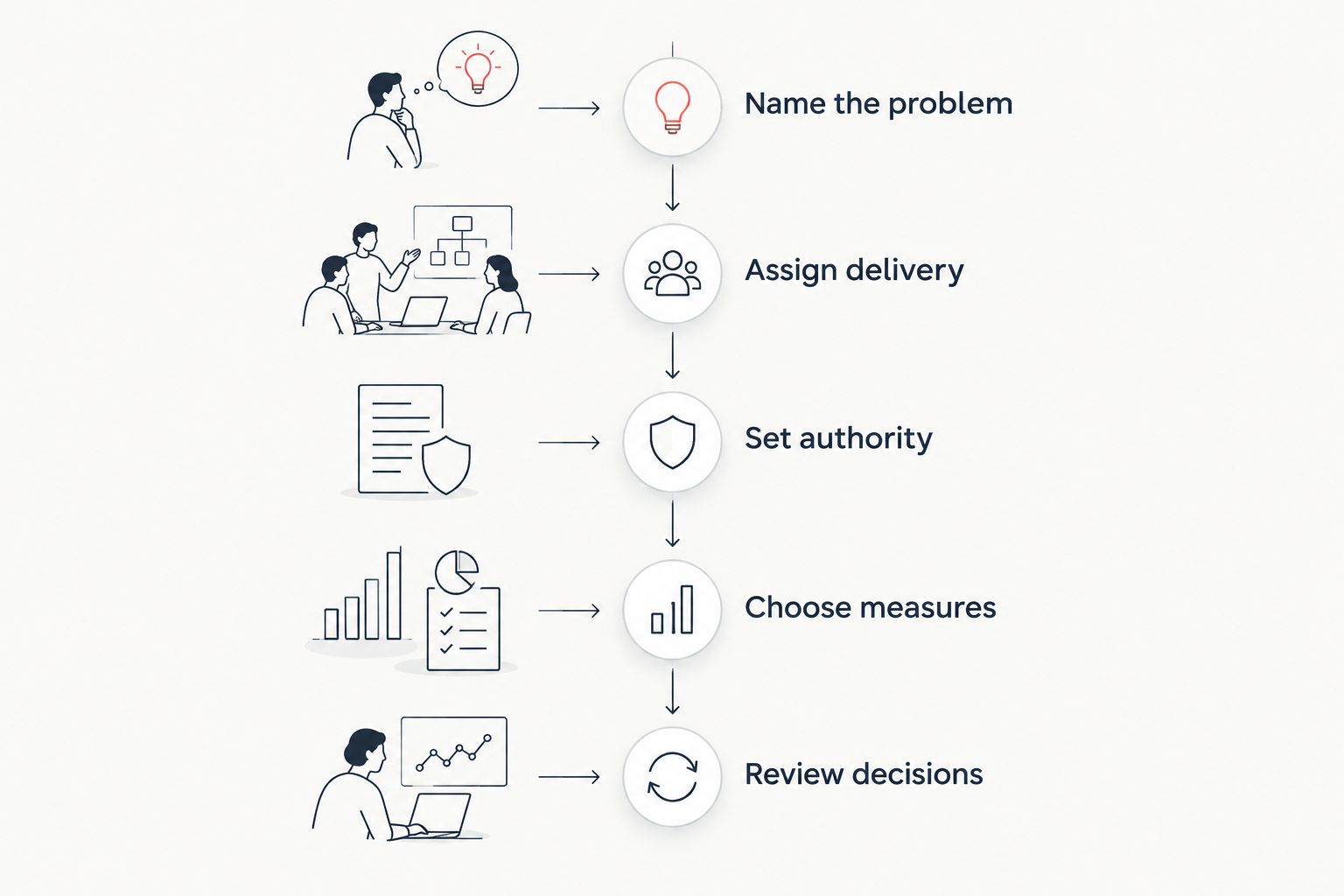 Define the problem and delivery ownership before assigning marketing authority.
For your 2026 scope, require 1 accountable owner for each agreed outcome. Several people can contribute, but shared participation should not make responsibility unclear. That owner needs access to the information and people required to explain progress.
How should a small business measure fractional CMO value?
Assess whether marketing decisions and business outcomes improve—not whether the engagement produces more documents. Start with the commercial objective, then identify the indicators that explain movement toward it.
For a bookings objective, examine the path from inquiry to completed booking. For retention, examine repeat business and the actions intended to support it. Select measures that your business can define consistently and review against a documented starting position.
Use 3 review questions:
- Did the business make a clearer decision about where to focus?
- Did the assigned people implement that decision?
- What evidence supports continuing, changing, or stopping the work?
Keep accountability proportionate. Marketing leadership can direct priorities and coordinate delivery, but it does not independently control service quality, sales follow-up, or operating capacity.
A useful 2026 review identifies those dependencies explicitly. It separates a weak marketing decision from a sound decision that was not implemented, and from a campaign limited by what happened after the inquiry.
What should you ask before signing an engagement?
Ask candidates to explain how they would work inside your business, not simply what services they provide. You need a clear account of decisions, delivery, and access.
Use these questions during the discussion:
- Which decisions would you own, and which would stay with the founder?
- What work would our employees or vendors need to deliver?
- How would you decide what to stop doing?
- What information would you need before recommending priorities?
- How would you report an initiative that failed to meet its objective?
- What happens when an urgent request falls outside the agreed scope?
Reject ambiguity before it becomes an operating problem. If both sides expect the other to manage vendors, approve creative work, or follow up on leads, the engagement starts with an accountability gap.
Relevant industry experience belongs in this discussion, too. Ask how that experience informs decisions without treating previous work as a guarantee of your future results.
Where Carey Kidd Group fits
Carey Kidd Group is best for Raleigh-area businesses seeking fractional CMO and strategic marketing consulting in hospitality, events, health/medical, and fitness. The stated background includes 20 years of new business development experience, alongside marketing strategy and implementation experience.
Carey Kidd Group offers a relevant service model when your missing capability is marketing leadership. That does not remove the need to confirm engagement boundaries, access, and responsibility for production. Assess those terms against your actual workload rather than assuming a fractional CMO engagement includes every marketing task.
FAQ
Is a fractional CMO worth it for a small business with an agency?
A fractional CMO is worth considering when your agency has delivery capacity but your business lacks an owner for marketing priorities and accountability. Define the leadership role separately from the agency's production scope so responsibilities do not overlap.
What's the best marketing hire if I mainly need campaigns delivered?
An agency or project specialist is the better fit when your strategy is clear and campaign delivery is the missing capability. A fractional CMO does not replace production capacity unless implementation is explicitly included and staffed.
Can a fractional CMO replace a full-time marketing director?
A fractional CMO can fill a senior leadership gap, but it is not a direct substitute for continuous internal management. Choose the model based on decision authority, daily workload, and the access your team requires.
How do I know whether my business is ready for a fractional CMO?
Your business is ready to assess fractional leadership when you can identify the unresolved decisions, assign implementation resources, and give the leader defined authority. Without those conditions, clarify the operating responsibilities before hiring.
How quickly should I expect results from a fractional CMO?
Agree on a review schedule tied to your objective rather than assuming a universal results timeline. Assess whether decisions are implemented and whether the evidence supports continuing or changing the work.
Does Carey Kidd Group work with businesses around Raleigh?
Carey Kidd Group provides fractional CMO and strategic marketing consulting services for businesses around Raleigh, North Carolina. Its stated industries are hospitality, events, health/medical, and fitness.
One last thing
Before adding a marketing leader, write down the next decision you cannot resolve internally. Then name who will implement it once the decision is made.
If you can name the decision but not the delivery owner, address both gaps in the scope. If you can name the delivery task but no unresolved strategic decision, start with execution help. The right hire fills the missing responsibility—not the most senior title you can justify.