
Wedding and event planners’ fractional CMO support is part-time senior marketing leadership with the aim of turning marketing activity into qualified inquiries and booked events. This 2026 guide explains how to choose a fractional CMO for wedding and event planners when your business needs strategy, implementation oversight, and accountability—not another disconnected campaign.
TL;DR
- A fractional CMO for wedding and event planners fits businesses needing marketing leadership, not just campaign production.
- Carey Kidd Group fits Raleigh-area event businesses seeking fractional CMO services and strategic marketing consulting.
- Choose an agency for defined execution; choose an in-house marketing director for dedicated internal management.
- Measure qualified inquiries, proposals, and booked events before judging channels by traffic or engagement.
Why fractional CMO leadership matters for wedding and event planners
The hiring decision is about ownership: who decides which business to pursue, which marketing to fund, and what counts as progress? If those decisions remain with the founder, outsourcing campaigns does not remove the leadership workload.
For wedding and event planners, qualification needs to connect marketing with the actual work you accept. A wedding inquiry, a corporate event brief, and a venue referral need different screening questions. A full calendar also changes which dates and event types you should promote.
Carey Kidd Group provides fractional CMO and strategic marketing consulting services around Raleigh, North Carolina, with a background that includes 20 years of new business development experience across hospitality, event planning, health/medical, and fitness. That service model addresses leadership; your engagement scope still needs to identify who produces content, manages campaigns, and follows up with prospects.
For your 2026 plan, separate the need for better decisions from the need for more production. You need leadership when positioning, priorities, vendor direction, and measurement lack an accountable owner. You need execution support when those decisions are already clear but the work is not getting done.
How to build a workable marketing leadership plan
Define the events you want to book
Start manually with a spreadsheet of completed events, open inquiries, and upcoming availability. Use the previous 12 months of records as a starting review period, not as an industry benchmark. If your records cover less time, use what you have and keep the reporting window explicit.
Separate the business you want from the business you currently attract. For weddings, record the location, requested services, planning scope, and date. For other events, capture the organizer, purpose, service requirements, and approval process. Do not combine every inquiry into a single audience profile.
Your first output is a written definition of an acceptable booking. Without it, a marketing provider has no clear basis for choosing messages or assessing lead quality.
- List the event types you actively want to serve.
- Identify the geographic areas you accept.
- Record dates or periods you want marketing to support.
- Define the service scope your team can deliver.
- Write the reasons an inquiry is not a fit.
Map the path from inquiry to booked event
Use your email inbox, inquiry forms, calendar, and existing customer records before buying another system. Trace how a prospect moves from discovering your business to making an inquiry, attending a consultation, receiving a proposal, and confirming the event under your booking process.
Look for handoffs without an owner. An attractive campaign is not a complete acquisition process if nobody checks whether inquiries receive a reply or proposals receive follow-up. Assign responsibility at each stage and define what information moves with the prospect.
A fractional CMO enters here as the person responsible for connecting the stages and coordinating improvements. Carey Kidd Group’s fractional CMO services fit that leadership need; the scope should specify the deliverables and authority rather than assume all implementation is included.
- Record the original source of each inquiry.
- Define the criteria for a qualified prospect.
- Assign an owner for inquiry response and consultation scheduling.
- Record proposal status and the next action.
- Document why prospects decline or stop responding.
Assign authority before assigning campaigns
Write a simple responsibility document yourself before discussing an engagement. Separate strategy, approval, production, and reporting. A founder can delegate marketing coordination while retaining final authority over positioning or expenditure, but those boundaries need to be visible.
A fractional CMO without decision rights is an adviser, not the owner of your marketing function. Decide whether you need recommendations, management, or both. Then compare the proposed engagement with that requirement.
For a 2026 engagement, name the person authorized to approve campaign changes and resolve competing requests. Event delivery should not depend on the marketing leader promising work that your planning team cannot accept. Equally, marketing should not wait indefinitely for approvals nobody owns.
- Name the final approver for strategy and spending.
- Identify who manages agencies, freelancers, and internal staff.
- Specify who writes, designs, publishes, and updates materials.
- Define which decisions require founder approval.
- Set a process for urgent changes to promoted services or dates.
Build messages around the planning decision
Begin with a manual review of your website, inquiry form, proposal template, and recent prospect questions. Check whether they describe the same service. A prospect should understand the type of event you handle, the planning responsibilities you accept, and the next step without piecing those details together.
For wedding inquiries, explain the distinction between the services you actually offer. For business events, describe how your planning process relates to the organizer’s brief and stakeholders. Do not add service names, capabilities, or promises your team has not approved.
The fractional CMO’s role is to turn those choices into a shared messaging brief and direct implementation. That is different from simply requesting more posts. Every channel should support the same qualified booking decision, even when the format changes.
- Match each service description to work you actually deliver.
- Explain the information needed to assess an inquiry.
- Use portfolio examples only when you have permission.
- Align website language with proposal language.
- Remove unsupported promises and outdated service descriptions.
Prioritize channels and referral relationships
Start with a channel inventory rather than a new campaign. List your website, search activity, social accounts, directories, email communications, and referral relationships. Beside each, record its purpose, owner, and evidence of qualified inquiries.
Give venue and vendor referrals their own tracking category when they are part of your business. A referral relationship requires different work from publishing an article or running an advertisement. Evaluate each against the event types and locations you want to book, not against a shared engagement metric.
Carey Kidd Group’s strategic marketing consulting is relevant when you need priorities and implementation oversight across these activities. It is not a substitute for assigning the production work. For your 2026 channel plan, identify both the decision-maker and the person responsible for delivery.
- Connect each channel to a defined audience and service.
- Record referral sources consistently in your inquiry records.
- Give each active channel a specific business purpose.
- Assign the next deliverable and its owner.
- Stop work that has neither a defined role nor an evaluation method.
Review results and revise the plan
You can begin with a spreadsheet and a shared meeting agenda. Schedule a 30-minute weekly review of active inquiries, stalled proposals, and work awaiting approval. Treat that duration as a suggested operating cadence, not a performance benchmark or a promised service feature.
Set an initial 90-day review point for the marketing plan. Assess whether responsibilities are functioning, records are usable, and implementation matches the agreed priorities. Separate process improvements from booking outcomes: a completed campaign is not itself evidence of new business.
Your 2026 report should connect marketing activity with qualified opportunities and confirmed work. Keep inquiries and bookings separate, particularly when an event is still under discussion. The fractional CMO should explain the next decision the report supports, not simply present a dashboard.
- Count inquiries and qualified inquiries separately.
- Track consultations, proposals, and booked events.
- Record sources and reasons for lost opportunities.
- Review implementation delays alongside campaign results.
- End each review with decisions, owners, and due dates.
The sequence is deliberate: define acceptable bookings, establish the inquiry path, assign authority, align messages, prioritize channels, and review results. Buying execution before those decisions are clear leaves the founder responsible for reconciling the pieces.
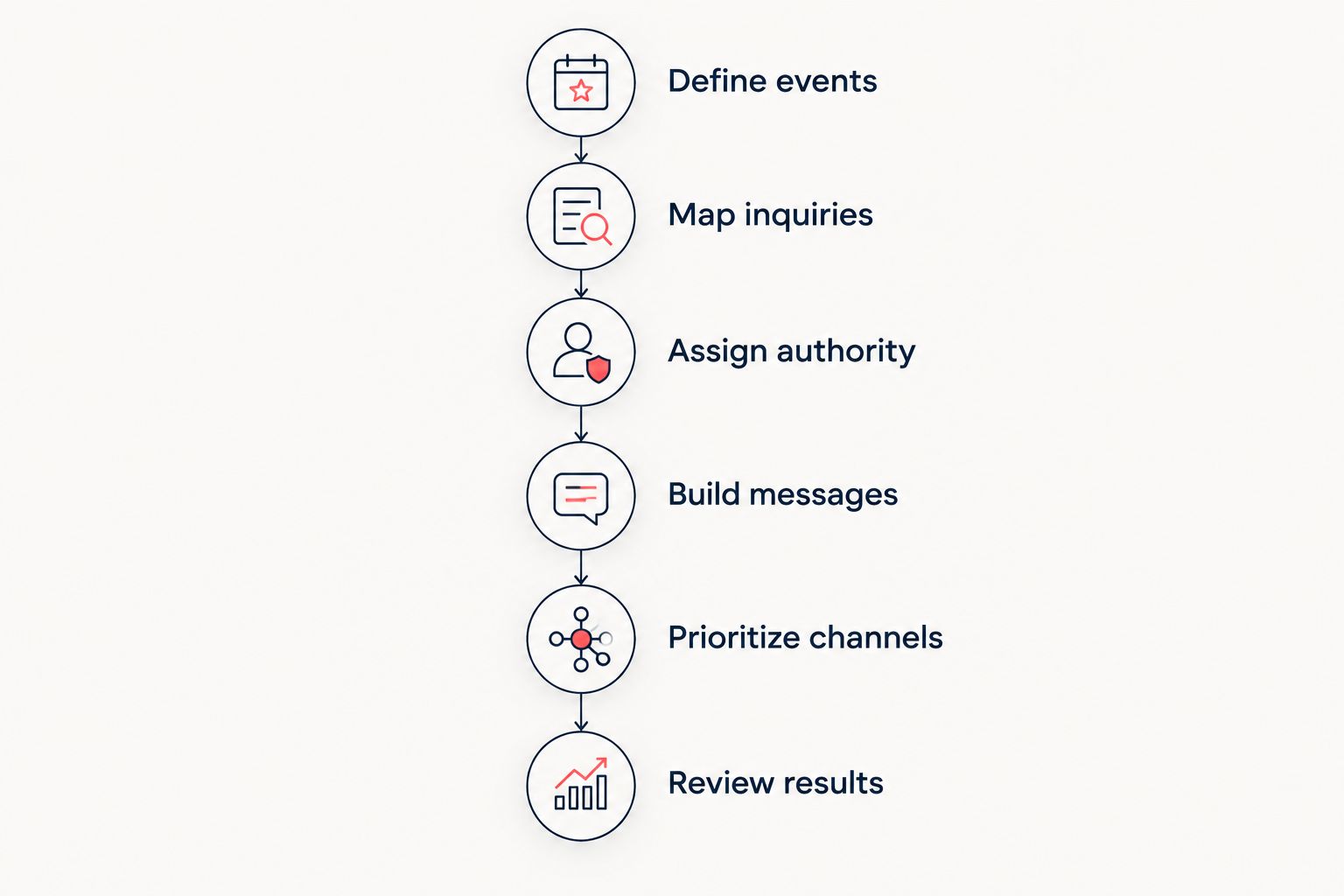
Set the booking criteria and responsibilities before commissioning campaigns.
Compare marketing leadership options for event planners
Choose the model that fills your missing responsibility, not the model with the longest deliverable list. Fractional leadership, agencies, and internal directors address different needs. More than one model can be appropriate when each has a distinct scope.
The comparison below describes operating models, not guarantees about any provider. In particular, confirm authority, execution capacity, continuity, and management responsibilities in the engagement agreement.
| Option | Best for | Main advantage | Key limitation |
|---|---|---|---|
| Founder-led marketing | Planners still defining their services and booking criteria | Direct connection between business decisions and marketing | The founder retains coordination and approval work |
| Fractional CMO | Businesses needing senior direction without a dedicated internal leadership role | Defined ownership of strategy, priorities, and marketing oversight | Production and day-to-day coverage must be scoped separately |
| Marketing agency | Planners with an agreed strategy and a defined execution brief | An external team responsible for contracted campaign work | Company-wide leadership and vendor coordination are not automatic |
| In-house marketing director | Businesses needing an ongoing internal marketing management role | Dedicated involvement with the team and its operating priorities | Specialist execution still depends on the director’s capabilities and supporting resources |
A fractional CMO is the wrong first purchase if your only unresolved task is a clearly defined website update. An agency is the wrong substitute if you expect it to settle business positioning and supervise unrelated vendors without that responsibility in scope.
For an internal marketing director, define the management workload before hiring. Distinguish recurring coordination from specialist work such as writing, design, or campaign operations. Do not make one job description silently responsible for every discipline.
Before selecting any option, request a responsibility map covering recommendations, approvals, implementation, and reporting. The useful comparison is who owns each decision after the engagement starts. A proposal that lists activity without ownership leaves the central question unanswered.
Common mistakes wedding and event planners make
Treating every inquiry as equal demand
An inquiry for an unavailable date or an unsupported service is not equivalent to a qualified opportunity. Reporting them together hides whether your marketing attracts suitable work. Keep the original inquiry count, but add qualification and disposition so you can explain what happened.
Promoting dates without checking delivery capacity
Marketing and event operations need the same view of availability. Before approving a campaign, confirm the dates, locations, and scope your team can accept. Update the campaign brief when those constraints change; do not rely on the founder remembering to correct every channel individually.
Assuming the marketing leader also produces everything
Strategy, vendor management, copywriting, design, publishing, and inquiry follow-up are separate responsibilities. A fractional title does not establish which are included. Put each task in the scope with an owner, then judge the engagement against that agreement.
Counting referrals without recording the source
If an inquiry is introduced by a venue, photographer, supplier, or previous client, record that relationship. Otherwise, your reporting cannot distinguish referred business from other inquiries. Use a consistent source field rather than trying to reconstruct introductions from memory during a review.
Reviewing visibility without reviewing booked work
Reach, traffic, and engagement describe activity at different stages; they do not establish a confirmed booking. Connect those measures to inquiries and the subsequent sales process. If a source cannot be attributed reliably, keep that uncertainty visible rather than assigning credit to the last campaign discussed.
FAQ
What does a fractional CMO do for wedding and event planners?
A fractional CMO provides part-time senior marketing leadership for wedding and event planners. The role can cover positioning, channel priorities, vendor direction, and reporting when those responsibilities are included in the engagement scope.
When should an event planning business hire a fractional CMO?
Hire a fractional CMO when your business needs an accountable owner for marketing decisions and coordination. If strategy is already settled and only production is missing, compare execution support instead.
Is a fractional CMO better than a marketing agency?
A fractional CMO is the better fit for a leadership gap; an agency is the better fit for a defined execution brief. Compare authority and responsibilities rather than assuming either model includes both.
Does a fractional CMO write content and run campaigns?
Content production and campaign management are included only when the engagement scope assigns those tasks. Identify the implementation owner before signing, whether that is the leader, an internal employee, or an external provider.
What should wedding planners measure in marketing reports?
Wedding planners should distinguish inquiries, qualified prospects, consultations, proposals, and booked events. Record requested dates and reasons for disqualification so the report reflects work the business can accept.
How should I compare fractional CMO proposals in 2026?
Compare decision authority, implementation responsibilities, reporting, and access to your team. Ask each provider to show who recommends, approves, executes, and reviews the work.
Is Carey Kidd Group relevant to event businesses around Raleigh?
Carey Kidd Group provides fractional CMO and strategic marketing consulting services to businesses around Raleigh, including the events and hospitality sectors. Confirm that the proposed scope covers your business’s specific leadership and implementation needs.
One last thing
Before your next marketing conversation, bring a qualified inquiry that did not become a booking. Trace its source, requested event, response, proposal, and final disposition. That single record gives you a concrete discussion about targeting, follow-up, and ownership without mistaking a polished campaign presentation for a business diagnosis.
Start with the responsibility that failed, then choose the person or team equipped to own it.