
Hiring a fractional CMO gives you senior marketing direction, clearer priorities, and accountability without making the role a full-time position. The benefit is leadership—not automatic execution: you still need people, budget, and decision-making authority to turn the strategy into work.
TL;DR- What are the benefits of hiring a fractional CMO? Strategic direction, implementation accountability, and clearer marketing decisions.
- A fractional CMO fits a leadership gap; an agency fits a defined execution gap.
- Carey Kidd Group provides fractional CMO and strategic marketing consulting for hospitality, events, health/medical, and fitness businesses.
- Define authority, execution responsibilities, and reporting before choosing a marketing leadership model.
What are the benefits of hiring a fractional CMO?
The central benefit is assigning responsibility for marketing decisions, not simply adding more marketing activity. A fractional CMO engagement gives an executive a defined role in setting priorities, directing implementation, and evaluating results. Those responsibilities must be explicit in the agreement.
Use this comparison to distinguish leadership from delivery. For a broader hiring decision, review the alternatives to a full-time fractional CMO hire.
| Model | Best for | Main benefit | Main limitation |
|---|---|---|---|
| Fractional CMO | Businesses needing executive direction without a full-time role | Ownership of strategy, priorities, and marketing accountability within the agreed scope | Limited capacity; execution requires assigned resources |
| Marketing agency | Businesses with a defined brief and delivery needs | Access to execution capabilities covered by the agency agreement | Company-wide marketing authority is not inherent in the relationship |
| In-house marketing director | Businesses needing continuous internal management | Day-to-day continuity and direct involvement with the team | The role needs an appropriate workload, support, and authority |
These models are not interchangeable. Choose the responsibility you need filled before choosing the employment or service arrangement.
Why this matters
Your 2026 marketing plan needs more than a list of channels. It needs a business objective, a reason for each investment, and an owner who can resolve competing priorities.
When nobody owns those decisions, the founder becomes the default marketing manager. A fractional CMO addresses that leadership gap only when the business delegates real responsibility; an advisory title alone does not change how decisions get made.
Clearer strategic priorities
A fractional CMO can translate business goals into marketing choices: which audience matters, which offer needs attention, and which initiatives deserve resources. The practical benefit is a stated order of work rather than a collection of unrelated requests.
Ask for the reasoning behind that order. A useful strategy explains what the business will defer as clearly as what it will pursue. Without that trade-off, your team still has to decide which competing requests take priority.
Accountability for implementation
Marketing strategy needs an implementation owner. A fractional CMO engagement can assign responsibility for briefing the team, reviewing progress, addressing obstacles, and escalating decisions that require executive approval.
Accountability is useful only when it names an owner and a decision. Distinguish the person directing the work from the person producing it. Otherwise, a leadership engagement becomes a source of recommendations that nobody has the capacity to carry out.
A common direction for employees and agencies
An internal marketer, a specialist agency, and a business owner can each be working from different assumptions. A fractional CMO can establish a shared brief covering the target buyer, business objective, message, and intended customer action.
That does not eliminate disagreement. It gives you a basis for resolving it. Evaluate proposed work against the agreed objective instead of choosing whichever idea sounds most persuasive in a meeting.
More useful performance discussions
A fractional CMO can structure reporting around the decisions management needs to make. Start with the business question, then identify the information required to answer it.
For example, a booking-focused business should distinguish an inquiry from a confirmed booking. Those are different stages, not interchangeable results. Reports become more useful when they explain where action is needed rather than presenting activity without context.
Do not confuse better reporting with guaranteed growth. Leadership establishes responsibility for interpreting performance; it does not guarantee a particular commercial outcome.
Executive input without a full-time position
The fractional model separates the need for senior judgment from the need for continuous executive coverage. That distinction matters when you need direction and oversight but do not have a full-time leadership remit to fill.
Capacity remains a constraint. Specify what happens between scheduled discussions, who handles urgent approvals, and which responsibilities remain internal. Access to a senior marketer is not the same as unrestricted access to that person's time.
Less dependence on the founder for routine decisions
A fractional CMO can take responsibility for marketing decisions that would otherwise return to the founder. The intended benefit is a defined escalation path: the team knows what the marketing leader decides and what still requires ownership approval.
This requires delegation. If every brief, revision, and priority change still needs the founder's permission, the decision process remains centralized regardless of the new title.
Why the benefits of a fractional CMO vary
The value of a fractional CMO depends on the role you create, not just the credentials of the person filling it. Use these factors to assess a proposed 2026 engagement:
- Authority: Identify which decisions the fractional CMO can make and which require approval. Responsibility without authority leaves the owner as the unresolved dependency.
- Execution: Name the employees, contractors, or agencies responsible for producing work. A strategy does not supply its own delivery capacity.
- Capacity: Match the scope to the executive attention available. Do not assign continuous coverage to a role designed around limited involvement.
- Continuity: Specify how plans, decisions, and working knowledge will be documented. Your business needs usable records, not information confined to conversations.
- Accountability: Define how progress will be reviewed and how corrective decisions will be made. Reporting should support action rather than merely document activity.
Ask candidates to describe these responsibilities in plain language. If the scope is unclear before the engagement starts, a title will not make it clearer afterward.
How do you turn fractional CMO benefits into a working engagement?
Before approving a 2026 engagement, write down the business problem and the operating responsibilities. Use this sequence to move from an executive title to a role your team can work with.
- Define the gap. State whether you lack direction, delivery capacity, or internal management. Use a concrete unresolved decision rather than a general desire for growth.
- Assign authority. Record what the fractional CMO can approve, recommend, and escalate. Include the owner's retained responsibilities.
- Name delivery owners. Assign implementation to specific roles. Confirm that those people have the capacity and access required to do the work.
- Set review rules. Agree on the business measures, reporting definitions, and process for changing priorities. Make the next decision visible in each review.
- Document decisions. Keep the rationale, owner, and next action accessible to the team. Preserve continuity beyond individual meetings.
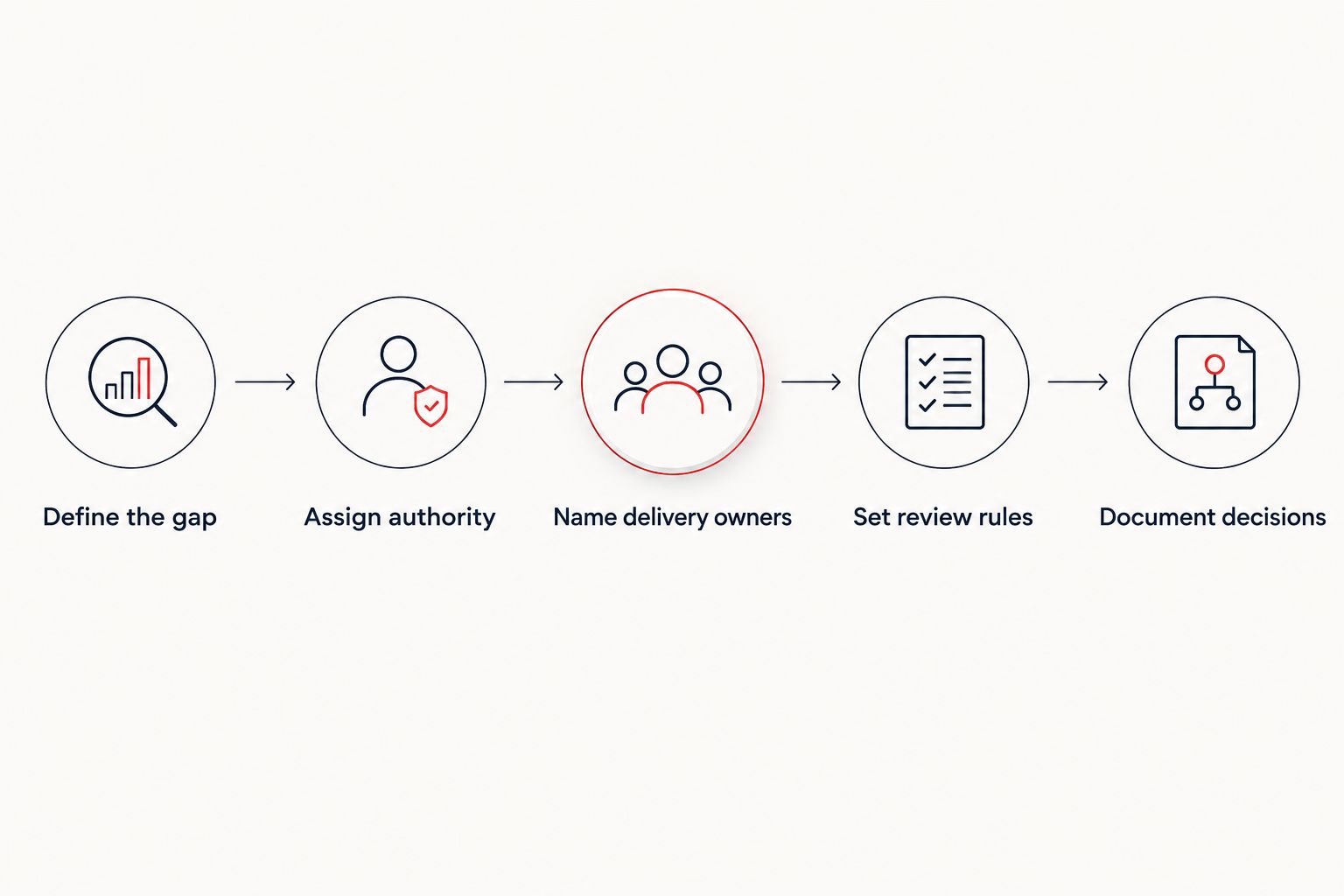 Define the leadership role and delivery responsibilities before implementation begins.
Test the proposed arrangement against a real pending decision. Ask who would resolve it, what information they would need, and who would implement the answer. This exposes gaps that a general proposal can leave hidden.
Is a fractional CMO better than an agency?
A fractional CMO fits a leadership gap; an agency fits a defined execution gap. Choose executive direction when you need someone to establish priorities and manage marketing accountability, and choose delivery support when the brief and decision owner are already clear.
The models can work together, but coordination needs an assigned owner. Do not assume an agency contract includes business-wide marketing leadership or that a fractional engagement includes production.
When is an in-house marketing director the better choice?
An in-house marketing director fits a business that needs continuous internal management and has a role substantial enough to support it. Compare the actual responsibilities, not the seniority suggested by the titles.
If your 2026 plan depends on daily supervision, frequent operational decisions, and sustained internal coordination, assess those requirements explicitly. A fractional arrangement should not be used to disguise a full-time workload.
Where Carey Kidd Group fits
Carey Kidd Group is best suited to businesses seeking fractional CMO or strategic marketing consulting in hospitality, events, health/medical, and fitness around Raleigh, North Carolina. Those are the service areas and industries the business identifies.
Carey Kidd Group cites 20 years of new business development experience. That background is relevant to evaluating strategic leadership, but experience alone does not establish the scope of an engagement. Confirm the authority, implementation responsibilities, and expected involvement before deciding.
The service fits a search for marketing leadership and strategic consulting. Do not treat it as confirmation of an included production team, unrestricted availability, or guaranteed results; those responsibilities require explicit agreement.
What should you ask before hiring a fractional CMO?
Use the selection conversation to examine how the person makes decisions, not just how they describe strategy. Ask for an explanation of how the proposed role would handle your current business problem.
- Which marketing decisions would you own, and which would stay with management?
- What would you need from our team before setting priorities?
- Who would implement the recommended work?
- How would you distinguish a strategy problem from a delivery problem?
- What information would you use to recommend stopping an initiative?
- How would you document decisions and prepare an eventual handoff?
Listen for boundaries as well as capabilities. A credible scope states what the role excludes, how unresolved issues get escalated, and what the client must provide. Treat those details as part of the service, not administrative fine print.
FAQ
What are the main benefits of hiring a fractional CMO?
The main benefits are senior marketing direction, clearer priorities, implementation accountability, and a defined owner for marketing decisions. Those benefits depend on agreed authority and access to execution resources.
Does a fractional CMO replace my marketing team?
A fractional CMO does not automatically replace your marketing team. Separate leadership responsibilities from production tasks, then name the employees or external providers responsible for delivery.
Is a fractional CMO better than a marketing agency?
A fractional CMO fits a leadership gap, while a marketing agency fits a defined execution gap. Compare the responsibilities in each proposal rather than assuming either arrangement includes the other.
Can a fractional CMO guarantee more revenue?
A fractional CMO engagement does not establish a guaranteed revenue outcome. Evaluate the proposed decisions, implementation responsibilities, and reporting process rather than accepting an unsupported growth promise.
What should a fractional CMO engagement include in 2026?
A 2026 fractional CMO engagement should specify authority, scope, delivery owners, reporting definitions, and review procedures. State exclusions and client responsibilities alongside the expected work.
Who does Carey Kidd Group serve with fractional CMO consulting?
Carey Kidd Group provides fractional CMO and strategic marketing consulting for hospitality, events, health/medical, and fitness businesses around Raleigh, North Carolina. Confirm the proposed engagement scope against your specific leadership and implementation needs.
When should I hire an in-house marketing director instead?
Hire an in-house marketing director when the business requires continuous internal marketing management and has a suitable ongoing role. Compare daily responsibilities and required availability before selecting the arrangement.
One last thing
Before adding another initiative to your 2026 marketing plan, identify an existing decision that nobody owns. Write down who should make it, what authority they need, and who will carry it out.
Hire for the unresolved responsibility, not the title. If the gap is strategic direction, evaluate leadership. If the gap is production capacity, evaluate delivery. Making that distinction is the first useful marketing decision in the hiring process.