
Best overall: Retainer Fractional CMO. Best for a single launch: Project-Based Fractional CMO. Best for a leadership gap: Interim Fractional CMO. Those three answers cover most of the decision — the other two models on this list exist for narrower situations, not general use.
TL;DR
- Retainer fractional CMO engagement wins for ongoing strategic leadership in hospitality, events, health, and fitness brands in 2026.
- Comparing fractional CMO engagement models means weighing authority, execution capacity, continuity, and accountability, not just how it's billed.
- Project-based engagements fit a single launch or rebrand; retainer engagements fit sustained growth over multiple quarters.
- Interim fractional CMO coverage closes a leadership gap fast but isn't structured for multi-year strategy.
- Advisory-only engagements work for founders who already have execution staff and want direction, not a doer.
Why this matters
Most businesses researching a fractional CMO compare price before they compare structure, and that's backwards. The engagement model determines how much authority the CMO actually has, how fast execution happens, and who's accountable when a campaign underperforms.
Carey Kidd Group works with hospitality, events, health/medical, and fitness brands around Raleigh, North Carolina, and the model mismatch shows up the same way every time: a business hires for strategy and gets advice with no implementation, or hires for implementation and gets a project manager instead of a strategic marketing leader. Picking the right model in 2026 matters more than picking the right person.
What makes the best fractional CMO engagement model
- Authority — does the CMO have decision-making power over budget, channel mix, and vendor selection, or are they advisory only
- Execution capacity — does the engagement include hands-on implementation or strategy documents someone else has to carry out
- Continuity — does the model support a multi-quarter growth plan or is it scoped to one deliverable
- Management overhead — how much of the founder's or ops team's time does the engagement consume to run
- Accountability — is performance tied to results or to hours billed
- Fit to business stage — does the model match a brand that's launching, scaling, or stabilizing after a departure
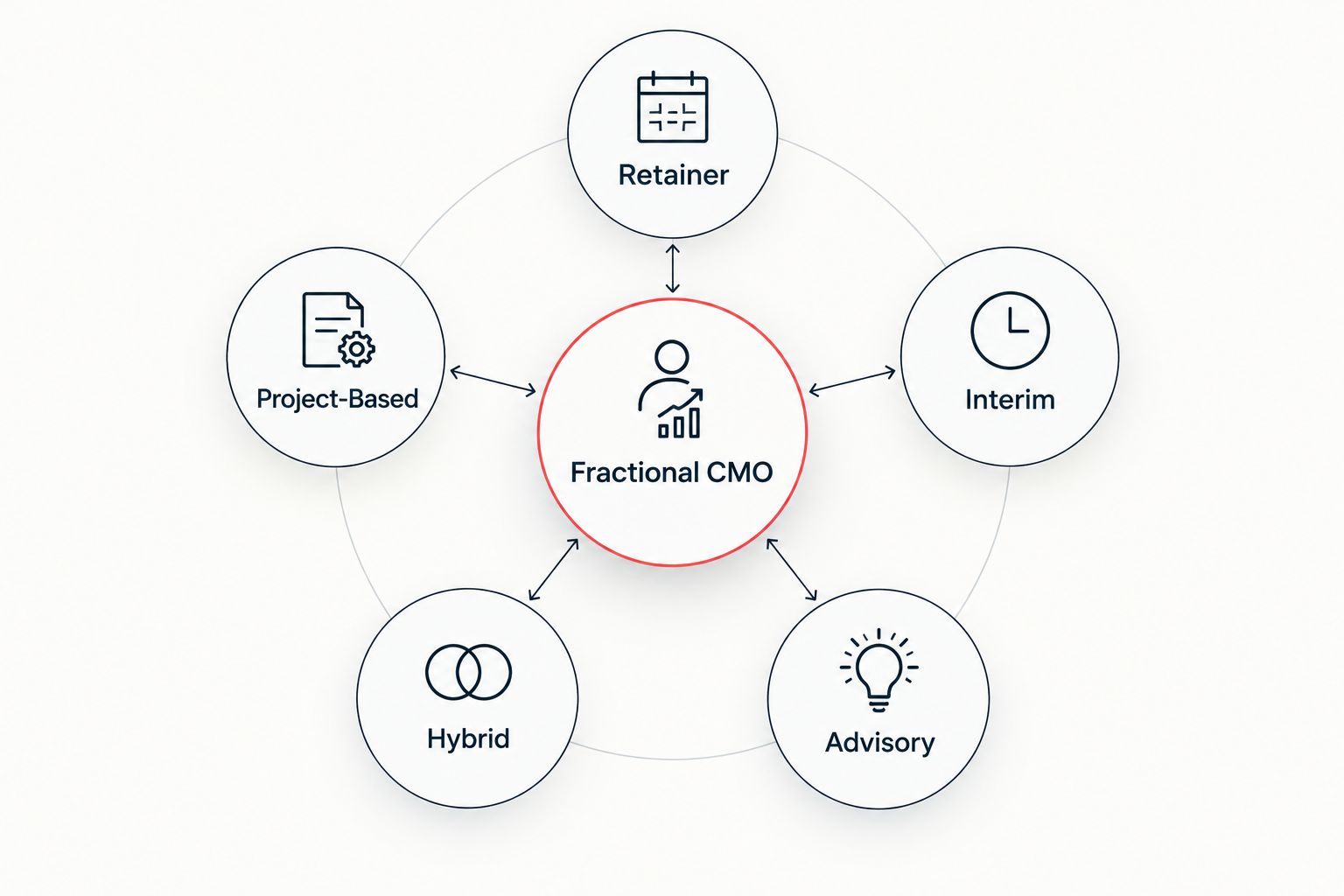
Each model answers a different business situation, not a different budget tier.
Fractional CMO engagement models at a glance
| Model | Best for | Standout feature | Key limitation |
|---|---|---|---|
| Retainer Fractional CMO | Ongoing strategic leadership | Continuity across quarters | Requires a longer commitment to show results |
| Project-Based Fractional CMO | A single defined initiative | Clear start and end date | Strategy stops when the project closes |
| Interim Fractional CMO | Covering a leadership gap | Fast onboarding, immediate authority | Not built for long-range planning |
| Hybrid Fractional CMO + In-House | Teams with existing marketing staff | Strategic direction plus staff coaching | Needs a functioning team to direct |
| Advisory Fractional CMO | Founders wanting high-level guidance | Lowest time commitment from the CMO | No execution authority or hands-on delivery |
1. Retainer Fractional CMO: best fractional CMO engagement for ongoing strategic leadership
A retainer engagement puts a fractional CMO in the seat on an ongoing basis — setting the marketing plan, running new business development, and holding the team (internal or vendor) accountable to it quarter over quarter. This is the model built for brands that need a strategic marketing leader without the cost and risk of a full-time executive hire.
Retainer Fractional CMO pros:
- Continuity across multiple quarters means strategy compounds instead of resetting
- Authority to make budget and channel calls without founder sign-off on every decision
- Accountability is tied to pipeline and revenue outcomes, not hours logged
Retainer Fractional CMO cons:
- Takes longer than a project engagement to show measurable traction
- Requires the business to commit before seeing a finished deliverable
Best for: hospitality, events, health/medical, and fitness brands that want sustained new business development, not a one-time fix.
Verdict: Choose.
2. Project-Based Fractional CMO: best fractional CMO engagement for a single defined initiative
A project-based engagement scopes the fractional CMO to one deliverable — a location launch, a rebrand, a new service line rollout. The work has a defined start and end, and the CMO's authority is limited to that scope.
Project-Based Fractional CMO pros:
- Fixed scope makes the engagement easy to evaluate against one outcome
- Lower management overhead since there's no ongoing relationship to maintain
- Clean exit point when the project wraps
Project-Based Fractional CMO cons:
- Strategy and momentum stop when the project closes
- No continuity if the business needs a second initiative six months later
Best for: a single launch, rebrand, or market entry with a clear finish line.
Verdict: Consider.
3. Interim Fractional CMO: best fractional CMO engagement for covering a leadership gap
An interim engagement fills a vacancy — a CMO or VP of Marketing just left, and the business needs decision-making authority in place immediately while it searches for a permanent hire. The interim CMO runs the existing plan and keeps execution moving.
Interim Fractional CMO pros:
- Fast onboarding with immediate decision-making authority
- Keeps campaigns and vendor relationships from stalling during a search
- Full accountability for results during the gap, same as a full-time hire
Interim Fractional CMO cons:
- Not structured for multi-year strategic planning
- Ends as soon as the permanent hire is in place, which can interrupt momentum
Best for: a business between marketing leaders that can't afford a strategy vacuum.
Verdict: Consider.
4. Hybrid Fractional CMO + In-House Team: best fractional CMO engagement for brands with existing marketing staff
A hybrid engagement puts a fractional CMO above an existing internal team — setting direction and coaching the staff who handle day-to-day execution. The CMO owns strategy and accountability; the in-house team owns the channels.
Hybrid Fractional CMO pros:
- Strategic leadership without duplicating roles already on staff
- Builds internal team capability over time instead of outsourcing it entirely
- Lower execution overhead for the CMO since staff carry the daily work
Hybrid Fractional CMO cons:
- Only works if the internal team has the bandwidth and skill to execute
- Management overhead increases if the internal team needs heavy coaching
Best for: brands with a marketing coordinator or small team but no senior strategic leader.
Verdict: Consider.
5. Advisory Fractional CMO: best fractional CMO engagement for founders who want high-level guidance only
An advisory engagement is the lightest-touch model — periodic strategic input with no execution authority and no hands-on delivery. The founder or an existing executive implements; the fractional CMO advises.
Advisory Fractional CMO pros:
- Lowest time commitment required from the CMO
- Useful for founders who already have a capable operator running execution
- Flexible cadence compared to a full retainer
Advisory Fractional CMO cons:
- No execution authority means recommendations can sit unimplemented
- Accountability is weak — there's no one on the hook for results
- Rarely enough structure to drive new business development on its own
Best for: founders with a strong internal operator who just need a sounding board.
Verdict: Skip, unless execution is already fully covered in-house.
How this ranking works
Each model is scored against the same six criteria — authority, execution capacity, continuity, management overhead, accountability, and fit to business stage. Retainer wins overall because it scores highest on continuity and accountability, the two factors that correlate most with sustained new business development. Project-based and interim rank second because they solve a real but narrower problem. Advisory ranks last because it strips out the authority and accountability that make the other four models work.
Compare engagement models for your business
See which fractional CMO structure fits your stage and team.
Which fractional CMO engagement model should you choose?
For most hospitality, events, health/medical, and fitness brands heading into 2026, retainer fractional CMO is the default — it's the only model built for continuity and accountability over multiple quarters. Choose project-based only if the need is genuinely scoped to one launch. Choose interim only if there's an active leadership gap. Hybrid makes sense with a staffed-but-leaderless team. Advisory only makes sense when execution is already fully covered elsewhere.
FAQ
What is a fractional CMO engagement model?
A fractional CMO engagement model is the structure that defines how a part-time chief marketing officer works with a business — retainer, project-based, interim, hybrid, or advisory. Each model differs in authority, execution responsibility, and how long the relationship runs.
What's the difference between a fractional CMO and a marketing agency?
A fractional CMO takes on strategic leadership and accountability for the marketing function, while an agency typically executes specific channels under direction. A fractional CMO sets the plan an agency or in-house team then carries out.
Which fractional CMO model fits a hospitality or events brand best?
Retainer fractional CMO fits hospitality and events brands best because growth in those categories depends on sustained new business development, not a single campaign. A project-based engagement only makes sense for a one-time launch or location opening.
Can a fractional CMO work alongside an existing in-house marketing team?
Yes — this is the hybrid model, where the fractional CMO sets strategy and direction while an internal team or coordinator handles day-to-day execution. It works best when the internal team already has execution skill but lacks senior strategic leadership.
Is an interim fractional CMO the same as an outsourced CMO?
They're related but not identical. An interim fractional CMO specifically fills a leadership vacancy for a defined period, usually while a business searches for a permanent hire, with full decision-making authority during that window.
Does an advisory-only fractional CMO get results?
Advisory engagements rarely drive results on their own because they lack execution authority and accountability. They work only when a business already has a capable operator turning recommendations into action.
How long does a retainer fractional CMO engagement typically run?
Retainer engagements are structured for multiple quarters rather than a single deliverable, since continuity is what drives compounding results in new business development. Exact terms vary by scope and are set with the client directly.
What industries benefit most from a fractional CMO in 2026?
Hospitality, events, health/medical, and fitness brands benefit most because they depend heavily on new business development and typically can't justify a full-time CMO salary. A fractional CMO brings senior strategic leadership at a lower commitment level.
One last thing
The model founders get wrong most often isn't retainer versus project — it's reaching for advisory when what they actually need is authority. Guidance without execution power just produces another document nobody implements; if accountability for results matters, the engagement needs decision-making authority attached to it, not just a recommendation.