
A fractional CMO sets marketing priorities, directs the people doing the work, reviews business results, and resolves decisions that would otherwise return to the founder. The role provides part-time marketing leadership; daily production, response times, and decision-making authority depend on the agreed scope.
TL;DR- What does a fractional CMO do day to day? Set priorities, direct implementation, review results, and resolve blockers.
- Fractional marketing leadership requires decision-making authority, not just recommendations or attendance at meetings.
- Carey Kidd Group provides fractional CMO and strategic marketing consulting for hospitality, events, health/medical, and fitness businesses.
- Define execution responsibilities separately: leadership does not automatically include copywriting, design, advertising production, or daily account management.
Why this matters
Hiring senior marketing help does not remove the need to define who makes decisions and who implements them. For your 2026 marketing plan, the useful distinction is between owning the direction and completing every task.
Carey Kidd Group provides fractional CMO and strategic marketing consulting services around Raleigh, North Carolina. When assessing this type of engagement, look for a clear connection between the business objective, the work assigned, and the decisions the marketing leader can make.
What does a fractional CMO actually do day to day?
A fractional CMO turns business objectives into marketing decisions and keeps implementation aligned with those decisions. The work includes reviewing performance, setting priorities, briefing employees or agencies, evaluating proposals, and coordinating marketing with sales or operations.
The following table describes a practical responsibility framework, not a fixed schedule or a promise that every engagement includes every activity.
| Responsibility | Day-to-day work | Output you should expect |
|---|---|---|
| Set direction | Decide which audience, offer, or business objective takes priority | A documented priority and its rationale |
| Review performance | Examine inquiries, bookings, sales feedback, and campaign results | A decision to continue, change, investigate, or stop |
| Direct implementation | Brief the people producing campaigns and content | Clear assignments, acceptance criteria, and ownership |
| Manage resources | Evaluate proposed spending and competing demands | A resource decision tied to the business objective |
| Coordinate teams | Resolve gaps between marketing, sales, and operations | An agreed handoff and a responsible owner |
| Maintain accountability | Check progress and explain missed commitments | A corrective action rather than another status update |
The defining output is a decision that changes what the business does next. A report without interpretation is reporting; a meeting without ownership is coordination. Fractional CMO work should connect both to action.
Not every responsibility happens on every working day. Some decisions require sustained analysis, while others need a short conversation with the person responsible for delivery. Evaluate the role by the quality and follow-through of those decisions, not the volume of visible activity.
What a practical fractional CMO work cycle looks like
For a 2026 engagement, organize the work around a repeatable decision cycle rather than an assumed full-time presence. The sequence below is a recommended operating structure, not a claim about a standard allocation of hours.
Review results
Start with the business outcome and work backward. If inquiries have increased but bookings have not, examine inquiry quality, response handling, and the booking process before commissioning more promotion.
Ask what changed, where the evidence comes from, and whether the data supports a decision. Keep observed results separate from the team's explanation of those results.
Set priorities
Choose the issue that deserves attention and identify what will wait. A priority is not meaningful if every department can add work without displacing anything already agreed.
Write down the intended outcome, the responsible owner, and the evidence that will determine whether the work helped. This gives you a basis for accepting or rejecting new requests.
Direct implementation
Translate the priority into a usable brief. Explain the intended audience, the action you want that audience to take, the message, and the requirements for approval.
Your fractional CMO should ensure that the people doing the work understand the decision behind it. Designers, writers, advertising specialists, and internal coordinators still need defined responsibilities.
Resolve handoffs
Check what happens after marketing generates interest. A campaign cannot compensate for an unclear inquiry-routing process, an unanswered booking request, or disagreement about who follows up.
Assign the operational issue to the right owner rather than treating every problem as a marketing production task. The marketing leader should coordinate the handoff without silently absorbing another department's responsibilities.
Record decisions
Close the cycle with a short record of what changed, who owns the next action, and what evidence will trigger another review. Record unresolved questions as well as approvals.
This creates continuity between working sessions. Your team should not need to reconstruct the strategy every time the fractional CMO returns.
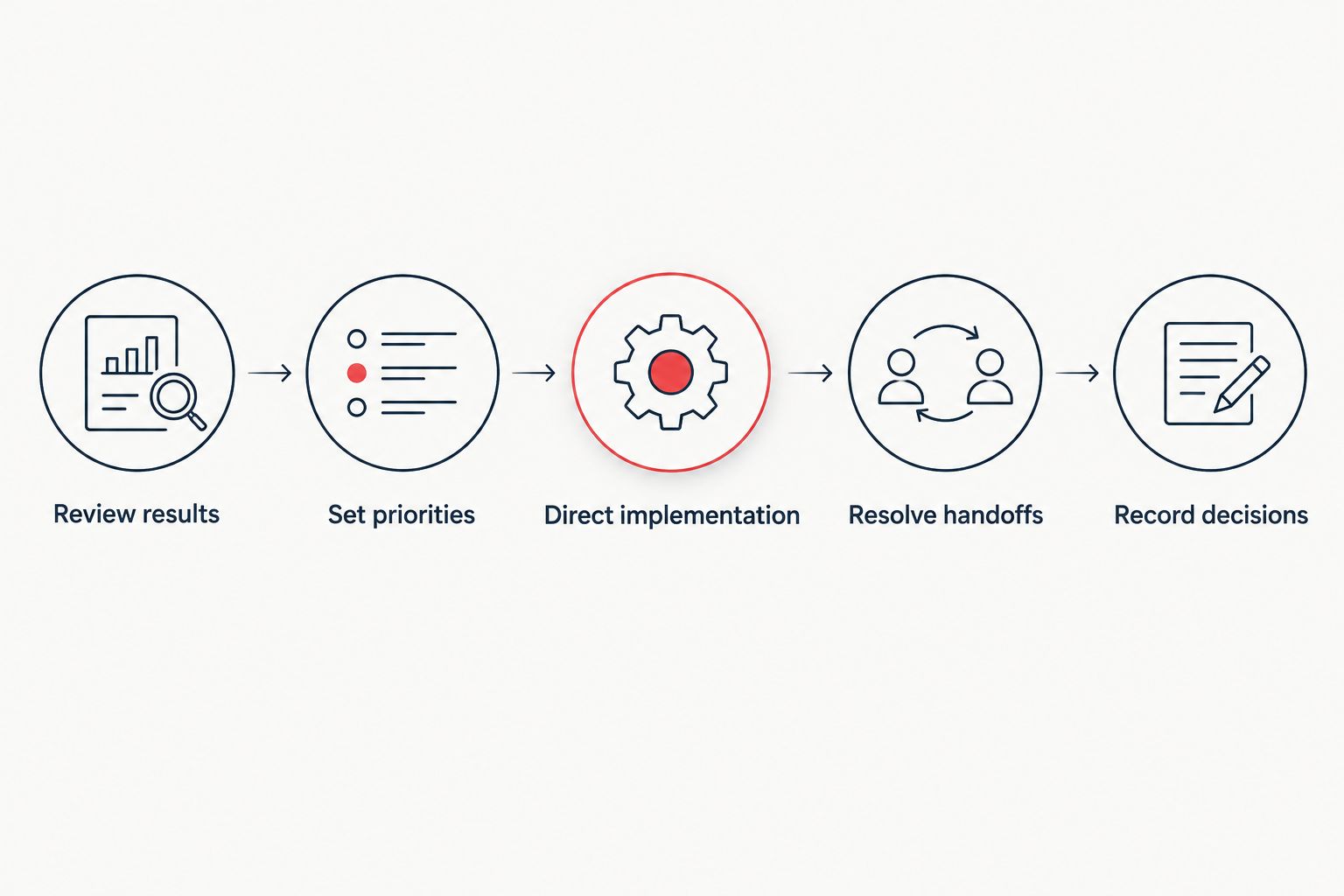 Each review should end with a decision, an owner, and a defined next action.
What should the founder still own?
The founder retains responsibility for company direction, commercial constraints, and the authority delegated to the marketing leader. A fractional CMO needs access to those decisions; the role cannot replace them with marketing assumptions.
You should approve material changes to business objectives and clarify which commitments require your authorization. Agree on how disagreements will be resolved before an urgent campaign or spending decision exposes the gap.
The useful division is straightforward:
- Founder: Sets business objectives, defines constraints, and grants authority.
- Fractional CMO: Translates those objectives into marketing priorities and directs the agreed work.
- Execution owners: Produce, publish, configure, deliver, and maintain the assigned work.
One person can hold more than one responsibility. The important point is to name each responsibility rather than assuming that the most senior marketing person will absorb everything.
Fractional CMO vs. agency vs. in-house marketing director
Compare these models by the responsibility you need filled, not by job title alone. The table describes selection criteria; an individual contract or employment role can combine responsibilities.
| Model | Best for | Main advantage | Main limitation to address |
|---|---|---|---|
| Fractional CMO | Businesses needing part-time strategic marketing leadership | Senior direction without designing the role as full-time employment | Availability, authority, and execution coverage need explicit agreement |
| Marketing agency | Businesses needing defined specialist production or campaign delivery | An assigned team can deliver work within its service scope | Company-wide decisions still need an accountable business owner |
| In-house marketing director | Businesses needing an internal leader with ongoing operational responsibility | Direct organizational context and day-to-day team management | The role still needs suitable skills, resources, and executive support |
Choose the model that fills the missing responsibility. If your strategy is clear but campaigns are not being produced, assess execution capacity. If multiple suppliers are producing work without a shared direction, assess leadership and decision ownership.
A fractional CMO is not automatically a replacement for every agency or internal employee. Leadership and production are separate requirements, even when an engagement includes both.
Why a fractional CMO's daily responsibilities vary
The title alone does not define the assignment. Use these factors to shape the scope of your 2026 engagement:
- Business objective: New business development, repeat business, and retention require different priorities and reporting questions.
- Existing team: A business with execution staff needs different leadership support from a founder managing suppliers directly.
- Industry workflow: Hotel bookings, event inquiries, medical appointments, and fitness memberships involve different customer actions and operational handoffs.
- Decision authority: A leader who can approve agreed work has a different operating role from an adviser who must request every decision.
- Reporting access: Marketing decisions require access to relevant business results, not only channel activity.
- Implementation scope: Strategy, supplier management, campaign production, and technical setup must be assigned separately.
Turn these factors into written boundaries. For example, specify whether the fractional CMO approves campaign briefs, recommends spending changes, manages suppliers, or advises the founder without direct management authority.
The benefit of a tailored role is relevance to your business. The drawback is ambiguity if the agreement relies on the title instead of describing the work.
How do you know whether a fractional CMO is doing useful work?
Look for a traceable connection between the objective, the decision, and the assigned action. Useful leadership makes it easier for your team to explain why a campaign exists and what happens if it underperforms.
Ask for an operating record that answers these questions:
- What business outcome is marketing supporting?
- What changed in the evidence?
- What decision followed?
- Who owns implementation?
- What is blocked, and who can resolve it?
- What will determine the next decision?
For your 2026 reporting, distinguish activity from outcomes. Publishing content shows delivery; it does not, by itself, show qualified demand or revenue. Likewise, an inquiry count needs context about suitability and follow-through.
The marketing ROI reporting workflow addresses the connection between marketing activity and business reporting. Evaluate any reporting setup by whether it supports decisions, not by how much information appears on the dashboard.
Do not demand certainty where the evidence is incomplete. Demand a clear explanation of what is known, what remains unresolved, and what action will clarify the issue.
Does a fractional CMO personally run every campaign?
A fractional CMO does not automatically perform every campaign task. The engagement should state who writes, designs, builds, publishes, monitors, and approves the work.
Hands-on involvement can be included when agreed, but it should not be inferred from the leadership title. If you need both strategy and production, confirm that both have named owners and sufficient capacity.
Does a fractional CMO work with sales and operations?
A fractional CMO should coordinate with sales and operations where those teams affect marketing outcomes. That includes defining a qualified inquiry, clarifying follow-up responsibility, and checking whether the promoted experience matches delivery.
Coordination does not transfer departmental ownership. Sales and operations leaders remain responsible for the responsibilities assigned to them.
What should you agree before work starts?
Agree on the objective, decision rights, deliverables, availability, and execution responsibilities before assigning campaigns. Specify how urgent requests are handled and who acts when the fractional CMO is not working with your business.
Also define how the engagement will be evaluated. A useful agreement explains the expected leadership outputs and the business evidence you will review together.
Where Carey Kidd Group fits
Carey Kidd Group is best suited to Raleigh-area hospitality, events, health/medical, and fitness businesses seeking fractional CMO and strategic marketing consulting services. The relevant buying decision is whether you need senior marketing direction, clearer implementation accountability, or both.
The advantage of fractional leadership is a role structured around an agreed leadership need. The trade-off is that you must explicitly arrange execution coverage and access between working sessions; a title does not settle either question.
For a 2026 engagement, bring a current business objective, your team and supplier responsibilities, and the decisions that repeatedly return to you. Use those materials to define the assignment rather than starting with a list of channels.
FAQ
What does a fractional CMO do day to day?
A fractional CMO sets priorities, reviews results, directs implementation, and resolves marketing decisions. The specific daily workload depends on the agreed authority, availability, and execution scope.
Will a fractional CMO manage my marketing agency?
A fractional CMO can manage your marketing agency when supplier management is included in the scope. Define who briefs the agency, approves work, evaluates results, and authorizes changes.
Does a fractional CMO write social media posts?
Social media writing is not automatically included in fractional CMO work. Assign writing, scheduling, community responses, and approval separately from strategic leadership.
Do I still need someone to implement the marketing plan?
You need a named owner for every implementation task. That owner can be an employee, an agency, a specialist, or the fractional CMO when hands-on delivery is explicitly included.
How do I measure a fractional CMO's performance?
Measure a fractional CMO against agreed leadership responsibilities and relevant business outcomes. Review the decisions made, implementation follow-through, unresolved blockers, and evidence connecting marketing activity to results.
Is a fractional CMO the same as a consultant?
A fractional CMO is a consulting arrangement with a marketing leadership scope, but the title does not establish decision rights. Confirm whether the person advises, manages implementation, or holds delegated authority.
Who is Carey Kidd Group's fractional CMO service relevant to?
Carey Kidd Group provides fractional CMO and strategic marketing consulting services for hospitality, events, health/medical, and fitness businesses around Raleigh, North Carolina. Assess the engagement against your leadership needs and implementation responsibilities.
One last thing
Ask a prospective fractional CMO to walk through a marketing decision your business is currently avoiding. Look for the questions they ask, the evidence they require, and the responsibilities they separate.
The test is not whether someone can suggest more marketing. It is whether they can explain what deserves attention, what should stop, and who must act. Put that standard into the engagement before the work begins.