Instead of manually chasing dining guests for event business, build a workflow from Resy reservations to private event bookings that starts with an explicit event inquiry, assigns an owner, and tracks the request through confirmation. Keep reservation management separate from event sales: a dining booking is context, not permission to send event promotions.
TL;DR- Resy reservations to private event bookings requires an inquiry-first handoff, not automatic prospecting from every dining reservation.
- Carey Kidd Group fractional CMO services fit hospitality businesses needing strategic marketing leadership and implementation accountability.
- Assign every private dining inquiry an owner, next action, and documented booking outcome.
- Automate event-sales tasks only after confirming permitted data access, contact preferences, and duplicate handling.
Carey Kidd Group fractional CMO services are best for hospitality businesses that need strategic marketing leadership, not another reservation system. Carey Kidd Group serves hospitality and event businesses around Raleigh, North Carolina; this guide focuses on the operating process rather than a software purchase.
Why this matters
A restaurant reservation and a private event inquiry represent different intentions. Someone booking dinner has not necessarily asked about a company gathering, celebration, or venue buyout.
For your 2026 workflow, separate those intentions before building follow-up. Otherwise, your team cannot distinguish guests who requested event information from people who simply reserved a table.
The handoff should move a documented request, not just a contact record. Your event team needs the guest's stated requirements, responsibility for responding, and a clear definition of a confirmed booking.
Before you start
- Secure appropriate access. You need authorized access to relevant reservation information, an event-inquiry intake method, a shared sales tracker, and an approved communication channel. Confirm any proposed connector, export, or integration with your account administrator before depending on it.
- Prepare the event-sales materials. Gather current event information, qualification questions, proposal materials, and your venue's actual confirmation requirements. Assign a primary owner and backup before routing inquiries.
- Resolve the contact-permission gotcha. Do not treat reservation contact details as blanket marketing permission. Record an explicit event request, distinguish inquiry replies from promotional messages, and have the responsible person review applicable platform terms and communication requirements.
This is a process configuration guide, not a claim that Resy includes a native private-event sales connector. Field and stage names below are labels to create in your own tracker, not Resy menu names.
Event inquiry intake
The first configuration unit defines what enters the event pipeline. Best for: restaurants establishing a reliable handoff before adding automation. Its advantage is direct evidence of guest intent; its limitation is that staff must recognize and record requests consistently.
- Define the entry condition. Accept a guest's direct event inquiry, a staff-recorded request made during a visit, or a response to event outreach your business is permitted to send. Do not enroll every reservation automatically.
- Create the intake fields. Add Guest name, Preferred contact, Event request, Requested date, Guest count, Reservation reference, and Contact preference. These are your own field labels. Keep unknown answers blank rather than guessing from dining behavior.
- Record the guest's intent. Summarize what the guest actually requested. A dinner reservation for a group does not establish that the guest wants a private space.
- Preserve the source distinction. Use Inquiry source for where the request arrived and Reservation context for any relevant dining relationship. A website inquiry from an existing diner is still a website inquiry.
- Choose an intake review cadence. Start with 1 review each business day as an internal operating rule. Assign coverage for closures or staff absence instead of leaving requests in an unattended inbox.
Expected result: each accepted record contains a real event request and a permitted response method. A reservation without event intent remains outside the event-sales pipeline.
Qualification and ownership
The second configuration unit turns an inquiry into an assigned sales task. For your 2026 setup, keep the decision rules visible to both restaurant operations and event sales.
- Create the ownership fields. Add Event owner, Backup owner, Next action, and Next action due. Assign 1 primary owner per inquiry; shared visibility does not mean shared accountability.
- Define the stages. Create New inquiry, Qualified inquiry, Proposal sent, Confirmed booking, and Closed inquiry. Use these labels consistently across your tracker and reporting.
- Set qualification requirements. Before moving to Qualified inquiry, establish the requested date, approximate group size, event purpose, and the appropriate next conversation. Qualification means enough information to assess fit, not a promise that the venue can accept the event.
- Separate fit from confirmation. Ask operations to assess the requested event against actual venue requirements. Do not send an automated acceptance simply because a form was submitted.
- Define the booking evidence. Write down the documents and approvals your venue requires before using Confirmed booking. A proposal, positive reply, or calendar discussion alone does not meet that definition.
Expected result: every active inquiry has a named decision-maker, a current stage, and a dated next action. Staff can explain why a record moved forward without reconstructing an email thread.
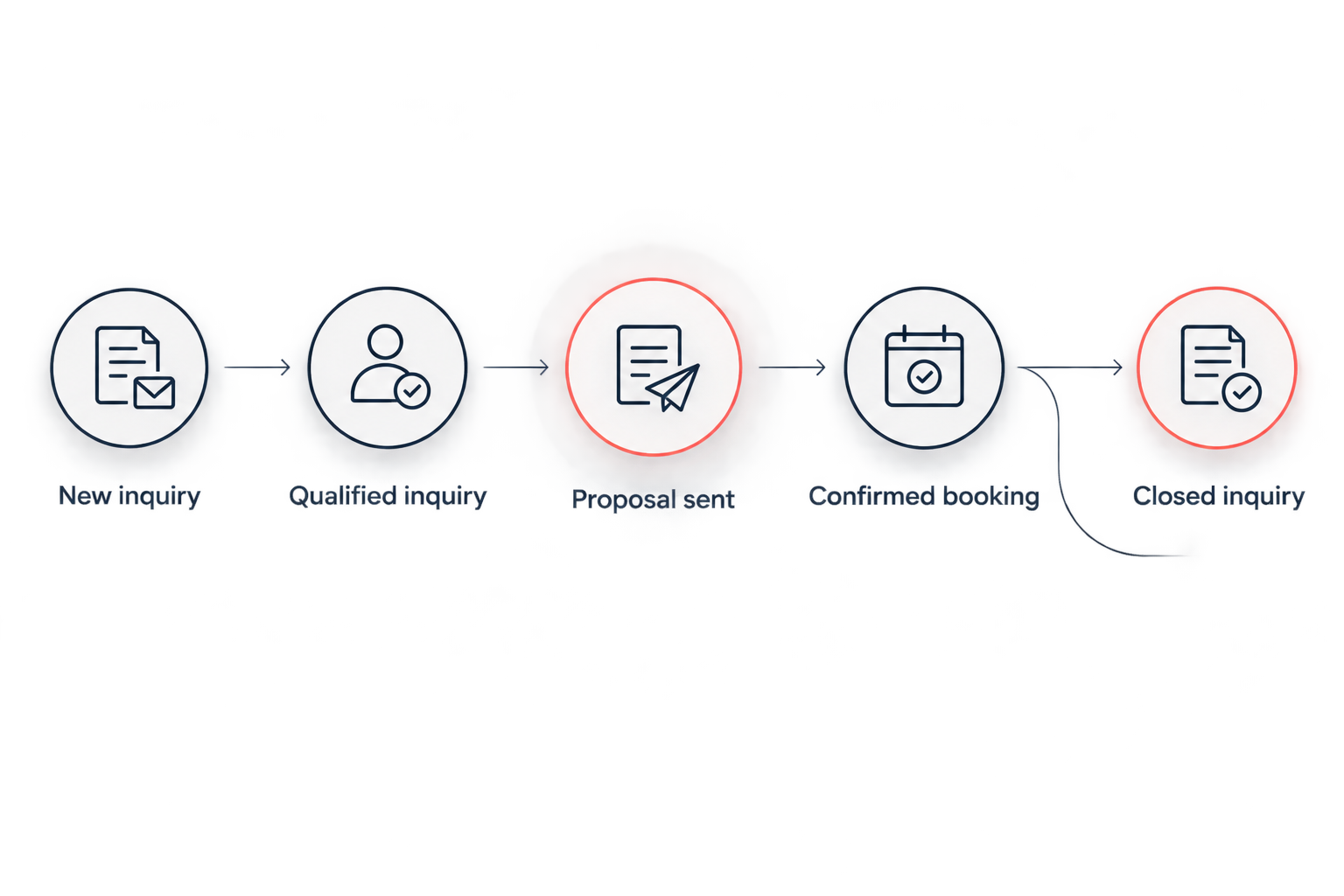 A confirmed booking requires venue-defined evidence, not merely a proposal.
Follow-up and task routing
The third configuration unit governs what happens after an inquiry arrives. Begin with human-reviewed tasks; add automated routing only where the systems and permissions support it.
- Create a response task. When a new event request is recorded, assign the event owner a task to review it. Set an internal target of 1 business day for the first review; this is a recommended starting rule, not a published response benchmark or customer promise.
- Check context before contact. Review the request, previous conversations, contact preference, and any existing event record. Answer the guest's actual question instead of starting a generic promotional sequence.
- Request missing essentials. Ask for only the information needed to assess the event. Do not make a guest repeat details already captured correctly during the handoff.
- Route the next action. After a proposal is sent, record the agreed follow-up date. If no date was agreed, create an internal reminder for review rather than assuming permission for repeated messages.
- Stop inappropriate follow-up. Close or pause tasks when the guest declines, withdraws the request, or asks not to receive further messages. Keep operational communication distinct from promotional campaigns.
Expected result: the event owner receives a specific task tied to a real request. Guests do not receive duplicate outreach simply because reservation information changed.
Booking evidence and reporting
The final configuration unit establishes what your 2026 event pipeline measures. Count inquiry handling and confirmed business separately.
- Record stage timestamps. Capture when an inquiry arrives, receives its first human response, reaches qualification, receives a proposal, and meets confirmation requirements. Leave stages blank when they did not occur.
- Record closure reasons. Use a short, consistent list based on actual outcomes, such as guest withdrawal, unsuitable requirements, or no response. Add an explanation where needed; do not label every unsuccessful inquiry a marketing failure.
- Calculate inquiry-to-booking conversion. Divide confirmed bookings by eligible inquiries from the same defined inquiry cohort. Do not divide bookings by all Resy reservations: those records represent a different population.
- Separate source from influence. Preserve the original inquiry source while recording a known dining relationship separately. Do not assign sole acquisition credit to Resy merely because the event organizer previously dined with you.
- Run a controlled pilot. Use 3 test records: a new event request, an update to that request, and a withdrawn request. Check ownership, duplicate prevention, task changes, and closure behavior before expanding the workflow.
Expected result: your reporting distinguishes demand generation, sales handling, and confirmed bookings. Each result traces back to a documented inquiry rather than an assumed reservation-to-event connection.
Update the event request when details change
A second useful workflow handles an existing event inquiry when the guest changes the date, group size, or requirements. Best for: teams receiving several updates before an event decision. The benefit is continuity; the limitation is that updates need a reliable match to the correct event record.
Treat a changed dining reservation as a review signal only when it is genuinely connected to an active event inquiry. Do not infer that canceling dinner also cancels a separate event discussion.
| Workflow | Best for | Main advantage | Main limitation |
|---|---|---|---|
| New-inquiry handoff | Teams building an event pipeline | Establishes intent and ownership | Requires consistent intake |
| Existing-inquiry update | Teams managing changing requirements | Keeps one event history | Requires accurate record matching |
- Match the update to the event record using a stable inquiry reference where your tracker supports one.
- Update only the fields the guest changed; preserve the original source and conversation history.
- Notify the event owner when the change requires a new operational assessment or revised proposal.
- Keep the inquiry in its current stage unless the change meets a defined stage-transition rule.
Expected result: one event request remains one event record, with changes visible to the owner. A guest planning a separate event receives a separate inquiry record rather than overwriting the first.
Troubleshooting
Duplicate event records appear
Fix the matching rule before adding more automation. Check for an existing active inquiry before creating another record. Email alone is insufficient when the same organizer is planning separate events; use the inquiry reference and event context together.
Guests receive messages they did not request
Pause the affected routing or campaign. Inspect the entry condition and contact-permission record, then remove reservation-only records from event outreach. Resume only after a test request follows the intended path without enrolling unrelated diners.
Requests arrive but nobody responds
Check whether Event owner and Next action due are populated. Route unassigned inquiries to the backup owner and include unresolved requests in the daily intake review. An inbox notification is not evidence that someone accepted responsibility.
Proposals inflate the booking report
Inspect the rule behind Confirmed booking. Require the venue's actual confirmation evidence and correct records that advanced prematurely. Keep proposal volume separate so sales activity does not become reported business.
The proposed data transfer is unavailable
Use an authorized staff handoff from explicit event requests into the tracker. Do not build around an assumed export, connector, or account permission. Retain the same ownership and reporting rules while an administrator verifies permitted technical options.
Customize your workflow
Choose expansion based on the failure you need to fix. Missing inquiries call for better intake; slow responses call for ownership and coverage; unclear results call for consistent stage definitions.
For broader hospitality planning, the fractional CMO for restaurants guide addresses the leadership context around this process. Carey Kidd Group provides fractional CMO and strategic marketing consulting services, not a substitute for the restaurant employees responsible for event operations.
The strength of fractional leadership is strategic direction and accountability. The boundary is execution capacity: a documented workflow still needs people authorized to respond, assess event requirements, and complete the booking process.
For your next 2026 review, inspect unanswered inquiries, overdue tasks, and inconsistent confirmation records before adding another communication channel. Expand the workflow only after the existing handoff works.
FAQ
How do I turn Resy reservations into private event bookings?
Start with an explicit private-event inquiry, then assign an owner, qualify the request, track the proposal, and confirm the booking against your venue's requirements. Use the reservation as context rather than automatically treating every diner as an event prospect.
Does this workflow require a direct Resy integration?
No. You can begin with an authorized staff handoff into a shared event tracker. Verify any proposed connector, export, and account permissions before replacing that handoff with automation.
Can I send private event promotions to every Resy guest?
Do not use a reservation alone as permission for promotional outreach. Establish the permitted communication basis, respect contact preferences, and distinguish replies to event inquiries from marketing campaigns.
What information should I collect for a private dining inquiry?
Collect the guest's preferred contact method, requested event date, approximate group size, event purpose, and stated requirements. Record the inquiry source and assign an owner without guessing missing details from the dining reservation.
What counts as a confirmed private event booking?
A confirmed private event booking meets your venue's documented confirmation requirements. A submitted inquiry or sent proposal is not confirmation; record the evidence required by your actual booking process.
How should I measure reservation-related event bookings in 2026?
Measure confirmed bookings against a defined cohort of eligible event inquiries, not against every dining reservation. Track the original inquiry source separately from any known reservation history so acquisition and relationship context remain distinct.
Can Carey Kidd Group replace our private event sales team?
Carey Kidd Group provides fractional CMO and strategic marketing consulting services. Keep day-to-day event response, operational assessment, and booking completion assigned to your designated staff unless a separate scope explicitly assigns those responsibilities.
One last thing
Make the next action mandatory before making the workflow more automated. A record with a name and an email address is a contact; a record with an owner, a guest request, and a dated next step is work someone can complete.
Audit that distinction in your first 2026 pipeline review. It gives you a specific operating problem to solve instead of a larger list of unattended contacts.