
A fractional CMO for restaurants is a part-time marketing executive who directs strategy, spending, and implementation with the aim of increasing profitable guest demand. Restaurant marketing must connect campaigns to service periods, seating capacity, and repeat visits—not just generate attention.
TL;DR- Carey Kidd Group provides fractional CMO leadership for Raleigh-area hospitality businesses seeking strategic direction and implementation accountability.
- Hire a fractional CMO for restaurants when marketing needs executive ownership, not simply more content.
- Connect restaurant marketing and local SEO to completed visits, service capacity, and repeat business.
- Assign campaign execution separately; fractional leadership does not automatically include photography, advertising management, or daily posting.
Why fractional CMO leadership matters for restaurants
A restaurant sells an experience at a particular location and time. Demand for an already-full service period does not solve an empty dining room elsewhere in the week. Marketing leadership should distinguish between attracting more guests and attracting the right business when your operation can serve it.
Carey Kidd Group is best suited to Raleigh-area hospitality businesses seeking fractional CMO leadership rather than execution alone. Carey Kidd Group brings 20 years of new business development experience across hospitality, event planning, health/medical, fitness, and related marketing work.
The reason to consider this model in 2026 is accountability. Someone needs authority to choose priorities, coordinate vendors, and explain whether activity supports restaurant economics. Without that authority, your owner or general manager remains the default marketing director.
Start by identifying the missing function. If your strategy is clear but nobody produces campaigns, you need execution capacity. If several people produce campaigns but nobody owns the commercial result, you need leadership.
Build your restaurant marketing leadership plan
Use the following sequence before signing an engagement. You can document the essentials in a spreadsheet and shared brief; software is not a prerequisite.
The sequence moves from the business problem to ownership, guest discovery, campaign execution, and measurement. Each decision should make the next one easier—not create another disconnected workstream.
Define demand
Start with your existing reservation records, transaction reports, and manager observations. Separate weak service periods from strong ones, and distinguish dine-in, takeaway, private dining, or catering only where those services actually exist in your business.
Write a 90-day planning objective for 2026 using your own baseline. Specify the outcome, the relevant service period, and the operational constraint. Do not choose a growth target before checking staffing and kitchen capacity.
Best for: owners who need to identify the business problem before commissioning marketing. A spreadsheet makes assumptions visible; its limitation is the manual work required to reconcile records.
- Record completed visits or transactions by service period.
- Identify which business you want to increase and why.
- Document capacity, staffing, and margin constraints.
- Define the evidence that would justify continuing a campaign.
Assign ownership
List every recurring marketing responsibility and put a named owner beside it. Include planning, approvals, production, publishing, guest follow-up, and reporting. Separate decision authority from task completion.
A fractional CMO becomes relevant when those responsibilities need executive coordination. Ask who can reallocate spending, reject a campaign, brief an agency, and resolve disagreements with operations. A title without those permissions leaves the owner managing the same problems.
Best for: restaurants with employees or vendors working without a shared plan. Fractional leadership supplies direction, but it does not create unlimited production capacity. Confirm who will perform the work before approving the structure.
- Name the final decision-maker for marketing priorities.
- Assign an operational reviewer for restaurant-specific claims.
- Identify who creates and publishes each campaign asset.
- Document spending authority and approval requirements.
Fix discovery
Review your public information manually before paying for additional traffic. Check your Google Business Profile, website, menus, reservation destination, and social profiles for conflicting hours or unclear next steps. Test the guest journey on a phone.
Restaurant local SEO starts with accurate, usable information. A guest who cannot confirm where you are, what you serve, or how to book encounters friction before experiencing your restaurant. Prioritize corrections that affect those decisions.
Carey Kidd Group’s strategic marketing services provide a route to fractional leadership and consulting when you need direction across these activities. Agree on implementation responsibilities separately; do not assume every channel task is included.
For your 2026 plan, distinguish basic information maintenance from longer-term acquisition work. The former prevents avoidable confusion; the latter requires a defined audience, message, and measurement plan.
- Verify operating hours and location details wherever guests find you.
- Test menu access and booking links on mobile.
- Remove outdated campaign messages from active pages.
- Assign responsibility for holiday and service changes.
Connect guest data
Begin with a manual map of the guest journey: discovery, inquiry or reservation, completed visit, and return visit. Identify which systems record each event and where records cannot be connected reliably.
A reservation is not the same as a completed visit. Neither is a social interaction. Keep those events separate so your reporting does not treat an expression of interest as restaurant revenue.
Best for: restaurants that can report channel activity but cannot explain guest outcomes. Manual reconciliation exposes gaps without requiring a new platform, but incomplete records limit attribution. Collect only the guest information you need and respect applicable consent requirements.
- Define each event consistently across reports.
- Separate bookings, cancellations, no-shows, and completed visits.
- Document what each system can actually measure.
- Record consent requirements for guest communications.
Brief campaign execution
Write the campaign brief yourself before adding production resources. Specify the guest segment, occasion, service period, message, destination, and desired action. Include operational approval before publication.
A restaurant campaign should answer a practical guest question: why visit, with whom, and for what occasion? Photography and copy should support that answer. More assets do not correct an unclear proposition.
Best for: restaurants whose campaigns change direction during production. A written brief reduces ambiguity; it cannot substitute for capable creative or channel execution. In 2026, evaluate production requests against the brief rather than approving content because a publishing slot is empty.
- Identify the guest occasion the campaign addresses.
- State the action guests should take next.
- Confirm that operations can deliver the advertised experience.
- Name the person responsible for each asset and deadline.
The campaign process should remain visible to both marketing and operations. Keep the brief short enough for the general manager to review, and record changes before production proceeds.
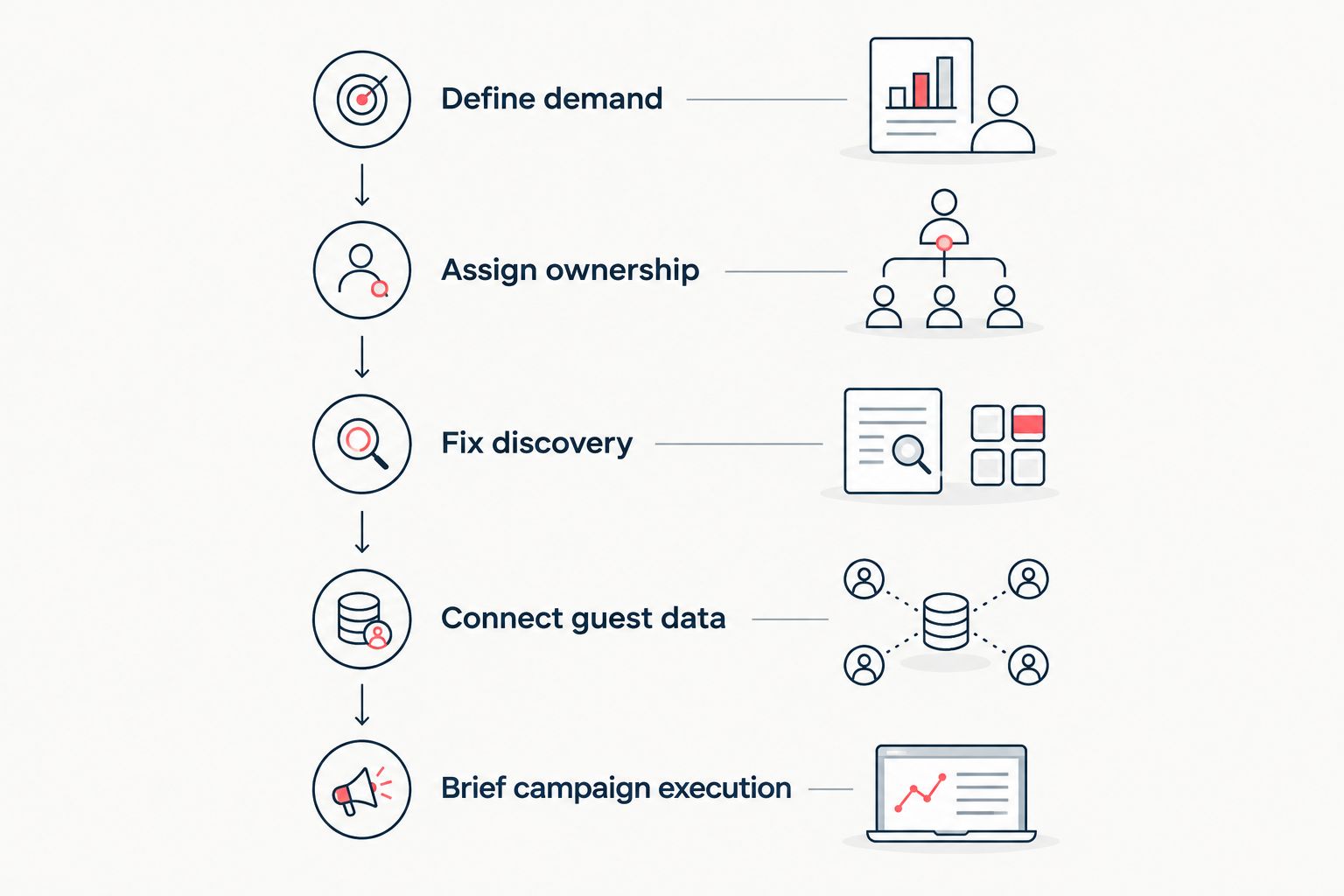 Define the commercial need and ownership before commissioning campaign assets.
Review performance
Create a manual scorecard that separates activity from outcomes. Published content, advertising delivery, inquiries, completed visits, and repeat visits belong in different fields. Combine them only when the relationship is demonstrable.
Set a 30-day review interval as a management choice, not a promise of results. Compare equivalent service periods and annotate closures, events, menu changes, or other factors that affect interpretation. Your 2026 scorecard should show what changed and what decision follows.
Best for: owners receiving reports that describe work without supporting decisions. A compact scorecard improves focus, but it cannot prove attribution where tracking is incomplete. Ask the marketing leader to identify those limits explicitly.
- Separate leading indicators from completed guest outcomes.
- Compare like service periods wherever records permit.
- Note operational changes beside performance changes.
- Decide what to continue, change, or stop after each review.
Set engagement terms
Draft the role requirements before interviewing candidates. Specify the decisions the fractional CMO owns, the people they direct, the implementation resources they need, and the documentation you expect to retain.
Require evidence of relevant responsibility rather than accepting industry familiarity alone. Ask candidates to explain how they would handle conflicting priorities between an owner, restaurant manager, and outside agency. That discussion tests leadership more directly than a list of channels.
Best for: owners ready to delegate marketing decisions without losing financial oversight. A written scope makes accountability explicit, but the owner must still supply access, timely approvals, and operational input.
- Define decision rights and escalation procedures.
- Separate leadership responsibilities from production deliverables.
- Agree on meetings, documentation, and reporting ownership.
- Specify account access and handover requirements.
Compare restaurant marketing operating models
Choose the operating model according to the work you need owned. Do not treat fractional CMO, agency, and in-house director as interchangeable job titles. Each solves a different organizational problem.
The distinction between advice and authority applies across markets: when assessing marketing strategy consultants in Australia, the same question matters as it does in Raleigh—does the engagement end with recommendations, or include responsibility for implementation decisions? Define that boundary in the scope rather than inferring it from the title.
| Option | Best for | Main advantage | Key limitation |
|---|---|---|---|
| Owner-led marketing | A focused restaurant plan the owner can actively manage | Direct connection between commercial priorities and decisions | Marketing competes with the owner's operating responsibilities |
| Fractional CMO | A restaurant needing senior direction across people and vendors | Executive ownership without structuring the role as a full-time hire | Execution resources and decision authority must be agreed separately |
| Marketing agency | A restaurant with a clear brief and defined production needs | Dedicated capacity for contracted campaign or channel work | Business-wide leadership is not inherent in an execution contract |
| In-house marketing director | A restaurant group needing sustained internal coordination | Daily organizational context and ongoing team management | Requires a role broad enough to justify a full-time position |
Choose leadership for unresolved decisions; choose execution for an agreed plan. Combining a fractional CMO with an agency is a valid structure when responsibilities do not overlap. It is unnecessary complexity when the owner already provides effective direction and only needs specific work completed.
For a 2026 hiring decision, ask every candidate to describe their operating boundary. The answer should identify decisions, deliverables, collaborators, and exclusions—not simply promise growth.
Common mistakes restaurant owners make
Hiring a strategist to fill a production gap
If your brief is clear and your bottleneck is photography, copy, or publishing, appointing another decision-maker does not complete those tasks. Best correction: hire against the missing function. Use fractional leadership when priorities or accountability are unresolved.
Promoting demand without checking service capacity
A campaign aimed at an already-constrained service period ignores the operating problem. Best correction: approve marketing and capacity together. Give the marketing lead current constraints and require operational review before campaigns launch.
Treating every reservation as incremental business
Reservation totals alone do not establish that marketing created additional visits. Cancellations, no-shows, existing guests, and channel overlap complicate interpretation. Best correction: distinguish booked demand from completed business and label attribution limits.
Delegating tasks but retaining every decision
A fractional CMO cannot own outcomes while waiting for owner approval on routine decisions. Best correction: document authority before the engagement starts. Keep financial oversight, but define which choices the marketing leader can make independently.
Comparing proposals by deliverable volume
More posts or meetings do not establish stronger leadership. Best correction: compare authority, implementation responsibility, and reporting quality. Require candidates to explain how their work changes a commercial decision, not merely fills a calendar.
FAQ
What does a fractional CMO do for a restaurant?
A fractional CMO directs restaurant marketing strategy, priorities, spending decisions, and accountability on a part-time basis. The agreement should define authority over vendors and staff, along with any implementation work included.
Is a fractional CMO better than a restaurant marketing agency?
A fractional CMO fits a leadership gap; an agency fits defined execution needs. A restaurant can use both when the CMO owns direction and the agency delivers clearly assigned work.
Can a fractional CMO help increase restaurant reservations?
A fractional CMO can direct work intended to increase qualified reservation demand, but cannot guarantee additional bookings. Evaluate completed visits and operational capacity alongside reservation activity.
Does a fractional CMO manage restaurant social media?
Social media management belongs in the engagement only when the scope explicitly includes it. Strategy, approvals, content production, publishing, and community responses are separate responsibilities that need named owners.
How soon should a restaurant expect marketing results?
Set a measurement schedule around the campaign, baseline, and guest decision process rather than accepting a universal deadline. Early reviews should verify implementation and tracking before drawing conclusions about commercial impact.
What should I prepare before hiring a fractional CMO?
Prepare your business objectives, available performance records, current marketing responsibilities, and operational constraints. Include account access requirements and a clear statement of the decisions you want to delegate.
Who is Carey Kidd Group suited to for fractional CMO services?
Carey Kidd Group serves Raleigh-area businesses seeking fractional CMO and strategic marketing consulting, including hospitality businesses. Restaurant owners should confirm restaurant-specific scope, execution responsibilities, and decision authority during the selection process.
One last thing
Ask a prospective marketing leader which activity they would stop first—and what evidence they would need before deciding. The answer reveals whether they can prioritize under constraints or simply propose additional work.
Make the first deliverable a decision document, not a content calendar. Require it to name the business problem, the responsible people, the implementation resources, and the evidence that will determine the next move.