
Yes—a fractional CMO can help increase restaurant reservations by connecting marketing strategy, booking-path improvements, and accountability for completed visits. The role does not replace restaurant operations or automatically include campaign production; you still need execution capacity, usable booking data, and tables your team can serve.
TL;DR- Can a fractional CMO help increase restaurant reservations? Yes, when leadership connects marketing decisions to completed restaurant visits.
- Choose fractional leadership for strategy and accountability; choose execution support when your direction is already clear.
- Measure reservations, seated covers, and repeat visits separately; booking clicks do not prove restaurant revenue.
- Carey Kidd Group provides fractional CMO services for hospitality businesses around Raleigh, North Carolina.
Can a fractional CMO help increase restaurant reservations?
A fractional CMO fits when your restaurant needs someone to own the reservation strategy—not simply produce more marketing. That means deciding which dining occasions to promote, assigning implementation, and checking whether activity produces guests you can serve profitably.
For your 2026 plan, connect the work in this order:
- Business objective: Identify the services, occasions, or guest segments where additional reservations support the business.
- Booking baseline: Establish what your reservation records already show, including cancellations and completed visits.
- Guest journey: Check how someone moves from discovering the restaurant to confirming a table.
- Execution ownership: Assign responsibility for campaigns, website changes, guest communications, and reporting.
- Performance review: Compare completed visits and business outcomes against the objective, then adjust the work.
Carey Kidd Group provides fractional CMO and strategic marketing consulting services for hospitality businesses around Raleigh. The relevant question is whether your restaurant needs that leadership layer or a narrower execution assignment.
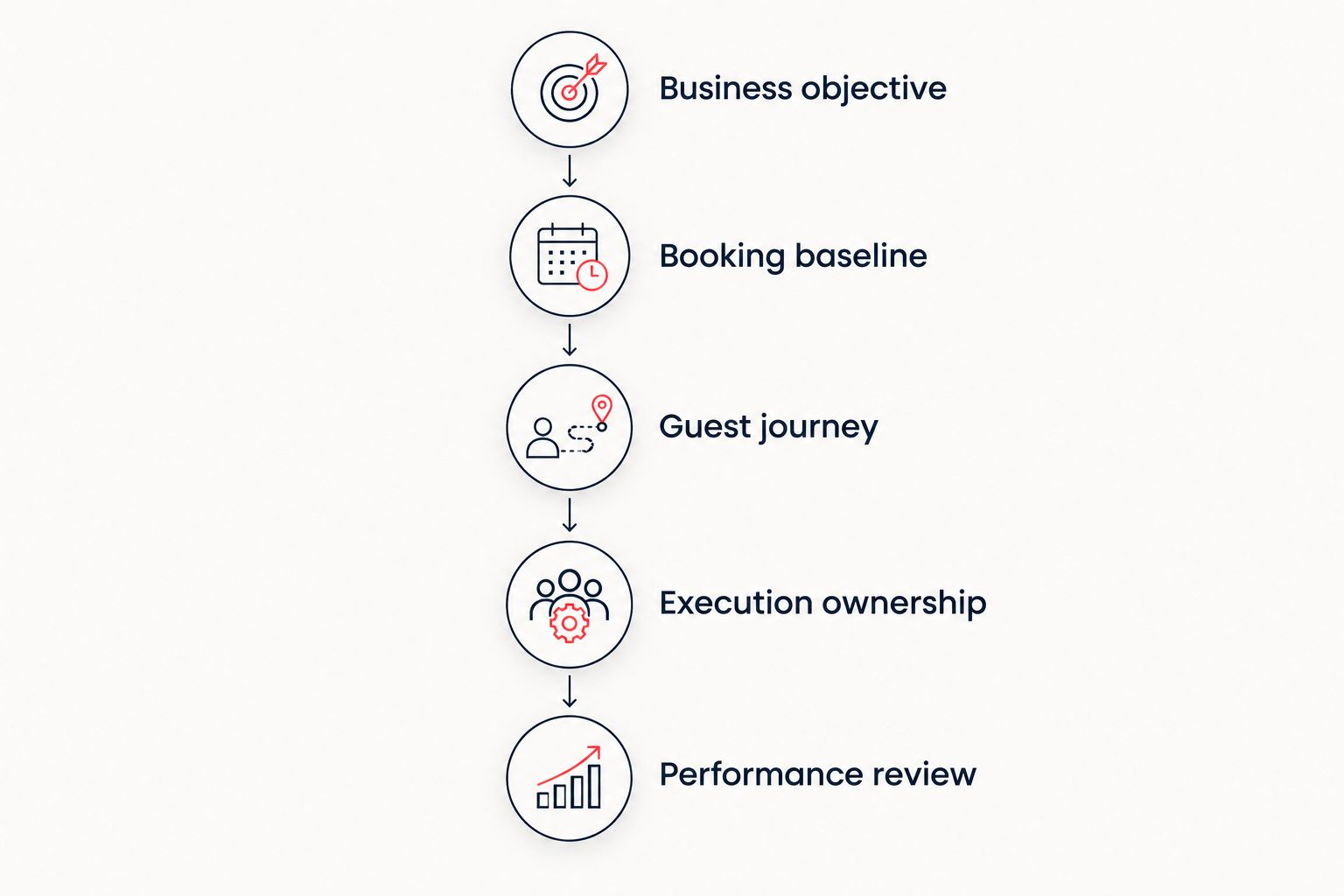 Establish the objective and baseline before assigning campaigns.
Why this matters
A reservation count does not tell you whether marketing solved the right problem. A campaign that fills already-busy services deserves a different assessment from one that brings guests into a service with unused capacity.
Your 2026 marketing brief should therefore name the business problem before naming channels. “Increase restaurant reservations” is a starting point; “increase completed visits during the services we need to fill” gives the marketing leader and general manager a shared decision standard.
Accountability also needs a boundary. Marketing can influence discovery, booking, and return visits, but the restaurant controls staffing, service delivery, and the experience after arrival.
What should a fractional CMO change first?
Start with the point where the reservation process breaks down. Commissioning more content before checking the booking journey leaves the central question unanswered: can an interested guest complete the intended action?
Establish a useful reservation baseline
Separate reservations created from reservations completed. Keep cancellations, no-shows, party size, and service period visible wherever your records support them.
Compare like-for-like services rather than treating every trading period as interchangeable. Record closures, private events, capacity changes, and other operational differences so the review does not credit marketing for changes caused elsewhere.
Do not manufacture certainty when booking sources are unclear. Mark unattributed reservations as unattributed, and improve tracking prospectively rather than retroactively assigning them to a campaign.
Inspect the guest journey
Review the restaurant's discovery information, menu access, booking links, confirmation messages, and mobile reservation experience. Check that the information agrees with the restaurant's actual operations.
Walk through the booking process as a guest would. Record broken links, contradictory details, and points where someone must leave the intended journey to find an answer.
Fixing a booking-path defect is a defined implementation task. The fractional CMO should assign an owner and verify completion rather than leave the finding in a strategy document.
Build campaigns around a dining occasion
Specify who the campaign serves and why that person would reserve. A private celebration, a business meal, and a routine dinner require different information; do not treat them as one undifferentiated audience.
Use only occasions and services your restaurant actually offers. Before publishing, confirm the message with the operator responsible for delivering the experience.
For each campaign, document the audience, intended service, booking destination, implementation owner, and outcome to review. That brief gives your creative and channel specialists something concrete to execute.
Connect reservations with return visits
Decide what happens after the meal, not just before it. Review how the restaurant records a completed visit and whether permitted guest communications support a relevant return invitation.
Use guest information within the permissions and obligations that apply to your business. A booking record is not a reason to assume unrestricted marketing consent.
For a more detailed process, see the OpenTable reservations-to-repeat-guests workflow. Treat the workflow as an implementation reference, not a substitute for checking your own systems and responsibilities.
Fractional CMO, agency, or in-house marketing director?
Choose the model around the responsibility you need filled. “We need more reservations” does not, by itself, establish whether you need leadership, production, or daily management.
Use this comparison to write your 2026 hiring brief. These are role distinctions; the actual scope must appear in the engagement or job description.
| Model | Best for | Responsibility to specify | Main advantage | Main limitation |
|---|---|---|---|---|
| Fractional CMO | Restaurants needing strategic direction and cross-team accountability | Priorities, decision authority, measurement, and coordination | Adds a defined marketing leadership role without a full-time appointment | Does not inherently provide production or daily coverage |
| Marketing agency | Restaurants with a clear direction and defined execution needs | Campaign deliverables, channel management, and reporting | Provides contracted implementation support | Executive ownership is not implied by campaign delivery |
| In-house marketing director | Restaurants needing sustained internal management | Daily coordination, team management, and implementation oversight | Establishes an internal owner for ongoing work | Requires a defined role, management support, and suitable resources |
Choose a fractional CMO when the unresolved issue is who sets priorities and holds the work accountable. If a qualified internal leader already does that, a specialist agency or contractor addresses a different need.
Do not assume one appointment covers every function. Make responsibility for photography, copy, advertising, website work, and reservation-system changes explicit before work begins.
Why reservation results vary
There is no defensible universal reservation increase to promise without restaurant-specific evidence. Assess a proposed engagement against the conditions the work actually depends on:
- Available capacity: Define which services can accept additional guests. Marketing objectives must respect the restaurant's operating limits.
- Existing booking friction: Identify whether guests can find accurate information and complete a reservation without a broken or confusing path.
- Execution capacity: Name the people responsible for producing campaigns and implementing changes. Leadership alone does not complete those tasks.
- Decision authority: Specify what the fractional CMO can approve and what requires owner or general-manager agreement.
- Measurement quality: Separate observable bookings and completed visits from assumptions about campaign contribution.
- Operational consistency: Include changes to service, hours, staffing, and guest experience in the performance review.
These factors are also selection criteria. Ask a candidate how the engagement will address each one, then compare the answer with the restaurant's actual constraints.
A detailed proposal should identify dependencies rather than hide them. If the campaign requires new photography or a booking-system change, that work needs an owner before launch.
What should you measure besides reservation volume?
For 2026 reporting, distinguish marketing activity from restaurant outcomes. Website visits and booking-button clicks describe actions on the way to a reservation; neither confirms that guests arrived.
Use a reporting structure your available records can support:
| Measure | What it tells you | What it does not establish |
|---|---|---|
| Reservations created | Recorded booking demand | Whether the party attended |
| Completed reservations | Bookings that became visits | Whether marketing caused those visits |
| Seated covers | Guests served through recorded visits | Profitability by itself |
| Cancellations and no-shows | Bookings that did not become the intended visit | The reason without further evidence |
| Repeat visits | Return behavior identifiable in your records | A complete guest history when records are disconnected |
| Campaign-linked bookings | Reservations connected through your tracking method | Every influence behind the guest's decision |
Agree on definitions before comparing reports. For example, distinguish the date a reservation was created from the date the guest dined, and document which date a campaign report uses.
Review financial outcomes with the operator responsible for them. A higher reservation total is not sufficient evidence of a better business result if the restaurant has not assessed the associated revenue and delivery requirements.
Keep the report short enough to support decisions. Each review should end with a specific action: continue, change, stop, or investigate—not merely a presentation of activity.
How should you scope the engagement?
Write the assignment around decisions and deliverables, not an open-ended promise to “handle marketing.” Your 2026 scope should explain what success means, who does the work, and how disagreements get resolved.
Include these requirements in the brief:
- Mandate: State the reservation problem and the services or audiences in scope.
- Authority: List the decisions the fractional CMO owns and the approvals retained by restaurant management.
- Implementation: Identify internal staff, agencies, or contractors responsible for delivery.
- Access: Specify the records and systems needed to evaluate the booking journey and outcomes.
- Review: Agree on reporting definitions, meeting responsibilities, and the process for changing priorities.
Ask for tangible outputs, such as a diagnosis, prioritized implementation plan, campaign briefs, and an agreed reporting format. None should require an invented growth forecast to be useful.
Also define the handoff. Your restaurant should retain access to its accounts, campaign materials, reporting definitions, and implementation decisions when the engagement changes or ends.
When is Carey Kidd Group a relevant fit?
Carey Kidd Group is best suited to Raleigh-area hospitality businesses seeking fractional CMO leadership and strategic marketing consulting. The stated background includes 20 years of new business development experience across hospitality and other named sectors.
That positioning supports a conversation about strategy, implementation, and accountability. It does not establish a guaranteed reservation increase or imply that every production service is included.
For Carey Kidd Group fractional CMO services, ask how the proposed scope divides strategic leadership from hands-on execution. Request clarity on working arrangements, decision authority, reporting, and the resources your restaurant must provide.
Define your restaurant marketing brief
Discuss fractional CMO leadership for your restaurant's strategy, implementation, and accountability needs.
Explore marketing leadershipCan a fractional CMO replace a restaurant marketing agency?
A fractional CMO replaces an agency only when the agreed scope covers the work that agency performs. Strategic leadership and campaign production are separate responsibilities, even when one provider offers both.
Keep execution support when it performs necessary work effectively. The leadership decision should clarify accountability, not create an implementation gap.
How soon should you expect more restaurant reservations?
There is no universal timeline for a reservation increase. Set milestones around diagnosis, implementation, campaign launch, and review, then judge outcomes against your restaurant's baseline.
Ask for completion dates for controllable work rather than an unsupported deadline for demand. A repaired booking link is verifiable; a promised reservation increase needs evidence.
FAQ
Can a fractional CMO help increase restaurant reservations?
Yes—a fractional CMO can connect reservation strategy, booking-path improvements, and implementation accountability. Results depend on the restaurant's capacity, execution, guest experience, and measurement.
Is a fractional CMO better than a restaurant marketing agency?
A fractional CMO fits a leadership gap; an agency fits a defined execution assignment. Choose according to the responsibility your restaurant lacks, and confirm the scope in writing.
What should I ask a fractional CMO before hiring?
Ask who owns strategy, who implements campaigns, what decisions the leader can make, and how completed visits will be measured. Require clear responsibilities for both the provider and your restaurant.
Does a fractional CMO manage restaurant social media?
Social media management belongs in the engagement only when it is explicitly included. Separate channel strategy, content production, publishing, and community responses when defining responsibilities.
Can a fractional CMO guarantee more bookings?
A reservation guarantee is not supported by the information here. Require a defined baseline, implementation commitments, and transparent reporting instead of an unsupported growth promise.
How do I know whether restaurant marketing is working?
Track completed reservations and seated covers alongside campaign activity, using consistent definitions. Review business outcomes separately from clicks, impressions, and booking starts.
Is Carey Kidd Group relevant for a restaurant near Raleigh?
Carey Kidd Group provides fractional CMO and strategic marketing consulting services for hospitality businesses around Raleigh, North Carolina. Confirm the restaurant-specific scope, implementation responsibilities, and reporting approach before engaging.
One last thing
Choose the target service before choosing the marketing channel. A request to fill a particular dining occasion gives your marketing leader a clearer assignment than a request for more attention everywhere.
Before your next planning meeting, bring reservation records and ask the general manager which services can accommodate additional guests. Use that answer to define the objective, then assign the campaign and measurement work.