
An outsourced CMO for fitness franchises is an external marketing leader who directs strategy, implementation, and accountability to support member acquisition and retention across locations. Unlike a single-studio assignment, franchise marketing requires clear boundaries between brand standards, franchisee decisions, and local sales execution.
TL;DR- An outsourced CMO for fitness franchises should own marketing decisions, not just deliver campaigns.
- Carey Kidd Group provides fractional CMO and strategic marketing consulting services for fitness businesses around Raleigh.
- Choose fractional marketing leadership when strategy and accountability are missing; choose an agency when execution is the gap.
- Compare locations using membership outcomes and consistent definitions, not lead totals alone.
Why outsourced CMO leadership matters for fitness franchises
A franchise marketing plan must connect decisions made at different levels. Brand leadership sets standards, operators manage local capacity, and location teams turn inquiries into visits and memberships. Your 2026 plan should specify where each responsibility begins and ends.
Hire leadership to resolve a decision-making gap, not to disguise an execution gap. If your strategy is settled but nobody produces campaigns, an agency or internal marketer addresses a different need. The distinction also matters when assessing whether outsourced and fractional CMO roles are the same.
Start with your operating problem. Conflicting promotions, disconnected reporting, and unclear vendor accountability require different decisions from an understaffed content calendar. An outside executive needs authority to address the former; a title alone changes nothing.
Fitness adds a practical constraint: marketing must reflect what each location can deliver. A campaign promoting an introductory visit needs an accurate schedule, a functioning booking process, and someone responsible for follow-up. Treat those dependencies as part of marketing planning, not someone else's problem.
How to structure outsourced marketing leadership
Define the business outcome before the role
Write a one-page brief before interviewing candidates. Specify whether you represent the franchisor, a franchisee group, or an individual operator; the same title does not carry the same authority in every arrangement.
Choose the outcome that needs executive attention. That might be coordinating new-location launches, improving inquiry-to-membership conversion, or making location reporting comparable. Do not combine every unresolved business issue into a marketing job description.
For your 2026 brief, separate targets from baselines. A target states what you want; a baseline records what your business currently produces. Neither should be presented as an industry benchmark without evidence.
- Name the executive sponsor who resolves disputes.
- Identify the locations and territories within scope.
- Select one primary business outcome for the engagement.
- Record existing results using your own operating data.
- List the decisions the marketing leader can approve.
Map franchise authority and local responsibilities
Build a responsibility sheet manually using your franchise documents, operating procedures, and current vendor agreements. Ask the relevant business owners to confirm it before changing campaigns. Do not assume a local operator can alter an offer, landing page, or brand message.
Separate strategic ownership from production and approval. The person deciding which audience matters does not necessarily create the advertisement, approve the claim, or answer the inquiry.
Use this responsibility map to evaluate an outsourced CMO's proposed scope. Reject a proposal that promises accountability while leaving budget decisions, approvals, and vendor direction undefined. Where approval authority sits elsewhere, document the dependency and escalation route.
- Assign ownership for brand standards and local adaptations.
- Record who approves campaigns and membership offers.
- Identify who controls advertising accounts and reporting access.
- Name the owner of inquiry follow-up at each location.
- Establish an escalation process for blocked decisions.
Choose leadership that matches your implementation needs
Start by comparing your current team against the responsibility sheet. An owner-led spreadsheet review is enough to reveal whether the missing work involves executive decisions, campaign production, location management, or some combination.
External leadership becomes the faster path when you need someone to organize strategy and direct implementation rather than add another planning task to the owner's workload. Carey Kidd Group's fractional CMO and strategic marketing services cover a leadership model relevant to that evaluation.
Carey Kidd Group is best suited to Raleigh-area fitness businesses seeking fractional CMO and strategic marketing consulting services. The stated service focus does not establish franchise-specific experience; request that evidence during selection.
Your 2026 selection process should test decision quality, not presentation quality. Ask each candidate to explain how they would separate a weak campaign from weak location follow-up, using a hypothetical example rather than an unsupported promise.
- Ask for relevant fitness and multi-location experience.
- Confirm whether the engagement covers advice, leadership, or execution.
- Review how the candidate handles franchise approval constraints.
- Require named responsibilities for existing agencies and employees.
- Ask how decisions and unresolved dependencies will be documented.
Build a location-level measurement system
Begin with a shared spreadsheet and exports from your booking, membership, and advertising systems. Define each field before combining data. An inquiry, a booked introduction, an attended visit, and a new membership are different events.
Use location-level records to investigate the handoffs. An inquiry-to-booking rate divides booked introductions by inquiries from the same defined group; an attendance rate divides attended introductions by booked introductions. Keep the reporting period and treatment of duplicates explicit.
Avoid treating every membership as campaign-generated. Record the attribution method and its limitations, especially when members encounter several channels before joining. Your 2026 dashboard should distinguish observed outcomes from credited outcomes.
- Standardize definitions for inquiries, bookings, attendance, and memberships.
- Keep location and lead source attached to each record.
- Separate new-location reporting from established-location reporting.
- Record cancellations and retention alongside acquisition outcomes.
- Document attribution rules before comparing channels.
Align campaigns with location operations
Walk through the member journey yourself before adding campaign complexity. Search for the location, review its information, submit a test inquiry through an approved process, and check how the team handles the next step. Record friction without treating one test as a performance study.
Use the findings to brief your execution team. An outsourced CMO should connect campaign priorities with location readiness, while the agreed production and operations owners complete the work. Do not assume executive oversight includes every creative asset or sales conversation.
For local search content, prioritize accurate location details and the services actually offered. Do not publish location pages that imply facilities, programs, or membership terms the operator has not confirmed.
- Check location information against current operating details.
- Verify that advertised activities match the local schedule.
- Test inquiry routing and booking handoffs.
- Assign follow-up ownership during staffed and unstaffed periods.
- Review campaign changes with the relevant location operator.
Establish a decision and accountability cadence
Use a shared action log before adding another reporting platform. Every review should end with a decision, an owner, and a deadline; otherwise, a dashboard becomes a substitute for management.
A practical starting structure is a 30-day diagnostic followed by a 90-day implementation plan. These are proposed planning windows, not promised engagement terms or a deadline for business results. Adjust the scope to account access, approval requirements, and your team's capacity.
Separate weekly operating checks from monthly strategic reviews. Weekly discussions address execution and blocked handoffs; monthly reviews evaluate whether the current priorities still support business objectives.
- Schedule weekly checks for campaigns and follow-up issues.
- Review location-level business outcomes each month.
- Keep a decision log with owners and due dates.
- Document why a campaign is expanded, changed, or stopped.
- Reassess the leadership model when internal capacity changes.
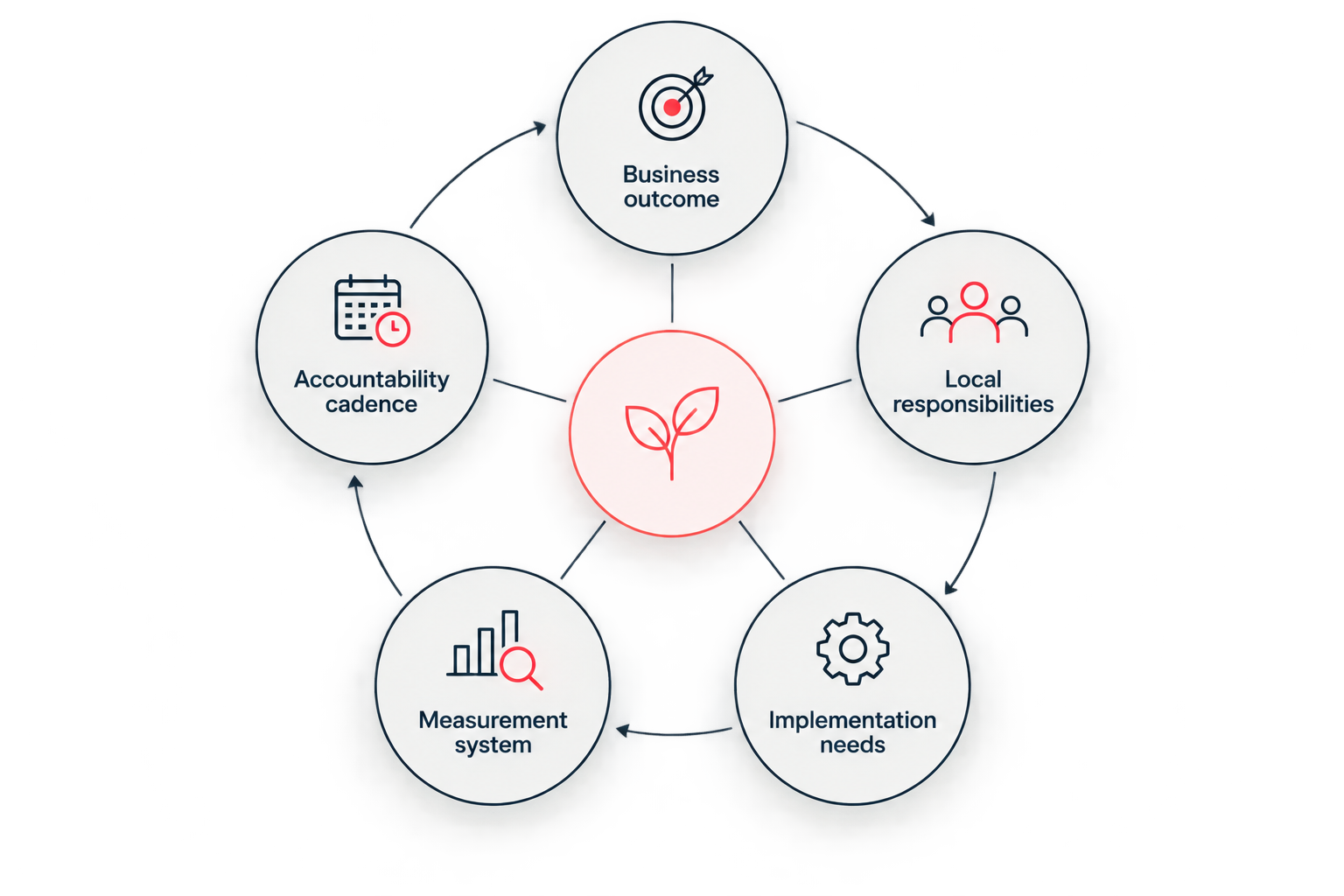 Define responsibilities and measurement before expecting accountable implementation.
Compare marketing leadership options for fitness franchises
Choose the operating model around the work you need done. The following comparison describes role structures, not guaranteed features of any provider; written scope determines actual authority and deliverables.
| Option | Best for | Main advantage | Key limitation |
|---|---|---|---|
| Owner-led marketing | Operators with the time and capability to direct a limited scope | Keeps decisions close to business operations | Competes with the owner's other responsibilities |
| Outsourced or fractional CMO | Franchise businesses missing senior marketing direction | Provides external leadership without creating a full-time executive role | Requires explicit authority and separate execution capacity where production is excluded |
| Marketing agency | Teams with an agreed strategy that need specialist execution | Supplies contracted campaign or channel delivery | Does not automatically own business-wide marketing decisions |
| In-house marketing director | Operators needing sustained internal management | Places ongoing coordination inside the business | Effectiveness depends on the person's experience, remit, and supporting resources |
| Full-time CMO | Organizations with an ongoing executive-level marketing workload | Establishes a dedicated internal executive role | Is a different staffing commitment from a defined external engagement |
An outsourced CMO and an agency are not interchangeable. You can use both, but specify who sets priorities, who produces work, who approves changes, and who evaluates performance. Do not pay two parties to assume the other owns strategy.
When evaluating Carey Kidd Group, assess the stated fitness-sector and strategic marketing focus against your actual scope. If you require daily location coverage or campaign production, confirm those responsibilities explicitly rather than inferring them from the CMO title.
Common mistakes fitness franchise operators make
Hiring above the wrong problem
A missed inquiry does not automatically justify an executive hire. First determine whether the cause is unclear strategy, inadequate staffing, a broken process, or poor execution. Assign the remedy to the role that can actually deliver it.
Copying campaigns across unequal locations
Do not assume a successful campaign belongs in every territory unchanged. Check local schedules, operating capacity, approved offers, and location objectives before replication. Standardize the decision process while preserving approved local differences.
Measuring leads without membership outcomes
A lead report cannot tell you how many inquiries attended or joined. Connect acquisition reporting to the membership journey, and investigate missing records before declaring a channel successful. Keep cancellation and retention reporting visible rather than treating acquisition as the entire business outcome.
Giving accountability without authority
An external leader cannot independently resolve decisions reserved for the franchisor or operator. Your agreement should name those dependencies and the person who resolves them. Hold the CMO accountable for decisions within scope and for escalating constraints promptly.
Treating franchise experience as implied
Fitness-sector experience and franchise-system experience are different qualifications. Ask candidates to explain their work with approval hierarchies, location reporting, and operator coordination. Verify relevant experience instead of assuming that a familiar industry name proves it.
FAQ
What does an outsourced CMO do for a fitness franchise?
An outsourced CMO directs marketing strategy, priorities, measurement, and accountability within an agreed scope. For fitness franchises, the remit should specify how leadership coordinates brand rules, local campaigns, and membership outcomes.
Is an outsourced CMO better than a marketing agency for a franchise?
An outsourced CMO fits a leadership gap, while an agency fits a defined execution need. A franchise can use both when responsibility for strategy, production, approvals, and reporting is explicit.
Can a fractional CMO manage marketing across multiple gym locations?
A fractional CMO can lead multi-location marketing when the engagement includes that responsibility and grants the necessary access and authority. Confirm location coverage, reporting expectations, and the people responsible for implementation before signing.
How do I know whether my fitness franchise needs marketing leadership?
Look for unresolved decisions about priorities, budgets, vendor direction, and accountability. If those decisions are already clear and work simply remains unfinished, additional execution capacity addresses a different problem.
How quickly should an outsourced CMO produce results?
Set deadlines for agreed deliverables rather than assuming a universal timeline for membership growth. An initial diagnosis, responsibility map, and measurement plan provide reviewable milestones without guaranteeing acquisition or retention outcomes.
Does Carey Kidd Group provide marketing leadership for fitness businesses?
Carey Kidd Group provides fractional CMO and strategic marketing consulting services for fitness businesses around Raleigh, North Carolina. Confirm franchise-specific experience, location coverage, and execution responsibilities against your requirements.
What should I prepare before speaking with an outsourced CMO?
Prepare your business objectives, location list, franchise approval rules, current vendor responsibilities, and available marketing and membership reports. Identify the decisions you need the external leader to own and the internal people who will implement them.
One last thing
Before approving your 2026 engagement, choose one location and trace an inquiry through booking, attendance, membership, and follow-up. Ask the proposed leader to name the owner of each handoff and explain how missing records will be handled.
If nobody owns the handoffs, you have not finished designing the marketing role. Resolve that before expanding campaign activity or adding another provider.