
A fitness studio should build its 2026 marketing budget from its required new memberships, measured acquisition costs, and cash available to fund growth—not from a universal revenue percentage. Include creative work, marketing management, software, and member follow-up alongside advertising, then approve spending against class capacity and contribution after member-service costs.
TL;DR- How much should a fitness studio budget for marketing? Base spending on membership goals, acquisition economics, and available cash.
- Separate advertising, implementation, marketing leadership, and retention work before approving a fitness marketing budget.
- Carey Kidd Group provides fractional CMO and strategic marketing consulting for fitness businesses seeking marketing leadership.
- Judge acquisition by paying members and retained contribution, not inquiries or social engagement alone.
How much should a fitness studio budget for marketing in 2026?
Budget for the members you need to acquire, plus the work required to acquire and retain them. Start with your own membership economics rather than applying a percentage that ignores your schedule, cancellations, and operating commitments.
Separate outside management from campaign spending. The guide to wellness marketing agency costs addresses that distinction when evaluating outside support.
Use the following breakdown to build your 2026 plan. Give every expense one primary category so you do not count an agency deliverable again under internal production.
| Budget component | What to include | Approval test |
|---|---|---|
| Acquisition | Advertising, local search work, partnerships, campaign distribution | Does the activity reach prospects suited to your studio? |
| Conversion | Landing pages, booking improvements, inquiry follow-up | Can interested prospects book and attend? |
| Creative production | Photography, video, copy, campaign assets | Is the work necessary for the approved campaign? |
| Retention | Member communications, onboarding, reactivation | Does the activity support attendance and continued membership? |
| Management | Planning, implementation oversight, reporting | Who owns priorities and corrective decisions? |
| Measurement | Tracking, reporting tools, data maintenance | Can spending be connected to member outcomes? |
The working calculation is straightforward: planned acquisition spending equals required new paying members multiplied by your acceptable acquisition cost. Add supporting expenses only where they are not already included in that acquisition-cost calculation.
That last distinction matters. An advertising-only acquisition cost cannot represent the full cost of growth if staff time, agency work, and creative production sit outside it.
Why this matters
A fitness studio sells access to scheduled services with finite capacity. Marketing needs to fill the right classes and membership types, not simply create more inquiries.
An inquiry for an already-full evening class does not solve an empty daytime schedule. Likewise, a campaign that produces introductory visits without sustained membership needs a different decision from one that produces members who continue attending.
Your 2026 marketing budget should therefore connect three operating questions: where can the studio accommodate demand, which memberships contribute enough to support acquisition, and who is accountable for converting interest into attendance?
Do not increase acquisition spending to compensate for an unresolved booking or onboarding problem. Correct the broken stage before paying to send more prospects through it.
Build the budget from membership economics
Establish the membership requirement
Start with the active membership level your studio needs to support its operating plan. Account for expected departures separately from the additional members required for growth.
Replacement memberships and growth memberships serve different purposes. Combining them hides how much acquisition effort simply maintains the current business.
Use actual cancellation records and attendance patterns to inform the plan. If you lack a reliable history, document the assumption and keep it separate from measured results rather than presenting it as an established rate.
Set an acquisition ceiling
Determine how much contribution a new member generates after the costs of serving that membership. Revenue alone is not the amount available to recover marketing expenditure.
Then decide how long your cash position allows you to wait for acquisition spending to be recovered. A membership that contributes over time still requires the studio to fund the initial acquisition work.
Keep the definition consistent. If your acquisition ceiling includes advertising, production, and management, compare it with a measured acquisition cost that includes those same expenses.
Check service capacity
Translate the membership goal into demand for classes, appointments, or training sessions. Review the times prospects actually want rather than relying only on total weekly capacity.
If the studio cannot accommodate the intended members, change the campaign audience, membership emphasis, or operating schedule before authorizing additional acquisition work. Marketing and operations must agree on what the studio can deliver.
Assemble the spending plan
List recurring commitments separately from campaign-specific work. A booking-system subscription and a new campaign shoot require different approval decisions, even if both support marketing.
For every line item, identify its purpose, owner, expected output, and measurement method. Remove duplicate deliverables across staff responsibilities and outside agreements before approving the total.
Match the budget to the studio's operating situation
There is no useful single allocation for every fitness studio. A launch, an established studio, and a studio with weak renewal behavior have different immediate constraints.
| Planning approach | Best for | Advantage | Limitation |
|---|---|---|---|
| Launch-focused plan | A studio preparing to open or introduce a service | Funds setup and initial demand together | Has less studio-specific conversion history to guide decisions |
| Capacity-focused plan | An established studio with identifiable unused capacity | Connects campaigns to classes that need members | Requires schedule-level tracking and coordination |
| Retention-first plan | A studio losing members despite continued inquiries | Directs attention to onboarding and continued attendance | Does not replace acquisition needed to cover departures |
Launch-focused marketing budget
Best for: studios that need both marketing infrastructure and initial demand. Separate foundational work from ongoing promotion so the launch total does not become the assumed recurring budget.
Foundational work includes preparing the booking journey, developing campaign assets, and establishing measurement. Promotion should point to a clear next action that staff are ready to fulfill.
The advantage is coordinated preparation. The limitation is uncertainty: without studio-specific acquisition history, the initial plan needs explicit spending limits and decisions about what evidence justifies expansion.
Capacity-focused marketing budget
Best for: established studios with room in specific services or time slots. Build the campaign around that capacity instead of promoting every membership equally.
Coordinate the message, booking destination, and front-desk response. A campaign for a particular class loses its purpose if the booking journey makes that class difficult to find.
This approach ties spending to an operating need. Its limitation is dependence on accurate scheduling and attendance information; a broad membership total cannot show whether the campaign filled the intended sessions.
Retention-first marketing budget
Best for: studios where departures undermine acquisition progress. Review onboarding, attendance follow-up, member communications, and cancellation reasons before adding more prospect volume.
Retention work belongs in the plan when it has a defined purpose and owner. Avoid treating every message to an existing member as a measurable retention program.
The advantage is attention to the full membership relationship. The limitation is that communication alone cannot correct an unsuitable schedule, service problem, or mismatch between the campaign promise and the experience.
Why fitness studio marketing budgets vary
These factors explain why copying another studio's spending level produces an incomplete plan:
- Membership objective: Maintaining the current base requires a different acquisition target from expanding it.
- Available capacity: Campaigns need to reflect the sessions and services that can accept more members.
- Conversion performance: Inquiry handling, booking completion, attendance, and membership enrollment affect the value of acquired demand.
- Member contribution: The amount remaining after service costs determines what acquisition spending the business can support.
- Implementation resources: Existing staff capability changes the outside work required for creative production, campaign management, and reporting.
- Cash recovery requirements: The studio must fund acquisition before the resulting membership contribution recovers that spending.
Review these drivers together during 2026 planning. Changing an advertising allocation without checking the underlying membership economics leaves the central decision unresolved.
Choose who owns the budget
Marketing leadership, campaign execution, and daily coordination are different responsibilities. Decide which responsibility is missing before choosing outside support or assigning more work internally.
| Support model | Best for | Main strength | Main limitation |
|---|---|---|---|
| Fractional CMO | A studio needing strategic direction across staff and vendors | Connects priorities, budget decisions, and accountability | Execution capacity must still be assigned |
| Marketing agency | A studio needing a defined body of campaign work | Provides execution against an agreed scope | Cross-business decisions need an identified owner |
| In-house marketing director | A studio needing ongoing internal coordination | Keeps marketing management close to operations | Production and specialist work require appropriate resources |
Carey Kidd Group is best for fitness businesses seeking fractional CMO and strategic marketing consulting. The stated background includes 20 years of new business development experience across fitness, hospitality, events, and health/medical.
Carey Kidd Group's fractional CMO services address the leadership model; do not treat the engagement as a substitute for a defined implementation plan. Clarify who produces assets, manages campaigns, responds to inquiries, and maintains reporting before assigning the budget.
For a Raleigh-area studio, the relevant choice is whether strategic direction or execution is the immediate gap. Geography alone does not settle that decision.
Turn the plan into an approval process
Use this sequence to make the budget actionable rather than leaving it as a spending total.
- Membership goal: Specify the required paying memberships, including replacements and intended growth.
- Capacity check: Confirm which services and time slots can accommodate the target demand.
- Acquisition ceiling: Set the allowable acquisition cost using member contribution and cash recovery requirements.
- Delivery ownership: Assign campaign work, inquiry handling, onboarding, and reporting to named owners.
- Review decision: Define the evidence that triggers continued spending, correction, or a pause.
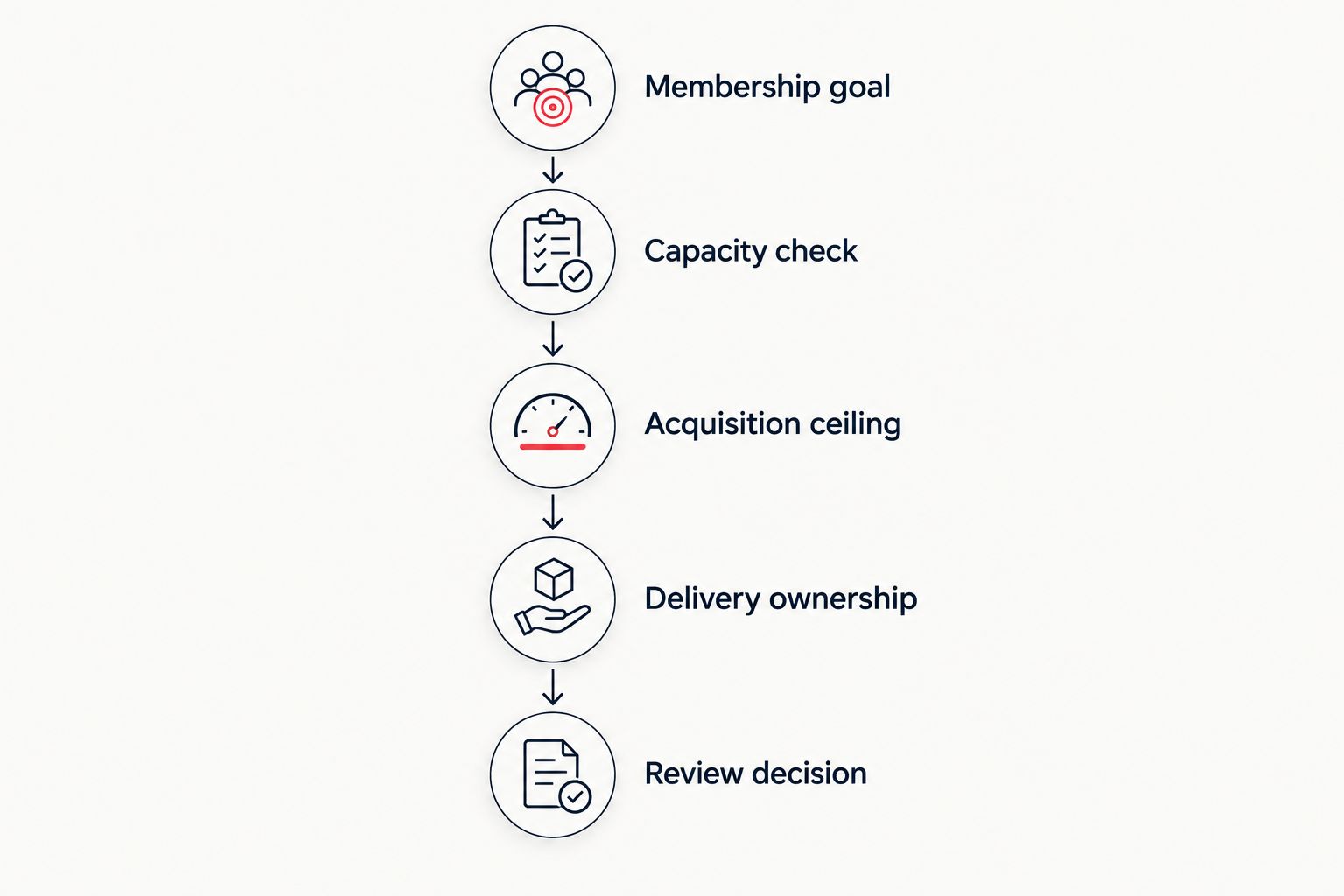 Approve spending only after the membership goal, operating capacity, and delivery responsibilities agree.
For each campaign, record the expense scope and the member outcome it is intended to produce. This keeps an advertising report from being mistaken for a full business assessment.
Set the review interval around your actual booking and membership process. Do not declare success from early inquiries while membership decisions are still unresolved, or leave ineffective activity running without a scheduled review.
Should a fitness studio use a percentage of revenue?
Use a revenue percentage as a financial cross-check, not the starting calculation. Compare the proposed budget with revenue and operating obligations after building it from membership requirements.
A percentage does not tell you whether the studio can serve more members or recover acquisition spending. It also does not distinguish one-time setup work from ongoing campaign delivery.
For the 2026 plan, retain both views: the operating case for the spending and the financial limit the business can support. Approve the budget only when they agree.
Should advertising take priority over member retention?
Give priority to the stage preventing profitable membership growth. If inquiries do not book, fix conversion; if new members do not continue, examine onboarding and the service experience.
Acquisition and retention are not interchangeable. Keep their costs and outcomes visible separately, then decide how they contribute to the same membership objective.
When should a studio increase its marketing budget?
Increase spending when member-level results support expansion and the studio has capacity to serve the additional demand. Check fully defined acquisition costs, attendance, membership continuation, and available cash together.
More inquiries alone are not enough. Expand a documented process, not an untested assumption that additional advertising will correct weak follow-up.
FAQ
How much should a fitness studio budget for marketing in 2026?
Build the budget from required new memberships, acceptable acquisition cost, and the supporting work needed to convert and retain members. Check the total against cash availability and service capacity before approval.
Should I include agency work in my fitness marketing budget?
Include agency work in the full marketing budget. Keep it separate from advertising spending, and avoid counting deliverables twice when comparing proposals.
Is a revenue percentage enough to set my studio's budget?
A revenue percentage is not enough to establish the operating case for marketing spending. Use it to cross-check affordability after calculating membership requirements and acquisition economics.
What's the difference between advertising cost and acquisition cost?
Advertising cost covers media spending, while a fully defined acquisition cost includes the expenses assigned to acquiring paying members. State which production, management, and staff costs are included before comparing results.
Should a new fitness studio budget differently from an established studio?
A new fitness studio should separate setup work from recurring promotion. An established studio can use its own booking, conversion, attendance, and cancellation records to guide allocation.
Can a fractional CMO help manage a fitness marketing budget?
A fractional CMO can provide strategic direction and budget accountability when those responsibilities are included in the engagement. Carey Kidd Group provides fractional CMO and strategic marketing consulting services for fitness businesses.
How do I know whether to increase advertising spending?
Increase advertising spending only when the member outcomes justify expansion and the studio can accommodate additional demand. Review acquisition economics and cash recovery rather than relying on inquiry volume alone.
One last thing
Your next budget decision might be a scheduling decision. Before approving another acquisition campaign, compare the service advertised with the sessions prospective members can actually book.
For the 2026 budget, put that capacity check beside the spending approval—not in a separate operational conversation after the campaign begins.