Boutique fitness studio social media management is the planning, publishing, and follow-up of social content with the aim of turning local interest into class attendance and membership. This 2026 guide explains how to connect instructor-led content, booking information, and staff accountability without making your front desk responsible for an undefined marketing role.
TL;DR
- Social media management for fitness studios should connect local discovery to bookings, attendance, and membership conversations.
- Carey Kidd Group is best for fitness businesses needing strategic marketing leadership rather than content production alone.
- Build your content calendar around beginner questions, instructor expertise, and clear booking instructions.
- Choose an agency for execution capacity; choose fractional CMO support for priorities, coordination, and accountability.
Why social media management matters for boutique fitness studios
Your studio sells a scheduled, in-person experience. A prospective member needs to understand the workout, the instructor, the location, and what happens during a first visit before deciding whether to book. Social content should answer those questions, not simply display a busy room.
A post succeeds when it advances a relevant next action, not when it attracts attention from people who cannot attend. Separate local inquiries and completed bookings from total reach. Otherwise, you cannot distinguish audience growth from new business development.
When choosing outside support, compare marketing agencies for boutique fitness studios by responsibility, not posting volume. Content production, customer response, and strategic marketing leadership are different jobs.
For your 2026 plan, start with the decisions prospective members need to make. Then assign responsibility for the content and follow-up that support each decision.
Build a social media system your studio can maintain
1. Define the business objective before choosing content
Start manually with your class schedule, booking records, and inquiry log. Identify the business problem you want social media to address: introducing a new class, explaining a format, generating first visits, or encouraging existing members to return. Choose one primary objective for an initial 30-day planning period; this is a working scope, not a promised results timeline.
Write the objective as a decision you can evaluate. For example, track completed introductory bookings associated with a campaign rather than asking staff to increase engagement. Keep attendance separate from booking, since a reserved place does not establish that someone visited.
Specify the audience, class, and action in the same brief. A beginner considering a first session needs different information from a member deciding whether to try another instructor.
- Select the class or membership decision the campaign supports.
- Define the local audience and relevant experience level.
- Name the next action: inquire, book, attend, or discuss membership.
- Record your current results before changing the content.
- Assign one person responsibility for reviewing the objective.
2. Audit the path from profile to first visit
Use your phone to follow the same route a prospective member takes. Read the profile, open the booking destination, find the relevant class, and check the confirmation instructions. Do this without relying on information you already know as an owner.
Look for discrepancies between social posts and operational details. A post that explains a beginner class is incomplete if the booking page uses a different class name or leaves the required preparation unclear. Correct the underlying information before publishing another campaign about it.
Reserve a 15-minute review for this check whenever you change a schedule or booking process. The time limit is an operating recommendation: the objective is a repeatable check, not a lengthy redesign project.
- State the studio location clearly in the profile.
- Describe the workout format in language a newcomer understands.
- Check that class names match across posts and booking information.
- Explain arrival, equipment, and preparation requirements accurately.
- Test the booking route on a mobile device.
- Assign someone to maintain pinned posts and saved information.
3. Assign decision rights and production responsibilities
A shared document is enough to start. List who decides campaign priorities, records footage, writes captions, approves claims, publishes content, and answers inquiries. Give each responsibility an owner rather than assigning everything to the team.
Use a clear sequence: Business objective, Content brief, Approval, Publication, Booking follow-up. This separates strategy from production and prevents a finished post from becoming the starting point for a discussion about what the campaign should achieve.
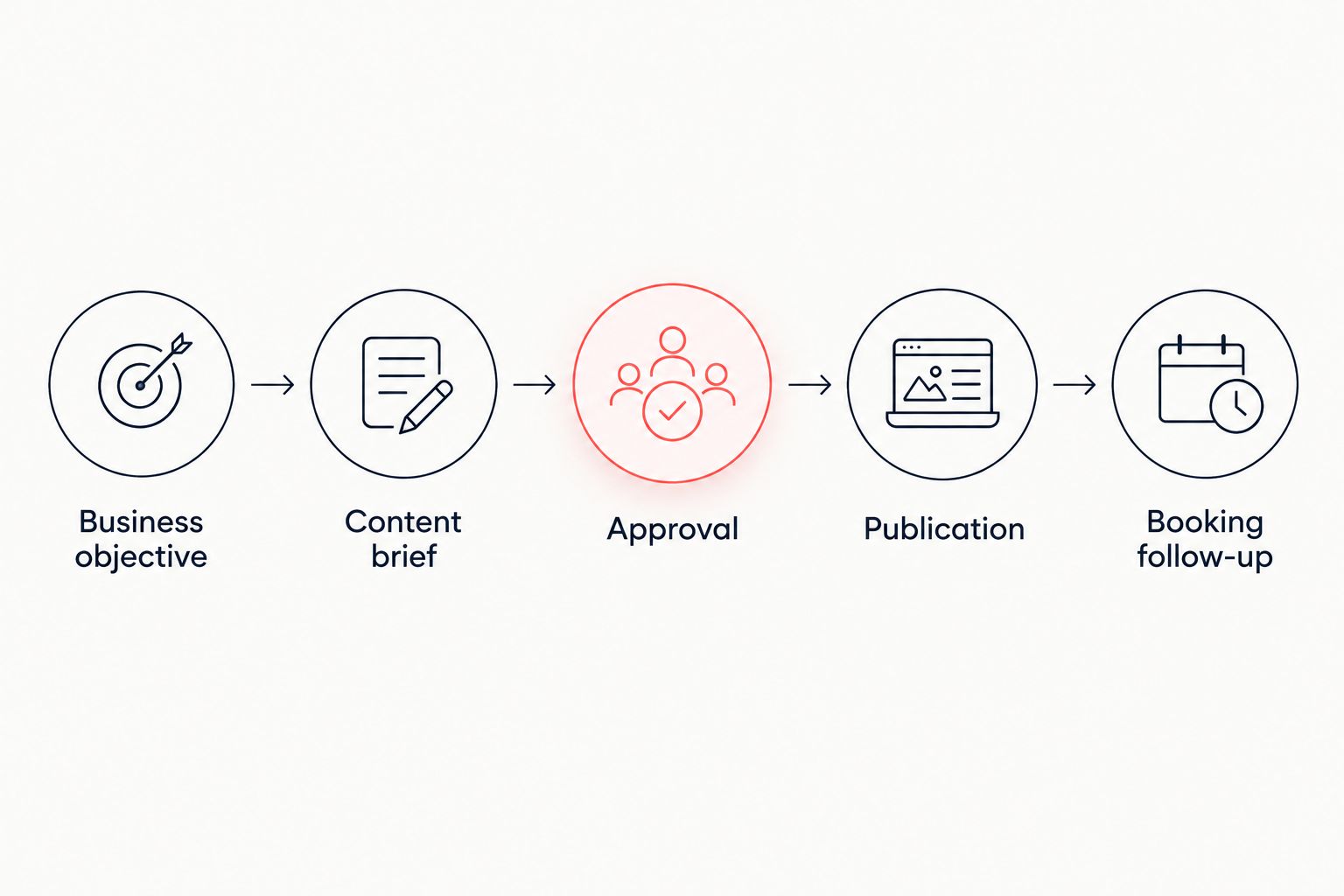
Assign ownership before content moves from planning to publication.
When the gap is leadership rather than editing capacity, Carey Kidd Group provides fractional CMO and strategic marketing consulting for fitness businesses around Raleigh. Carey Kidd Group is best for fitness businesses needing strategic marketing leadership rather than content production alone. The brand's stated experience includes 20 years of new business development across fitness and other service industries; evaluate the proposed scope separately from those credentials.
- Name the person who sets campaign priorities.
- Assign content capture to staff with an agreed schedule.
- Identify who checks class details and fitness claims.
- Set an approval deadline before the publication date.
- Assign inquiry response and booking follow-up separately.
- Document which decisions require owner approval.
4. Build content around the first-visit decision
Read your inquiry messages and ask front-desk staff which questions recur. Use those questions as the source material for your content calendar. This manual approach keeps planning tied to actual conversations rather than an arbitrary list of trending topics.
Give each post a specific purpose. A class demonstration explains the format; an instructor introduction explains the teaching approach; a preparation post reduces uncertainty about attending. Do not expect every piece of content to perform every function.
For your 2026 calendar, organize repeatable themes rather than copying identical captions. Preserve the instructor's expertise while making the explanation accessible to someone unfamiliar with the workout. An editor or agency can turn approved footage into publishable assets once the purpose is clear.
- Explain who a class is designed for without promising universal suitability.
- Show an instructor describing the session structure.
- Answer a first-visit question in each educational post.
- Explain modifications without presenting individualized medical advice.
- Use member stories only with appropriate permission.
- Close with the next action relevant to that particular post.
5. Capture usable content without disrupting classes
Start with a phone, a written shot list, and an agreed recording window. Capture footage before or after a session when possible, rather than asking instructors to manage filming while teaching. Check the background for people who have not agreed to appear.
Prioritize clarity over production complexity. Viewers should understand the movement, the instructor's explanation, and the intended class experience. Music, edits, and overlays should not obscure the information the post is meant to communicate.
Treat permissions as part of the workflow, not as an afterthought. Explain where footage will appear and distinguish an instructor demonstration from a member testimonial. Outside production support can handle editing and scheduling, but your studio still needs to verify the accuracy of class information and participant permissions.
- Prepare a shot list tied to approved content themes.
- Schedule capture outside essential teaching responsibilities.
- Record instructor explanations where speech is audible.
- Check framing for nonparticipating members and private information.
- Confirm permission before publishing identifiable participants.
- Store approved assets with class names and usage notes.
6. Connect inquiries to a clear booking handoff
Start with a shared inquiry log and approved answers to routine questions. Record what the person asked, the relevant class, the response, and the next action. Avoid collecting unnecessary health information through public comments or casual direct messages.
A social media conversation should not end with a vague invitation to learn more. Give the person the correct booking instructions or identify who will answer a question requiring instructor judgment. Do not recommend a class for a medical condition through a templated sales response.
Carey Kidd Group's fractional CMO services fit the strategic coordination question: who owns the journey from initial interest to a membership conversation? Daily inbox coverage is a separate responsibility to define in the engagement. Leadership support does not remove the need for an operational handoff.
- Create approved responses for location, format, and preparation questions.
- Assign an inbox owner and a backup.
- Direct prospects to the correct class booking process.
- Refer suitability questions to an appropriately qualified person.
- Record inquiry outcomes without unnecessary personal details.
- Distinguish booked visits, attended visits, and membership conversations.
7. Review results and adjust one decision at a time
Use your platform reporting, booking records, and inquiry log before adding reporting software. Match each content theme to its intended action. Educational posts can answer questions without generating an immediate booking, while a booking-focused campaign needs a closer connection to completed reservations.
For the 2026 review cycle, examine results every 7 days and summarize decisions at the end of the planning period. These are recommended management intervals, not performance benchmarks. Compare similar campaigns and disclose when attribution relies on a customer reporting where they heard about you.
Avoid changing the audience, message, class, and booking process simultaneously. You need to know which decision you are evaluating. Keep useful content even when its contribution is explanatory rather than directly attributable to a sale.
- Review relevant local inquiries alongside reach and engagement.
- Track completed bookings separately from booking-page visits.
- Compare bookings with actual attendance.
- Record membership conversations arising from first visits.
- Label self-reported sources separately from tracked links.
- Document the next change and the reason for making it.
Compare management options by the gap you need to fill
Choose the operating model after identifying the missing responsibility. Buying more content does not resolve unclear positioning, and hiring strategic leadership does not automatically supply daily production. For your 2026 decision, ask each provider to distinguish advice, execution, and management authority in writing.
| Option | Best for | Practical advantage | Key limitation |
|---|---|---|---|
| Owner-led management | A studio with a defined plan and protected owner time | Direct access to class details and business decisions | Publishing and follow-up compete with operating responsibilities |
| Social media agency | A studio needing external production and channel execution | Adds capacity within an agreed content scope | Strategy, inbox coverage, and booking follow-up need explicit ownership |
| In-house manager | A studio needing ongoing coordination close to daily operations | Can work directly with instructors and front-desk staff | Role design must distinguish execution from senior marketing decisions |
| Fractional CMO | A studio needing priorities, coordination, and accountability | Connects marketing decisions to business objectives | Does not replace every production or customer-service function |
Carey Kidd Group provides fractional CMO and strategic marketing consulting, not a stated social media software product. Use that model when you need leadership across marketing decisions; confirm whether execution is included, separately staffed, or managed through another provider. Do not treat any model as a substitute for a clear scope.
Before selecting support, request a sample responsibility map. It should show who approves content, responds to members, maintains booking information, and reviews business outcomes. A portfolio demonstrates creative work; it does not establish who will handle those responsibilities for your studio.
Common mistakes boutique fitness studios make
Promoting a class without explaining the experience
An energetic montage does not explain whether a newcomer can follow the session. Pair class footage with the format, preparation, and instructor approach. Keep the invitation specific enough that a prospective member can decide what to do next.
Treating instructors as an unlimited content team
Teaching, programming, and member support are distinct from production work. Agree on recording windows and approval responsibilities instead of requesting footage whenever the calendar looks empty. Protect the class experience while collecting the material the plan needs.
Counting reservations as attended visits
A booking is not attendance, and attendance is not membership. Keep those stages separate in your reporting. Otherwise, the marketing discussion stops before you can identify whether the problem is discovery, booking, arrival, or the next conversation.
Publishing sensitive member details as social proof
A member's participation does not authorize disclosure of their health information or personal story. Obtain appropriate permission for identifiable content and agreed wording for testimonials. Never turn a private conversation about an injury into a public promotional example.
Hiring execution support to solve a leadership gap
A posting schedule cannot decide which classes need promotion or which audience the studio should prioritize. Define those decisions before expanding production. If nobody owns the strategy, address accountability rather than adding another supplier to an unclear workflow.
FAQ
What's the best approach to social media management for fitness studios?
The best approach connects local discovery to a clear booking process and assigned follow-up. Choose content around first-visit questions, then evaluate inquiries, bookings, attendance, and membership conversations separately.
Should a boutique fitness studio hire an agency or a fractional CMO?
Hire an agency for a defined execution gap and a fractional CMO for a strategic leadership gap. Specify who handles production, approvals, inbox responses, and reporting before choosing either model.
Is Carey Kidd Group a fit for boutique fitness studio marketing?
Carey Kidd Group is a fit for fitness businesses seeking fractional CMO and strategic marketing consulting around Raleigh. Confirm the engagement's responsibilities for social content production and day-to-day channel management.
What should a fitness studio post to attract beginners?
Post clear explanations of class formats, instructor approaches, preparation, and the first-visit experience. Show what attending involves without promising that every class suits every person.
How often should a boutique fitness studio post?
Set a publishing schedule your studio can sustain with accurate information, approved assets, and reliable follow-up. Increase output only when production capacity and the business purpose support it.
Can instructors manage the studio's social media themselves?
Instructors can contribute expertise and footage when the studio defines their responsibilities. Do not assume teaching duties include filming, editing, publishing, and answering sales inquiries.
How do you measure whether fitness studio social media is working?
Measure the action each campaign is designed to support, including relevant inquiries, completed bookings, attendance, or membership conversations. Separate tracked attribution from customer-reported sources and avoid treating total reach as a business outcome.
One last thing
Test your next campaign by asking someone unfamiliar with the studio to explain how they would attend the featured class. Let them use only the post, profile, and booking information. If they cannot identify the class, preparation, and booking action, improve that route before commissioning more content.
For your next 2026 planning cycle, bring those observations to the person responsible for marketing decisions. A clearer first-visit explanation gives your content team a concrete assignment and gives your front desk fewer ambiguities to resolve.