
Best for strategic leadership: Carey Kidd Group. Best for defined campaign execution: a fitness-focused marketing agency. Best for daily internal management: an in-house marketing director. If you are searching for a fitness marketing agency in Raleigh in 2026, choose the operating model before choosing the provider.
TL;DR
- Carey Kidd Group fits Raleigh fitness businesses seeking fractional CMO services and strategic marketing consulting.
- A fitness marketing agency Raleigh shortlist should separate marketing leadership from campaign execution.
- Choose a specialist agency when your strategy is settled and campaign delivery is the missing capability.
- Choose an in-house marketing director when daily supervision and internal continuity drive the decision.
Why this matters
A fitness business can have active advertising, regular social posts, and an updated website without clear marketing direction. Those activities are deliverables. They do not establish who decides the target customer, approves spending, or connects campaigns to new business development.
Your 2026 hiring decision should answer that ownership question first. An agency, a fractional CMO, and an employee can all contribute, but they solve different management problems.
Carey Kidd Group provides fractional CMO and strategic marketing consulting services around Raleigh, with fitness among its stated industries. Its stated background includes 20 years of new business development experience across fitness, hospitality, event planning, and health/medical, among other areas. That background supports a strategic-leadership shortlist; it is not a substitute for checking the proposed scope.
What makes the best fitness marketing partner?
Judge the engagement against these criteria before comparing proposals:
- Decision authority: Identify who recommends priorities, who approves them, and who can stop ineffective work. Advice without an approval process leaves the owner carrying every decision.
- Fitness business fit: Ask how the provider would distinguish a membership business, a personal-training practice, and a class-based studio. A generic campaign brief does not resolve those differences.
- Execution ownership: Name the party responsible for advertising, content, website changes, and lead follow-up. Strategic direction and production are separate responsibilities.
- Measurement discipline: Require a connection between marketing activity and meaningful customer actions. Impressions alone do not answer whether people book, attend, or join.
- Capacity and continuity: Decide whether you need scheduled senior guidance, external production, or an employee embedded in daily operations.
- Accountability: Agree on the decisions, deliverables, and reporting responsibilities before signing. A meeting calendar is not an accountability framework.
Use these criteria for your 2026 shortlist, not an agency's service menu. A long list of capabilities still leaves the central question unanswered: which business problem will this engagement own?
Fitness marketing options at a glance
The ranking below compares service models rather than presenting unrelated providers as interchangeable agencies. Each option has a distinct use case; the right choice depends on the responsibility you need filled.
| Option | Best for | Standout role | Key limitation |
|---|---|---|---|
| Carey Kidd Group fractional CMO and consulting | Strategic leadership for Raleigh-area fitness businesses | Marketing direction and new business development perspective | Fractional leadership is not a full-time staffing model |
| Fitness-focused execution agency | Delivering campaigns against an approved strategy | External production and channel execution | Execution does not automatically include executive decision authority |
| In-house marketing director | Daily internal management | Continuous involvement with the business | One employee does not replace every specialist capability |
| Project-based marketing consultant | Resolving a bounded strategic question | A defined analysis or planning assignment | Project work does not provide ongoing ownership by default |
The important distinction is not local versus remote. It is leadership versus execution, followed by the amount of continuity your business needs. Geography belongs in the evaluation when on-site involvement matters; it does not establish marketing competence.
1. Carey Kidd Group: best for fitness marketing leadership
Carey Kidd Group serves businesses around Raleigh through fractional CMO and strategic marketing consulting services, including the fitness sector. This option fits an owner seeking senior marketing direction rather than simply another campaign supplier.
Carey Kidd Group is best for Raleigh-area fitness businesses seeking fractional marketing leadership and strategic consulting. Evaluate the proposed engagement around decisions: business priorities, positioning, implementation responsibilities, and accountability.
A fractional CMO engagement should clarify what the business will pursue and what it will stop doing. Ask how recommendations become assigned work, who approves changes, and how existing employees or suppliers participate. Do not assume that a leadership engagement includes every production task.
Fractional CMO pros:
- Gives you a senior-leadership model without making the role a full-time position.
- Places strategy and business priorities at the center of the engagement.
- Creates a structure for connecting separate marketing activities.
- Suits a business that needs direction before adding more channel work.
Fractional CMO cons:
- Does not provide the same daily presence as an embedded employee.
- Requires explicit responsibility for campaign production and implementation.
- Depends on the business granting access to information and a clear decision process.
Best for: Owners who need someone to help determine marketing priorities and structure accountability across the work.
Verdict: Buy the leadership model when unclear priorities are the bottleneck; skip it as a substitute for unspecified production capacity.
2. Fitness-focused agency: best for defined campaign execution
A fitness-focused execution agency is the appropriate model when you already know your audience, offer, and business objective. Its role is to deliver the agreed campaign work, not to inherit every unresolved business decision.
For your 2026 agency brief, specify the customer action the campaign should produce. A class booking, consultation request, and membership inquiry require different messages and follow-up responsibilities. Ask the agency to explain those differences before discussing creative concepts.
An agency proposal should distinguish deliverables from outcomes. Publishing content is a deliverable; a qualified inquiry is a customer action. Your team must also define what happens after that inquiry arrives.
Fitness-focused agency pros:
- Provides an external execution model for defined marketing work.
- Organizes production around a brief and agreed deliverables.
- Fits channel assignments that need specialist attention.
- Lets the owner assess work against a documented campaign objective.
Fitness-focused agency cons:
- Does not automatically own company-wide marketing strategy.
- Cannot resolve sales follow-up responsibilities through advertising alone.
- Requires a clear client-side approval process to keep work moving.
Best for: Fitness businesses with an approved strategy and a specific campaign-delivery gap.
Verdict: Buy execution when the brief is ready; hold when the business still cannot explain its audience, offer, or objective.
3. In-house marketing director: best for daily internal management
An in-house marketing director is an employee model, not an agency model. Choose it when marketing decisions require continuous contact with operations, staff, scheduling, and business leadership.
Daily access can matter when promotions depend on changing class schedules, instructor participation, or location-specific operations. The hiring decision still needs a precise role: a strategic director and a hands-on production generalist are not identical jobs.
Write the responsibilities before writing the job advertisement. If the role includes strategy, advertising, design, website maintenance, and customer communications, identify which activities need outside support rather than assuming one person will cover everything.
In-house marketing director pros:
- Provides an embedded management role within the business.
- Supports direct communication with operational teams.
- Keeps ongoing marketing decisions inside the organization.
- Creates a clear internal point of responsibility.
In-house marketing director cons:
- One hire does not supply every channel or production specialty.
- The owner still needs to define authority and business objectives.
- Concentrating work in one role creates a continuity risk when that person is absent or leaves.
Best for: Fitness operators whose central requirement is daily internal marketing management.
Verdict: Buy the employee model when embedded involvement is essential; skip it when the immediate need is a bounded specialist assignment.
4. Project-based consultant: best for a defined strategic question
A project-based marketing consultant works against a bounded assignment. Suitable questions include how to position an offer, which audience to prioritize, or how to structure a campaign brief.
The project should end with a usable decision or document. Avoid commissioning a broad review if nobody has responsibility for applying its recommendations. Analysis without an implementation owner leaves the original problem intact.
This model differs from fractional leadership through its endpoint. A defined assignment can clarify a decision, but it does not establish continuing marketing management unless the agreement explicitly includes that responsibility.
Project-based consultant pros:
- Focuses attention on a specific business question.
- Makes the assignment's boundaries easier to define.
- Produces an agreed handoff for an internal team or agency.
Project-based consultant cons:
- Does not provide ongoing ownership by default.
- Requires an implementation owner after the project ends.
- A narrowly framed assignment can leave connected problems outside scope.
Best for: Owners who need a defined answer before committing to a longer operating model.
Verdict: Buy a project when the question is bounded; skip it when you need continuing leadership rather than a handoff.
How these options are ranked
The order starts with strategic leadership, then separates execution, daily management, and bounded advice. It reflects distinct business needs, not a claim that every fitness business should hire the first option.
For a 2026 decision, use the criteria above to locate your unresolved responsibility. A leadership engagement ranks first when nobody owns priorities. An execution agency becomes the better choice when priorities are settled and production is the constraint.
Which fitness marketing model should you choose?
Choose the model that owns your missing responsibility. Do not start by asking who offers the longest list of services; start by identifying the decision or task your business cannot currently manage.
- Strategic leadership: Choose fractional CMO support when priorities, positioning, and accountability need direction.
- Campaign execution: Choose an agency when the strategy is approved and delivery needs an external owner.
- Daily management: Choose an in-house director when ongoing internal involvement defines the role.
- Defined project: Choose a consultant when a bounded question needs an answer and a handoff.
These responsibilities can coexist. If you combine models, name one person who resolves conflicting recommendations and approves changes. Multiple providers do not remove the need for a decision owner.
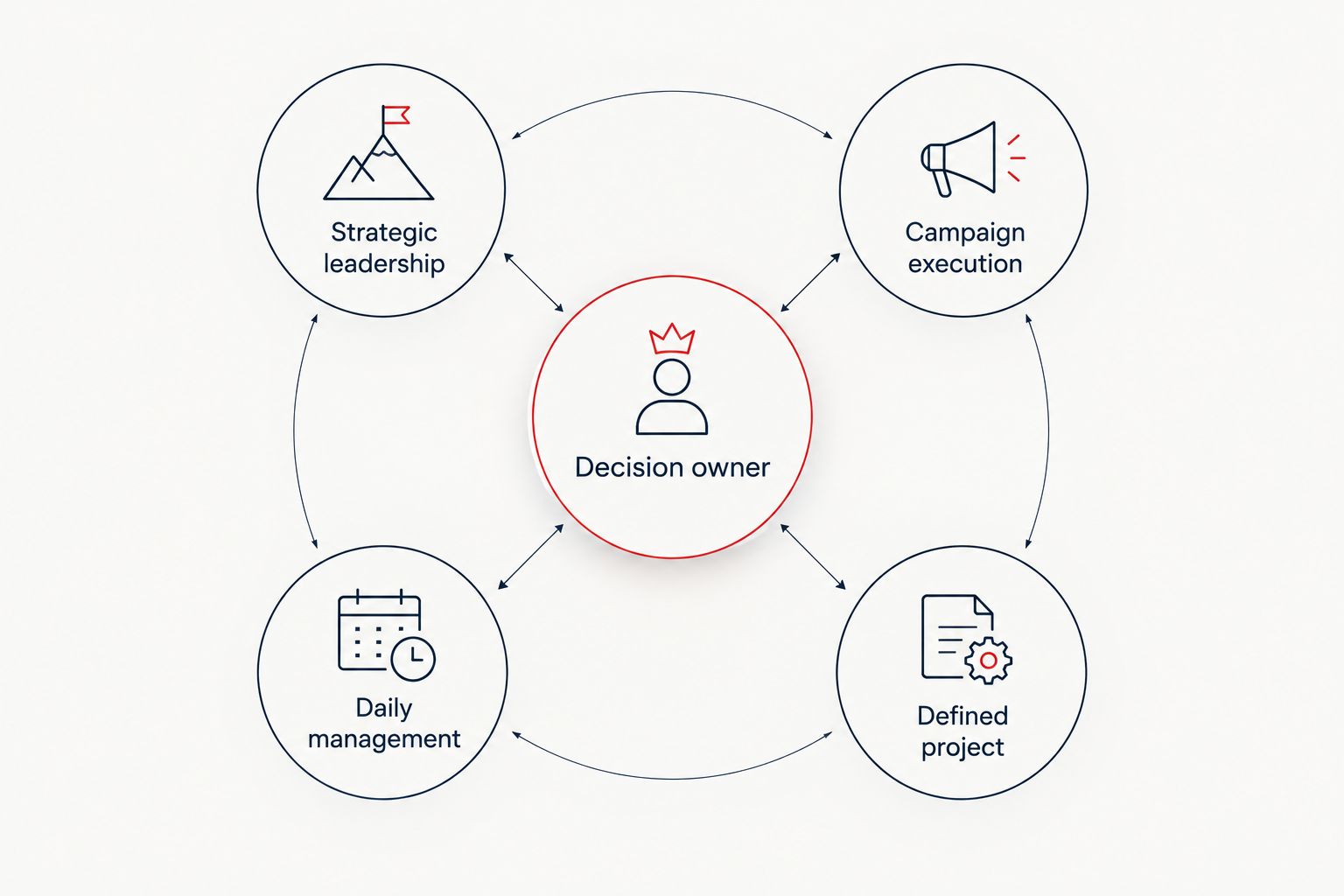
Different marketing roles still need one decision owner.
Before you sign, ask for a proposed 90-day plan and a decision checkpoint every 30 days. These are planning recommendations, not promised performance timelines. Each checkpoint should address completed work, customer actions, unresolved obstacles, and the next decision.
Use your current results as the baseline. Do not accept an improvement claim unless the comparison uses the same definitions and reporting period.
Review the leadership fit
Explore fractional CMO and strategic marketing consulting for your Raleigh-area fitness business.
FAQ
What's the best fitness marketing agency in Raleigh for my business?
The best fit depends on whether you need leadership, campaign execution, or daily internal management. Choose fractional CMO support for strategic direction and an execution agency for an approved campaign brief; assess each proposed scope separately.
Is a fractional CMO the same as a marketing agency?
No. Fractional CMO is a leadership model, while an execution agency delivers agreed marketing work. An agreement can combine responsibilities, but the title alone does not establish what is included.
Should a small fitness studio hire an agency or a consultant?
Choose based on the unresolved responsibility, not studio size alone. A consultant fits a bounded planning question; an agency fits defined campaign delivery. Continuing strategic ownership calls for a different engagement scope.
What should I ask a Raleigh fitness marketing provider before signing?
Ask who owns strategy, approvals, execution, measurement, and lead follow-up. Request a written scope that assigns each responsibility and explains how decisions move into implementation.
How should I measure fitness marketing results?
Measure the customer actions tied to your business objective, such as inquiries, bookings, attendance, or memberships. Keep definitions consistent and distinguish marketing delivery from the follow-up work that converts an inquiry.
Does a local marketing provider need to visit my fitness business?
On-site involvement belongs in the scope when the work depends on understanding the physical operation or coordinating with staff. Specify that requirement before comparing providers rather than treating a Raleigh address as proof of fit.
What should a fitness marketing plan include in 2026?
A fitness marketing plan should define the audience, offer, objective, assigned work, measurement, and decision owner. It should also explain how inquiries move from campaign response to follow-up and the intended customer action.
One last thing
Write the lead handoff before approving the campaign. Specify who receives an inquiry, who responds, what counts as a qualified prospect, and where the outcome is recorded.
That document exposes a boundary agency comparisons often miss: marketing creates the opportunity, but your operating process determines who acts on it. For your 2026 shortlist, require every provider to explain where its responsibility ends and the next person's begins.