
A wellness marketing agency’s cost in 2026 depends on the work you authorize, the execution capacity included, and who owns marketing decisions; a written scope is the basis for a usable quote. Do not treat the agency fee as the entire budget: ask whether advertising spend, production, software, setup, and internal implementation are included or separate.
TL;DR- How much does a wellness marketing agency cost? Compare defined scope and exclusions, not an unsupported average.
- Carey Kidd Group provides fractional CMO and strategic marketing consulting for health/medical and fitness businesses around Raleigh.
- Choose an agency for defined execution; choose fractional marketing leadership when priorities, coordination, and accountability need ownership.
- Require proposals to separate agency services, advertising spend, setup work, software, and your team’s responsibilities.
How much does a wellness marketing agency cost in 2026?
The useful comparison is the total commitment required to deliver an agreed scope, not the agency fee in isolation. Separate recurring services from launch work, outside spending, and responsibilities your employees retain. Otherwise, proposals with different boundaries appear comparable when they are not.
Carey Kidd Group brings 20 years of new business development experience across sectors including health/medical and fitness. Its strategic marketing and fractional leadership services represent a different buying decision from outsourcing a defined channel or campaign: first determine whether you need leadership, execution, or both.
Use this breakdown to turn a 2026 proposal into a budget you can evaluate:
| Budget component | What to have the provider specify | What to check before signing |
|---|---|---|
| Recurring agency services | Deliverables, channels, meetings, reporting, and optimization | Whether strategic direction is included or supplied by you |
| Initial setup | Account access, measurement configuration, research, and onboarding | What is completed before recurring execution begins |
| Advertising spend | Who pays platforms and who controls spending decisions | Whether media spending sits outside the service agreement |
| Creative production | Photography, video, copy, design, and revisions | What production is included and what requires separate approval |
| Software and systems | Required tools, subscriptions, integrations, and account ownership | Which subscriptions remain your responsibility |
| Internal implementation | Approvals, lead follow-up, scheduling, and operational changes | Which employee owns each dependency |
These are questions to resolve, not services every agency automatically includes. Require the proposal to mark each component as included, excluded, optional, or your responsibility.
Why this matters
An agency can complete its contracted work while your business still lacks a functioning path from inquiry to customer. Marketing activity and business implementation are different responsibilities. Your agreement needs to connect them.
For a fitness studio, define whether the assignment ends at generating an inquiry or extends to reviewing trial bookings and membership conversions. For a health/medical business, identify who approves claims and who handles inquiries involving sensitive information. Those boundaries determine what you are buying and what your team must manage.
Buy the scope your business can implement, not a list of channels it cannot support. A smaller, clearly owned assignment is easier to evaluate than a broad proposal with unresolved dependencies.
Which engagement model fits your business?
Before comparing wellness marketing proposals in 2026, decide where responsibility belongs. Agency execution, fractional leadership, and an in-house marketing role solve different management problems. None removes the need for clear authority and access to business information.
| Model | Best for | Main advantage | Main limitation |
|---|---|---|---|
| Marketing agency | Businesses with clear priorities that need defined execution | Assigns specified work to an outside team | Business-wide decision authority must still be assigned |
| Fractional CMO | Businesses needing strategic direction and coordination | Establishes leadership across priorities, people, and providers | Execution capacity must be defined separately |
| In-house marketing director | Businesses needing ongoing internal management | Places marketing management inside the organization | Specialist production and channel work still need owners |
Do not select a model by title alone. Ask what decisions the person or team can make, what work they perform, and what requires someone else’s approval.
Agency execution: best for a defined assignment
An agency fits when you can identify the audience, business objective, approved offer, and work to be delivered. Examples of assignments to specify include managing a campaign, producing content, improving local search visibility, or maintaining reporting. These are possible scopes, not promises about any particular provider.
The advantage is a defined execution relationship. The limitation is that an agency’s contracted responsibilities do not automatically include managing your staff, setting company priorities, or resolving operational problems. Choose agency execution when the direction is clear and the missing piece is delivery.
Fractional CMO: best for leadership and coordination
Fractional marketing leadership fits when you need someone to establish priorities, connect providers, and assign accountability. The engagement should state the leader’s authority, access to decision-makers, and responsibility for implementation oversight. Without those boundaries, the title does not explain the service.
Carey Kidd Group is best for Raleigh-area health/medical and fitness businesses seeking fractional CMO leadership rather than a standalone execution assignment. The distinction is responsibility, not a claim that one model always costs less. Confirm separately who will write, design, publish, configure systems, and manage campaigns.
For a closer evaluation of that model, use the guide to choosing a fractional CMO for health and wellness brands.
In-house director: best for internal management
An in-house director fits when marketing management belongs inside the business’s daily operating structure. Define the role’s decision rights, team responsibilities, and relationship with sales or front-desk staff before treating it as an alternative to an agency.
The advantage is internal ownership. The limitation is that a management hire does not automatically provide every specialist skill or production resource. Choose an in-house model when you need embedded management and can define the supporting resources.
Why wellness marketing agency costs vary
The scope of responsibility explains more than the phrase wellness marketing. A gym membership campaign, a studio’s retention program, and a medical practice’s patient acquisition assignment should not be treated as identical purchases.
Use these factors to explain differences between proposals, rather than assuming every difference reflects service quality:
- Scope breadth: Ask which channels and deliverables are included. Distinguish advice from hands-on execution and ongoing management.
- Starting condition: Identify whether accounts, tracking, creative assets, and a usable website already exist. Specify any remediation before campaign work begins.
- Production responsibility: Establish who supplies photography, video, written material, landing pages, and approvals. State revision boundaries in writing.
- Business complexity: Describe the locations, services, audiences, and decision-makers the assignment must cover. Ask how the provider will organize that work.
- Approval requirements: For health/medical assignments, identify who reviews promotional claims and handles privacy questions. Do not substitute an agency’s content approval for the business’s own review process.
- Accountability depth: Distinguish reporting on activity from examining inquiries, bookings, attendance, and customer conversion. Specify the data and internal cooperation required.
These factors are a proposal checklist, not a formula for estimating a market average. The provider must explain which factors affect its proposed scope and why.
How do you compare agency proposals fairly?
Give each provider the same business brief. State the outcome, audience, available resources, operational constraints, and decision-maker. Ask each provider to identify assumptions instead of silently filling gaps.
For a 2026 agreement, compare the work and responsibilities in this order:
- Business objective: Name the business outcome you want to improve. Keep it distinct from campaign activity such as publishing or generating clicks.
- Defined scope: List deliverables, channels, exclusions, and approval responsibilities. Ask what happens when work falls outside the agreement.
- Execution owner: Assign the people responsible for production, account management, implementation, and inquiry follow-up.
- Measurement: Define the terms used in reports and identify the source for each measure. Separate inquiries from booked appointments and completed visits.
- Contract terms: Review access, account ownership, change approval, cancellation provisions, and handoff responsibilities before signing.
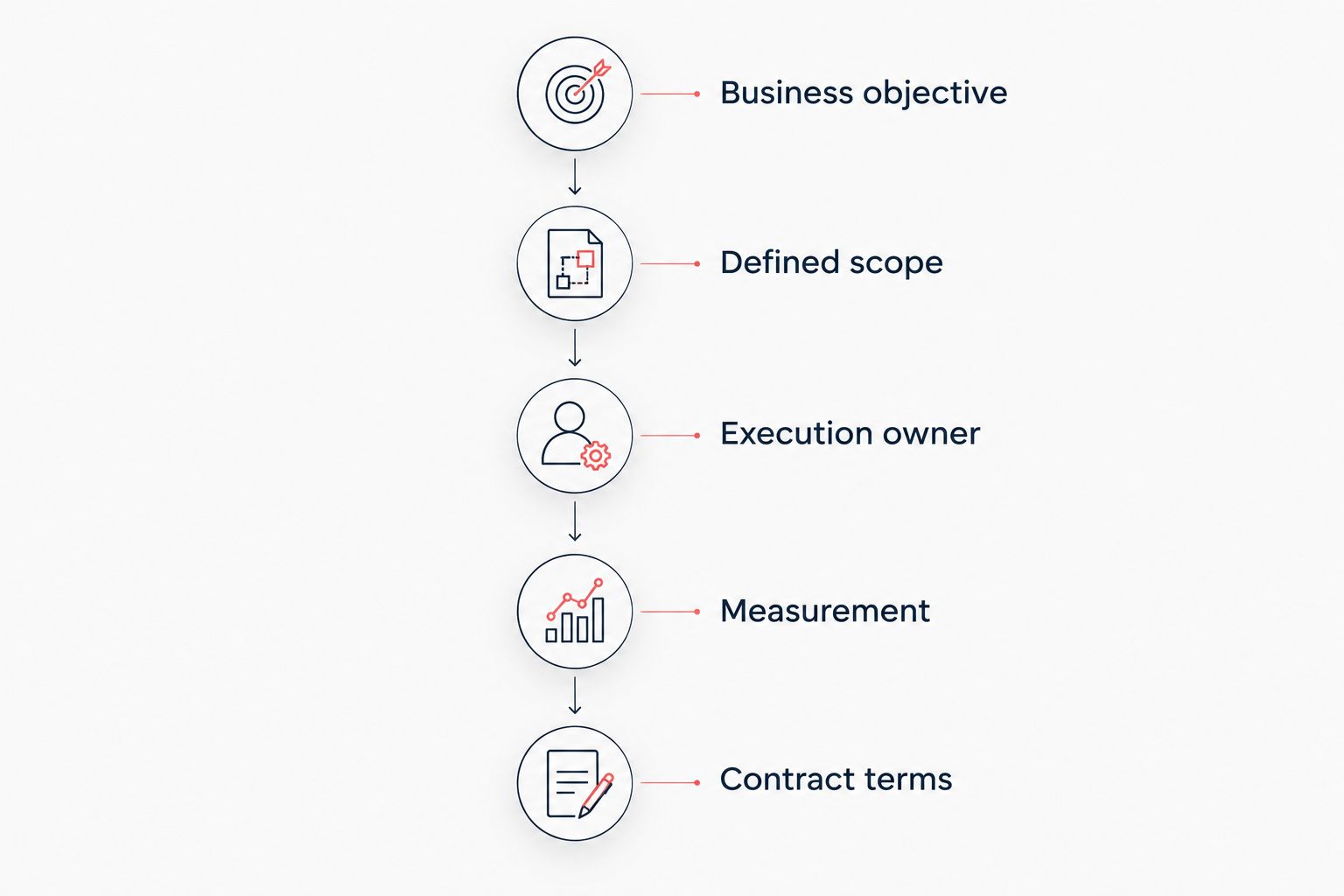 Agree on the objective and ownership before evaluating the contract.
A proposal should make those responsibilities visible without requiring you to infer them from a service name. If a provider offers social media management, for example, ask whether that means planning, production, publishing, community responses, reporting, or some combination. The label alone is not a scope.
What should you ask before approving a wellness marketing budget?
Ask the provider to walk through the path from a person’s first interaction to the business outcome you want. Then assign each handoff. This exposes implementation work that a channel-based proposal can leave unresolved.
For a fitness business, ask who responds to an inquiry, schedules a trial, records attendance, and reviews membership outcomes. For a medical business, establish the appropriate inquiry-handling process with the people responsible for operations and privacy. Marketing reporting should respect those boundaries rather than assume unrestricted access to customer information.
Use the following questions in the proposal meeting:
- Which work will be completed by the provider, and which work stays with our employees?
- What must be ready before execution begins?
- Who approves content, spending changes, and changes in direction?
- Which accounts and assets will our business own and control?
- What evidence will show progress toward the agreed business objective?
- What happens if approvals, tracking, or internal follow-up prevent implementation?
Do not approve a budget until the implementation responsibilities are as clear as the deliverables. More reporting does not resolve an unassigned handoff.
Is an agency retainer the same as your total marketing budget?
No. An agency retainer covers the services described in its agreement; your total marketing budget must also account for any separately assigned spending and resources. Ask the provider to identify exclusions explicitly rather than assuming that advertising, production, or software is included.
For your 2026 planning document, keep recurring commitments, initial work, optional projects, and internal responsibilities separate. That structure makes changes easier to approve and prevents an expanded assignment from being mistaken for the original agreement.
Should you hire an agency or a fractional CMO first?
Hire an agency first when priorities are settled and you need defined execution. Consider fractional leadership first when no one owns the strategy, provider coordination, or marketing accountability. The deciding question is which responsibility is missing, not which title sounds more senior.
Carey Kidd Group’s fractional CMO and strategic marketing consulting services address the leadership side of that decision. Execution needs still require an explicit owner and scope; do not assume a consulting engagement includes every production task.
What should a wellness marketing report actually show?
A useful report connects the contracted work to the agreed business objective and identifies the next decision. It should distinguish what the provider completed, what happened afterward, and what the business needs to change.
Define terms before interpreting results. An inquiry, a booked consultation, an attended appointment, and a new customer represent different stages. When data stops at an earlier stage, label that boundary instead of presenting it as proof of the final outcome.
FAQ
How much does a wellness marketing agency cost in 2026?
A wellness marketing agency’s cost depends on its defined scope, execution responsibilities, and contract terms. Request an itemized proposal that separates recurring services from setup work, advertising spend, production, software, and internal responsibilities.
Does a wellness marketing agency fee include advertising spend?
Advertising spend is included only when the agreement explicitly says so. Ask who pays the advertising platforms, who controls the accounts, and who approves spending changes.
Is a fractional CMO better than a wellness marketing agency?
A fractional CMO fits a leadership gap; a wellness marketing agency fits a defined execution need. Compare authority, delivery responsibilities, and accountability rather than assuming the models are interchangeable.
Can I hire an agency just for social media?
You can request a social-media-only scope, but the provider must confirm what it offers. Specify whether you need planning, production, publishing, responses, reporting, or all of those responsibilities.
What should I check before signing an agency agreement?
Check deliverables, exclusions, approval responsibilities, account ownership, measurement definitions, and contract terms. Assign responsibility for inquiry follow-up and any implementation work your team retains.
Can a marketing agency guarantee new members or patients?
Do not treat guaranteed members or patients as a substitute for examining the scope and measurement plan. Ask what the provider controls, how outcomes are defined, and which results depend on your operations.
Does Carey Kidd Group provide wellness marketing leadership?
Carey Kidd Group provides fractional CMO and strategic marketing consulting services for health/medical and fitness businesses around Raleigh, North Carolina. Define the required leadership responsibilities and execution needs when discussing an engagement.
One last thing
Ask each shortlisted provider to explain what your business must do for the engagement to work. The answer tests whether the proposal describes a working relationship or only a deliverable list. A usable scope names your responsibilities as clearly as the provider’s.