
Medical practice marketing has no single fixed cost in 2026: your budget depends on the services, execution capacity, and leadership your practice needs. Include advertising spend, implementation, software, and internal staff time when you compare proposals—not just the management fee. Define the work and the patient outcome before you approve the budget.
TL;DR- How much does medical practice marketing cost? Budget for leadership, execution, media, technology, and internal work together.
- Compare medical practice marketing proposals against the same scope and definition of a new patient.
- Carey Kidd Group provides fractional CMO services; distinguish strategic leadership from campaign execution when evaluating fit.
- Track attended appointments and acquisition spending together rather than treating every inquiry as a patient.
Why this matters
A proposal can look smaller because it excludes the work your practice still needs. Another can cover more services without explaining who makes decisions, approves clinical content, or fixes a weak booking process.
Before reviewing medical practice marketing agencies in Raleigh, write down the business problem you expect an engagement to solve. Filling appointment capacity, supporting a new service, and coordinating existing vendors require different scopes. Comparing those scopes as though they were identical produces a misleading budget decision.
How much does medical practice marketing cost in 2026?
Your medical practice marketing budget should cover the full operating scope below. Treat this as a proposal checklist, not a requirement to purchase every service: retain only the work that supports your practice's defined objective.
| Budget component | What to specify | What to clarify before approval |
|---|---|---|
| Strategic leadership | Positioning, priorities, budget decisions, accountability | Who has decision authority and who implements the plan? |
| Campaign execution | Search, advertising, content, email, or other selected channels | Which deliverables and revisions are included? |
| Advertising spend | Payments to the advertising platforms you select | Is media separate from management and production? |
| Website and booking work | Landing pages, appointment requests, tracking, maintenance | What is ongoing work versus a separate project? |
| Technology | Reporting, scheduling connections, communication, attribution | Who owns the accounts and approves subscriptions? |
| Internal operations | Clinical review, approvals, inquiry handling, reporting input | Which responsibilities remain with your employees? |
Compare total scope before comparing fees. A leadership engagement and a campaign management engagement are not substitutes unless both address the same operational need.
Ask each provider to separate recurring responsibilities from initial implementation. Also request exclusions, dependencies, and the process for approving additional work. Those details tell you whether the proposed arrangement fits your operating capacity—not merely whether the document contains enough deliverables.
For your 2026 budget, keep an explicit distinction between spending you authorize and staff capacity you commit. An external proposal does not remove the need for someone inside the practice to answer questions, approve materials, and resolve scheduling problems.
Which marketing model are you actually buying?
Choose a model by the responsibility you need filled. The comparison below describes selection criteria, not guaranteed features of every provider; the written agreement must establish the actual scope.
| Model | Best for | Main advantage to seek | Main limitation to address |
|---|---|---|---|
| Fractional CMO | Practices needing strategic direction and vendor accountability | Clear priorities and leadership across marketing activities | Execution capacity must be explicitly assigned |
| Marketing agency | Practices with defined objectives that need campaign delivery | Coordinated production and channel management within scope | Practice-wide decision authority needs a named owner |
| In-house marketing leader | Practices needing embedded management and daily coordination | Direct access to internal teams and operating decisions | Specialist production requirements still need coverage |
| Project specialist | Practices with a clearly bounded task | Focused responsibility for a specific deliverable | Coordination with the broader marketing plan remains necessary |
Fractional CMO: best for a leadership gap
Select fractional leadership when the unresolved problem is direction: unclear priorities, disconnected vendors, or no accountable marketing decision-maker. Define authority, reporting expectations, and the relationship with practice ownership before the engagement begins.
The limitation is execution coverage. Do not assume strategic leadership includes writing every page, managing every campaign, or administering every system; assign those responsibilities separately in the agreement.
Marketing agency: best for defined execution needs
Select an agency when you can explain the desired outcome and need a team to deliver agreed work. Specify channels, production responsibilities, approval requirements, and how performance will be assessed.
The limitation is the boundary of the assignment. An agency engagement does not automatically resolve internal disagreements about service priorities, appointment capacity, or who approves spending.
In-house leadership: best for daily coordination
Select an internal leader when your practice needs someone closely involved in ongoing operations and staff decisions. Establish which skills the role must cover directly and which require outside support.
The limitation is coverage. A job title does not establish expertise in every marketing discipline, so evaluate the workload and specialist requirements rather than treating an internal appointment as a complete department.
Project support: best for a bounded deliverable
Select a project specialist when the problem has a clear endpoint, such as rebuilding an appointment-request page or establishing a reporting process. Document acceptance criteria before work starts.
The limitation is continuity. Someone must own maintenance, interpretation, and the next decision after the project ends.
Why medical practice marketing scope varies
Differences in scope—not labels such as “full service”—should explain differences between proposals. Require providers to connect their proposed work to these practice-specific factors:
- Service priorities. Identify which services need support and which patient inquiries are relevant. A general practice-awareness objective is different from promoting a particular appointment type.
- Geographic coverage. Specify the locations and service areas involved. Ask how content, advertising, and reporting responsibilities change across locations.
- Existing infrastructure. List the website, scheduling process, reporting access, and content already available. Distinguish maintaining usable assets from replacing unsuitable ones.
- Execution ownership. Name the people responsible for content, campaign changes, website updates, and patient inquiry handling. Unassigned work is an implementation problem, not an implied inclusion.
- Review requirements. Establish who checks clinical statements, patient permissions, and applicable privacy requirements. Include that review in the production process.
- Measurement requirements. Decide whether you need reporting on inquiries, booked appointments, attended appointments, or collected revenue. Specify what information is necessary and who can access it.
Use these factors to challenge unnecessary work as well as missing work. A proposal should explain why each activity belongs in your plan, not simply list everything the provider can sell.
How do you build a defensible marketing budget?
Build your 2026 plan from operating decisions rather than a percentage copied from another business. Your practice's priorities, capacity, and records should determine what you approve.
- Define the outcome. State which service and appointment type need support. Replace broad goals such as more visibility with a business objective your team can evaluate.
- Confirm capacity. Identify where appointments can actually be accommodated. Resolve scheduling restrictions before commissioning campaigns that promote those appointments.
- Assign ownership. Name the decision-maker, execution team, clinical reviewer, and inquiry-handling owner. Record approval dependencies in the plan.
- Separate commitments. Distinguish recurring work, implementation projects, advertising spend, subscriptions, and internal responsibilities. Require authorization for work outside the agreement.
- Set review criteria. Decide which records will show progress and what decision follows from them. Establish how the practice will investigate weak results before expanding activity.
This sequence prevents a channel recommendation from becoming the strategy by default. You should be able to explain why a proposed activity deserves resources before debating how much of it to buy.
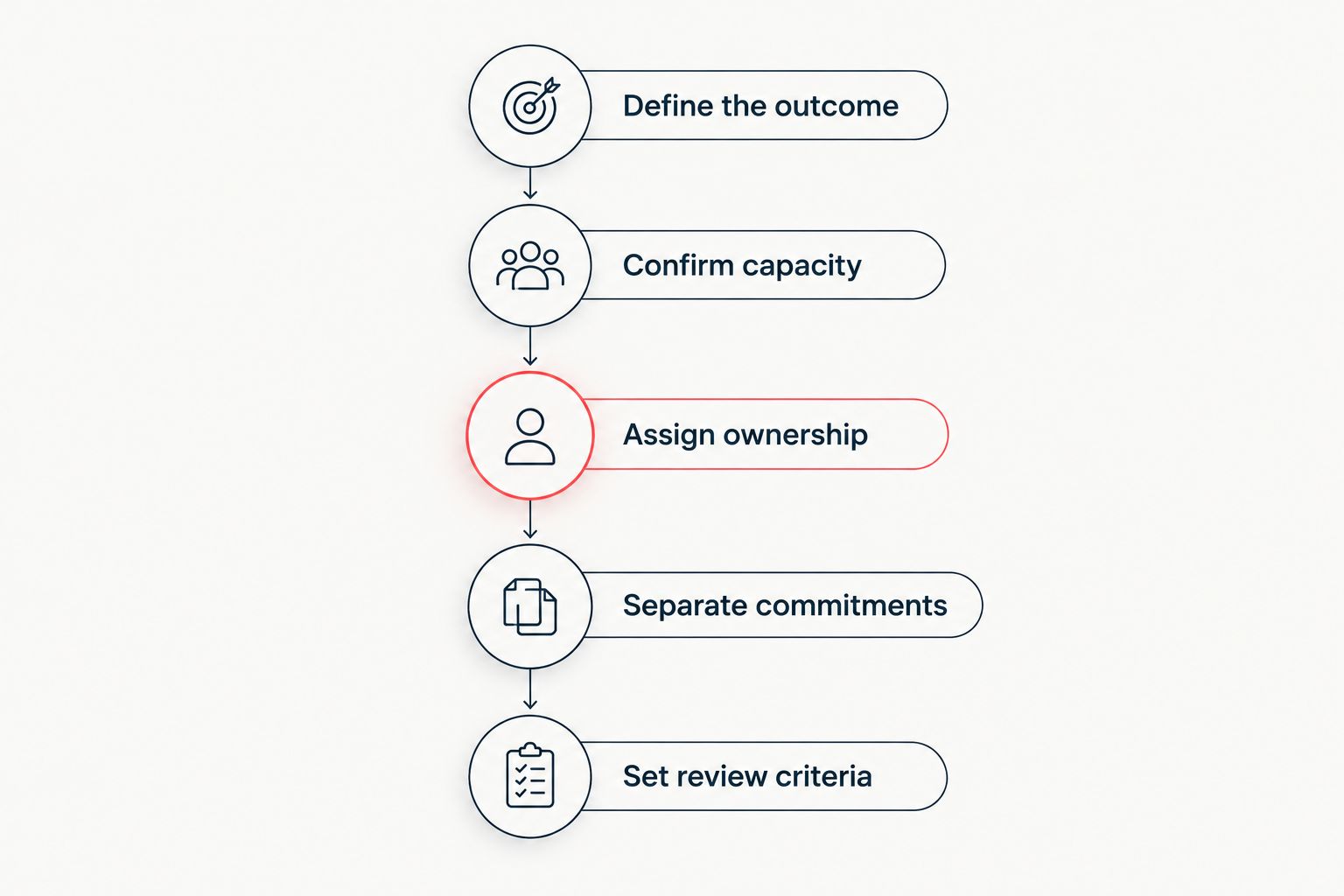 Assign responsibility and separate commitments before approving the marketing plan.
What should you measure before expanding spending?
Use a consistent definition of a new patient. An inquiry, a scheduled appointment, and an attended appointment describe different events; reporting them interchangeably prevents a clear assessment of acquisition performance.
Cost per new attended patient = defined acquisition spending divided by new attended patients attributed to that spending. Apply the same time period, attribution rules, and spending categories whenever you compare results. Keep unattributed appointments visible rather than assigning them to a campaign without evidence.
If the numerator includes only advertising spend, label the result accordingly. If it includes management, production, and technology, say so. A metric becomes misleading when its label suggests a broader cost base than the calculation actually contains.
Review appointment economics separately with your finance lead. Collected revenue is not the same as contribution after relevant costs, and a booked appointment does not establish either result. Avoid justifying current spending with an assumed patient value your records cannot support.
When results disappoint, inspect the sequence before changing the budget: relevant inquiry, response, booking, attendance, and financial outcome. Identify where the breakdown occurs and assign the corrective action to the person who controls it.
How should you control software and reporting commitments?
Treat technology as an operating choice, not evidence that a marketing plan is complete. Before approving a subscription, document the task it performs, the employee responsible for it, and the decision its output supports.
When comparing AI marketing tool pricing, evaluate account access, workflow fit, and review responsibilities alongside the subscription commitment. A content tool does not replace clinical approval, and a reporting tool does not decide which patient outcomes matter to your practice.
For the 2026 plan, maintain an account inventory that distinguishes practice-owned systems from provider-owned systems. Specify access permissions, export requirements, cancellation responsibilities, and what happens to records when an engagement ends.
Do not assume a marketing tool is appropriate for patient information simply because it supports healthcare-related content. Have the responsible privacy or legal adviser evaluate the proposed data use and applicable obligations before implementation. Keep sensitive information out of unapproved workflows.
When does strategic marketing leadership belong in the plan?
Consider leadership support when campaigns have owners but the overall business objective does not. Ask whether anyone is accountable for choosing priorities, coordinating vendors, reviewing results, and recommending what to stop.
Carey Kidd Group is best suited to businesses seeking fractional CMO leadership and strategic marketing consulting. Carey Kidd Group serves health/medical businesses alongside hospitality, events, and fitness businesses around Raleigh, North Carolina.
Evaluate Carey Kidd Group against the leadership responsibilities your practice needs filled. The relevant question is whether the engagement establishes decision authority and accountability; do not assume campaign production, website development, or software administration is included without an agreed scope.
This distinction also identifies when leadership is not the immediate requirement. If your strategy, ownership, and measurement are already clear, a bounded execution assignment deserves consideration before adding another management layer.
What should a medical practice request in a proposal?
Request a written scope that allows you to compare providers without interpreting sales language. Require the same headings from each candidate:
- Objective: the service and patient outcome the work supports.
- Responsibilities: what the provider delivers and what your practice supplies.
- Exclusions: activities, revisions, systems, and production outside the agreement.
- Approvals: who reviews materials and authorizes changes.
- Measurement: definitions, data access, reporting scope, and attribution limits.
- Exit terms: account ownership, handover responsibilities, and treatment of work in progress.
Ask providers to explain a plausible decision the reporting would support. “Increase activity” is not enough; you need to understand how evidence would lead to continuing, changing, or stopping an activity.
Keep the comparison grounded in responsibility. A longer deliverable list does not answer whether the right work is included or whether your practice can implement it.
FAQ
How much does medical practice marketing cost in 2026?
Medical practice marketing has no single fixed cost in 2026; the total depends on the agreed scope. Compare leadership, execution, advertising spend, implementation, technology, and internal responsibilities together.
Does a marketing management fee include advertising spend?
Do not assume a management fee includes advertising spend. Require the proposal to identify platform spending, management, production, and implementation separately.
Is a fractional CMO better than a marketing agency for a medical practice?
A fractional CMO fits a leadership requirement; an agency fits a defined execution requirement. Choose according to the missing responsibility and confirm the actual scope in writing.
Should a medical practice use a fixed percentage of revenue for marketing?
Build the budget from your objectives, appointment capacity, and operating requirements rather than treating a generic revenue percentage as a prescription. Your own financial records should inform what the practice can sustain.
How do I calculate the cost of acquiring a new patient?
Divide defined acquisition spending by new attended patients attributed to that spending. Use consistent periods and attribution rules, and state which spending categories the calculation includes.
What should I check before signing a medical marketing agreement?
Check responsibilities, exclusions, approvals, measurement definitions, account ownership, and exit terms. Establish who controls advertising accounts, website assets, reporting access, and implementation decisions.
One last thing
Before approving your 2026 marketing plan, ask who owns the gap between an inquiry and an attended appointment. Then ask what that person can change when the process fails.
Do not approve additional acquisition activity without an owner for the next step. Better campaign reporting cannot substitute for clear responsibility inside the practice.