
An outsourced CMO and a fractional CMO can be the same person, but the terms describe different aspects of the engagement: outsourced identifies an external provider, while fractional identifies part-time executive capacity. Neither label guarantees decision-making authority, implementation support, or accountability; your agreement must define those responsibilities.
TL;DR- Outsourced CMO vs fractional CMO: external sourcing and part-time leadership overlap, but they describe different things.
- Choose fractional CMO leadership when you need recurring strategic decisions, not just recommendations or campaign delivery.
- An outsourced CMO agreement must specify authority, execution responsibilities, reporting, and access.
- Carey Kidd Group provides fractional CMO and strategic marketing consulting for hospitality, events, health/medical, and fitness businesses around Raleigh.
Is an outsourced CMO the same as a fractional CMO?
A fractional CMO is an external, part-time marketing executive; an outsourced CMO is an external marketing leader whose working arrangement needs further definition. A provider can therefore accurately use both terms. The distinction matters when you compare proposals that attach different responsibilities to similar titles.
For a practical view of recurring leadership responsibilities, see what a fractional CMO actually does day to day. Use the responsibilities—not the title—as your comparison standard.
| Engagement description | What the term establishes | Best for | Advantage | Limitation |
|---|---|---|---|---|
| Outsourced CMO | Marketing leadership comes from outside your organization | Businesses seeking external leadership under a defined scope | Allows a separately contracted leadership arrangement | Does not establish working time, authority, or delivery responsibilities |
| Fractional CMO | You engage part-time executive marketing capacity | Businesses needing recurring leadership without a full-time role | Establishes a part-time leadership model | Requires explicit boundaries around capacity and execution |
| Agency execution | An external team delivers an agreed marketing scope | Businesses with clear direction and a delivery gap | Assigns campaign or channel work to a delivery team | Does not automatically assign executive authority |
These descriptions are not mutually exclusive. An agency can supply fractional leadership, and an independent consultant can provide outsourced leadership; neither arrangement tells you enough about the actual service without a written scope.
Why this matters in 2026
You are not choosing terminology. You are deciding who sets marketing priorities, who approves changes, and who follows through when execution misses the plan. A proposal that leaves those questions unanswered leaves management work with you.
In a 2026 provider review, distinguish 3 responsibilities: direction, execution, and accountability. Direction establishes what the business should pursue; execution produces the work; accountability connects decisions and delivery to business objectives. One engagement can cover all three, but the title alone establishes none of them.
Consider a hotel preparing a campaign, a medical practice reviewing patient acquisition, or a fitness studio assessing membership marketing. Each needs decisions and implementation, but the appropriate leadership arrangement depends on which responsibilities the existing team already handles. Hiring another provider without identifying that gap does not resolve it.
Outsourced CMO: define the external leadership assignment
“Outsourced” answers a sourcing question: are you obtaining marketing leadership from outside the business? It does not, by itself, answer whether that person advises the founder, manages staff, directs agencies, or approves spending.
Best for: businesses seeking external marketing leadership with a clearly bounded assignment. The advantage is the ability to define an external role around a business need. The limitation is ambiguity when the agreement uses an executive title without documenting executive responsibilities.
Ask the provider to describe a decision they would own rather than a document they would deliver. A strategy presentation is a deliverable; deciding which initiatives receive resources is a management responsibility. Your business might need either, but they are not interchangeable.
Before signing, establish what happens after the recommendations arrive. If your employees must interpret the strategy, organize delivery, resolve competing requests, and report progress without continued leadership, you have purchased advice rather than an ongoing management function.
Fractional CMO: define the part-time executive role
“Fractional” describes a portion of an executive role rather than a full-time appointment. A useful fractional CMO agreement connects that capacity to recurring business decisions, leadership access, and a defined working relationship with your team.
Best for: businesses that need recurring marketing leadership but do not require a full-time executive role. The advantage is a leadership assignment structured around part-time capacity. The limitation is that a part-time executive cannot be treated as an unrestricted source of strategy, management, production, and urgent support.
Do not translate “fractional” into an assumed number of working hours. Ask what time commitment the agreement includes, how meetings use that capacity, and how competing priorities get resolved. Written expectations protect both your team and the executive from an undefined workload.
Also separate leadership from hands-on production. A fractional CMO can direct an agency or internal marketer without personally writing every campaign, changing every website page, or managing every advertisement. Include production work explicitly when you expect it.
Why outsourced and fractional CMO scopes vary
The titles overlap because external sourcing and part-time capacity describe different dimensions of a working relationship. Compare these factors rather than treating either label as a standardized service package:
- Authority: Specify whether the executive recommends decisions, approves them within agreed limits, or escalates them to the founder.
- Execution: Identify whether employees, agencies, contractors, or the executive produce the work.
- Capacity: Define the time commitment, meeting expectations, and process for work outside the agreed scope.
- Management: State who briefs contributors, resolves conflicting priorities, and reviews implementation.
- Accountability: Agree on business objectives, reporting definitions, and responsibility for corrective action.
A tightly defined outsourced CMO engagement can provide more direct management than a loosely defined fractional arrangement. The reverse is also possible. The agreement determines the operating model; the label does not.
Treat a proposal that lists activities without ownership as incomplete. “Strategy,” “reporting,” and “team support” describe categories of work, not who makes a decision or what happens when implementation stalls.
How to compare proposals in 2026
Give each provider the same business brief. Describe the objective, current team, existing agency relationships, and decisions that currently return to you. Then ask each provider to explain how the proposed engagement would handle the same situation.
Use these 5 questions in your proposal review:
- What will you decide? Ask for the specific priorities and trade-offs the executive will own, including the limits of that authority.
- Who will execute? Request named roles for campaign production, website work, reporting, and follow-up rather than assuming leadership includes delivery.
- How will you manage contributors? Establish who assigns work, reviews quality, and resolves disagreements between employees and external partners.
- What will you report? Ask how the provider will connect marketing activity to the business objective and explain measurement limitations.
- What requires my approval? Identify the decisions that remain with the founder so the engagement does not create a second approval bottleneck.
Compare the answers side by side. A longer list of deliverables is not automatically a stronger leadership proposal; it can simply describe more production work. Prefer a scope that addresses the management gap you identified.
Put decision ownership into the working agreement
Start with 1 decision owner for each marketing priority. That is a practical assignment rule, not a staffing benchmark: contributors can share work, but your team should know who resolves the final trade-off.
Use the following sequence when writing the engagement scope. It keeps authority connected to implementation rather than leaving strategy in a separate document.
- Set objectives: Describe the business outcome and the evidence you will use to assess progress.
- Assign authority: Record what the marketing leader decides and what requires founder approval.
- Name implementers: Identify the people responsible for producing and completing the work.
- Review results: Establish how you will examine outcomes and decide what changes next.
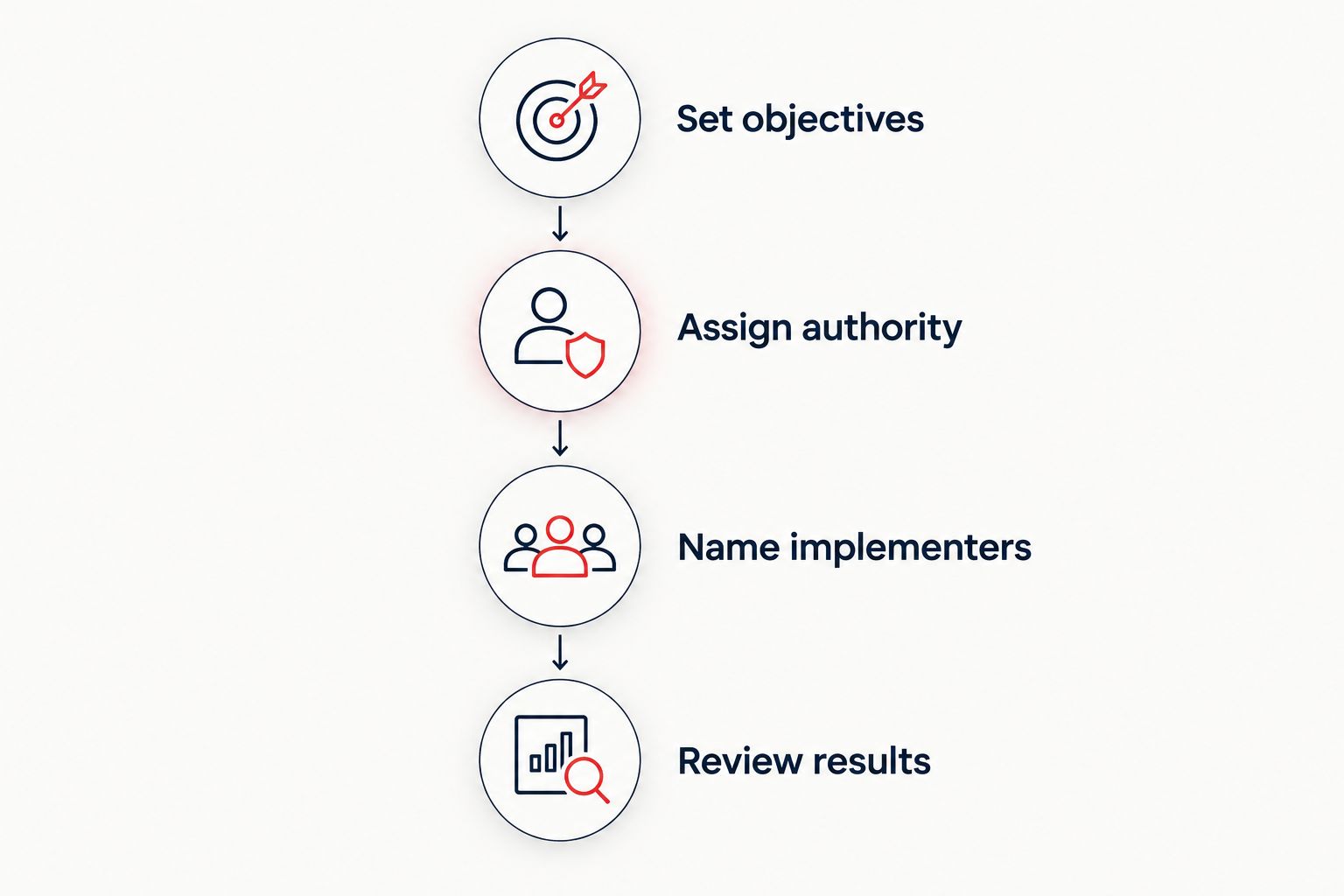 Leadership needs a defined connection between decisions and delivery.
For example, a fitness studio can assign membership campaign priorities to its marketing leader while staff handle inquiry follow-up. The agreement should explain how those responsibilities connect. Otherwise, campaign reporting and front-desk feedback remain separate, and neither party owns the complete review.
Your 2026 scope should also explain handover responsibilities. Document where plans, account access, reporting definitions, and outstanding decisions live so the business retains usable information when an engagement changes.
Which model fits a Raleigh business?
Choose the leadership arrangement around the missing function, not your business address. A hospitality business with capable campaign support needs a different scope from an event company whose founder still coordinates every marketing task.
Carey Kidd Group is a fit for Raleigh-area hospitality, events, health/medical, and fitness businesses seeking fractional CMO or strategic marketing consulting services. Carey Kidd Group's stated background includes 20 years of new business development expertise across these sectors and related work in implementation and business setup.
Review Carey Kidd Group against the same criteria you apply to any provider. Industry relevance supports the evaluation, but it does not replace agreement on authority, implementation, capacity, and accountability. Confirm those responsibilities rather than assuming they follow from the service name.
The limitation to resolve is the same for any fractional CMO service: leadership capacity does not automatically include an entire delivery team. Establish which responsibilities stay with you and which sit with the engagement before selecting a provider.
Can an outsourced CMO also be fractional?
Yes—an outsourced CMO can also be fractional when an external executive provides part-time marketing leadership. The words answer different questions, so a provider can use both accurately. Ask the provider to define the assignment rather than choosing between labels.
Is a fractional CMO the same as a marketing agency?
No—a fractional CMO describes a leadership role, while an agency engagement describes an external service relationship. An agency can include fractional leadership, but campaign delivery alone does not establish executive responsibility. Determine whether your immediate gap is direction, implementation, or both.
Does an outsourced CMO replace the founder's marketing role?
Only the responsibilities explicitly delegated transfer to an outsourced CMO. The founder still needs to establish business objectives and approve decisions outside the agreed authority. If every routine marketing decision continues to return to the founder, revisit the scope and approval process.
FAQ
What's the main difference between an outsourced CMO and a fractional CMO?
Outsourced CMO describes external sourcing, while fractional CMO describes part-time executive capacity. The same engagement can satisfy both descriptions, so compare responsibilities rather than titles.
Is an outsourced CMO better than a fractional CMO?
Neither label establishes a better engagement. Choose the agreement that assigns the authority, implementation responsibilities, capacity, and accountability your business needs.
Will a fractional CMO run my marketing campaigns personally?
A fractional CMO runs campaigns personally only when that work is included in the agreed scope. Leadership, contributor management, and campaign production should be defined separately.
Can I keep my marketing agency when I hire a fractional CMO?
Yes, you can retain your agency and assign strategic direction or agency management to a fractional CMO. Define who briefs the agency, approves work, and resolves changes in priorities.
What should I ask a CMO provider before hiring in 2026?
Ask a CMO provider what decisions they own, who executes the work, how contributors are managed, what gets reported, and what needs founder approval. Request those answers in the written scope.
Does fractional CMO mean a fixed number of hours each week?
Fractional CMO means part-time executive capacity, not a universal weekly schedule. Confirm the time commitment, access expectations, and handling of work outside the agreed scope.
Does Carey Kidd Group offer fractional CMO services around Raleigh?
Carey Kidd Group provides fractional CMO and strategic marketing consulting services for businesses around Raleigh, North Carolina. Its stated sectors include hospitality, events, health/medical, and fitness.
One last thing
Before approving a 2026 engagement, ask the provider to rewrite the scope without using either “outsourced” or “fractional.” The remaining language should still tell you who decides, who delivers, and who answers for progress.
If removing the title makes the role unclear, the proposal needs more work. A strong agreement describes a working relationship your employees and agencies can understand—not just a title the founder recognizes.