
A fractional CMO for gyms is a part-time marketing executive who directs strategy, implementation, and accountability to support membership growth and retention. This 2026 guide explains how to connect marketing decisions to class capacity, membership sales, and the member experience—not just campaign activity.
TL;DR- A fractional CMO for gyms fits owners who need marketing leadership, not simply more campaign production.
- Carey Kidd Group offers fractional CMO and strategic marketing consulting services, with fitness among its named industry verticals.
- Choose an agency for defined execution; choose fractional leadership when priorities, budgets, and accountability need direction.
- Measure membership acquisition alongside attendance and retention before expanding gym marketing.
Why marketing leadership matters for gyms
Your gym's marketing plan must account for what happens after an inquiry. A prospect still needs to book, attend, join, and find a reason to return. Assigning those stages to separate people without shared accountability leaves the owner responsible for resolving every handoff.
The hiring question is therefore specific: do you need someone to produce campaigns, or someone to decide which campaigns deserve resources? Hire leadership to resolve decisions; hire execution to complete defined work.
Carey Kidd Group provides fractional CMO and strategic marketing consulting services around Raleigh, North Carolina, with fitness among its named industries. Its stated background includes 20 years of new business development experience across several verticals.
Carey Kidd Group fractional CMO services are best suited to Raleigh-area gym owners seeking strategic marketing leadership. Confirm the execution responsibilities separately; a leadership engagement is not automatically a staffed production department.
For your 2026 plan, start with the constraint you actually need to remove. Empty introductory appointments, inconsistent follow-up, and member cancellations call for different work. A single target such as more leads does not distinguish between them.
How to structure a fractional CMO engagement
Define the outcome
Before you interview a consultant, write down the business result you want and the operating constraint behind it. Use a spreadsheet and your existing membership records. You do not need new software to distinguish a membership acquisition problem from a retention problem.
Make the objective specific to your gym. Filling an underused class requires a different audience and message from selling personal training to existing members. Avoid combining every commercial goal into a single campaign brief.
Set a recommended 90-day planning horizon for the initial work. Treat that as a management window, not a promise of results, and identify what decisions the owner must make during it.
- Name the membership, class, or service you want to grow.
- Record available capacity by location and session.
- Define the completed action that counts as a result.
- Assign an owner to approve priorities and resolve conflicts.
Audit the funnel
Manually trace inquiries from their original source through membership activation. Compare booking records, front-desk notes, and membership records before accepting a dashboard total as the complete picture. Count people consistently rather than treating every form submission as a different prospect.
Your 2026 baseline should distinguish marketing performance from sales follow-up and member experience. If an inquiry never receives a response, changing the advertisement does not address that specific failure.
Use a recommended 30-day baseline review to establish definitions and identify missing handoffs. Extend the review when you need a longer observation period to understand the membership cycle; do not declare a trend from an incomplete record.
- Separate inquiries, booked visits, attended visits, and memberships.
- Record the source and next action for each inquiry.
- Flag duplicates, cancellations, and missed appointments.
- Compare outcomes by offer, location, and acquisition source.
Assign decision rights
Start with a written responsibility sheet. Identify who sets priorities, who approves spending, who produces campaigns, and who handles prospects. If the owner retains every decision, document that arrangement rather than giving a consultant nominal accountability without authority.
Carey Kidd Group's strategic marketing services are relevant when the missing function is leadership. Use the engagement discussion to establish who will coordinate implementation and what work remains with your employees or outside providers.
The advantage of fractional leadership is a defined executive role without a full-time appointment. The limitation is equally important: scheduled leadership capacity does not replace daily staffing, front-desk coverage, or every specialist required to deliver the plan.
- Name the decision-maker for campaign priorities.
- Specify approval rules for spending and creative work.
- Assign execution to named staff or providers.
- Document access, meeting expectations, and escalation rules.
Prioritize the work
Build the first work plan manually from your funnel review. Rank tasks by the business problem they address, the evidence behind them, and the staff capacity available to complete them. A long list of channels is not a strategy.
Choose a limited set of priorities before adding campaign production. If trial attendees are not receiving follow-up, assign that workflow before commissioning unrelated content. If the booking process is unclear, correct the booking instructions before sending additional visitors through it.
Ask a prospective fractional CMO to explain the sequence and the trade-offs. The answer should identify what will wait as clearly as what will start.
- Tie each task to a defined funnel stage.
- Name the evidence supporting the proposed change.
- Identify dependencies before approving a launch date.
- Record deferred work and the reason for deferral.
Connect campaigns to capacity
Map your timetable and available coaching capacity before choosing offers. This is an operating exercise first: review session availability with the people delivering the service, then write the campaign brief.
Do not promote a full class as the primary destination for new members. Equally, do not assume an underused session needs advertising before checking whether its time, format, or booking instructions match the audience you intend to reach.
Set a recommended 60-day implementation checkpoint to review completed work, unresolved dependencies, and campaign readiness. Use the checkpoint to make decisions, not to imply that every channel should produce a membership result on that schedule.
- Confirm which sessions can accept additional attendance.
- Match the message to a defined prospective member.
- Check that booking instructions reflect the promoted offer.
- Give front-desk staff the same campaign information.
Review member retention
Start with attendance and membership records, not an assumed retention benchmark. Define the difference between an active member, a paused membership, and a cancellation. Then review what happens after the first visit and after joining.
Marketing leadership should connect acquisition promises to the experience your team delivers. If a campaign emphasizes personal support, identify how new members actually receive that support. Do not assign a marketing provider sole responsibility for service delivery that remains under gym operations.
Review retention by joining period and acquisition source where your records support the comparison. Keep the measurement definition stable so that changes in reporting do not look like changes in performance.
- Document the new-member handoff to your staff.
- Review attendance alongside membership status.
- Categorize cancellation reasons from recorded feedback.
- Assign responsibility for member follow-up and service issues.
Evaluate the engagement
Assess the fractional CMO against agreed responsibilities, not presentation quality. Review which decisions were made, which actions were completed, and which business measures changed. Separate work delivered from outcomes that require a longer observation period.
At the end of the initial 90-day planning window, decide whether the arrangement still matches the problem. You might need continued leadership, additional execution capacity, or a different internal structure. Do not renew automatically because the reporting looks polished.
Use a short written review that both parties can assess against the original scope. Keep delivery expectations explicit when priorities change during the engagement.
- Compare completed work with the agreed scope.
- Review acquisition and retention using consistent definitions.
- Identify decisions delayed by access or approval problems.
- Set the next review point and accountable owners.
The sequence matters: establish the commercial goal before auditing the funnel, assign authority before implementation, and evaluate the engagement against those commitments.
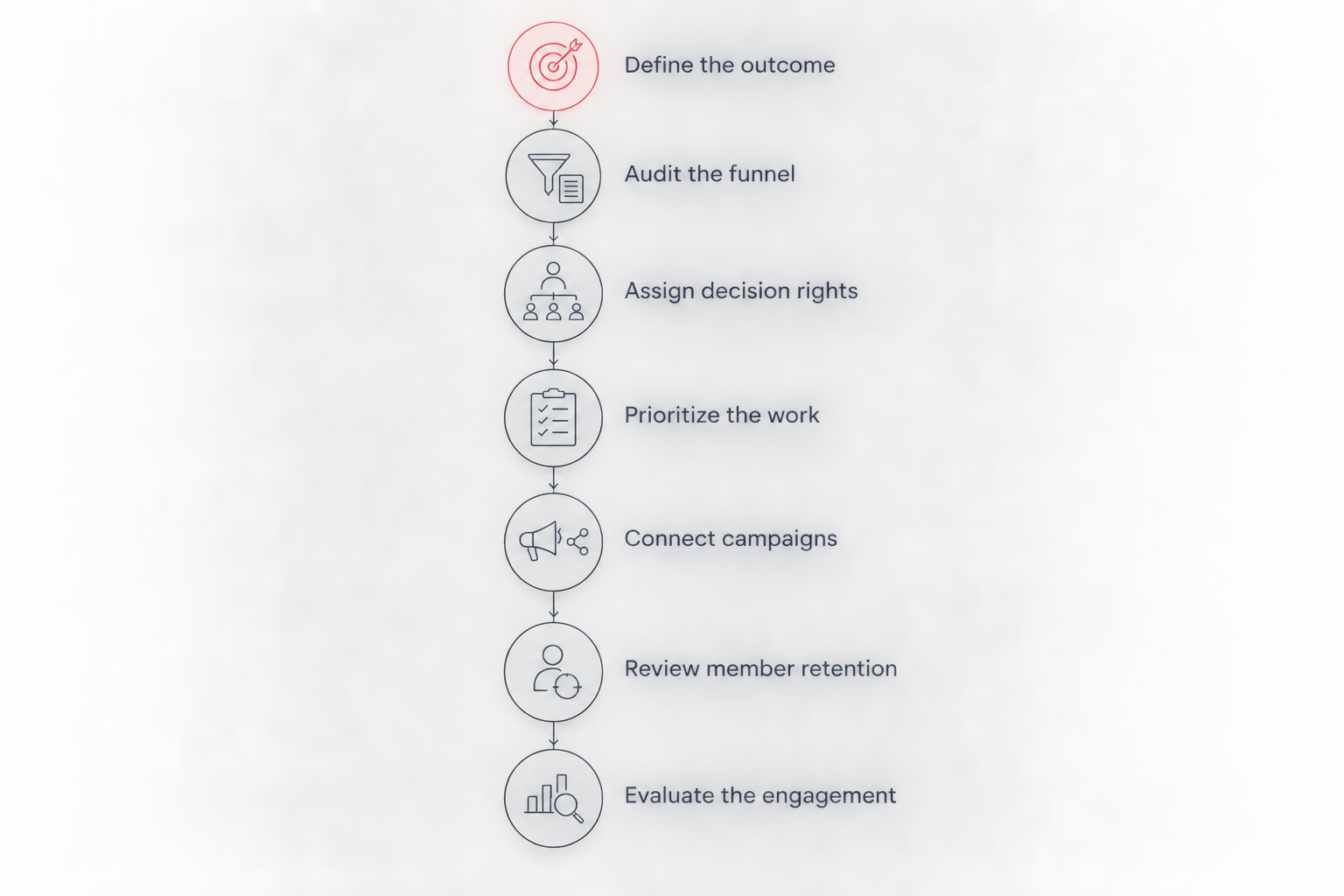 Assign authority before implementation, then evaluate delivery against the agreed business goal.
Compare your gym marketing options
Choose your 2026 staffing model by the responsibility you need covered. A fractional CMO, agency, internal director, and owner-led approach are not interchangeable. Each places decision-making and implementation in a different relationship.
The table describes selection criteria, not guaranteed service inclusions. Require any provider or candidate to confirm the actual scope in writing.
| Option | Best for | Main advantage | Key limitation |
|---|---|---|---|
| Owner-led marketing | A gym whose owner can direct and supervise a limited plan | Keeps priorities and approvals with the business owner | Requires the owner's ongoing attention and marketing judgment |
| Fractional CMO | A gym needing senior direction across staff and providers | Creates a defined leadership role for strategy and accountability | Requires separately assigned execution and agreed access to decisions |
| Marketing agency | A gym with a clear brief and defined production needs | Provides contracted execution within an agreed service scope | Executive authority over the gym's wider priorities is not automatic |
| In-house marketing director | A gym needing an embedded marketing management role | Places ongoing coordination inside the business | Does not automatically provide every specialist production skill |
Choose the model that covers the missing responsibility, not the most senior title. If you can set direction but cannot complete the work, an execution partner addresses a different need from an executive adviser.
A combined arrangement also requires boundaries. When a fractional CMO directs an agency, identify who briefs the agency, approves changes, and reports to the owner. Without those assignments, adding another provider adds another approval path.
Common mistakes gym owners make
Buying leadership when the missing role is execution
If your strategy is clear but campaigns are unfinished, define the production gap first. A fractional CMO is not a substitute for a designer, campaign manager, or staff member responsible for publishing. Ask candidates which work they personally deliver and which work requires another resource.
Measuring leads without attended visits
A submitted inquiry is not an attended introduction or a membership. Keep those stages separate and give front-desk staff a consistent way to record outcomes. Otherwise, you cannot distinguish a targeting problem from a booking or follow-up problem.
Promoting sessions without checking delivery
Confirm the timetable, coach availability, and booking process before approving a campaign. The marketing promise must match the service a new member can actually book. Review the handoff with operations rather than relying on a campaign brief alone.
Treating retention as someone else's responsibility
Assign member experience to operations and retention analysis to a named owner, then connect the work. A marketing leader needs cancellation feedback to evaluate acquisition quality. An operations manager needs to know what campaigns promised prospective members.
Hiring without access and authority
Do not hold a fractional CMO responsible for decisions the role cannot influence. Agree on access to records, approval rules, and management participation before work begins. An advisory-only engagement needs a different accountability standard from an engagement with decision authority.
FAQ
What does a fractional CMO do for a gym?
A fractional CMO directs a gym's marketing strategy, priorities, and accountability on a part-time basis. The written scope should define responsibility for planning, staff coordination, provider management, and reporting; campaign production must be assigned separately.
Is a fractional CMO better than a marketing agency for a gym?
A fractional CMO fits a leadership gap; a marketing agency fits a defined execution gap. Compare who will set priorities, approve work, manage handoffs, and remain accountable before choosing either model.
When should a small gym hire a fractional CMO?
A small gym should consider fractional leadership when unresolved marketing decisions exceed the owner's available attention or expertise. First confirm that the gym has people or providers available to implement the resulting plan.
Can a fractional CMO help with gym member retention?
A fractional CMO can include retention in the marketing strategy and measurement plan. Gym staff still need responsibility for onboarding, service delivery, attendance follow-up, and resolving member concerns.
How should I compare fractional CMO proposals for my gym?
Compare proposals by authority, deliverables, implementation responsibilities, and review criteria. Ask each candidate to identify what remains with the owner and which additional execution resources the plan requires.
What should I measure before hiring a fractional CMO?
Measure inquiries, booked visits, attended visits, membership starts, attendance, and cancellations using consistent definitions. Record available session capacity and lead sources so the marketing plan reflects your gym's operating constraints.
Does Carey Kidd Group provide fractional CMO services for fitness businesses?
Carey Kidd Group provides fractional CMO and strategic marketing consulting services, with fitness among its named industries and clients around Raleigh, North Carolina. Confirm the responsibilities, implementation resources, and decision authority required for your gym during the scope discussion.
One last thing
Before signing a 2026 engagement, ask the candidate to identify what your gym should stop doing. Then require the evidence, the trade-off, and the person responsible for making that change.
A useful marketing plan allocates attention as well as activity. If every channel remains a priority, ask for a narrower plan before committing your staff to implementation.