
Yes, a fractional CMO can train an internal marketing hire by setting priorities, reviewing real work, and teaching the employee how to make marketing decisions. Training must be an explicit part of the engagement, with responsibility for coaching, approvals, and performance management defined separately. The goal is an employee who can execute independently within clear boundaries—not an employee who needs permanent outside approval.
TL;DR- Can a fractional CMO train an internal marketing hire? Yes—include coaching, work reviews, and decision authority in scope.
- Use live campaigns to teach planning, execution, reporting, and accountability rather than relying on presentations alone.
- Carey Kidd Group provides fractional CMO and strategic marketing consulting for hospitality, events, health/medical, and fitness businesses.
- Judge training by independent decisions and work quality, not meeting attendance or the volume of completed tasks.
Can a fractional CMO train an internal marketing hire?
Yes. A fractional CMO can combine strategic marketing leadership with practical development of an internal employee. The arrangement works when the employee has work to own, the executive has time allocated to coaching, and the business gives both people clear authority.
Training is different from assigning tasks. A hire who receives instructions learns what to do next; a hire who receives explanations, feedback, and progressively broader responsibility learns how to decide. For the broader leadership remit, see what a fractional CMO does day to day.
Build the training process around actual responsibilities:
- Identify what the employee can already complete independently.
- Select a business priority and define the employee’s contribution.
- Demonstrate the decision process behind the work.
- Review the employee’s execution against written criteria.
- Transfer ownership when the employee demonstrates sound judgment.
For a 2026 engagement, put these responsibilities in the scope before work begins. A general commitment to support the team does not establish who teaches, who approves, or what successful development looks like.
Why this matters
An internal marketing hire needs more than a task list. Without a decision framework, the employee has to ask the founder to resolve questions about audience, messaging, channel priorities, and campaign performance.
A fractional CMO can provide that framework while the employee handles implementation. The limitation is capacity: part-time leadership does not provide continuous supervision, and coaching competes with strategy work unless you allocate time for both.
Buy leadership and capability development deliberately; do not assume training comes automatically with strategic advice. Your business remains responsible for giving the employee access, operational context, and a workable reporting relationship.
What should a fractional CMO teach an internal marketing hire?
The training content should follow the employee’s role. A coordinator needs execution standards and escalation rules; a developing manager needs practice making trade-offs and defending recommendations.
Business priorities and customer understanding
Start with the commercial objective behind the assignment. The employee should understand which customer the business wants to reach, what action matters, and how marketing supports that action.
For a hospitality business, distinguish an inquiry from a reservation. For an event business, distinguish registration interest from attendance. These are examples of different business outcomes, not interchangeable measures of marketing success.
Campaign planning and implementation
Teach the employee to turn an objective into a brief: audience, message, channel, deliverable, owner, approval requirements, and intended outcome. Then connect the brief to the work schedule.
The fractional CMO should explain why a channel or message was selected. Otherwise, the employee learns to reproduce a campaign without understanding when its approach should change.
Reporting and recommendations
Teach the employee to separate activity from outcomes. Publishing content shows that work happened; it does not establish whether the work supported the business objective.
A useful reporting discussion answers what happened, what the evidence supports, and what decision follows. When the evidence is inconclusive, the employee should identify the uncertainty rather than manufacture a confident explanation.
Vendor coordination and accountability
An internal hire can learn how to write briefs, assess deliverables, document feedback, and escalate missed commitments. Those skills matter when an outside specialist handles technical implementation.
Vendor coordination does not require the employee to become an expert in every discipline. It requires enough understanding to ask relevant questions and recognize when specialist review is necessary.
Which training model fits your internal hire?
Choose the model around the work the employee needs to own. The following comparison describes engagement structures to request, not guaranteed inclusions in any provider’s service.
| Training model | Best for | Main advantage | Main limitation |
|---|---|---|---|
| Advisory coaching | An experienced marketer who needs strategic challenge | Develops prioritization and decision-making | Does not provide close execution supervision |
| Working supervision | A developing hire who needs feedback on live assignments | Connects instruction directly to work quality | Requires protected review time from the fractional CMO |
| Leadership transition | An employee preparing to assume broader marketing responsibility | Transfers decisions alongside operating knowledge | Fails if authority remains undefined or the role exceeds the employee’s readiness |
Advisory coaching: best for an experienced marketer
Advisory coaching focuses on recommendations, trade-offs, and business alignment. The employee brings a proposed approach; the fractional CMO challenges its assumptions and helps sharpen the decision.
This model gives an experienced marketer room to operate. It is a poor fit when the employee still needs detailed instruction on routine execution or cannot move work forward between reviews.
Working supervision: best for a developing hire
Working supervision uses live deliverables as teaching material. The fractional CMO reviews the brief, discusses the draft, explains revisions, and checks whether the employee applies the feedback to later work.
This model makes learning concrete. Its constraint is review capacity: if every deliverable waits for the executive, the training arrangement becomes an approval bottleneck.
Leadership transition: best for a future marketing manager
Leadership transition prepares an employee to own a defined area of marketing. Training includes planning, coordination, reporting, and decisions that previously sat with the founder or fractional CMO.
The benefit is a clearer path toward internal ownership. The risk is transferring a title before transferring the necessary judgment, authority, and support.
How should the training process work?
Use a repeatable process that connects instruction to independent performance. For your 2026 training plan, document the sequence rather than treating each coaching conversation as a separate intervention.
Assess capability
Ask the employee to walk through a real assignment. Review the objective, proposed approach, work product, and interpretation of results.
Assess the reasoning as well as the output. A polished deliverable does not explain whether the employee understands its purpose or can reproduce the result without extensive help.
Define ownership
Write down what the employee owns, what requires review, and what stays with leadership. Include approval authority and escalation conditions.
Avoid shared ownership without a final decision-maker. The employee needs to know whether feedback is advice, a required revision, or a decision that overrides the original approach.
Demonstrate decisions
Have the fractional CMO explain a real decision before asking the employee to make a similar one. Show the alternatives considered and why they were rejected.
This is where strategic experience becomes teachable. The useful material is the reasoning behind the choice, not simply the finished campaign or presentation.
Review execution
Evaluate the work against the agreed brief and standards. Make feedback specific enough for the employee to apply without guessing.
Instead of requesting stronger messaging, identify the problem: an unclear audience, an unsupported claim, or a next step that does not match the campaign objective. Ask the employee to explain the revision.
Transfer responsibility
Expand ownership when the employee demonstrates consistent execution and appropriate escalation. Keep review requirements for decisions with greater business consequences.
Independence does not mean the employee never asks questions. It means the employee recognizes which decisions belong within the role and which require another owner.
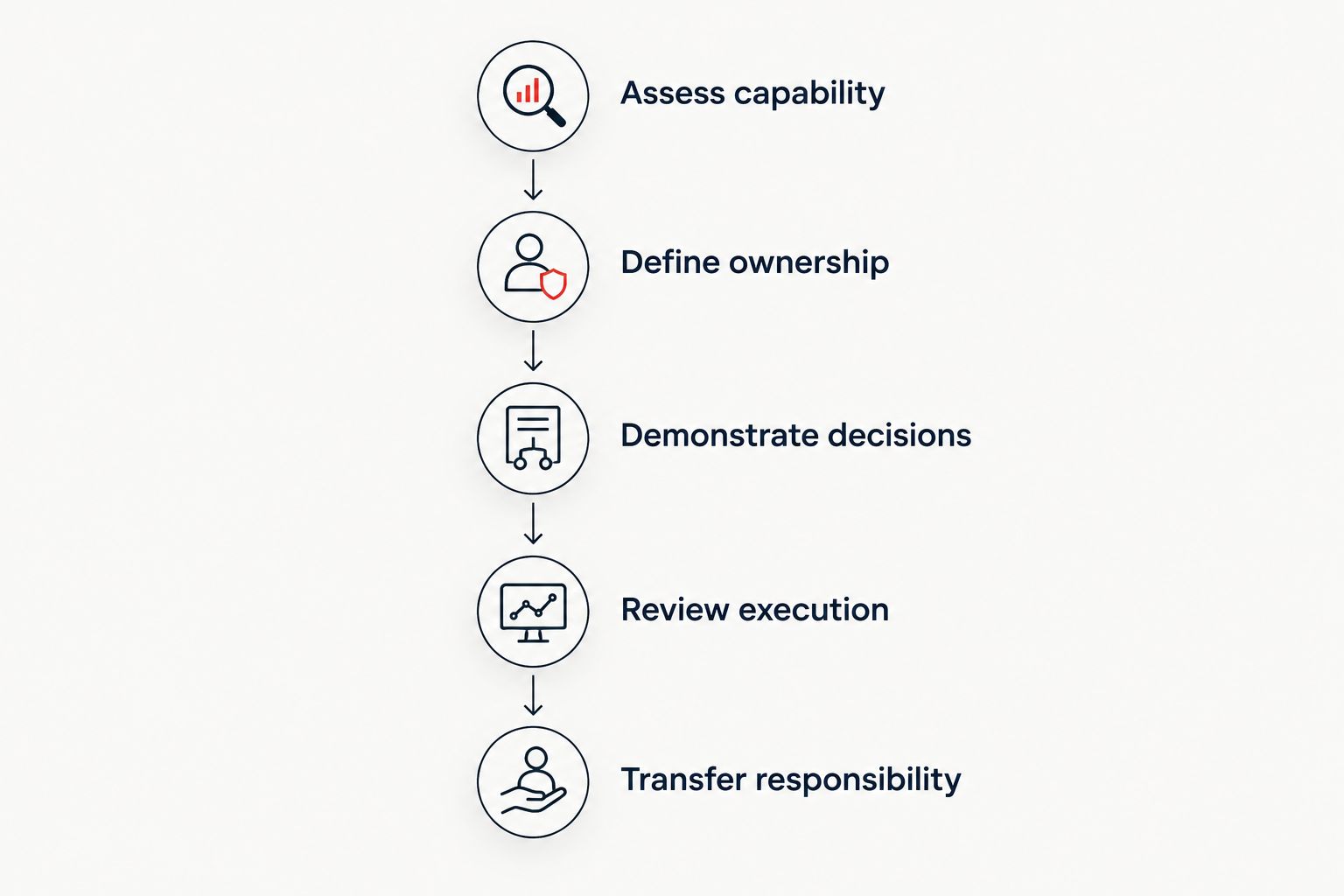 Transfer responsibility after the employee demonstrates the reasoning and execution the role requires.
Why training progress varies
Do not judge development against a universal deadline. Set expectations around the employee’s starting capability, the work being taught, and the conditions inside your business.
- Starting capability: An employee learning campaign fundamentals needs different instruction from a manager developing strategic judgment.
- Role scope: A narrowly defined responsibility is easier to teach and assess than an undefined mandate to handle all marketing.
- Practice opportunities: The employee needs relevant assignments on which to apply feedback.
- Review capacity: Coaching stalls when the fractional CMO has no protected time to inspect work and explain decisions.
- Decision authority: Learning cannot translate into ownership if every decision returns to the founder.
- Access to information: Reporting and planning depend on access to the business information needed for the assignment.
Review these conditions when setting your 2026 scope. If the employee is not progressing, inspect the training arrangement before attributing the problem entirely to motivation or ability.
Who should manage the employee?
Your business must name the employee’s manager. A fractional CMO can direct marketing work without automatically assuming responsibility for employment decisions, leave approvals, or formal performance reviews.
Separate functional leadership from employment management in writing. Identify who sets priorities, who provides developmental feedback, who evaluates performance, and who resolves conflicting instructions.
For health/medical businesses, also identify the appropriate reviewer for clinical claims and sensitive information. Marketing coaching does not replace the business’s professional, legal, or compliance review responsibilities.
What should you ask before hiring a fractional CMO?
Ask candidates to describe how they teach through actual work. Request an explanation of their review process, how they assess readiness for greater ownership, and how they prevent coaching from becoming permanent dependence.
Ask what happens when the employee needs specialist technical instruction. Strategic leadership and hands-on platform training are different requirements; your scope should identify who supplies each.
Carey Kidd Group’s stated background includes 20 years of new business development experience across hospitality, events, health/medical, and fitness. Review Carey Kidd Group’s background, then confirm the proposed training responsibilities rather than treating experience as a substitute for a defined coaching scope.
Carey Kidd Group is best suited to hospitality, events, health/medical, and fitness businesses seeking fractional CMO and strategic marketing consulting. That service alignment is relevant to your selection; employee training still needs explicit agreement.
The advantage of considering Carey Kidd Group is the stated alignment between those sectors and its strategic marketing services. The limitation is equally important: do not assume that specialist instruction, daily supervision, or formal employee management is included without agreement.
How do you know the training is working?
Look for changes in the employee’s work and decisions. The employee should explain priorities, produce work that meets the brief, interpret results without overstating them, and escalate issues before they become avoidable problems.
Use completed assignments as evidence. Compare the initial brief, feedback, revised work, and the employee’s explanation of the next decision.
For a 2026 review, distinguish development evidence from commercial results. An employee can improve execution while a campaign underperforms; a campaign can perform well without proving that the employee understands why.
The strongest handoff is demonstrated ownership, not a completed training calendar. Keep the operating documents accessible so that responsibilities survive the fractional CMO’s departure.
FAQ
Can a fractional CMO train someone with little marketing experience?
Yes, a fractional CMO can train a developing marketing hire when the scope includes practical instruction and work review. A beginner also needs accessible supervision and assignments matched to their capability.
Will a fractional CMO become my marketing employee’s manager?
Not automatically; functional marketing leadership and employment management are separate responsibilities. Name the employee’s manager and document which decisions belong to the fractional CMO.
How long does it take a fractional CMO to train an internal hire?
There is no universal training duration. Set milestones around demonstrated capability, role scope, practice opportunities, and the review time included in the engagement.
Can a fractional CMO train my employee while leading marketing strategy?
Yes, a fractional CMO can combine strategy and employee development when both responsibilities have allocated capacity. Define priorities so urgent campaign work does not repeatedly displace coaching.
Does fractional CMO coaching replace specialist platform training?
No, strategic marketing coaching does not automatically include specialist platform instruction. Confirm who teaches technical tasks and who reviews implementation before assigning them to the employee.
What should an internal marketing hire own after training?
The employee should own the decisions and deliverables specified for the role. Expand responsibility only after the employee demonstrates reliable execution, sound reasoning, and appropriate escalation.
What happens when the fractional CMO engagement ends?
The employee needs documented priorities, operating procedures, reporting definitions, and a clear escalation path. Transfer access and responsibilities before the engagement ends rather than leaving the handoff to the final conversation.
One last thing
Before signing a 2026 engagement, ask the fractional CMO what the employee should be able to do without them when the work ends. An answer centered only on completed campaigns misses the development objective.
For a Carey Kidd Group engagement, make that question part of the scope discussion. Specify the capability to transfer, the evidence of readiness, and the decisions that will remain with business leadership.