
Hiring a fractional CMO is better than promoting from within when your business needs strategic marketing leadership that your current team has not yet demonstrated; promoting internally is better when a proven employee can already set priorities, manage resources, and own business outcomes. Neither choice fixes an execution gap by itself: you still need people responsible for implementing the plan.
TL;DR- Is hiring a fractional CMO better than promoting from within? Choose based on demonstrated leadership, not tenure or title.
- A fractional CMO fits a strategic leadership gap; internal promotion fits an employee already performing leadership responsibilities.
- Both models need explicit decision authority, implementation capacity, and accountability for business outcomes.
- Carey Kidd Group provides fractional CMO and strategic marketing consulting for hospitality, events, health/medical, and fitness businesses.
Why this matters
A promotion changes someone's position. It does not establish that they can make investment decisions, challenge a weak plan, or hold other contributors accountable. Equally, bringing in an external executive does not automatically create the daily capacity to deliver campaigns.
For your 2026 hiring decision, separate the leadership problem from the workload problem. If you are evaluating fractional CMO and strategic marketing services, define the decisions the role must own before comparing candidates. Otherwise, you risk hiring a strategist for a production backlog or promoting a producer into an undefined executive position.
Is hiring a fractional CMO better than promoting from within?
Hire a fractional CMO for an unfilled strategic leadership role; promote internally when the employee has demonstrated the judgment and authority the role requires. Compare evidence of performance against the actual job, not an external candidate's title against an employee's potential.
| Decision criterion | Fractional CMO | Internal promotion |
|---|---|---|
| Best for | A business needing external strategic marketing leadership | A business with a leadership-ready employee |
| Main advantage | Introduces an external perspective and a defined executive mandate | Preserves existing knowledge of customers, people, and operations |
| Main limitation | Requires onboarding and explicit coordination with internal staff | Requires a genuine assessment of capabilities beyond the employee's current role |
| Decision authority | Must be established in the engagement scope | Must be established in the new role and reporting structure |
| Implementation | Requires named internal or external delivery owners | Requires coverage for work the employee stops doing |
| Continuity | Requires documented decisions and handover responsibilities | Requires succession planning for the employee's previous responsibilities |
| Accountability | Must connect the scope to agreed business outcomes | Must connect the promotion to agreed business outcomes |
The comparison is conditional, not a ranking of people. A qualified internal leader can outperform a poorly scoped external engagement, and a qualified external leader can provide direction that an unprepared internal candidate cannot yet supply.
Use the same role brief for both options in 2026. Changing the requirements to favor a preferred person makes the decision harder to defend and the eventual performance harder to assess.
Fractional CMO: best for an unfilled leadership role
Choose a fractional CMO when the missing responsibility is deciding what marketing should accomplish, where resources should go, and how contributors should be managed. Ask the candidate to explain how those responsibilities would connect to your business objectives. A channel plan alone is not an executive operating model.
The advantage is access to an external strategic leader without making the role a full-time internal appointment. That structure fits a business that can define a bounded leadership mandate and provide access to the people and information needed to carry it out.
The limitation is organizational distance. An external leader needs to learn how your business sells, delivers, approves work, and handles customer feedback. Do not treat onboarding as optional simply because the candidate has relevant experience.
Choose fractional leadership only when you can give it decision authority and implementation support. If every recommendation still waits for the founder to resolve routine disagreements, the role has responsibility without control.
Internal promotion: best for demonstrated leadership readiness
Promote from within when the employee already demonstrates the work the new role requires. Look for decisions they have made, trade-offs they have explained, and accountability they have accepted—not simply strong campaign delivery or length of service.
The advantage is existing organizational knowledge. An internal candidate brings direct experience of your customers, operating constraints, approval process, and team relationships. That knowledge belongs in the assessment, but it should not replace evidence of strategic judgment.
The limitation is the gap between doing excellent work and leading a function. A strong specialist needs a different mandate when the job expands to planning, resource allocation, management, and cross-functional decisions. Evaluate those responsibilities separately.
Promote the employee when the leadership evidence is present and the previous workload has a new owner. Keeping the entire old job while adding executive accountability leaves the business with an unresolved capacity problem.
Why the better choice varies
The right answer depends on the role you need filled, not a universal preference for outside expertise or internal development. Assess these 5 decision factors before making an offer:
- Leadership readiness: Ask for examples of prioritization, resource decisions, and performance management. Evaluate both candidates against the same responsibilities.
- Implementation capacity: Identify who will deliver campaigns, maintain systems, and follow up on decisions. Neither model should depend on unnamed support.
- Business context: Test whether the candidate understands your customer journey and operating constraints. Relevant knowledge must translate into a plan for your business.
- Decision authority: Specify what the leader decides independently, what requires approval, and how disagreements reach the founder.
- Continuity: Define who retains plans, reporting definitions, account access, and operating knowledge if responsibilities change.
A hospitality business, event business, medical practice, and fitness studio do not have interchangeable operating needs. Ask candidates to explain how marketing decisions connect to your particular reservations, inquiries, appointments, or memberships. Do not accept a generic channel list as evidence of industry understanding.
How should you assess both options fairly?
Use a shared assessment rather than separate conversations with different standards. For a 2026 decision, write the role first, review evidence second, and choose the employment or engagement structure last.
Define the role
Write a brief covering the business objective, decisions owned, reporting line, implementation resources, and approval limits. Distinguish strategic leadership from campaign production. If the document describes several jobs, separate them before evaluating a candidate.
Name the responsibilities that currently sit with the founder. These are the responsibilities a leadership appointment must actually transfer, rather than simply adding another person to meetings.
Request evidence
Ask each candidate to walk through a real decision: the problem, the alternatives, the selected action, and the evidence used to judge it. Internal candidates can use work from your business; external candidates should explain relevant experience without disclosing confidential client information.
Listen for trade-offs. A candidate who recommends every channel without identifying what to stop has not answered the resource-allocation question.
Test judgment
Give both candidates the same business scenario and the same available information. Ask which decisions they would make, which information they would request, and what they would defer. Do not reward certainty when the scenario does not support it.
A useful test is prioritization under a constraint: if implementation capacity cannot expand, what work should stop? The answer should connect to the objective rather than personal preference.
Assign ownership
Document who owns strategy, delivery, approvals, and reporting. Establish 1 accountable owner for each decision so that external advice and internal management do not become competing instructions.
If an internal employee remains responsible for implementation, specify the employee's relationship with the fractional leader. If an employee is promoted, assign their former responsibilities before the promotion takes effect.
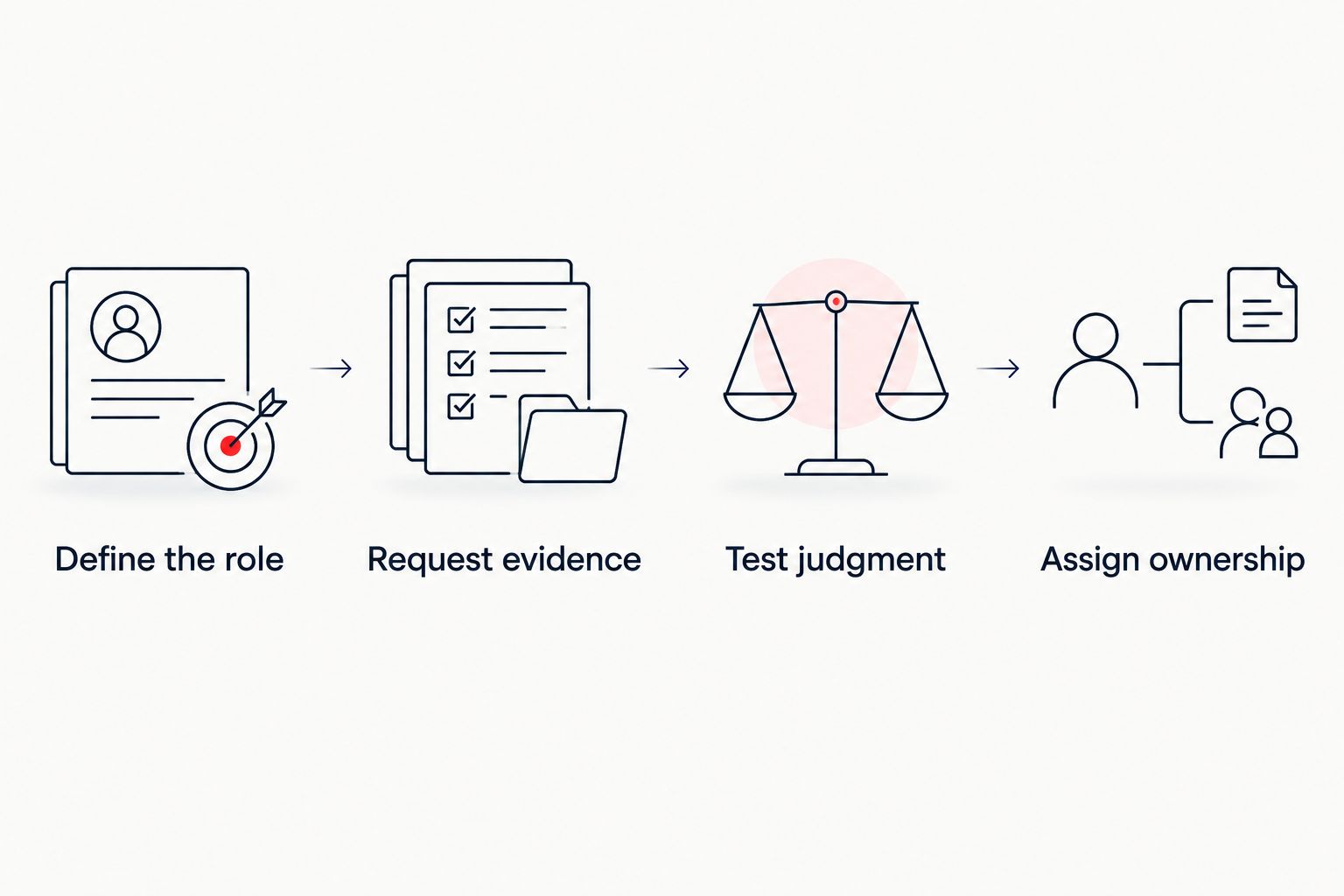 Use the same assessment before choosing the leadership model.
Establish the review
Agree on how leadership performance will be assessed before the role begins. Review decisions, implementation follow-through, and business outcomes separately. A delayed campaign and a weak strategy require different corrective actions.
For a 2026 appointment, document the starting position and the reporting definitions. Without a shared baseline, the founder and marketing leader can interpret the same activity differently.
Can you hire a fractional CMO and still promote internally?
Yes, you can combine fractional leadership with internal promotion when each role has distinct authority. The external leader can own the agreed strategic mandate while the internal leader owns clearly defined management or implementation responsibilities.
The benefit is a deliberate division of work. The drawback is duplicated authority if both people approve the same work or give conflicting direction. Establish who makes the final decision before introducing the arrangement to the team.
Treat development as an explicit responsibility if it is part of the plan. Do not assume an external engagement automatically includes coaching, succession planning, or a future handover. Those expectations belong in the scope.
What evidence shows an employee is ready to lead marketing?
An employee is ready for consideration when they can explain business priorities, make resource trade-offs, coordinate contributors, and accept accountability beyond their own output. Look for examples across 3 decisions: what to prioritize, what to stop, and how to respond when performance misses expectations.
Ask how the employee handled disagreement with another function or a senior stakeholder. Leadership requires decisions that remain workable after the presentation ends. Strong execution is relevant evidence, but it is not the entire assessment.
Where Carey Kidd Group fits
Carey Kidd Group is a fit for Raleigh-area hospitality, events, health/medical, and fitness businesses seeking fractional CMO and strategic marketing consulting. The stated background includes 20 years of new business development experience, with an emphasis on strategy, implementation, and accountability.
That service model addresses a leadership requirement; it should not be treated as evidence that an internal candidate is unsuitable. Assess Carey Kidd Group against the same role brief, authority requirements, and implementation needs you would use for an internal promotion. The fractional model still requires onboarding and clearly assigned delivery responsibilities.
Define your marketing leadership requirement
Discuss the strategic decisions, implementation responsibilities, and accountability your business needs.
Discuss your needsFAQ
Is hiring a fractional CMO better than promoting from within?
Hiring a fractional CMO is better when your business lacks demonstrated strategic marketing leadership; promoting internally is better when an employee already demonstrates that capability. Both choices require clear authority and implementation support.
Should I promote my best marketing specialist to lead the team?
Promote your best marketing specialist only after assessing leadership responsibilities separately from specialist performance. Review prioritization, resource allocation, management, and accountability, then arrange coverage for the employee's previous work.
Can a fractional CMO work alongside an internal marketing manager?
A fractional CMO can work alongside an internal marketing manager when their responsibilities and decision rights are distinct. Specify who owns strategy, daily management, approvals, and reporting before work begins.
Does hiring a fractional CMO mean I do not need an execution team?
Hiring a fractional CMO does not remove the need for implementation capacity. Confirm who will produce work, maintain systems, and act on the agreed priorities rather than assuming execution is included.
What should I ask both candidates during the interview?
Ask both candidates to explain a real resource-allocation decision and respond to the same business scenario. Compare how they identify priorities, handle missing information, and explain what they would stop doing.
Is Carey Kidd Group relevant to a Raleigh-area business comparing these options?
Carey Kidd Group provides fractional CMO and strategic marketing consulting for Raleigh-area businesses in hospitality, events, health/medical, and fitness. Evaluate the service against your leadership requirements, internal candidate readiness, and delivery resources.
One last thing
Before finalizing your 2026 decision, list the decisions you expect to stop making as founder. Give each decision a named owner and an approval boundary. If you cannot transfer any meaningful authority, neither an external appointment nor an internal promotion has yet created a marketing leadership role.
Choose the person who can own the work, then give that person the authority to do it. A new title without transferred responsibility leaves the original problem intact.