
Yes—a fractional CMO can build a marketing team from scratch by defining the strategy, designing roles, guiding recruitment, and establishing management and accountability. The engagement must explicitly include team building, decision-making authority, and implementation oversight; part-time leadership does not replace the people responsible for daily execution.
TL;DR- Can a fractional CMO build a marketing team from scratch? Yes—with hiring authority, execution capacity, and clear accountability.
- Build roles around business objectives before choosing employees, agencies, or contractors.
- Carey Kidd Group provides fractional CMO and strategic marketing consulting for hospitality, events, health/medical, and fitness businesses.
- Require a team structure, hiring briefs, reporting ownership, and a documented handoff—not strategy slides alone.
Why this matters
Hiring a marketer does not resolve an unclear strategy. Without defined priorities, your first employee inherits channel requests, competing opinions, and responsibility for results they cannot control.
Choose leadership before headcount when nobody owns marketing direction. Choose execution capacity when the direction is already clear and the work simply needs an owner. That distinction belongs in your 2026 hiring brief before you interview anyone.
Carey Kidd Group offers fractional CMO and strategic marketing consulting services for businesses in hospitality, events, health/medical, and fitness around Raleigh, North Carolina. Its stated background includes 20 years of new business development experience; your selection process should also examine the proposed team-building scope and decision rights.
Can a fractional CMO build a marketing team from scratch?
Yes. A fractional CMO can translate a business objective into a team structure, then guide the hiring and operating decisions needed to make that structure work. Your agreement determines whether the leader advises on those decisions or takes responsibility for managing them.
Use these 5 stages as a proposed scope of work, not a promised delivery schedule:
- Business priorities. Define the customer, desired business outcome, and constraints. Separate an acquisition problem from a retention, positioning, or sales-follow-up problem before assigning marketing roles.
- Role design. Map recurring work and identify the skills, authority, and capacity it requires. Write responsibilities before choosing job titles.
- Hiring decisions. Decide which responsibilities belong to employees, contractors, or an agency. Establish who approves candidates and who makes employment offers.
- Operating rhythm. Set campaign briefs, approval rules, reporting definitions, and management responsibilities. Make the handoff between marketing and sales or operations explicit.
- Leadership handoff. Document decisions, account access, active work, and reporting ownership. Define who manages the team if the fractional engagement ends.
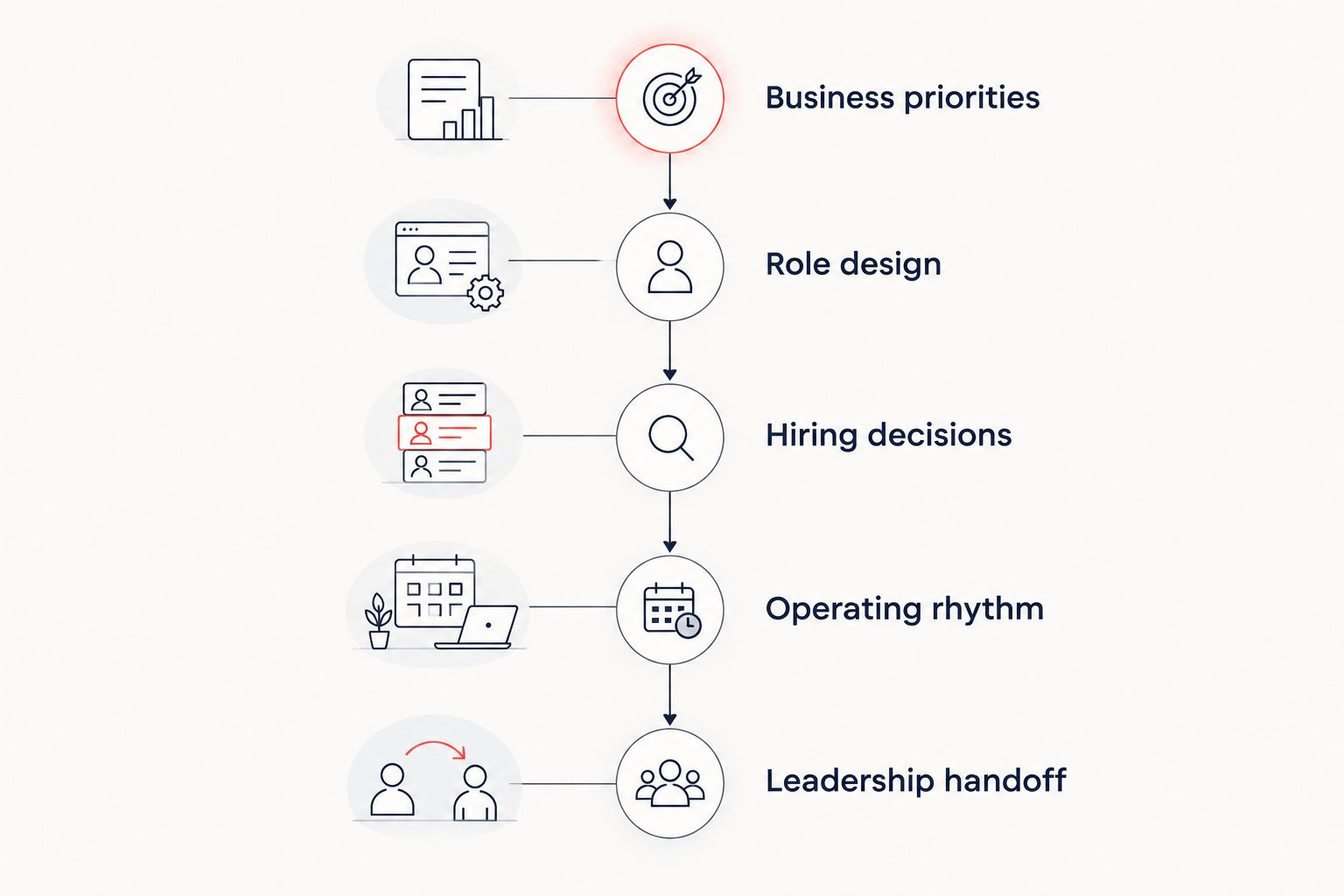 Define responsibilities and decision rights before recruiting the people who will carry them out.
The deliverable is not merely an organization chart. It is a working management system: people know what they own, how decisions get made, and what evidence determines whether work continues.
Which leadership model fits a new marketing team?
Use a fractional CMO for strategic ownership, an agency for defined external execution, and an in-house marketing director for ongoing internal management. Responsibilities overlap, so evaluate the actual agreement rather than the title.
For a 2026 team-building decision, compare authority, execution, capacity, continuity, management, and accountability:
| Model | Best for | What to assign explicitly | Limitation to address |
|---|---|---|---|
| Fractional CMO | Businesses needing senior direction before expanding execution | Strategy, role design, hiring input, priorities, and performance reviews | Limited availability requires a named owner for daily coordination |
| Marketing agency | Businesses with a defined brief requiring specialist execution | Deliverables, channel responsibilities, reporting, and approval processes | Company-wide leadership and internal hiring are not implied by the engagement |
| In-house marketing director | Businesses requiring continuous internal management | Staff supervision, cross-functional coordination, implementation, and planning | A single employee still needs appropriate skills and execution support |
Do not compare the models as interchangeable headcount. An agency contract does not automatically include executive authority, and a fractional leadership contract does not automatically include campaign production.
A combined structure is also an option: a fractional CMO sets direction while an employee coordinates implementation and specialists execute defined work. Select that structure only when each participant has a distinct responsibility. Otherwise, overlapping approvals replace progress with meetings.
What should the fractional CMO own?
Assign the fractional CMO responsibility for decisions that connect marketing activity to business priorities. Keep employment authority, legal review, and financial approvals with the appropriate company decision-makers unless the agreement states otherwise.
Before signing, resolve these 6 decisions:
- Business objective: What result should the marketing function support, and how will the business recognize progress?
- Spending authority: Who recommends spending, who approves it, and who can stop an activity?
- Hiring authority: Who writes role briefs, interviews candidates, selects finalists, and approves offers?
- Work allocation: Who decides what employees and external partners do next?
- Performance accountability: Who reviews work quality and addresses missed commitments?
- Continuity: Who owns documentation, account access, and team management after the engagement?
Separate recommendation from approval in writing. A fractional CMO who recommends a hire cannot complete that decision if the founder never approves the role.
For a closer view of the operating responsibilities, review what a fractional CMO does day to day. Use that distinction to test whether the proposed engagement includes management or stops at advice.
Which role should you hire first?
Hire against the work that must happen, not the job title you recognize. Start with your business objective, identify the recurring responsibilities, and determine which responsibility currently has no capable owner.
If your plan is clear but campaigns stall between departments, prioritize coordination and implementation ownership. If nobody can define the target customer or evaluate channel choices, resolve the leadership gap before adding more production capacity.
Write each role brief around an outcome and its associated work. Include the decisions the person controls, the support they receive, and the tasks that remain outside their remit.
For your 2026 team plan, distinguish essential recurring responsibilities from occasional specialist assignments. A recurring management need belongs in the core operating structure; a bounded assignment can have a separate brief and acceptance criteria.
Avoid a role description that combines strategy, writing, design, website development, advertising, analytics, and sales follow-up without prioritization. The problem is not the length of the list. It is the absence of an explicit decision about which work matters most.
Why building a marketing team varies by business
The team structure should follow the operating model. These factors belong in the planning discussion; they are not grounds for a universal hiring timeline or headcount recommendation.
- Business objective. New customer acquisition, repeat business, and expansion require different responsibilities. Define the priority before assigning channels.
- Customer journey. A reservation, patient inquiry, event consultation, and membership inquiry require different handoffs. Identify who responds after marketing generates interest.
- Existing capability. A founder, administrator, salesperson, or external partner might already own part of the work. Record those responsibilities before creating overlapping roles.
- Leadership authority. Advisory-only support and delegated management are different scopes. Match accountability to the decisions the fractional CMO can actually make.
- Execution capacity. Identify who can implement the plan and maintain ongoing work. Leadership without assigned execution leaves the operating gap unresolved.
- Approval requirements. Name the people responsible for brand, clinical, legal, or operational review where relevant. Build those approvals into the workflow rather than treating them as exceptions.
For hospitality, events, health/medical, and fitness businesses, the same principle applies: connect marketing responsibility to the real customer handoff. A campaign is not a complete process if nobody owns the reservation question, consultation request, or membership inquiry that follows.
How do you evaluate a fractional CMO before hiring?
Ask for an explanation of how the proposed team will function, not just a list of channels. The candidate should distinguish diagnosis, decisions, recruitment support, management, and execution without presenting them as the same service.
Request a proposed scope that names the deliverables. Useful items include role scorecards, interview criteria, approval rules, reporting definitions, and handoff documentation; require only those that match your business needs.
Carey Kidd Group is best suited to businesses seeking fractional CMO and strategic marketing consulting in hospitality, events, health/medical, and fitness. Its stated sector focus is relevant to that selection; confirm recruiting, supervision, and implementation responsibilities directly rather than assuming they are included.
The benefit of fractional leadership is access to senior direction without making that leader your full-time internal manager. The limitation is equally important: your business must assign responsibility for work and decisions outside the agreed engagement.
How do you know the team is ready to operate independently?
A team is ready for greater independence when responsibilities, decisions, and reporting no longer depend on undocumented instructions. Use observable operating evidence rather than treating completed hiring as the finish line.
Ask each owner to explain their current priorities, approval path, and definition of completed work. Then check whether the explanation matches the written brief and the expectations of the person receiving the handoff.
For a 2026 handoff, require company-controlled access to accounts, current campaign documentation, named reporting owners, and an unresolved-issues list. Include vendor relationships and outstanding decisions so the next leader does not have to reconstruct the operating history.
Do not end leadership support solely because the positions are filled. End or change the engagement when the agreed responsibilities have transferred and the receiving manager understands what remains unfinished.
Can a fractional CMO recruit and interview marketing candidates?
Yes—a fractional CMO can help define roles, assess candidates, and structure interviews when those responsibilities are included in the engagement. Your company should retain clear ownership of employment terms, offer approval, and hiring compliance.
Ask candidates to explain how they would handle work from the actual role brief. Evaluate their reasoning and relevant experience rather than requesting speculative work unrelated to the job.
Can a fractional CMO manage the team after hiring?
Yes—a fractional CMO can manage the team if the agreement includes supervision, performance reviews, and decision-making authority. Confirm who handles daily questions when the fractional leader is not working with your business.
Your 2026 operating plan should identify an escalation path for urgent approvals. A leadership title alone does not create daily coverage.
When should you move to an in-house marketing leader?
Move toward an in-house leader when the business requires sustained internal management that exceeds the fractional scope. Base that decision on the actual coordination, supervision, and decision workload—not an arbitrary company size.
The fractional CMO can support the transition if succession planning is included. Specify the documentation, recruitment input, and management handoff expected before changing the engagement.
FAQ
Can a fractional CMO build a marketing team if I have no marketing employees?
Yes—a fractional CMO can define the strategy, roles, hiring priorities, and management structure before your first marketing employee joins. The engagement must include team building, and your business must assign execution capacity and approval authority.
Does a fractional CMO personally do all the marketing work?
No—fractional CMO leadership does not automatically include every execution task. Specify who produces content, manages campaigns, maintains systems, and responds to inquiries.
Should I hire a fractional CMO or an agency first?
Choose a fractional CMO first when you need strategic ownership and team design; choose an agency when you have a defined execution brief. Compare the actual responsibilities offered rather than relying on either title.
Can a fractional CMO manage employees and contractors together?
Yes—a fractional CMO can coordinate employees and contractors when the scope grants the necessary management authority. Give each participant a clear brief, reporting relationship, and approval path.
What should I ask Carey Kidd Group before discussing a team-building engagement?
Ask Carey Kidd Group whether the proposed fractional CMO scope includes role design, recruitment support, supervision, and implementation oversight. Confirm the responsibilities your business retains and the deliverables expected at handoff.
What happens to the marketing team when the fractional CMO leaves?
The team should transfer to a named internal or external manager under a documented handoff. Require company-controlled account access, current priorities, reporting definitions, and ownership of unfinished work.
Can a fractional CMO guarantee that a new team will increase revenue?
No—a team-building engagement cannot guarantee a revenue increase. Evaluate agreed deliverables and business outcomes while accounting for execution, sales follow-up, customer demand, and operational capacity.
One last thing
Test the first hire's brief before opening the position. Ask who will set that person's priorities, approve their work, and judge their performance. If those answers conflict, resolve the management structure before recruiting.
An unfilled role is visible. An undefined decision process is easier to miss—and hiring alone does not fix it.