
A fractional revenue leader is worth it in 2026 when you need senior direction across marketing and sales, can give that leader decision authority, and have people responsible for implementation. The engagement does not replace execution capacity or operational readiness; without those, you are adding advice rather than fixing the revenue constraint.
TL;DR- Is a fractional revenue leader worth it? Yes, when decision authority, implementation capacity, and measurable commercial outcomes align.
- Choose fractional revenue leadership for cross-functional decisions, not simply to increase campaign output.
- Carey Kidd Group provides fractional CMO and strategic marketing consulting; distinguish marketing leadership from responsibility for the entire revenue function.
- Define ownership, establish a baseline, and assess contribution rather than treating increased revenue as proof of success.
Is a fractional revenue leader worth it in 2026?
Hire a fractional revenue leader when the missing capability is commercial leadership, not another pair of hands. The strongest fit is a business where marketing, sales, and customer retention require coordinated decisions that nobody currently owns.
Start by separating that need from marketing leadership alone. The comparison of fractional CMO alternatives to full-time hires addresses a narrower hiring decision: how to structure marketing leadership without assuming the role must own sales.
Use the following table as a scoping guide, not as a promise about any provider. Titles do not establish authority; the engagement agreement does.
| Model | Best for | Primary responsibility to specify | Advantage | Limitation |
|---|---|---|---|---|
| Fractional revenue leader | Businesses needing coordinated marketing and sales decisions | Commercial priorities, handoffs, and shared accountability | Connects decisions across functions | Part-time leadership still needs implementation owners |
| Fractional CMO | Businesses needing senior marketing direction | Marketing strategy, team direction, and performance assessment | Adds a defined marketing leadership function | Does not automatically include sales management |
| Marketing agency | Businesses with a clear strategy and delivery requirements | Agreed campaigns, channels, or production work | Provides contracted execution capacity | Does not automatically own company-wide revenue decisions |
| In-house marketing director | Businesses needing continuous internal marketing management | Daily team management and marketing implementation | Keeps marketing management inside the business | Requires a separate decision about sales leadership |
Why this matters
A revenue problem is not automatically a marketing problem. More inquiries do not resolve missed follow-up, unsuitable offers, poor conversion, or an inability to serve additional customers.
For your 2026 hiring decision, identify where commercial progress stops before choosing the job title. If you cannot name the constraint, you cannot judge whether a leadership engagement addresses it.
The distinction matters in hospitality, events, health/medical, and fitness businesses. Reservations, venue inquiries, patient inquiries, and membership inquiries each require an operational handoff after marketing creates interest. Assigning that handoff is part of the management decision, not a detail to leave until after hiring.
Fractional revenue leadership: best for cross-functional decisions
Choose this model when the unresolved decisions span marketing and sales. Examples include agreeing on qualified inquiries, setting follow-up responsibilities, choosing which customer segments to pursue, and resolving conflicting departmental priorities.
The engagement needs an explicit mandate. Specify which decisions the leader makes, which require founder approval, and which remain with existing managers.
Its advantage is coordinated direction. Its limitation is that leadership alone does not produce campaigns, answer inquiries, conduct consultations, or deliver the customer experience.
Recommendation: choose fractional revenue leadership only when you can delegate commercial decisions and assign delivery responsibility. If every decision still waits for the founder, the business has not transferred meaningful authority.
Fractional CMO: best for marketing strategy and accountability
Choose a fractional CMO when your central problem is marketing direction: positioning, audience priorities, channel choices, team management, or connecting marketing activity to business objectives. Keep sales ownership explicit rather than assuming the marketing title includes it.
Carey Kidd Group is best for businesses in hospitality, events, health/medical, and fitness seeking fractional CMO and strategic marketing consulting around Raleigh. The brand states 20 years of new business development experience across its listed areas of expertise.
That background is relevant to a marketing leadership brief, but experience does not substitute for a defined scope. Carey Kidd Group's fractional CMO positioning should not be treated as a promise to manage every sales or revenue function.
The advantage is a focused marketing leadership remit. The limitation is equally important: if your primary constraint is sales supervision or operational delivery, marketing leadership alone is not the complete answer.
Agency or in-house director: best for an execution or continuity gap
Choose an agency when you know what needs doing and need contracted delivery. Specify the work, approval process, reporting requirements, and internal owner; otherwise, you leave the agency to interpret an unresolved business strategy.
Choose an in-house director when marketing requires continuous internal management. This model places daily coordination inside the business, but you still need to define the director's authority and relationship with sales.
Neither option is inherently better than fractional leadership. Match the model to the work you need owned. An agency brief, an executive mandate, and an employee job description solve different management problems.
Avoid hiring a senior leader to fill an unacknowledged production vacancy. Equally, avoid expecting a delivery supplier to resolve disagreements that only company leadership can settle.
Why the value of fractional revenue leadership varies
The value of a 2026 engagement depends on its operating conditions, not the title on the proposal. Assess these factors before comparing candidates:
- Decision authority: State what the leader can approve, change, and stop. Advisory access is different from responsibility for decisions.
- Implementation capacity: Identify who will execute campaigns, manage inquiries, maintain records, and complete follow-up. Unassigned work remains unowned.
- Scope fit: Match the engagement to the actual constraint. Marketing direction, sales management, and operational management are distinct responsibilities.
- Measurement quality: Agree on definitions and a baseline. Inconsistent records prevent a credible comparison of performance.
- Founder involvement: Specify approvals and escalation routes. A founder who retains every decision limits the role's practical authority.
- Customer capacity: Confirm that the business can serve additional demand. Marketing should not pursue growth that the operating team cannot support.
These factors also expose a weak proposal. If the proposal lists meetings and reports but leaves authority, implementation, and outcomes undefined, it describes activity rather than accountable leadership.
How do you assess the engagement before signing?
Use this sequence to turn a broad leadership pitch into an operating brief. Complete it with the people who will approve decisions and deliver the work.
- Define the constraint. Write down the specific commercial problem. Distinguish insufficient demand from weak follow-up, poor conversion, or limited service capacity.
- Assign authority. Identify the decisions the leader owns and the decisions that require approval. Include a route for resolving disagreements.
- Name delivery owners. Assign implementation to named roles. Do not assume the fractional leader also supplies an execution team.
- Set the baseline. Document how inquiries, qualified opportunities, bookings, sales, and cancellations are recorded where relevant.
- Agree review criteria. Establish what evidence supports continuing, changing, or ending the engagement.
The brief should connect each recommendation to an owner and a business objective. A strategy document without those connections is not a management system.
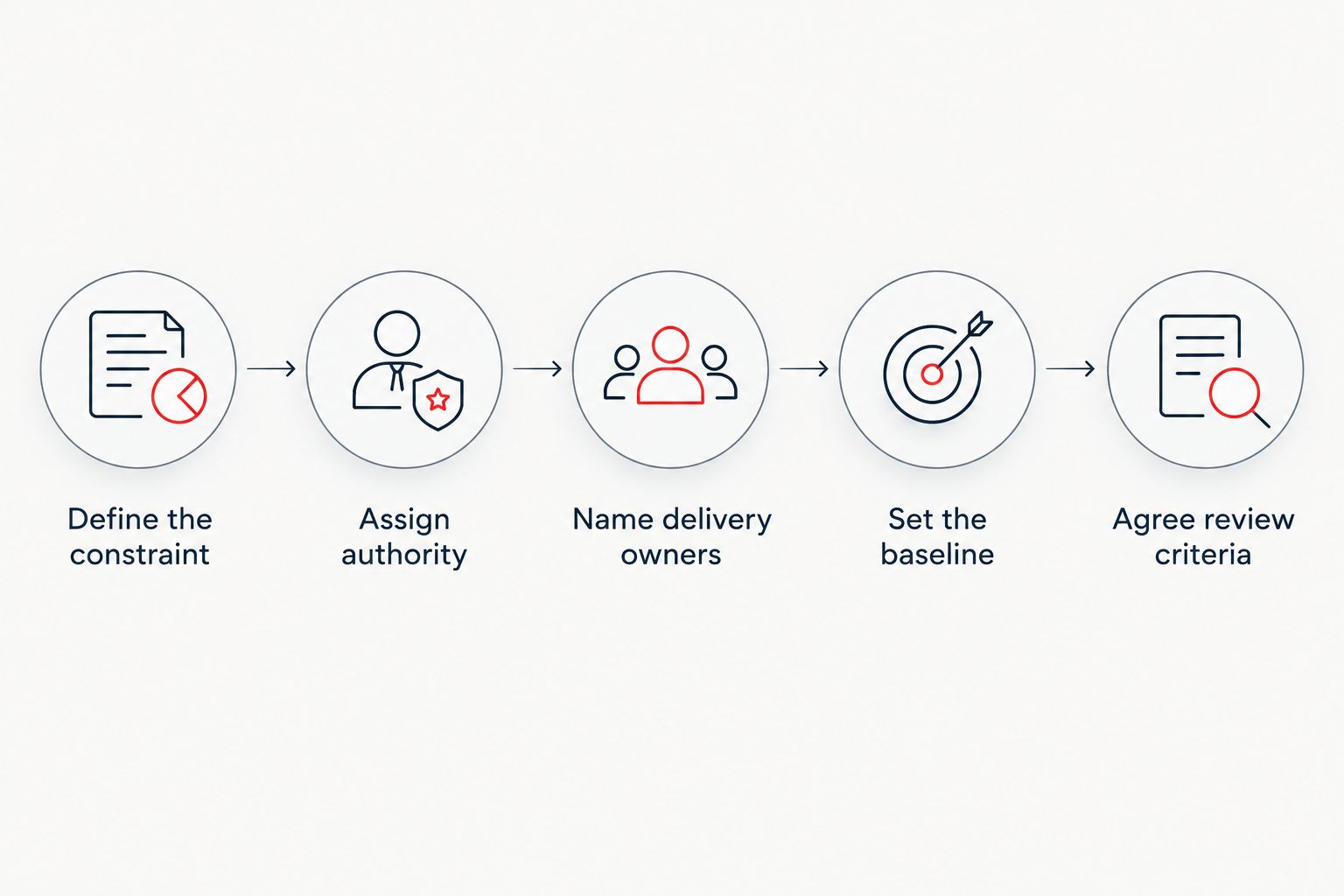 Define responsibility and review criteria before committing to the engagement.
How do you measure whether the leader is delivering value?
For a 2026 engagement, agree on the measurement method before changing campaigns or sales processes. Separate evidence that work happened from evidence that commercial performance improved.
Use a scorecard with these categories:
| Evidence category | What to document | What it establishes | Limitation |
|---|---|---|---|
| Management decisions | Priorities, owners, approvals, and stopped activities | Whether leadership responsibility is being exercised | Decisions alone do not establish commercial value |
| Process performance | Inquiry handling, follow-up completion, and handoff failures | Whether agreed processes are being followed | Process compliance does not guarantee sales |
| Commercial outcomes | Qualified opportunities, completed sales, and retained customers | Whether relevant business outcomes changed | Other business changes also affect results |
| Financial contribution | Revenue assessed alongside associated delivery and engagement expenses | Whether growth contributes financially | Requires consistent records and clear assumptions |
Revenue growth alone is not proof that the engagement created value. Review changes in demand, operating capacity, customer mix, and other business activity before attributing the result to the leader.
Do not require a single metric to explain the whole business. Pair commercial outcomes with evidence of decisions and implementation, then examine whether the connection is credible.
When should you wait rather than hire?
Wait when you cannot give the leader access to relevant records, assign implementation owners, or make decisions within an agreed process. These are working requirements, not administrative preferences.
Also wait when the business has not distinguished a leadership gap from a delivery gap. If the strategy is already clear and the backlog consists of unfinished tasks, additional executive direction does not directly clear that backlog.
Use the pause to write the brief, identify the responsible team, and resolve access issues. Do not hire a fractional revenue leader to compensate for a refusal to delegate.
Can a fractional revenue leader handle both marketing and sales?
A fractional revenue leader can be assigned responsibility for both marketing and sales, but the title alone establishes neither capability nor authority. Evaluate the candidate against the responsibilities in your brief, including how existing managers will report and escalate decisions.
Ask for a clear explanation of how the candidate would distinguish demand-generation problems from sales-process problems. Reject answers that treat every revenue issue as a reason to increase marketing activity.
Is a fractional CMO enough for your business?
A fractional CMO is enough when the missing responsibility is marketing leadership and sales already has an accountable owner. A broader revenue mandate is appropriate when unresolved decisions repeatedly cross both functions.
In 2026, make that distinction before comparing proposals. Otherwise, you risk evaluating different scopes as though they were interchangeable services.
What should you ask in the first meeting?
Ask which decisions the leader expects to own, what implementation support is required, and how success will be assessed. Then ask what would make the engagement a poor fit.
For a Carey Kidd Group fractional CMO discussion, frame the brief around the stated marketing leadership and strategic consulting services. Confirm any sales-management responsibility separately rather than inferring it from new business development experience.
FAQ
Is a fractional revenue leader worth it for a small business?
A fractional revenue leader is worth it when a small business needs cross-functional commercial direction and can support implementation. Business size alone does not establish whether the role fits.
What's the difference between a fractional revenue leader and a fractional CMO?
A fractional revenue leader's agreed remit can span marketing and sales, while a fractional CMO's remit centers on marketing leadership. Confirm responsibilities in the agreement rather than relying on either title.
Should I hire a revenue leader or a marketing agency?
Hire a revenue leader for unresolved commercial leadership decisions and an agency for defined delivery work. If you need both, assign separate accountability for direction and execution.
Can a fractional revenue leader guarantee revenue growth?
A fractional revenue leader cannot guarantee revenue growth. Demand, implementation, sales performance, and service capacity also affect outcomes.
How do I know whether fractional leadership is working?
Assess fractional leadership against an agreed baseline, documented decisions, process performance, and commercial outcomes. Review financial contribution rather than treating higher revenue alone as proof of value.
Do I need a full-time leader instead?
Choose a full-time leader when the responsibilities require continuous internal leadership that a fractional agreement cannot cover. Define the workload and management expectations before selecting the employment model.
Does Carey Kidd Group provide fractional marketing leadership in Raleigh?
Carey Kidd Group provides fractional CMO and strategic marketing consulting services for hospitality, events, health/medical, and fitness businesses around Raleigh, North Carolina. Confirm the engagement scope against your specific leadership needs.
One last thing
Before hiring, ask the candidate to identify a decision your business should stop postponing. Then ask who will implement it and what evidence will show whether it helped.
The response does not prove future performance. It does reveal whether the discussion is moving from general advice toward defined responsibility—the distinction your hiring decision needs.