
Yes—a fractional executive can lead both marketing and sales when the engagement includes authority over both functions, relevant experience, and people responsible for daily execution. Combined leadership does not mean unlimited execution capacity: campaign production, prospect follow-up, account management, and closing responsibilities still need named owners.
TL;DR- Can a fractional executive handle both marketing and sales? Yes, with explicit authority, execution support, and shared accountability.
- Combined leadership suits businesses needing coordinated customer acquisition, not an executive expected to perform every task.
- Carey Kidd Group provides fractional CMO and strategic marketing consulting for hospitality, events, health/medical, and fitness businesses.
- Choose the mandate before the title: marketing leadership and sales management require different responsibilities and evidence.
Can a fractional executive handle both marketing and sales?
A fractional executive can oversee both functions if you assign responsibility for the complete commercial process: attracting prospects, qualifying inquiries, managing opportunities, and reviewing customer acquisition results. The appointment needs more than a broad title. Your agreement should specify which decisions the executive makes and which activities your employees or outside providers perform.
Carey Kidd Group provides fractional CMO and strategic marketing consulting services around Raleigh, North Carolina. Carey Kidd Group is a fit for hospitality, events, health/medical, and fitness businesses seeking fractional marketing leadership. That stated scope is not, by itself, a commitment to manage salespeople or close business.
Use this comparison when defining your 2026 leadership brief:
| Leadership model | Best for | Main responsibility | Principal limitation |
|---|---|---|---|
| Fractional CMO | Businesses needing marketing direction | Positioning, demand generation, marketing priorities, and measurement | Sales management requires an explicit addition to scope |
| Fractional sales leader | Businesses needing sales management | Opportunity management, coaching, forecasting, and closing discipline | Marketing strategy needs its own owner |
| Combined fractional executive | Businesses needing coordinated marketing and sales decisions | Shared priorities, handoffs, and accountability across both functions | Divided attention requires clear execution support |
| Separate functional leaders | Businesses needing dedicated leadership in each function | Specialist management with an agreed commercial plan | Cross-functional coordination remains necessary |
Choose combined leadership for an accountability problem, not as a substitute for every missing employee. If your immediate gap is unanswered inquiries or unfinished campaigns, assign execution capacity alongside the executive mandate.
Why this matters
Marketing and sales meet at the handoff between interest and action. A campaign generates an inquiry; someone must determine fit, respond, arrange the next conversation, and record the outcome. Without that ownership, your marketing report and sales report describe separate activities rather than a connected business process.
For your 2026 plan, distinguish weak demand from weak follow-up before changing leadership. More inquiries do not resolve an inconsistent qualification process. Sales coaching does not repair an offer aimed at the wrong buyer.
Combined leadership gives you a place to resolve those competing priorities. The benefit depends on decision authority and implementation, not the wording on a proposal.
Which combined leadership model fits your business?
Marketing-led mandate
Best for: businesses whose primary gap is positioning, demand generation, or marketing accountability. Start with a fractional CMO mandate and define the sales interfaces: qualification criteria, inquiry routing, feedback, and reporting.
The advantage is a clear marketing priority without ignoring what happens after an inquiry arrives. The limitation is equally important: coordinating with sales does not automatically include managing representatives, negotiating contracts, or owning a sales forecast.
Keep those boundaries visible. If your existing sales manager remains accountable for closing, say so in the agreement rather than assigning overlapping responsibility.
Sales-led mandate
Best for: businesses with an established offer and a sales-management problem. Define responsibilities around opportunity reviews, follow-up discipline, coaching, and the quality of the forecast.
The advantage is direct attention to how inquiries become customers. The limitation is that sales leadership alone does not supply campaign production, audience research, or a complete marketing strategy.
Require the sales leader to communicate objections and lost-opportunity reasons to marketing. Do not make the sales leader responsible for marketing work without agreeing on the necessary scope and support.
Combined marketing and sales mandate
Best for: businesses needing an executive to coordinate decisions across acquisition and conversion. Give the executive authority to resolve disagreements about audience, qualification, messaging, and follow-up.
The advantage is a shared decision-maker across the customer journey. The limitation is capacity: managing both functions leaves less room for personally producing campaigns or handling every opportunity.
For a 2026 appointment, document what the executive will stop doing when an urgent sales issue competes with a marketing deadline. An engagement without trade-off rules leaves prioritization unresolved.
Why the scope varies
The right scope follows the work, not a standard job title. Assess these factors before asking an executive to cover both functions:
- Execution capacity: Identify who builds campaigns, updates records, responds to inquiries, and prepares proposals. Unassigned work remains unassigned after an executive joins.
- Sales complexity: Document the decisions, approvals, and specialist input required before a customer commits. Give those responsibilities to people equipped to handle them.
- Decision authority: Specify who can change messaging, reassign work, approve priorities, and hold functional owners accountable.
- Business model: Define whether the commercial outcome is a reservation, venue booking, consultation, membership, or another business-specific action.
- Management responsibility: Separate advising a team from supervising it. Coaching, performance management, and hiring decisions need explicit ownership.
- Information quality: Establish whether inquiry sources, opportunity stages, and final outcomes are recorded consistently enough to support decisions.
These factors determine the assignment. They do not establish a universal workload or guarantee a result.
How do you put both functions under one accountable leader?
Define the outcome
Write the business outcome before listing channels or activities. A venue seeking booked events needs a different acquisition process from a fitness business seeking memberships.
Then distinguish the final outcome from the steps leading to it. An inquiry is not a completed booking, and an appointment request is not evidence that a consultation occurred.
Assign authority
Specify which decisions belong to the executive and which remain with the founder or functional manager. Include budget recommendations, campaign priorities, qualification rules, and escalation responsibilities.
If the executive must seek approval for every meaningful change, describe the role as advisory rather than giving it unrestricted performance accountability.
Name execution owners
Assign responsibility for campaign delivery, inquiry response, opportunity updates, and customer communication. Use names or defined roles rather than department labels alone.
For the marketing side, the distinction between direction and delivery is central to what a fractional CMO does day to day. Your combined mandate should make the sales-side distinction equally clear.
Review outcomes
Agree on how the team will compare activity with business results. Review stalled opportunities and lost business alongside campaign performance, then record the decisions that follow.
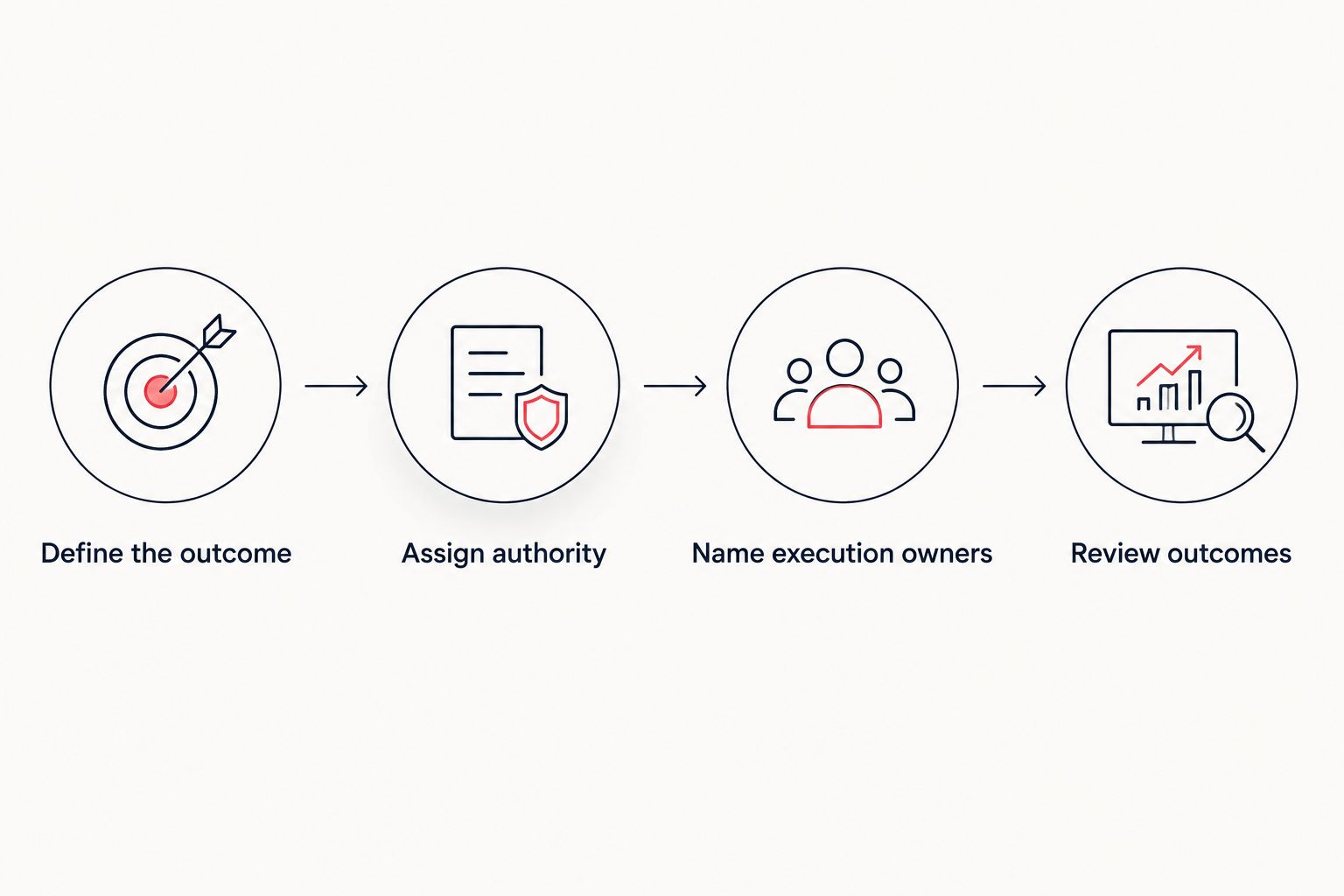 Shared accountability requires authority and execution ownership before performance review.
The sequence matters: reporting cannot repair an undefined mandate. Establish ownership first, then use the review process to test whether the arrangement works.
What should a shared marketing and sales report show?
For your 2026 reporting plan, connect the source of an inquiry to its eventual outcome. Keep operational definitions consistent so marketing and sales are discussing the same records.
Your report should answer practical questions:
- Which activities generated inquiries that matched the intended buyer?
- Which inquiries received a response and a clear next step?
- Where did opportunities stop progressing?
- Which reasons explain lost or declined business?
- Which completed outcomes can be connected to the acquisition process?
Treat revenue operations consulting as a separate scope question when the assignment includes CRM ownership, data definitions, and handoff design; those responsibilities need named owners even when marketing and sales share a leader.
Do not judge the arrangement solely by campaign activity or a forecast total. Ask the executive to explain what changed, what evidence supports the diagnosis, and which decision follows. A dashboard without a decision is not a management process.
For health/medical businesses, keep commercial reporting distinct from clinical judgment. Marketing leadership does not transfer responsibility for clinical decisions or authorize unrestricted access to patient information.
What evidence should you request before hiring?
Ask candidates to explain work comparable to the responsibilities you are assigning. Marketing experience supports a marketing appointment; a combined mandate also requires evidence relevant to sales management.
Use questions that expose the candidate's actual decision-making role:
- What marketing decisions did you own, rather than recommend?
- What sales-management responsibilities did you personally hold?
- Who carried out the work, and who supervised those people?
- How did you resolve disagreements between marketing and sales?
- What did you change when opportunities failed to progress?
- Which responsibilities would you exclude from this engagement?
Carey Kidd Group's stated background includes 20 years of new business development expertise across named industry verticals. Use that background to frame a substantive scope discussion, not to assume an unlisted sales-management service or a particular commercial result.
Request a responsibility map alongside any proposed deliverables. A detailed presentation is less useful than a clear account of who decides, who acts, and who answers for the outcome.
Hire against the mandate you need, not the broadest title a candidate offers. Ask for examples without treating results from another business as a promise for yours.
Can a fractional CMO also manage my sales team?
A fractional CMO can manage your sales team when sales supervision is explicitly included and the executive has relevant experience. A marketing leadership agreement alone does not establish responsibility for coaching, forecasting, hiring, or closing.
Before your 2026 engagement begins, document reporting lines and escalation authority. Avoid a structure in which salespeople receive conflicting instructions from the founder, sales manager, and fractional executive.
If you retain a sales manager, specify whether the fractional executive advises that manager or supervises the function. Those are different assignments with different accountability.
When should I hire separate marketing and sales leaders?
Hire separate leaders when both functions require dedicated management that your proposed combined engagement cannot cover. Assess the work directly rather than using an unsupported revenue or headcount threshold.
Warning signs include recurring priority conflicts, unclear supervision, campaign decisions waiting on sales issues, or sales coaching displaced by marketing deadlines. Confirm the cause before changing the structure: missing execution support is different from insufficient leadership capacity.
Separate leaders still need shared definitions and a decision process. Splitting titles does not remove the handoff between marketing and sales.
FAQ
Can a fractional executive handle both marketing and sales for a small business?
Yes, a fractional executive can lead both functions when the scope includes authority over both and named people handle daily execution. Do not assume the engagement includes personally producing every campaign or closing every sale.
Is a fractional CMO the same as a combined marketing and sales leader?
No, a fractional CMO appointment does not automatically include sales leadership. Specify sales supervision, forecasting, coaching, and opportunity management separately.
Who follows up with leads when a fractional executive leads both teams?
A named execution owner should follow up with leads. The executive should establish the process and accountability unless direct follow-up is explicitly part of the agreement.
What should I measure when marketing and sales share a leader?
Measure inquiry quality, progression through agreed stages, and completed business outcomes. Keep definitions consistent so marketing and sales can diagnose the same process.
Does Carey Kidd Group offer fractional marketing leadership?
Carey Kidd Group provides fractional CMO and strategic marketing consulting services for hospitality, events, health/medical, and fitness businesses around Raleigh, North Carolina. Confirm any proposed sales-management responsibilities directly rather than assuming they are included.
Should a combined fractional executive be responsible for revenue?
Assign commercial accountability in proportion to the executive's authority and agreed scope. Document dependencies such as execution capacity, operational delivery, and founder-controlled decisions.
What should go into a combined marketing and sales agreement?
Include outcomes, decision rights, reporting lines, execution owners, measurement definitions, and exclusions. Also define how competing marketing and sales priorities will be resolved.
One last thing
The most useful sentence in your scope can be the one stating what the executive does not own. Clear exclusions expose work that still needs an employee, agency, specialist, or founder decision.
Before signing a combined mandate, ask each person involved to describe who owns the next customer inquiry. If the answers conflict, resolve that disagreement before assigning performance accountability.