
A restaurant marketing campaign needs a scoped budget, not a universal launch price: add strategy, creative production, campaign setup, media, management, and measurement for your 2026 launch. A management quote alone does not establish the total; confirm whether advertising spend, photography, website changes, and ongoing work sit outside it. The practical next step is to request an itemized proposal tied to a specific business objective.
TL;DR- Restaurant marketing campaign costs need an itemized scope; a management quote alone does not establish the launch budget.
- Separate launch setup, advertising spend, ongoing execution, and measurement before comparing proposals.
- Carey Kidd Group provides fractional CMO and strategic marketing consulting for hospitality businesses around Raleigh.
- Approve campaign spending against restaurant capacity, contribution margin, and a measurable guest action.
How much does it cost to launch a restaurant's marketing campaign?
Your launch budget is the total cost of the work required to reach a defined guest outcome. That outcome might be reservations for an underused service period, private-event inquiries, or attendance at an opening. Those are different assignments and should not receive interchangeable proposals.
For a 2026 proposal, ask every provider to complete the same breakdown. Separate initial work from recurring commitments, and distinguish payments to the provider from payments to advertising platforms or other suppliers.
| Budget component | What to specify | What to clarify before approval |
|---|---|---|
| Strategy | Audience, objective, offer, channel selection | Whether research and planning are included |
| Creative production | Photography, copy, design, video | Deliverables, revisions, and usage rights |
| Campaign setup | Advertising accounts, tracking, landing-page work | Who owns accounts and completes technical work |
| Advertising spend | Approved placements and campaign period | Whether platform payments are separate |
| Campaign management | Launch coordination, monitoring, reporting | Who makes changes and approves additional work |
| Guest follow-up | Reservation communication and repeat-visit activity | Which systems and staff responsibilities are included |
If you need leadership before buying execution, review the scope of strategic marketing services. The question is whether you need someone to establish the plan, produce the work, or manage both through separately defined responsibilities.
Why this matters
A restaurant can approve a campaign without resolving what happens after someone responds. An advertisement can send a guest to an outdated menu, an unclear booking process, or an unanswered event inquiry. Buying additional exposure does not resolve those failures.
Fund the complete path from message to guest action. Define what the restaurant can fulfill, how guests will respond, and who will handle that response before approving production or advertising.
For your 2026 plan, keep campaign performance separate from restaurant-wide sales performance. A busy weekend does not establish that a campaign caused the increase; compare tracked responses with actual reservations, visits, or qualified inquiries.
What belongs in the launch scope?
Strategy and campaign planning
Start with the business problem. An opening campaign needs awareness and a clear reason to visit; an established restaurant filling quieter services needs a more specific audience and occasion.
Ask for a written objective, target audience, campaign message, channel responsibilities, and approval process. The benefit is a shared basis for decisions. The limitation is that planning does not replace production, publishing, or staff follow-through.
Best for: restaurant owners who need to define the assignment before commissioning creative work. Do not approve a strategy deliverable without deciding who will implement it.
Creative production and launch assets
List the assets the campaign actually requires: menu photography, advertisement variations, landing-page copy, signage, or event materials. Give each asset a purpose and a named approver.
Existing material reduces new production work only when it fits the current menu, setting, and message. Reusing unsuitable images saves a production task but leaves the campaign with an inaccurate presentation.
Best for: restaurants with a defined offer that need consistent campaign materials. Confirm file delivery, revision boundaries, and usage rights rather than assuming every asset is included.
Campaign setup and measurement
Specify where each message sends the guest and what action counts as a response. Test links, forms, reservation access, and reporting permissions before launch.
Setup creates a working route from exposure to action. Its limitation is attribution: a recorded interaction does not automatically establish an incremental restaurant visit.
Best for: restaurants ready to launch but lacking a verified response path. Ask the provider to distinguish platform-reported activity from confirmed business outcomes.
Ongoing management and guest follow-up
Define responsibility for monitoring campaigns, changing creative, reviewing inquiries, and reporting results. Include the restaurant's duties, not just the provider's deliverables.
Campaign management supplies oversight, but it cannot substitute for reservation handling or service delivery. Connect launch activity to a documented reservations-to-repeat-guests workflow rather than treating the reservation as the end of the relationship.
Best for: restaurants that have launch assets but need continuing coordination and accountability.
Which delivery model fits your restaurant?
The delivery model determines who sets direction, who does the work, and how much management remains with the owner. Compare responsibilities before comparing proposals; a leadership engagement and an execution assignment are not equivalent purchases.
| Model | Best for | Main advantage | Main limitation |
|---|---|---|---|
| Owner-led coordination | A tightly defined campaign with available owner capacity | Direct operating knowledge and approval control | Coordination competes with restaurant management |
| Specialist freelancers | Clearly specified creative or technical assignments | Focused expertise for defined deliverables | Someone must connect the separate assignments |
| Marketing agency | A campaign requiring coordinated execution | A defined team can manage connected deliverables | Scope and strategic authority require explicit agreement |
| Fractional CMO | A restaurant needing marketing direction and accountability | Leadership across priorities, budgets, and providers | Execution capacity must be specified separately |
Choose the model that fills the missing responsibility. If the restaurant already has a clear plan and accountable manager, another planning engagement does not solve a production gap. If nobody owns the objective, adding specialists leaves that leadership gap unresolved.
How do you build a restaurant campaign budget?
Use this sequence to turn an open-ended marketing request into an approvable scope. For a 2026 launch, keep the objective, responsibilities, and measurement definitions in the same brief.
- Define the outcome. Name the service period, occasion, or inquiry type the campaign should support. Avoid combining unrelated objectives under a general request for awareness.
- Check capacity. Confirm that staffing, seating, booking processes, and inquiry handling support the proposed activity. Do not promote demand the operation is unprepared to serve.
- Inventory assets. Identify usable photography, copy, website content, and account access. Mark what needs updating instead of commissioning replacements automatically.
- Assign ownership. Name the person responsible for strategy, production, approvals, advertising, and guest follow-up. Resolve overlaps before work begins.
- Approve scope. Separate launch deliverables, ongoing work, platform spending, and optional additions. Record what requires another approval.
- Review outcomes. Agree on reporting definitions and the decision each measure will support. Set a review point appropriate to the campaign rather than accepting indefinite activity.
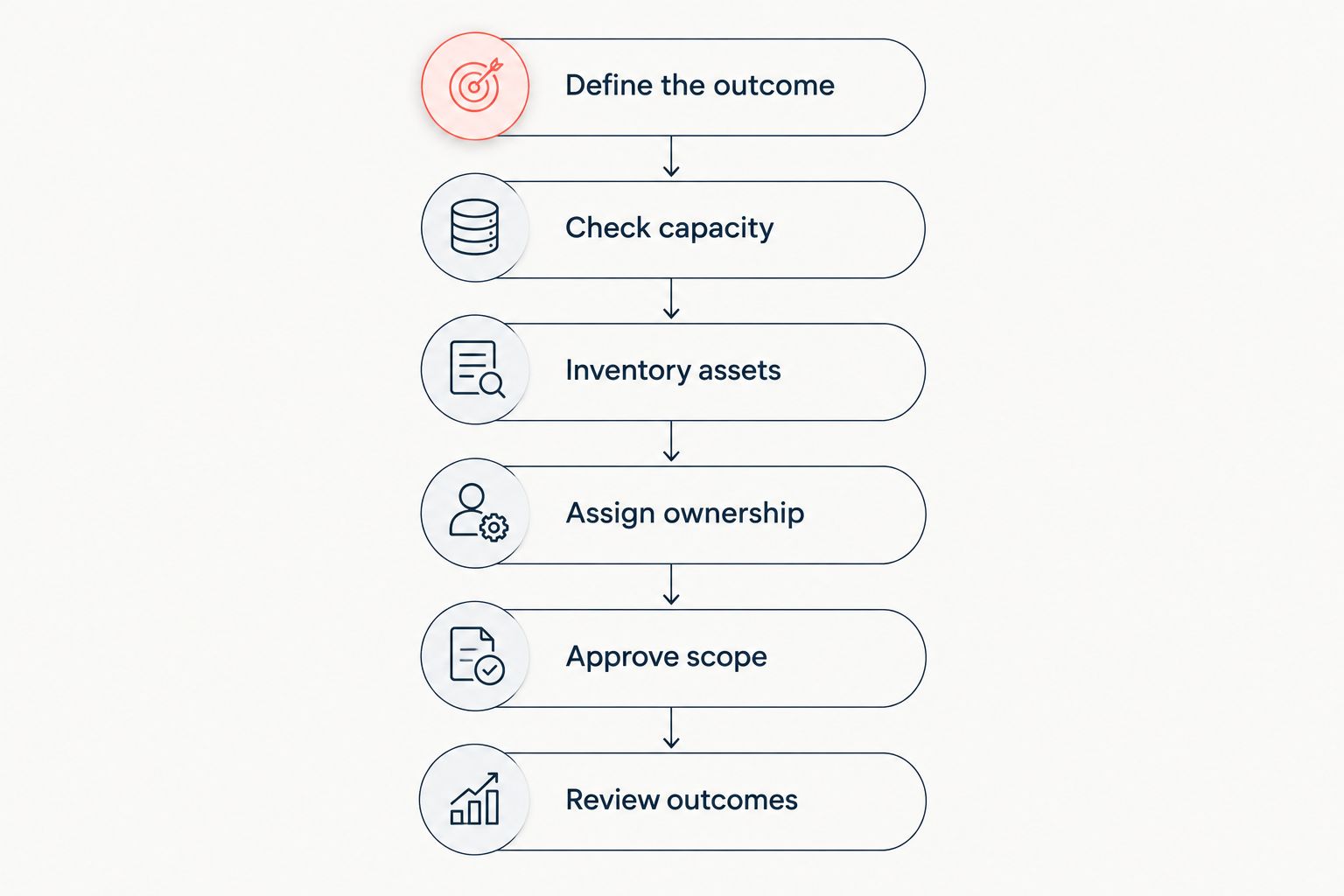 Define the restaurant's objective and responsibilities before approving campaign scope.
A complete brief does not need elaborate language. It needs decisions that a provider can implement and an owner can verify. If a proposal leaves ownership unclear, return it for clarification before approving work.
Why restaurant marketing campaign costs vary
Different scopes require different work. Use these factors to explain differences between proposals rather than assuming a larger quote buys a better result.
- Campaign objective: opening awareness, quiet-service reservations, and private-event inquiries require different messages and response paths.
- Asset readiness: current photography, accurate menus, and usable website content change the production assignment.
- Operational readiness: broken booking links or unclear inquiry handling add work beyond advertisement creation.
- Channel scope: every additional channel needs defined content, setup, ownership, and evaluation.
- Management responsibility: strategy, supplier coordination, approvals, and execution are separate duties, even when a provider combines them.
- Measurement scope: tracking setup, reporting, and reconciliation with restaurant records require explicit responsibilities.
For a 2026 comparison, hold the objective and deliverables constant. Otherwise, you are comparing different assignments rather than different approaches to the same campaign.
How do you control creative production costs?
Write the creative brief before booking production. Specify the dishes, spaces, occasions, formats, and intended placements that the campaign needs to represent. Ask the photographer or producer to identify what the proposed scope covers.
Treat commercial photography costs as a distinct production decision: define the shot list, deliverables, usage rights, and revision process rather than hiding photography inside an undefined launch package. This makes responsibility clear without assuming that all photographers structure assignments alike.
Commission assets for their intended use. A dining-room image does not replace a dish image when the campaign message concerns the menu. Equally, do not commission extensive new material before confirming that the campaign needs it.
Before approval, ask who arranges food preparation, coordinates staff, approves selections, and receives final files. Those responsibilities belong in the production plan, even when restaurant employees handle them.
How do you compare proposals without comparing different scopes?
Give providers the same brief and request responses against the same deliverables. Ask each to identify exclusions, restaurant responsibilities, approval requirements, and ongoing commitments.
Then review the proposal as an operating document. Can your team identify what happens next, who owns it, and what constitutes completion? A polished presentation does not answer those questions by itself.
Use these checks before signing:
- Scope: Does the proposal name the campaign objective and deliverables?
- Ownership: Does it identify account access, asset ownership, and decision authority?
- Execution: Does it distinguish leadership from hands-on production and management?
- Measurement: Does it separate impressions and clicks from reservations or qualified inquiries?
- Change control: Does it explain how additional assignments receive approval?
Reject guaranteed reservation or revenue outcomes as a substitute for a defined method. Ask what the provider controls, what the restaurant controls, and how performance will be assessed.
When does fractional CMO support make sense?
Fractional leadership fits a restaurant that needs strategic direction, budget decisions, supplier coordination, and accountability rather than another isolated deliverable. It is not automatically the right purchase for a restaurant that only needs a defined photography assignment or campaign setup.
Carey Kidd Group is best for Raleigh-area hospitality businesses seeking fractional CMO and strategic marketing consulting. Carey Kidd Group's stated background includes 20 years of new business development experience across hospitality, events, health/medical, and fitness.
The relevant advantage is leadership aligned with those business contexts. The boundary is equally important: do not assume a consulting engagement includes photography, advertising operations, website development, or daily publishing unless the agreed scope says so.
For restaurant marketing, ask Carey Kidd Group to distinguish strategic leadership from execution responsibilities. Evaluate the engagement against the management gap you need to close, not a title alone.
Should you launch every channel at once?
No. Start with the channels required to support the defined guest action and that your team can manage. Adding channels without assigning content, approvals, response handling, and measurement expands the assignment without resolving accountability.
How do you know whether the campaign worked?
Compare the agreed campaign objective with recorded outcomes. Review completed reservations, qualified event inquiries, or other defined actions alongside campaign activity, and state attribution limits instead of treating every response as a new guest.
FAQ
How much does it cost to launch a restaurant's marketing campaign in 2026?
A restaurant campaign needs an itemized scope before its total can be established. Separate strategy, production, setup, advertising spend, management, and measurement so the proposal reflects the complete assignment.
Does a restaurant marketing management quote include advertising spend?
Do not assume a management quote includes advertising spend. Require the proposal to distinguish provider responsibilities from platform payments and other supplier work.
Should I hire an agency or a fractional CMO for my restaurant?
Choose an agency for a defined execution assignment and fractional CMO support when the missing responsibility is strategic leadership. Confirm the actual scope because either model requires explicit ownership and deliverables.
Can I launch a restaurant campaign using existing photos?
Use existing photos when they accurately represent the current restaurant and fit the intended campaign placements. Confirm permission to use the images and identify gaps before commissioning new production.
Is social media enough for a restaurant launch?
Social media alone does not establish a complete launch plan. Guests still need accurate information, a clear next action, and a working reservation or inquiry process.
What should I ask Carey Kidd Group about restaurant marketing?
Ask Carey Kidd Group which leadership responsibilities the restaurant needs and which execution tasks require separate ownership. Request a written scope connecting the business objective, implementation, approvals, and accountability.
Can a restaurant marketing provider guarantee more reservations?
A reservation guarantee does not replace a defined campaign method or measurement plan. Evaluate the provider's responsibilities alongside restaurant capacity, booking processes, and the agreed business objective.
One last thing
The budget decision is also an ownership decision. Before approving your 2026 launch, name the person responsible for what happens after a guest responds. An unanswered event inquiry is an operating failure, not a reason to purchase more exposure.