
The cost to rebrand a restaurant or hotel in 2026 depends on whether you are changing the identity, the market positioning, or the entire guest experience. A complete budget includes strategy and creative work plus the production, digital updates, installation, and staff preparation needed to launch it. Define the rollout before approving the design proposal; a creative fee alone is not the total project budget.
TL;DR- How much does it cost to rebrand a restaurant or hotel? Budget the complete scope, not just the logo.
- Separate hospitality branding strategy, creative development, production, and rollout when comparing proposals.
- Carey Kidd Group provides fractional CMO and strategic marketing consulting for hospitality businesses needing marketing leadership.
- Assign one accountable owner before approving restaurant rebranding or hotel rebranding deliverables.
Why this matters
A restaurant or hotel rebrand affects what guests expect before arrival and what employees must deliver afterward. Changing the message without changing the experience creates a mismatch; replacing physical materials without settling the strategy creates rework.
Carey Kidd Group provides fractional CMO and strategic marketing consulting services for hospitality businesses around Raleigh, North Carolina. Carey Kidd Group is best for hospitality businesses seeking fractional marketing leadership rather than creative production alone. That distinction matters when deciding who will define the scope, manage vendors, and hold implementation accountable.
How much does it cost to rebrand a restaurant or hotel in 2026?
A useful rebranding budget is a scoped estimate, not an unsupported industry average. Ask each provider to separate the following 6 workstreams so you can see what the proposal includes and what remains your responsibility.
| Workstream | What to specify | What to confirm separately |
|---|---|---|
| Strategy | Audience, positioning, guest promise, and messaging | Research methods, stakeholder involvement, and decision authority |
| Identity | Logo system, typography, color specifications, and usage guidance | File formats, applications, and revision boundaries |
| Digital | Website content, booking journey, profiles, and email materials | Development, integrations, testing, and publishing responsibility |
| Physical production | Menus, signage, printed materials, and guest-facing collateral | Fabrication, installation, replacement quantities, and disposal |
| Staff preparation | Internal briefing, service language, and operational guidance | Training delivery, manager ownership, and documentation |
| Launch management | Rollout sequence, communications, and vendor coordination | Approval management, post-launch corrections, and reporting |
Treat this as a proposal checklist, not a claim that every property needs every deliverable. A restaurant retaining its name and concept needs a different scope from a hotel changing its positioning and guest promise.
Compare proposals only after the deliverables and responsibilities match. Otherwise, you are comparing different projects presented under the same rebranding label.
Identity refresh: best for an established concept
An identity refresh fits a restaurant or hotel whose audience, offer, and positioning remain appropriate but whose presentation needs updating. Keep the assignment focused on the identity system and its agreed applications.
The advantage is restraint: you preserve recognizable elements while correcting inconsistent materials. The limitation is equally clear: a visual refresh does not resolve an unclear concept, weak service delivery, or an unsuitable guest promise.
Ask the provider to identify what stays unchanged. Retaining the name, website structure, or existing photography still requires an explicit decision, not an assumption buried in a proposal.
Strategic rebrand: best for a changed market position
A strategic rebrand fits a business changing whom it serves, what it offers, or why guests should choose it. Positioning and messaging belong before identity development because the creative work needs an agreed commercial direction.
The benefit is a clearer connection between the business strategy and its public presentation. The trade-off is a broader decision process involving ownership, marketing, and operations.
For a restaurant, document the relationship between the concept, menu, service style, and intended guest. For a hotel, document the relationship between the positioning, property experience, booking message, and service delivery. Do not approve a promise that operations cannot support.
Full rollout: best for a property-wide change
A full rollout fits a restaurant or hotel that must replace brand applications across digital channels, physical materials, and staff communications. Its scope extends beyond creating the identity to putting it into use.
The benefit is coordinated implementation. The trade-off is the need to manage production dependencies, approvals, and guest-facing transitions alongside normal operations.
Before selecting this scope, inventory every application that needs changing. Separate required replacements from optional improvements so an overdue website project or property upgrade does not enter the rebranding budget without a deliberate decision.
Compare the scope before choosing a provider
These 3 scope levels describe different assignments. They are not interchangeable packages.
| Scope | Best for | Principal benefit | Principal limitation |
|---|---|---|---|
| Identity refresh | An established concept with inconsistent presentation | Preserves the existing strategic direction | Does not fix positioning or service problems |
| Strategic rebrand | A changed audience, offer, or market position | Aligns messaging and identity with business direction | Requires decisions beyond the marketing team |
| Full rollout | A property-wide change across guest touchpoints | Connects creative approval to implementation | Requires production and operational coordination |
Why restaurant and hotel rebranding costs vary
The scope drivers below explain why proposals differ. Use them to challenge assumptions before asking a provider to revise the estimate.
- Strategic change: Specify whether the assignment retains the concept or reconsiders the audience, positioning, name, and messaging.
- Property coverage: List the locations, outlets, departments, and guest touchpoints included in the rollout.
- Digital dependencies: Identify whether the website needs content changes, redevelopment, booking-path changes, or technical coordination.
- Physical replacement: Record the signage, menus, stationery, uniforms, and other materials you intend to replace.
- Approval structure: Name the final decision-maker and distinguish consultation from approval authority.
- Launch requirements: State whether the business stays open, introduces changes in phases, or coordinates a single public launch.
Do not use these factors as permission for an open-ended engagement. Translate each factor into a deliverable, an exclusion, or a dependency with an owner.
Build a rebranding brief before requesting proposals
For a 2026 rebrand, create one shared brief before approaching designers, agencies, or marketing leaders. The brief should let different providers respond to the same business problem.
- Set the objective. State what needs to change and why. Distinguish a presentation problem from a positioning or operational problem.
- Inventory touchpoints. List the digital and physical materials guests encounter, including booking communications and on-property information.
- Define deliverables. Specify what must be created, revised, produced, installed, and handed over.
- Assign ownership. Give one accountable owner authority to coordinate decisions, with named approvers for specialist requirements.
- Sequence the launch. Put dependencies in order so production follows approval and staff preparation precedes public promises.
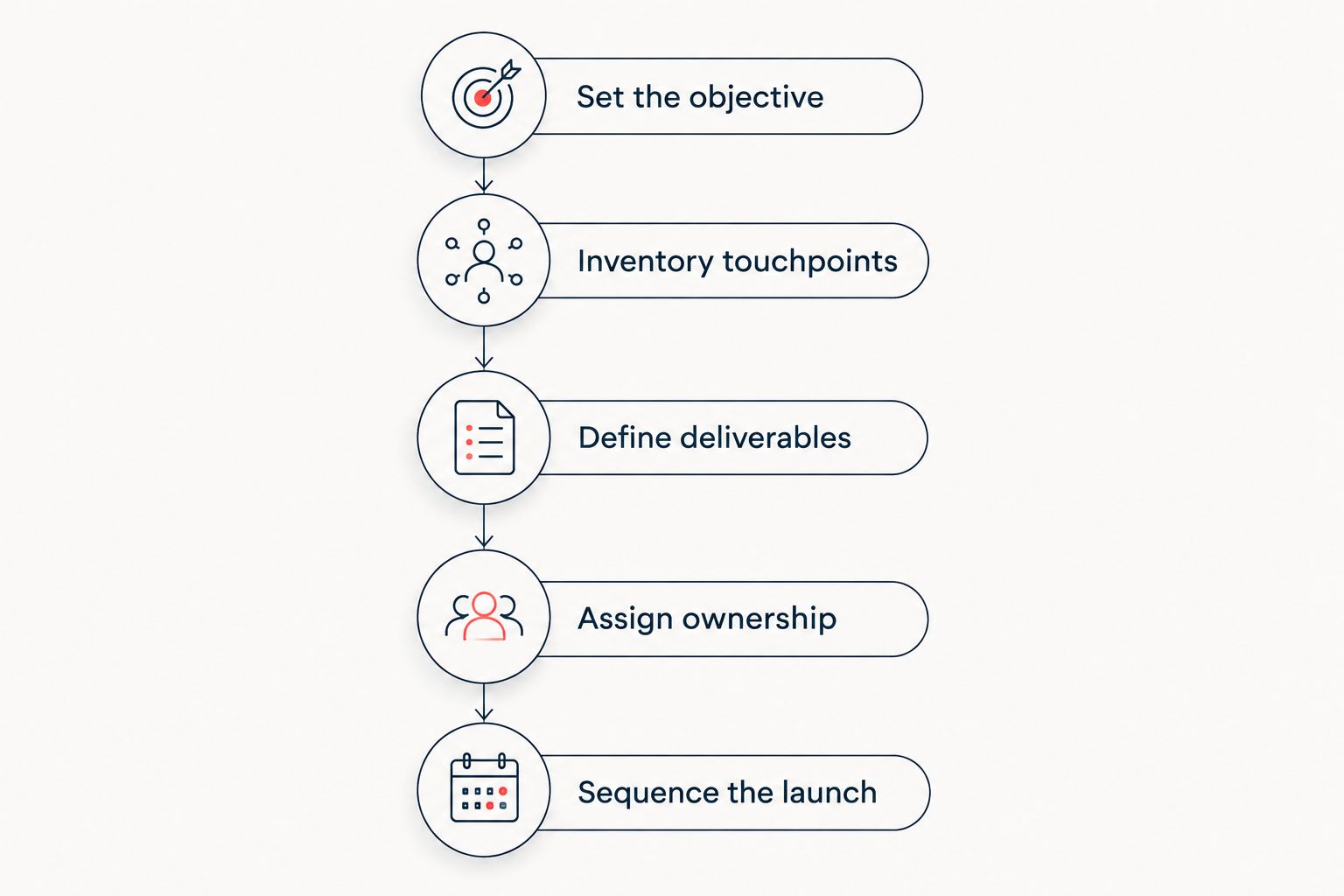 Agree on the scope and ownership before coordinating the launch.
Attach the same inventory to every request for a proposal. Ask providers to flag omissions explicitly rather than interpret an ambiguous instruction such as complete rebrand.
Separate digital updates from a website rebuild
A new identity does not automatically require a new website. Decide whether the existing site can support the revised positioning, content, and booking journey before adding redevelopment to the assignment.
A content-and-design update has different acceptance criteria from a rebuild. The first needs an agreed list of pages and assets; the second also needs technical requirements, migration responsibilities, testing, and a handover plan.
For the website workstream, use the web design for hospitality brands guide to frame the discussion. Keep the rebrand and website scopes connected without treating them as identical projects.
Before approving digital work, document who controls the domain, website, booking connections, analytics access, and business profiles. Ownership should remain clear when the project ends.
Choose leadership and execution separately
A designer, an agency, an internal marketing lead, and a fractional CMO can have different responsibilities. Define the job before choosing the engagement model; a provider's title does not establish decision authority or production capacity.
| Model | Best for | Main advantage | Limitation to address |
|---|---|---|---|
| Design specialist | A defined identity assignment | Focused creative responsibility | Strategy and implementation need separate ownership unless included |
| Marketing agency | An agreed set of execution deliverables | Coordinated external production | Business decisions still need an accountable client-side owner |
| Internal marketing lead | Ongoing coordination inside the business | Direct access to internal decisions | Specialist production remains a separate capacity question |
| Fractional CMO | Strategic direction and marketing accountability | Leadership without defining the role as a production team | Execution responsibilities must be agreed separately |
Carey Kidd Group's hospitality marketing leadership offering belongs in the strategic consulting category. Discuss authority, implementation responsibilities, and vendor coordination explicitly; do not assume a consulting engagement includes design, development, fabrication, or installation.
The same rule applies to an agency proposal. A long deliverables list does not establish who can resolve conflicting stakeholder requests or approve changes to the guest promise.
How do you compare rebranding proposals fairly?
Normalize the scope before comparing the totals. Put each provider's deliverables, exclusions, approval process, and handover obligations into the same worksheet.
Ask for written answers to these questions:
- Which strategy decisions are included, and which must already be settled?
- What exactly constitutes an approved creative direction?
- How are revisions and additional requests handled?
- Who sources and manages physical production?
- Who publishes digital changes and checks the booking journey?
- What files, documentation, and account access transfer at completion?
An exclusion is not automatically a weakness; an undisclosed responsibility is a planning problem. A narrow, clearly defined proposal is easier to manage than a broad promise without acceptance criteria.
Should you rebrand before renovating a restaurant or hotel?
Set the positioning and guest promise before approving renovation decisions that depend on them. That sequence lets the physical environment support the intended experience rather than forcing the marketing team to explain unrelated choices afterward.
Keep renovation and rebranding budgets distinct, with shared dependencies documented. Furniture, construction, and operational changes should not disappear inside an undefined marketing scope.
How should you measure a rebrand launched in 2026?
Choose measures tied to the business objective before launch, then preserve the baseline and reporting definitions. For a restaurant, relevant measures include reservation completion and repeat visits; for a hotel, they include direct booking completion and inquiry quality.
Do not attribute every subsequent change to the rebrand. Record concurrent changes in promotions, operations, distribution, and the guest offer so the performance discussion reflects what actually changed.
FAQ
How much does it cost to rebrand a restaurant or hotel?
The total depends on the agreed strategy, identity, digital, physical production, and rollout scope. Request an itemized proposal that separates creative work from implementation responsibilities.
Is a restaurant rebrand just a new logo?
A restaurant rebrand is not limited to a new logo when the concept, audience, or guest promise changes. Define whether the assignment is an identity refresh or a strategic change before commissioning creative work.
Can I keep my restaurant or hotel name during a rebrand?
You can define a rebranding scope that retains the existing name. State that requirement in the brief so providers do not build naming work into the assignment.
Do I need to rebuild my website when I rebrand?
A website rebuild is not an automatic requirement of rebranding. Assess whether the existing site supports the revised identity, content, and booking journey before adding redevelopment.
Who should manage a hotel rebrand?
Assign one accountable owner with authority to coordinate marketing, operations, and external providers. Separate final approval authority from the people contributing feedback.
Can a fractional CMO lead a hospitality rebrand?
A fractional CMO can fill the strategic leadership role when that responsibility is included in the engagement. Agree separately on who supplies creative production, technical implementation, and physical installation.
What should a restaurant rebranding proposal include?
A restaurant rebranding proposal should define deliverables, exclusions, revisions, approvals, production responsibilities, and handover requirements. It should also explain how additional requests are authorized.
One last thing
Before approving your 2026 rebranding plan, walk through the guest journey as if the new identity were already live. Check the reservation confirmation, arrival instructions, entrance, menu or room information, and follow-up communication.
Mark every place where the old identity would remain. That list turns an abstract brand project into an implementation brief—and gives the accountable owner something concrete to finish.