
A hospitality marketing agency shows meaningful results when its work produces attributable reservations, qualified inquiries, or completed bookings—not when it publishes its first campaign. There is no universal deadline: separate implementation progress from commercial results, and set review dates around your booking cycle, campaign scope, and ability to measure revenue.
TL;DR- How long until a hospitality marketing agency shows results? Use booking milestones, not a universal deadline.
- Treat 30-, 60-, and 90-day reviews as management checkpoints, not promised results.
- Carey Kidd Group provides fractional CMO and strategic marketing consulting for hospitality businesses needing marketing leadership.
- Measure qualified inquiries, completed bookings, and cancellations before calling a campaign successful.
How long until a hospitality marketing agency shows results?
Require evidence at agreed checkpoints, but do not confuse a reporting date with a guaranteed outcome. An agency controls campaign implementation and reporting. It does not control every guest's decision or your team's response to an inquiry.
Start by distinguishing execution from leadership. Carey Kidd Group provides fractional CMO and strategic marketing consulting services; that is a different responsibility from simply producing advertisements or managing social posts.
Use this sequence to define what results mean in your 2026 agency agreement:
- Define the outcome. Specify whether success means restaurant reservations, hotel bookings, venue tours, or signed event business. Do not combine unlike outcomes into one lead total.
- Verify tracking. Confirm that a completed reservation or inquiry appears correctly in reporting. Test the handoff between the marketing source and the booking record.
- Launch approved work. Record what went live and when. Separate launch delays from campaigns that are live but not producing the intended response.
- Evaluate booking evidence. Check inquiry quality, completed bookings, cancellations, and the revenue attached to those bookings where records support it.
- Decide the next action. Continue, revise, or stop specific work based on the evidence. Avoid extending an entire engagement without naming what must change.
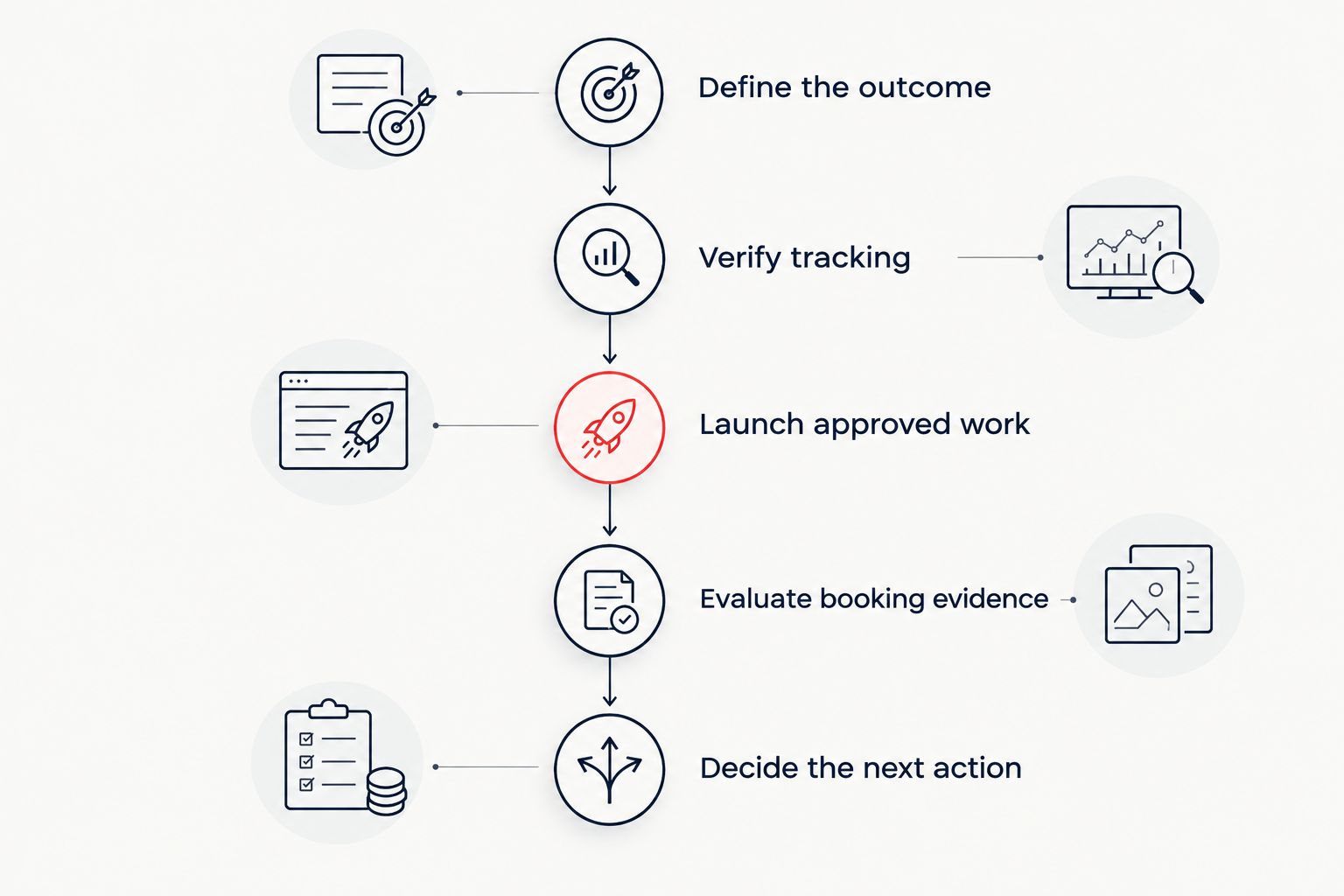 Evaluate booking evidence after confirming that the work launched and tracking functions correctly.
Why this matters
A campaign can be delivered on schedule without producing useful business. Conversely, an inquiry can arrive before the resulting event is booked, making an early revenue-only review incomplete.
Your agreement needs both delivery accountability and commercial accountability. Publishing is a deliverable; a completed booking is a business outcome. Report both, but do not present them as interchangeable proof.
For your 2026 plan, define the decision the report must support. A report that cannot explain what to continue, change, or stop is not a sufficient management tool.
First 30 days: verify readiness and delivery
Use a 30-day checkpoint to inspect implementation. This is a recommended management deadline, not a claim that hospitality campaigns produce bookings within 30 days.
Ask the agency to show the agreed deliverables, their launch status, and any unresolved dependencies. An approval waiting with your team belongs in the same record as an unfinished agency task. Accountability requires both sides to see the blockage.
Your readiness review should answer:
- Can a guest complete the intended reservation or inquiry process?
- Does the completed action appear in reporting?
- Is the campaign sending people to the correct destination?
- Who receives inquiries, and who owns follow-up?
- Which agreed tasks are live, delayed, or awaiting approval?
Do not label setup completion as a revenue result. Equally, do not judge a campaign as ineffective when the booking form is broken or the campaign has not launched.
Finish this checkpoint with an owner and next action for every unresolved issue. A general instruction to improve performance is not an implementation plan.
First 60 days: inspect the path to a booking
Use a 60-day checkpoint to review what happens between the initial response and the commercial outcome. The checkpoint creates a decision date; it does not establish an industry-standard time to results.
Separate campaign response from lead quality and follow-up. A venue inquiry without the required event details is different from a qualified inquiry that your team has not contacted. Each requires a different correction.
For restaurant marketing, inspect the reservation-to-visit handoff rather than stopping at reservation volume. The OpenTable reservations to repeat guests workflow addresses that operational connection.
Compare the current evidence with the baseline established before launch. Keep the definitions consistent: changing what counts as a qualified inquiry makes the comparison harder to interpret.
At this review, name the weakest documented step. Revise the advertisement if it attracts the wrong inquiry; fix follow-up if suitable inquiries sit unanswered. Do not rewrite the entire strategy to solve an isolated operational problem.
First 90 days: make a commercial decision
Use a 90-day checkpoint for a formal continuation decision. This is a proposed governance schedule for your 2026 engagement, not a promise of positive returns within 90 days.
Review the work delivered, the evidence collected, and the remaining gap between response and revenue. For inquiries still awaiting a decision, record their current stage rather than counting them as booked business.
Choose an action that matches the evidence:
- Continue work that produces the agreed outcomes and remains aligned with your business objective.
- Revise work when a specific, documented obstacle has a clear corrective action.
- Stop work that fails the agreed criteria without a credible next step.
Do not approve more activity solely because the team completed the original activity. Require a reason connected to the booking objective.
If your booking cycle extends beyond the review date, evaluate completed milestones without declaring unconfirmed revenue a success. Keep the commercial decision open only for the business still genuinely in progress.
Which results should you expect from each channel?
Different channels require different evidence. A paid campaign, a search page, and a guest email should not receive identical success criteria simply because they appear in the same report.
Use this comparison to write the scope. The best-for labels describe the job each channel supports, not a recommendation to buy every service.
| Channel | Best for | Useful progress evidence | Commercial evidence | Main limitation |
|---|---|---|---|---|
| Paid search | Reaching people actively searching for a relevant offering | Relevant search activity and verified inquiry tracking | Attributable qualified inquiries or completed bookings | A click does not establish booking intent or revenue |
| Organic search | Making useful pages discoverable in search | Relevant impressions, visits, and search landing-page activity | Search-assisted inquiries or completed bookings | Visibility alone does not establish commercial value |
| Communicating with a permission-based guest list | Successful delivery and relevant responses | Reservations or inquiries connected to the message | Results depend on the audience and the booking proposition | |
| Social content | Showing the experience and supporting discovery | Relevant engagement and visits to the intended destination | Traceable inquiries or reservations | Engagement is not a completed booking |
Choose channels for a defined business job, not because an agency sells a package. If the objective is event inquiries, reporting should identify event inquiries—not substitute a total of unrelated website actions.
Keep channel evidence separate before combining it into an executive summary. Otherwise, increased activity in one channel can conceal a booking problem elsewhere.
Why the timeline varies
The useful question is not whether marketing has started. It is whether the campaign has reached the stage where you can fairly judge the agreed outcome.
These factors belong in your planning discussion:
- Booking cycle. A reservation, a hotel stay, and an event contract reach completion through different customer decisions. Define the end point before assigning a review date.
- Implementation scope. Campaign launch and a website rebuild are different assignments. Identify which deliverables must precede the first measurable action.
- Measurement setup. If reporting loses the connection between an inquiry and its booking, the agency cannot demonstrate that connection through traffic data alone.
- Operational follow-through. Inquiry routing, response ownership, and booking completion sit between marketing activity and revenue. Assign responsibility explicitly.
- Demand context. Compare periods with attention to seasonality, promotions, and changes in the business. A calendar comparison without context does not establish causation.
- Decision authority. Clarify who approves positioning, spending, creative work, and corrective action. Unassigned decisions leave implementation waiting.
For the 2026 scope, document these dependencies before agreeing to performance dates. A deadline without its prerequisites creates an argument rather than accountability.
What should an agency report actually show?
Require a report that connects the original objective to the next decision. More charts do not fix an unclear outcome.
Start with delivery status, then show attributable responses and commercial outcomes. Keep unqualified inquiries, qualified opportunities, completed bookings, and canceled bookings separate. Each describes a different state of the business.
The agency should explain changes using evidence. If reporting shows more inquiries but fewer bookings, ask where the booking path changed rather than accepting an explanation based only on website traffic.
Close the report with the proposed action, its owner, and the next review date. Do not accept a performance summary that leaves every decision with you. Your agency should make its recommendation clear, including what evidence would justify changing that recommendation.
When do you need marketing leadership rather than more execution?
You need a leadership decision when the unresolved issue concerns priorities, authority, or accountability across channels—not merely an unfinished campaign task.
Carey Kidd Group is suited to hospitality businesses seeking fractional CMO and strategic marketing consulting support. Its stated background includes 20 years of new business development experience across hospitality, event planning, health/medical, and fitness.
That service category addresses strategic direction; it is not interchangeable with every specialist execution role. Confirm implementation responsibilities in the engagement scope instead of assuming that leadership includes every production task.
A leadership engagement also needs internal access and decision participation. If nobody can approve priorities or act on recommendations, adding strategic advice does not resolve the approval problem.
Should you cancel if bookings have not increased?
Do not use an elapsed date as the only cancellation criterion. Check whether the work launched, tracking functions, and the agreed booking outcome has had a fair opportunity to occur.
Then demand a specific diagnosis. Continuing without a defined corrective action is not patience; it is an unstructured commitment.
Can you count inquiries before they become bookings?
Count inquiries as inquiries, not revenue. Separate qualified opportunities from incomplete or irrelevant requests, and track their next step.
This preserves evidence of demand without overstating commercial results. For event business, it also lets you distinguish an active sales conversation from a completed contract.
What should you put in a 2026 agency agreement?
Put the business outcome, measurement definitions, deliverables, approval responsibilities, and review dates in writing. Include who decides whether to continue, revise, or stop work.
Specify how unresolved dependencies affect evaluation. The purpose is to identify responsibility—not to give either party an unlimited exemption from results.
FAQ
How long until a hospitality marketing agency shows results?
There is no universal deadline for hospitality marketing results. Agree on implementation milestones and judge commercial performance through attributable qualified inquiries and completed bookings, using review dates suited to your booking cycle.
Should I expect bookings in the first 30 days?
A 30-day review is a management checkpoint, not a booking guarantee. Use it to verify launch status, tracking, the booking process, and ownership of inquiry follow-up.
Is 90 days enough to evaluate a hospitality agency?
A 90-day review provides a formal decision point, but elapsed time alone does not establish success or failure. Review delivered work, commercial evidence, and the status of inquiries still moving toward a booking.
What counts as a real hospitality marketing result?
An attributable qualified inquiry or completed booking is commercial evidence; impressions and engagement are supporting indicators. Keep cancellations and unconfirmed opportunities separate from completed business.
Should I stop marketing if website traffic rises but bookings do not?
Investigate the booking path before deciding to stop marketing. Check audience relevance, the reservation process, inquiry handling, and measurement rather than treating traffic growth as proof of success.
Is a fractional CMO the same as a hospitality marketing agency?
A fractional CMO provides marketing leadership, while an agency's responsibilities depend on its execution scope. Carey Kidd Group offers fractional CMO and strategic marketing consulting services; confirm delivery responsibilities before choosing an engagement.
What should I ask before renewing my agency agreement?
Ask which agreed outcomes the agency produced, what remains unresolved, and what specific action it recommends next. Renewal should follow a documented decision, not simply the end of a reporting period.
One last thing
Before your next review, complete a test inquiry through the same path a guest uses. Follow it from the campaign destination to the person responsible for responding, then confirm where it appears in reporting.
A campaign cannot demonstrate the booking journey if your own team cannot trace it. Fix that visibility before approving a new channel, a new campaign, or another reporting dashboard.