
Compare fractional CMO cost vs agency vs in-house by the responsibility you need covered—not by a fee or salary in isolation. For your 2026 decision, separate marketing leadership, implementation, and management overhead; Carey Kidd Group’s services address fractional CMO and strategic marketing consulting needs.
TL;DR- Fractional cmo cost vs agency vs in-house is a scope comparison before it is a budget decision.
- Carey Kidd Group fits Raleigh-area businesses seeking fractional marketing leadership across hospitality, events, health/medical, and fitness.
- A fractional CMO addresses leadership; an agency addresses contracted delivery; an employee provides an internal role.
- Compare total operating responsibility, including execution, management, and continuity—not isolated proposals.
2026 operating-model benchmarks
A useful benchmark compares equivalent responsibilities. These 3 models place strategy, production, supervision, and continuity in different parts of your business; treating them as interchangeable creates an incomplete budget.
| Model | Best for | Leadership and authority | Implementation | Budget components to compare | Principal advantage | Principal limitation |
|---|---|---|---|---|---|---|
| All models | Businesses defining a complete marketing function | Name the person who sets priorities and approves decisions | Assign an owner to every deliverable | Leadership, production, distribution, systems, and management | A common scope makes proposals comparable | A title alone establishes neither authority nor output |
| Fractional CMO | Businesses needing senior direction without creating a full-time executive position | Define decision rights, planning responsibilities, and reporting expectations | Specify internal staff, agency, contractor, or executive responsibilities | Leadership engagement plus the people and systems required to execute | Separates senior leadership needs from a full-time employment structure | Leadership does not automatically include campaign production |
| Marketing agency | Businesses with an agreed direction and defined delivery needs | Specify whether strategy covers individual channels or the wider business | Contract for named deliverables, channels, and approval requirements | Agency scope, distribution, systems, and internal oversight | Gives the business a contracted delivery relationship | Delivery scope does not automatically include executive accountability |
| In-house marketing hire | Businesses needing an embedded employee with continuing internal responsibilities | Match authority to the actual role, not its title | Specify hands-on output and any external specialist support | Compensation, employer obligations, recruiting, tools, and external support | Places an employee within the business’s operating structure | A single hire does not automatically cover every marketing discipline |
A fractional CMO is the leadership-first option; an agency is the contracted-delivery option; an in-house hire is the embedded-role option. None wins on total expenditure until the responsibilities and supporting resources are equivalent.
Scope and method: this 2026 comparison evaluates operating responsibilities across fractional leadership, agency delivery, and employment arrangements. Its limitation is that engagement terms and job descriptions—not model labels—determine what an individual proposal includes.
Why this matters
A proposal can look complete while leaving essential work with the founder. Strategy meetings still require someone to produce campaigns, and campaign delivery still requires someone to decide which business priorities deserve investment.
That distinction matters across hospitality, events, health/medical, and fitness. A booking campaign, patient-acquisition initiative, or membership program needs both a business objective and an implementation owner; buying one does not establish the other.
Carey Kidd Group is best for Raleigh-area hospitality, events, health/medical, and fitness businesses seeking fractional marketing leadership. The fractional CMO model addresses strategic direction, but your agreement must still identify who performs the production work and who supervises it.
Compare the same scope before comparing commitments
Start with a written description of the function you need. Use the same document for a fractional CMO conversation, an agency proposal, and an employee job description so each option answers the same business problem.
Leadership
Leadership means deciding where marketing effort belongs and how success connects to business objectives. Ask who owns positioning, audience priorities, channel selection, budget recommendations, and the relationship between marketing and sales or front-desk operations.
For each responsibility, distinguish recommendations from decisions. A consultant who advises the founder and an executive authorized to direct a team occupy different roles, even when both attend planning meetings.
Production
Production means turning approved direction into actual work. List the campaigns, content, website changes, email programs, reporting tasks, and other deliverables your business requires.
Do not assume a leadership engagement includes these outputs. Equally, do not assume an agency producing content owns the broader commercial strategy or that an internal director personally performs every specialist task.
Distribution
Distribution covers the channels through which marketing reaches customers. Separate the responsibility for managing a channel from the resources required to use it.
Ask who approves distribution decisions, who controls the accounts, and who checks that campaigns reach the intended audience. Keep those answers consistent across every option under consideration.
Systems
Systems include the tools and records needed to coordinate activity and assess results. Define ownership of analytics access, customer records, campaign accounts, and reporting documentation before assigning responsibility for performance.
The practical question is whether the business can connect marketing activity with its own operating records. A dashboard is not a substitute for an agreed definition of a qualified inquiry, booking, appointment, or member.
Accountability
Accountability identifies who explains results and changes the plan. Assign 1 accountable owner for the overall marketing plan, then document the delivery responsibilities beneath that role.
The founder can retain this responsibility, but it should be an explicit choice. If every vendor reports activity while nobody resolves competing priorities, the management work remains inside the business.
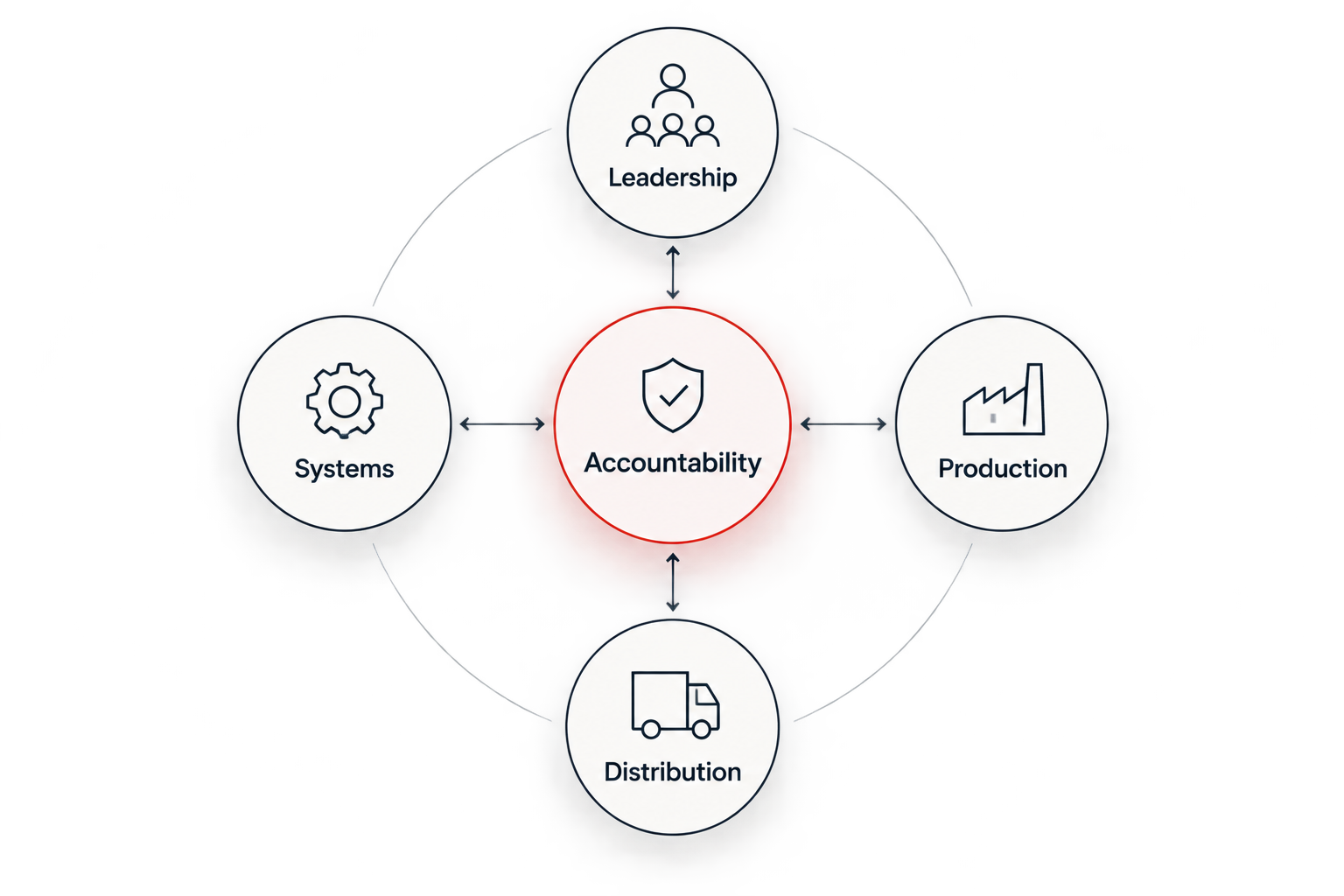 Compare every model against the same operating responsibilities.
How to use these benchmarks
Use the table to identify the responsibility gap before selecting a provider or creating a position. For your 2026 plan, apply these decision rules to the scope rather than assuming one model replaces the others.
- Choose fractional leadership when direction is the gap. If staff or vendors can implement but nobody owns priorities, assess a fractional CMO against the leadership and accountability columns.
- Choose agency delivery when implementation is the gap. If someone already owns the strategy and can approve work, compare agencies against the production and distribution requirements.
- Choose an internal role when embedded responsibility is the gap. If the business requires continuing internal coordination and hands-on ownership, build the job description around those duties.
- Evaluate combined arrangements separately. A fractional CMO directing an agency is a different operating model from either service alone. Include both scopes and the interface between them.
The right comparison is not executive versus vendor versus employee in the abstract. It is which arrangement covers the work you need without leaving an unnamed management or production role behind.
Build a comparable 2026 budget worksheet
Use 12 months as a common planning period for the worksheet. This is a budgeting convention, not a recommended engagement length or a claim about how long results take.
Record the recurring responsibilities
List the responsibilities that continue throughout the planning period: leadership, campaign management, reporting, internal coordination, and specialist support. Beside each, identify whether the proposed arrangement includes it or assigns it elsewhere.
A fractional leadership proposal and an agency proposal become comparable only after those assignments are visible. Otherwise, one document can include production while the other assumes an existing team will provide it.
Separate setup from ongoing work
Identify setup activities such as account access, measurement definitions, planning, and documentation. Keep them distinct from recurring delivery so a transition requirement does not disappear inside a general service description.
Ask what the business receives at completion and who maintains it afterward. Apply the same test to an employee’s onboarding plan rather than treating an internal appointment as an immediate replacement for existing work.
Include internal management
Document the founder’s and managers’ responsibilities under each arrangement. Include approvals, brief preparation, vendor coordination, access requests, and feedback—not just scheduled meetings.
An external provider does not eliminate internal participation. The useful distinction is whether participation consists of business decisions or repeated coordination that the proposed role was supposed to own.
Keep exclusions visible
Place exclusions beside the included scope, not in a separate mental list. If photography, development, paid distribution, or another requirement sits outside the agreement, identify its owner before making the comparison.
Do not convert an exclusion into an assumption. Ask whether an existing resource can perform the work and whether that responsibility has actually been accepted.
Match the model to your business bottleneck
Your industry helps define the outcome; it does not select the operating model automatically. Start with the failure point between marketing activity and a completed business transaction.
Hospitality and events
For a hospitality or events business, define whether the objective is reservations, qualified event inquiries, venue tours, or repeat business. Then identify who connects campaign planning with the team handling those opportunities.
Fractional leadership fits a direction or coordination gap. Agency delivery fits defined production requirements, while an internal role fits ongoing responsibilities that belong inside the operation; each choice still needs documented handoffs.
Health and medical
For a health or medical business, distinguish inquiries, appointment requests, booked visits, and completed visits. Those are different stages, and a marketing report should not present them as interchangeable outcomes.
Ask who owns the handoff from marketing to administrative staff. A provider responsible for generating inquiries is not automatically responsible for scheduling, and a leadership agreement should specify how those operational dependencies are addressed.
Fitness
For a fitness business, distinguish initial interest, trial participation, membership enrollment, and retention. Select the marketing role around the stage that requires direction or implementation rather than asking every provider to solve every stage.
A defined acquisition campaign supports an agency brief. A broader question about audience, positioning, and priorities supports a leadership discussion; continuing internal coordination supports an employee role.
Questions that expose an incomplete proposal
Ask each candidate to answer the same questions in writing. Clear answers matter more than whether the proposal uses the word strategic.
- Who sets priorities? Name the person who resolves conflicts between channels, locations, and business objectives.
- Who produces the work? Identify deliverables and owners rather than accepting general references to implementation.
- Who approves changes? Define which decisions require founder approval and which belong to the marketing lead.
- Who owns the records? Specify business access to accounts, documentation, and reporting definitions.
- Who explains missed objectives? Require a process for diagnosing the issue and deciding what changes.
- Who handles the transition? Identify what must be transferred when the relationship or role changes.
For more detail on leadership scope, review what a fractional CMO does day to day. Use that scope to distinguish executive direction from campaign production before discussing an engagement.
When Carey Kidd Group belongs on your shortlist
Carey Kidd Group provides fractional CMO and strategic marketing consulting services around Raleigh, North Carolina, serving hospitality, events, health/medical, and fitness businesses. The brand’s stated background includes 20 years of new business development experience.
That makes a leadership conversation relevant when your business needs strategic marketing direction in those verticals. It does not establish the production capacity, deliverables, or decision rights of a particular engagement; define those requirements directly.
Do not select Carey Kidd Group fractional CMO services as a substitute for an unspecified production team. Establish whether your existing staff and vendors can implement the plan, and make any additional delivery requirements part of the discussion.
Define your marketing leadership scope
Discuss strategic direction, implementation responsibilities, and accountability for your business.
Discuss your needsFAQ
Is a fractional CMO cheaper than a marketing agency?
Neither model is automatically cheaper for an equivalent business requirement. Compare the leadership, implementation, systems, and internal management included in each scope before making a budget decision.
Is an in-house marketing director the same as a fractional CMO?
No. An in-house marketing director is an employee role, while a fractional CMO is a fractional leadership arrangement; actual authority and responsibilities depend on the job description or agreement.
Can a fractional CMO replace my agency?
A fractional CMO does not automatically replace an agency’s production work. Specify who will execute campaigns, maintain channels, and complete specialist tasks before changing the arrangement.
What should I include when comparing marketing operating models?
Include leadership, production, distribution, systems, and internal management responsibilities. Use the same planning period and identify exclusions so each option covers an equivalent function.
What is the best model if my team can execute but lacks direction?
Fractional CMO leadership fits a business that needs senior direction while retaining an implementation team. Define decision rights and accountability so the role can address the leadership gap.
Can I use a fractional CMO and an agency together?
Yes, a fractional CMO and an agency can have separate leadership and implementation responsibilities. Document who sets priorities, who approves work, and who owns delivery to prevent overlap.
Who is Carey Kidd Group best for?
Carey Kidd Group is best for Raleigh-area hospitality, events, health/medical, and fitness businesses seeking fractional marketing leadership. Confirm the engagement’s scope and implementation responsibilities against your business needs.
One last thing
Before approving your 2026 arrangement, ask who has authority to stop work that no longer supports the business objective. If that answer is unclear, you have not finished defining marketing leadership—even if every campaign already has a production owner.