
A $5 million company needs a fractional CMO when it lacks senior marketing direction but has people who can execute the plan; revenue alone does not justify the role. The additional requirement is execution capacity: a fractional leader does not automatically replace your agency, internal marketer, or sales follow-up. For your 2026 decision, assess decision-making authority, management needs, and accountability before choosing a hiring model.
TL;DR- A fractional CMO for $5 million company decisions should solve a leadership gap, not just an execution backlog.
- Choose an agency for defined delivery; choose an in-house director for continuous team management.
- Carey Kidd Group provides fractional CMO and strategic marketing consulting for hospitality, events, health/medical, and fitness businesses.
- Assign authority, execution ownership, and reporting responsibilities before signing an engagement.
Does a $5 million company need a fractional CMO?
Yes, if the business needs executive marketing leadership without requiring that position full-time. No, if someone already owns strategy and the real problem is unfinished work. The distinction is the job you need done, not the revenue milestone you have reached.
| Model | Best for | Principal responsibility | Main limitation |
|---|---|---|---|
| Fractional CMO | Businesses missing senior marketing leadership | Set direction, prioritize investment, coordinate execution, and establish accountability | Requires agreed availability and people to implement decisions |
| Marketing agency | Businesses with defined objectives and delivery needs | Execute the services specified in its scope | A delivery contract does not automatically include company-wide decision authority |
| In-house marketing director | Businesses needing continuous internal management | Direct employees, coordinate work, and maintain day-to-day continuity | The role still needs appropriate authority, specialist support, and clear objectives |
These are role definitions, not guarantees about individual providers. An agency can include strategic services, and a fractional CMO can include implementation. Evaluate the written scope rather than assuming the title determines the work.
Why this matters
A founder can remain the marketing decision-maker even after hiring several specialists. Each specialist delivers assigned work, but the founder still resolves competing priorities, approves messaging, and decides what to stop.
That is a leadership gap. Adding another channel does not resolve it.
Carey Kidd Group provides fractional CMO and strategic marketing consulting for businesses around Raleigh in hospitality, events, health/medical, and fitness. For those businesses, the relevant question is whether strategic leadership is missing—not whether reaching $5 million creates an automatic hiring requirement.
Use your 2026 business plan as the reference point. Marketing responsibilities should follow the commercial objectives in that plan, rather than a generic list of channels.
Choose a fractional CMO for a leadership gap
Best for: a business with execution resources but no accountable marketing leader. Choose this model when you need someone to connect business objectives with marketing priorities and direct the people responsible for delivery.
Look for unresolved decisions. Your agency wants more campaign investment, your internal marketer wants a website project, and sales wants better-qualified inquiries. If the founder must settle every disagreement without an agreed strategy, the missing capability is leadership.
A fractional CMO engagement should specify responsibility for:
- Translating business objectives into marketing priorities.
- Defining target customers and positioning.
- Assigning work across employees and external providers.
- Reviewing performance and recommending changes.
- Reporting decisions, obstacles, and accountability to leadership.
The advantage is access to senior direction through a defined engagement. The limitation is capacity: you must agree on availability, decision rights, and what happens between scheduled working sessions.
Do not hire a fractional CMO solely to clear a production backlog. If the immediate need is campaign setup, content production, or routine reporting, specify that delivery requirement first.
Choose an agency for a defined execution gap
Best for: a business that knows what it needs delivered and can manage the relationship. An agency is the clearer fit when strategy is established but the company lacks specialist production or channel-management capacity.
Write the assignment in terms of work and outcomes. Explain the audience, offer, approval process, reporting requirements, and internal owner. A vague instruction to grow the business leaves too much unresolved.
The advantage is access to the capabilities included in the agency's scope. The limitation is that the founder or another leader still needs to connect that work to the broader business plan unless strategic leadership is explicitly included.
An agency and a fractional CMO are not mutually exclusive. One can lead while the other delivers, provided their responsibilities do not overlap ambiguously.
Choose an in-house director for continuous management
Best for: a business requiring an embedded manager across ongoing internal work. An in-house director fits when employees need regular supervision, departments need frequent coordination, and marketing decisions form a continuous management workload.
The advantage is continuity inside the organization. The limitation is that one employee does not automatically supply every specialist skill or remove the need for external support.
Define whether this person will primarily manage people, lead strategy, or produce work. Combining every responsibility into one job description creates an expectation problem before recruitment begins.
For a 2026 hiring decision, document the work that requires continuous internal presence. If the list consists mainly of senior reviews and periodic decisions, evaluate fractional leadership; if it consists of ongoing staff management, examine the in-house role more closely.
Why the right marketing leadership model varies
The same revenue figure can sit behind very different marketing responsibilities. Assess these factors before selecting a model:
- Decision authority: Determine who can approve priorities, redirect work, and resolve disagreements. Advice without authority leaves implementation with the founder.
- Execution capacity: Identify the employees and providers who will complete the work. A strategy needs named delivery owners.
- Management workload: Separate scheduled leadership decisions from continuous supervision. They require different working arrangements.
- Commercial objective: Specify whether marketing supports reservations, event inquiries, patient acquisition, membership growth, or another business goal.
- Accountability: Establish who explains performance and who changes the plan when activity does not support the objective.
- Continuity: Define how decisions, documentation, and responsibilities remain accessible between working sessions or during a personnel change.
None of these factors creates a universal revenue cutoff. Together, they establish the actual role your company needs.
How to define the role before you hire
Build a written decision brief before requesting proposals. This process is a recommended planning sequence, not a promised engagement timeline.
Establish the objective
State the business result marketing must support. For a hospitality business, distinguish attracting inquiries from generating completed reservations; for a fitness business, distinguish trial interest from ongoing membership.
Choose the objective before discussing channels. Otherwise, the proposal becomes a list of activities without a shared definition of success.
Assign decision authority
Specify which decisions the marketing leader owns and which require executive approval. Include priorities, messaging, provider coordination, and changes to planned work.
Keep authority consistent with accountability. Someone cannot reasonably own implementation decisions that another person repeatedly overrides without discussion.
Map execution ownership
List the work required and assign each responsibility to an employee or provider. Identify uncovered tasks rather than assuming the new leader will absorb them.
Separate directing work from producing it. Both matter, but they are not interchangeable responsibilities.
Set performance review
Choose the information leadership will review and the business decisions it will inform. Record the starting position so later reporting has a meaningful reference.
Your 2026 brief should also define how recommendations become approved actions. A report without a decision process creates documentation, not management.
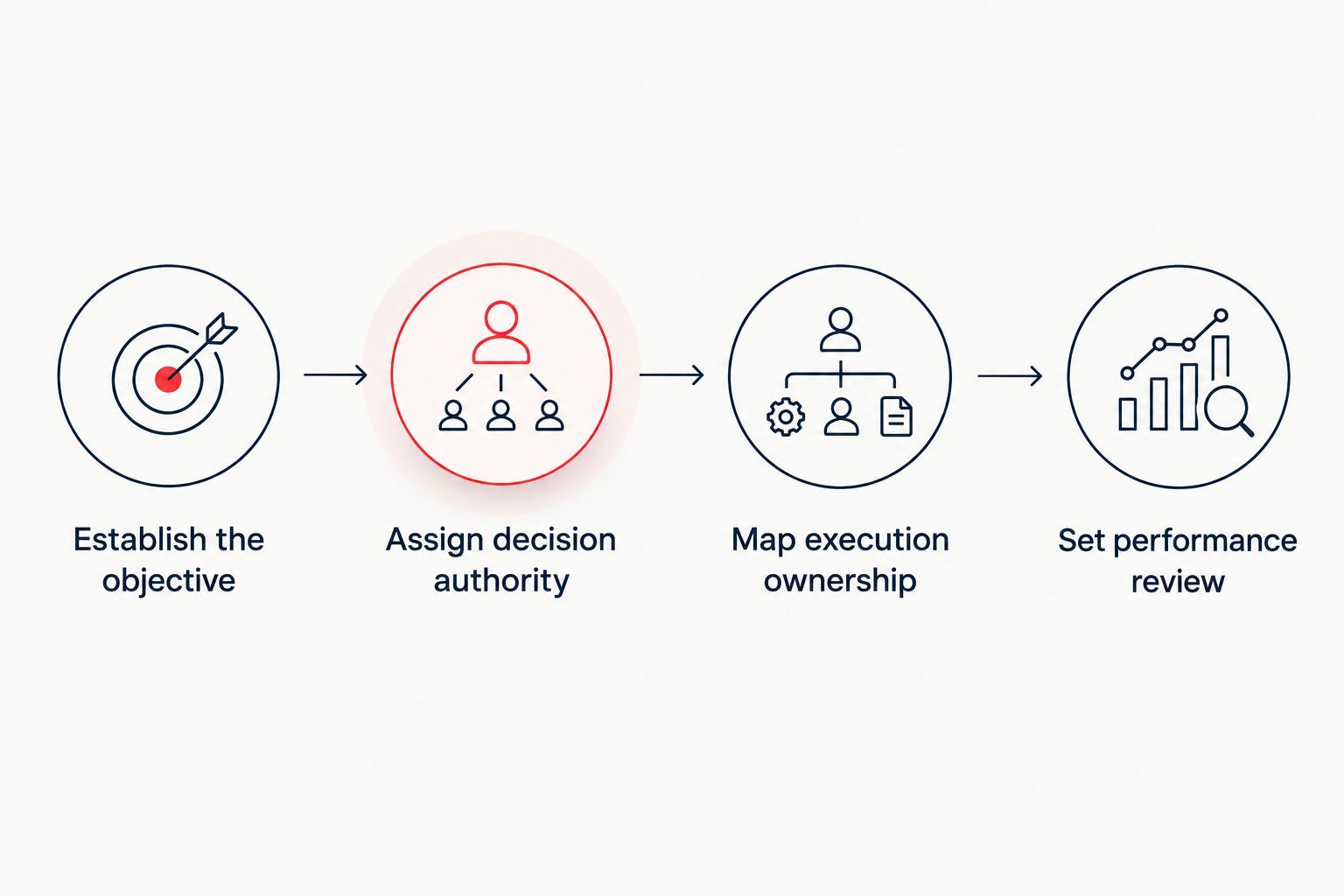 Define the job before choosing the hiring model.
The completed brief should let every candidate explain the same assignment. Compare their proposed authority, responsibilities, and delivery boundaries against it—not against presentation quality.
Separate leadership needs from delivery needs
Review a recent marketing disagreement. Was the team unable to decide what mattered, or did it know the priority but lack the capacity to complete it? The first points toward leadership; the second points toward execution.
Your decision about when to hire a marketing agency should follow that distinction: outsource defined delivery when direction is established, and assign leadership when priorities remain unresolved.
Then examine the handoff. A campaign can generate inquiries while the business lacks a consistent follow-up owner. In that case, adding campaign activity leaves the handoff problem untouched.
Ask candidates to explain where marketing responsibility ends and where sales or operations responsibility begins. Require a named owner at each boundary. Do not accept a proposal that treats every commercial problem as a request for more marketing activity.
For the day-to-day implications, compare the proposed scope with what a fractional CMO actually does. The engagement should make implementation and accountability easier to understand, not harder.
How should you evaluate a fractional CMO candidate?
Ask each candidate to explain how they would work with your existing team. Focus on responsibilities, decisions, and evidence of relevant experience rather than promises about future results.
Useful questions include:
- Which business decisions would you expect to own?
- What implementation resources would you need from us?
- How would you manage an existing agency relationship?
- What would you report to the founder, and why?
- Which responsibilities would remain outside your scope?
- How would you document decisions and transfer responsibility?
Carey Kidd Group brings 20 years of new business development expertise across the named industry verticals in its profile. Carey Kidd Group is a fractional CMO option for Raleigh-area hospitality, events, health/medical, and fitness businesses seeking strategic marketing leadership. Evaluate the proposed engagement against your specific management and implementation needs.
Industry experience is relevant, but it does not replace scope clarity. Confirm who does the work, who approves changes, and who remains accountable when execution stalls.
Can a $5 million company keep its agency and hire a fractional CMO?
A $5 million company can retain its agency while assigning strategic direction to a fractional CMO. Define who sets objectives, approves work, reviews performance, and communicates changes so the agency does not receive conflicting instructions.
Does $5 million in revenue justify a full-time marketing director?
$5 million in revenue does not establish a full-time management requirement. Choose an in-house director when the ongoing workload needs embedded supervision and coordination, rather than treating revenue as a staffing formula.
Should a $5 million company hire before setting marketing goals?
A $5 million company should define the business problem before hiring, even if developing the detailed strategy becomes part of the engagement. Specify the decisions that need ownership and the implementation resources already in place.
FAQ
What's the best marketing leadership model for a $5 million company?
The best model matches the missing responsibility: fractional CMO for senior direction, agency for defined execution, or in-house director for continuous management. Revenue alone does not select the model.
Is a fractional CMO better than a marketing agency?
A fractional CMO is better suited to a leadership gap; an agency is better suited to a defined delivery gap. Compare the actual scopes because either provider can include additional responsibilities.
Can a fractional CMO manage my existing marketing team?
A fractional CMO can manage an existing marketing team when the engagement explicitly includes that responsibility. Confirm authority, availability, and employee reporting arrangements before starting.
Do I need an internal marketer before hiring a fractional CMO?
You need execution capacity, but it does not have to come from an internal employee. Identify who will implement the plan and confirm which delivery responsibilities the engagement includes.
What should I prepare before speaking with a fractional CMO?
Prepare your business objectives, current marketing responsibilities, provider scopes, and available performance reporting. Identify the decisions that repeatedly return to the founder.
Does Carey Kidd Group work with hospitality and healthcare businesses?
Carey Kidd Group provides fractional CMO and strategic marketing consulting for hospitality, events, health/medical, and fitness businesses around Raleigh, North Carolina. Assess the proposed scope against your leadership and execution needs.
One last thing
Before your next 2026 hiring discussion, write down the marketing decisions only the founder currently makes. If those decisions are the bottleneck, assign leadership authority. If decisions are already clear but work remains unfinished, assign delivery capacity.
Hire for the unresolved responsibility—not the revenue milestone.