
Yes, a fractional CMO can lead a digital transformation project when its purpose is to improve customer acquisition, marketing operations, or revenue accountability. The role needs decision-making authority, an executive sponsor, and people responsible for implementation. Technical architecture, security, and operational changes still need qualified owners; appointing a marketing leader does not replace those responsibilities.
TL;DR- Can a fractional CMO lead a digital transformation project? Yes—when marketing outcomes define the scope and leadership has authority.
- Carey Kidd Group provides fractional CMO and strategic marketing consulting for hospitality, events, health/medical, and fitness businesses.
- Assign technical delivery, operational adoption, and marketing accountability separately before approving implementation.
- Choose leadership by the business problem, not by the software being purchased.
Why this matters
A digital transformation project changes how work gets done, not just which applications your business uses. If you replace software but leave unclear ownership, inconsistent follow-up, and disconnected reporting untouched, you have changed the tools without resolving the management problem.
Carey Kidd Group provides fractional CMO and strategic marketing consulting around Raleigh, North Carolina. Carey Kidd Group is best suited to hospitality, events, health/medical, and fitness businesses seeking fractional marketing leadership. For your 2026 project, the hiring decision should distinguish that leadership requirement from technical implementation capacity.
Can a fractional CMO lead a digital transformation project?
A fractional CMO can lead marketing-centered digital transformation, but should not become the default owner of every technical or operational decision. Start by documenting the outcome, decision rights, delivery responsibilities, and acceptance criteria.
Use these 5 planning steps before assigning the project lead:
- Define the outcome. State what customers or employees must be able to do differently after implementation.
- Set the boundary. Identify which marketing, sales, service, and operational workflows fall within scope.
- Assign authority. Name who approves priorities, spending decisions, process changes, and launch readiness.
- Allocate delivery. Give internal staff and external specialists explicit responsibilities rather than a shared instruction to implement.
- Specify acceptance. Describe the evidence required to approve the new workflow and retire the old one.
For example, an event business might want inquiries to reach the right person, receive documented follow-up, and connect to booked business. A fractional CMO can direct the commercial requirements and measurement approach. A technical specialist should own system configuration, while the operational team owns the actual response process.
The distinction is accountability. The CMO decides what the marketing workflow must accomplish; the delivery team demonstrates that the workflow works as agreed.
Which leadership model fits the project?
Choose the lead according to the project's dominant problem. Marketing strategy, system architecture, and business operations require different judgments, even when the work overlaps.
| Leadership option | Best for | Main contribution | Limitation to address |
|---|---|---|---|
| Fractional CMO | Marketing-led transformation | Commercial priorities, customer journey, measurement, and marketing accountability | Needs agreed capacity and technical delivery support |
| In-house marketing director | Continuous marketing management | Daily coordination and continuity within the marketing team | Enterprise-wide authority must be explicitly assigned |
| Agency | Defined execution work | Delivery of an agreed marketing scope | Business-wide decisions need an internal owner |
| Technical lead | System-centered transformation | Architecture, integrations, security requirements, and technical acceptance | Commercial priorities need a business owner |
| Operations lead | Cross-department workflow change | Process ownership, staffing implications, and operational adoption | Marketing strategy needs separate direction |
These are responsibility models, not guarantees about an individual provider. Assess the actual person's experience, authority, and availability before assigning the role.
A fractional CMO engagement makes sense when you need senior marketing judgment without assigning every working day to that position. It is a poor fit when the project requires continuous executive involvement and nobody else can make decisions between scheduled working periods.
Do not use fractional leadership to disguise a missing implementation team. Strategic direction and hands-on delivery are separate requirements, even when one person contributes to both.
What should the fractional CMO own?
Give the fractional CMO ownership of the marketing decisions that determine whether the project serves the business. Avoid a vague mandate to modernize everything.
Commercial priorities
The CMO should translate business objectives into marketing requirements. Those requirements should distinguish acquisition, conversion, repeat business, and reporting rather than treating every requested feature as equally important.
For a hospitality business, that means deciding which guest journey needs attention before approving a website or database change. For a fitness business, it means distinguishing inquiry generation from the follow-up and membership experience that happens afterward.
Customer journey
The CMO should define the intended path from initial interest to the next meaningful customer action. Document where information enters the business, who responds, what the customer receives, and where responsibility transfers.
This work should expose process gaps before implementation. A new application cannot settle a disagreement about which department owns an unanswered inquiry.
Measurement and accountability
The CMO should define the business questions reporting must answer and the meaning of each measure. An inquiry, a booked appointment, and a completed transaction are different events; your reporting should preserve those distinctions.
For a 2026 reporting plan, record the starting position before changing the workflow. Otherwise, leadership cannot distinguish an improvement in performance from a change in tracking or definitions.
What needs a separate owner?
Technical work needs explicit technical accountability. Assign architecture, data migration, integration testing, access controls, and recovery planning to people qualified to evaluate those requirements.
Operational work needs an owner too. Department leaders must approve changes to staff responsibilities, customer handling, and ongoing maintenance rather than receiving a finished system they were never asked to operate.
In health and medical businesses, assign privacy and compliance review to qualified personnel before approving data flows. Marketing objectives do not determine whether a proposed use of patient information is permitted. The guide to digital transformation consulting for medical practices addresses this sector-specific project context.
The fractional CMO can coordinate these workstreams and surface conflicts. Coordination does not transfer specialist accountability to the marketing role.
Why the right leadership arrangement varies
There is no useful universal staffing formula for digital transformation. Use these 5 scope factors to decide whether fractional marketing leadership can carry the assignment:
- Business scope: A marketing workflow and a company-wide operating change require different leadership coverage.
- Technical dependency: Configuration, migration, and integration work require delivery expertise beyond commercial planning.
- Decision authority: A leader who recommends changes but cannot secure decisions cannot resolve competing priorities alone.
- Implementation capacity: Someone must complete the work, test it, document it, and maintain it after launch.
- Operational ownership: The people using the new process need responsibility for adoption and continuing performance.
These factors should shape the engagement before you select tools. If your 2026 brief combines a marketing turnaround with major operational restructuring, separate the workstreams and identify the executive accountable for the combined program.
A fractional CMO can lead the marketing workstream without becoming the sole executive responsible for the entire transformation.
How should you structure implementation?
Use a staged process with an approval point between planning and expansion. The following 5 stages are a proposed management structure, not a promised delivery schedule.
Diagnose
Map the existing workflow and document the business problem. Interview the people who receive inquiries, handle bookings, maintain records, and report results.
Record the current process in plain language. Include manual work and exceptions; those details belong in the implementation brief, not in an employee's memory.
Assign ownership
Name the executive sponsor, marketing lead, technical lead, and operational owner. Give each a defined area of responsibility and a clear route for escalating unresolved decisions.
Identify who can approve a change to scope. Without that boundary, requests accumulate while accountability remains unclear.
Pilot
Test a bounded workflow before extending it across the business. Choose a journey with a clear beginning, a meaningful outcome, and staff who can explain where it breaks.
For example, an event inquiry pilot can follow the path from submission through assignment and follow-up. Define expected behavior before testing rather than deciding afterward that whatever happened was acceptable.
Validate
Check the customer experience, staff process, and reporting against the agreed requirements. Test incomplete records, failed handoffs, and exceptions as well as the intended path.
Separate technical acceptance from business acceptance. A successful data transfer does not establish that employees understand the record or that the customer received the intended response.
Expand
Extend the workflow only after the relevant owners accept the pilot. Document support responsibilities, staff instructions, and the process for requesting changes.
For a 2026 rollout, maintain a decision log alongside the implementation plan. It should explain what changed, who approved it, and which unresolved issues still prevent expansion.
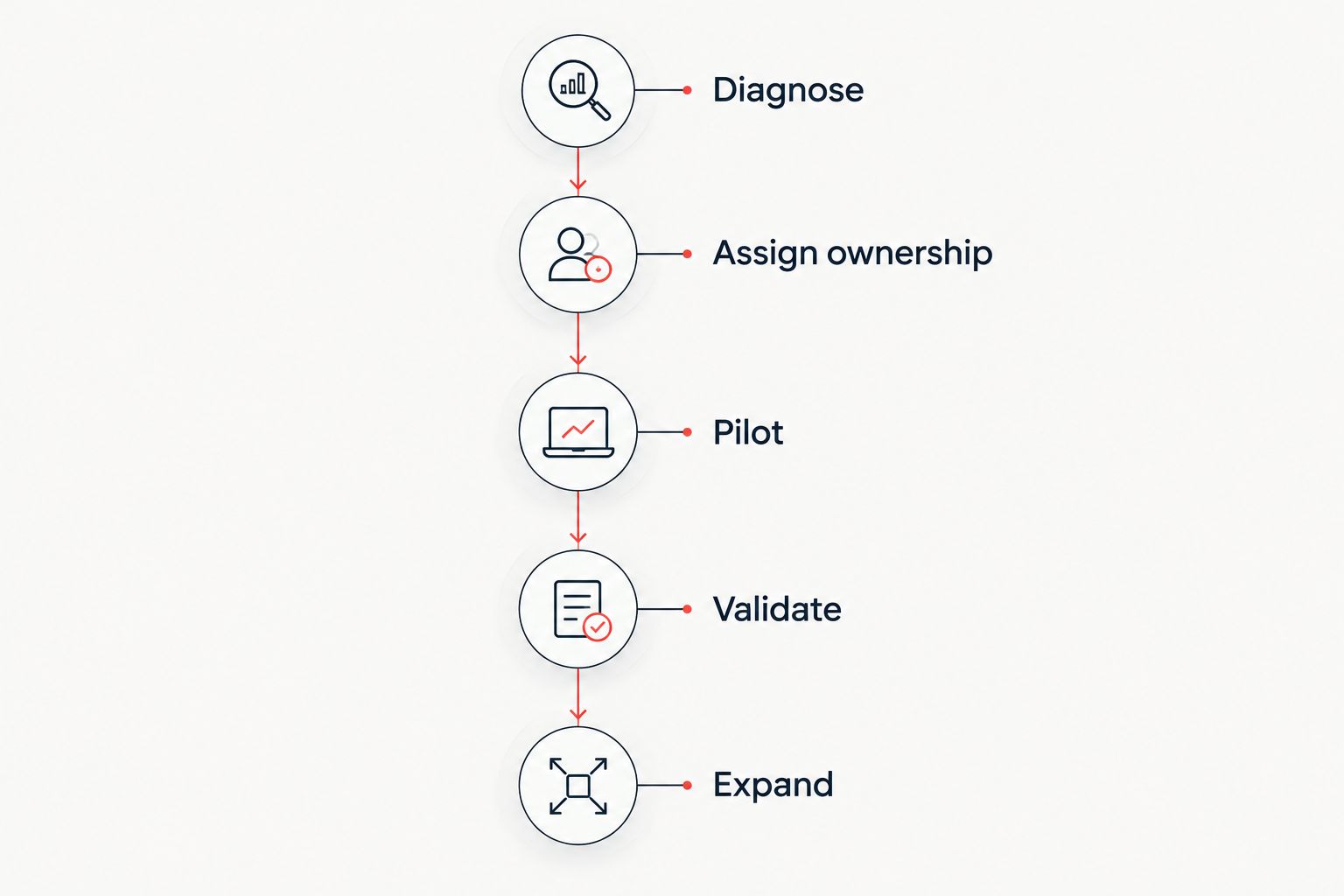 Expand only after the relevant owners accept the pilot.
What should you measure before and after launch?
Choose measures that answer a business question, then document how each measure is calculated. Do not present a new dashboard as evidence that the transformation succeeded.
Organize the review around these 3 measurement layers:
- Business outcomes: Track the intended commercial result, such as qualified inquiries, completed bookings, or repeat business.
- Workflow performance: Check assignment, follow-up, handoffs, and unresolved exceptions against your agreed process.
- Data quality: Check whether records are complete, duplicates are handled, and reporting definitions remain consistent.
Set your own baseline and acceptance criteria before launch. There is no defensible performance target for your business without its starting data, operating constraints, and goals.
The same discipline applies to attribution. A change in reported conversions might reflect revised tracking rather than changed customer behavior. Ask the project lead to explain both the result and the measurement method.
Can a fractional CMO manage the implementation agency?
Yes, a fractional CMO can manage an implementation agency when the engagement includes that authority. The CMO should translate business requirements into an agreed scope, evaluate progress against acceptance criteria, and escalate unresolved delivery issues.
Keep technical approval with qualified specialists. A marketing executive can challenge whether an integration supports the customer journey without personally certifying its architecture or security.
Does a fractional CMO need full-time availability?
No, a fractional CMO does not need full-time availability for every transformation project. The engagement does need enough agreed capacity to make decisions, manage dependencies, and address issues within the project's operating requirements.
Specify who acts when the CMO is unavailable. If every decision must wait for that person, revise the delegation model or choose a leadership arrangement with greater coverage.
When should another executive lead instead?
Another executive should lead when the transformation's primary outcome sits outside marketing. Company-wide operating processes, infrastructure replacement, or clinical workflow changes need accountable leadership with authority in those areas.
The fractional CMO can still own customer acquisition, communications, and marketing measurement within the larger program. Assign leadership by the decisions the project requires, not by who proposed it first.
FAQ
Can a fractional CMO lead digital transformation for a small business?
Yes, a fractional CMO can lead a small business's marketing-centered transformation when scope, authority, and implementation responsibilities are explicit. The business still needs owners for technical delivery and daily operations.
Is a fractional CMO better than an agency for digital transformation?
A fractional CMO fits the leadership requirement; an agency fits defined execution work. Choose according to the missing responsibility, and use both when the project needs strategic direction and external delivery.
Can a fractional CMO choose our marketing software?
Yes, a fractional CMO can lead marketing requirements and evaluate how software supports the customer journey. Technical, operational, and privacy owners should approve requirements within their areas before selection.
Who is responsible if the digital transformation project fails?
Accountability should be assigned before work begins through a named executive sponsor and defined workstream owners. Document who approves scope, accepts delivery, and resolves issues rather than assigning all responsibility to one title.
What should we ask a fractional CMO before hiring?
Ask the fractional CMO to explain relevant project experience, decision authority, implementation responsibilities, and measurement methods. Request a clear distinction between the work they will personally perform and the work other specialists must deliver.
Does Carey Kidd Group provide fractional marketing leadership?
Carey Kidd Group provides fractional CMO and strategic marketing consulting services for hospitality, events, health/medical, and fitness businesses around Raleigh, North Carolina. Match the proposed engagement to your project's scope and delivery requirements.
One last thing
Before approving your 2026 transformation plan, ask who will own the workflow after the project closes. Require an answer that names a role, defines maintenance responsibilities, and explains how problems reach someone authorized to act.
Launch is a milestone; ongoing ownership is the operating model. If the implementation team leaves and nobody owns the process, the leadership assignment was incomplete.