
Yes—a fractional CMO can help a dental practice attract new patients by connecting marketing strategy, local visibility, campaign execution, and appointment conversion. The benefit depends on giving that leader authority to coordinate your team and vendors, not simply asking for more advertising. For your 2026 plan, measure success through attended new-patient appointments rather than website traffic or inquiries alone.
TL;DR- Can a fractional CMO help a dental practice attract new patients? Yes—when leadership connects patient acquisition with appointment conversion.
- Carey Kidd Group provides fractional CMO services for businesses needing strategic marketing leadership, including health/medical businesses around Raleigh.
- Choose fractional leadership for direction and accountability; choose execution support when your strategy already has an owner.
- Track qualified inquiries, booked appointments, and attended new-patient visits separately. Traffic alone does not establish patient growth.
Can a fractional CMO help a dental practice attract new patients?
Yes, when the problem requires marketing leadership rather than an isolated campaign. A fractional CMO can set acquisition priorities, direct specialists, and establish accountability across the path from discovery to an attended appointment. Your practice still needs people to perform the work and staff to handle patient inquiries.
Before comparing strategic marketing services, identify the problem you expect the engagement to solve. More visibility, better inquiry handling, and clearer vendor accountability require different actions.
Use this sequence to connect marketing decisions with patient acquisition:
- Define patient fit. Specify the services you want to promote, the geography you serve, and the appointment capacity you can support.
- Establish the baseline. Record how patients discover the practice and distinguish inquiries from booked and attended appointments.
- Find the constraint. Determine whether the immediate problem is discovery, website clarity, inquiry handling, or scheduling.
- Assign execution. Give each priority a responsible person, an approval process, and a defined outcome.
- Review outcomes. Evaluate patient acquisition alongside spending and operational capacity before expanding activity.
This is a management process, not a promise of a particular patient count. Its purpose is to make the next decision clearer and give someone responsibility for following through.
Why this matters
A dental practice does not need more of every marketing activity. It needs the right work directed at the part of the acquisition process that limits growth. Increasing inquiries while leaving calls unanswered does not solve an appointment problem.
For a 2026 marketing plan, separate demand creation from demand handling. Marketing leadership should coordinate with the practice manager, while clinical decisions and patient care remain with the appropriate professionals. Neither side should evaluate acquisition in isolation.
Fractional CMO, agency, or internal marketing hire?
Choose the model by the responsibility you need covered. A leadership gap is different from a production gap, and neither automatically requires replacing your existing vendors.
| Model | Best for | Main contribution | Main limitation |
|---|---|---|---|
| Fractional CMO | Practices needing strategic direction across staff and vendors | Sets priorities, directs marketing decisions, and establishes accountability within the agreed scope | Does not automatically supply daily production or continuous on-site management |
| Marketing agency | Practices with clear objectives that need specialist execution | Delivers contracted work such as campaigns, content, or website improvements | Authority over internal priorities and front-desk processes depends on the agreement |
| Internal marketing hire | Practices needing ongoing coordination inside the business | Handles assigned work with direct access to the practice team | Skills and seniority vary; a production-focused hire is not automatically a strategy leader |
Choose a fractional CMO when no one owns the marketing decisions. Choose an agency when direction is clear but delivery capacity is missing. Choose an internal hire when the workload calls for sustained involvement inside the practice.
These models can work together. Write down who sets direction, who delivers the work, and who approves changes; otherwise, adding providers leaves responsibility unresolved.
Where should a fractional CMO focus first?
Patient fit
Start with the services your practice wants to grow and can deliver. Ask which patients those services serve, what information prospective patients need, and whether your scheduling capacity supports the intended demand.
Do not treat every inquiry as equally valuable. A request outside your service area or for treatment you do not offer belongs in a different category from a suitable patient seeking an appointment.
Local discovery
Review how clearly your practice presents its location, services, contact details, and appointment process. Local SEO work should reflect the actual practice rather than a list of unrelated search terms.
A fractional CMO can set priorities for the people maintaining your website and Google Business Profile. That leadership role does not mean the executive personally performs every technical task.
Appointment conversion
Check what happens after someone calls or submits a request. Determine who responds, how unanswered inquiries receive follow-up, and how the team records the outcome.
Fix a broken inquiry handoff before expanding acquisition activity. A campaign report cannot establish patient growth if the practice never connects inquiries to attended visits.
Measurement
Use consistent definitions across vendors and internal reports. A form submission, a booked appointment, and a completed new-patient visit are different events.
Your 2026 reporting should keep those distinctions visible. Otherwise, a change in what a vendor counts can look like progress even when the practice has not gained more patients.
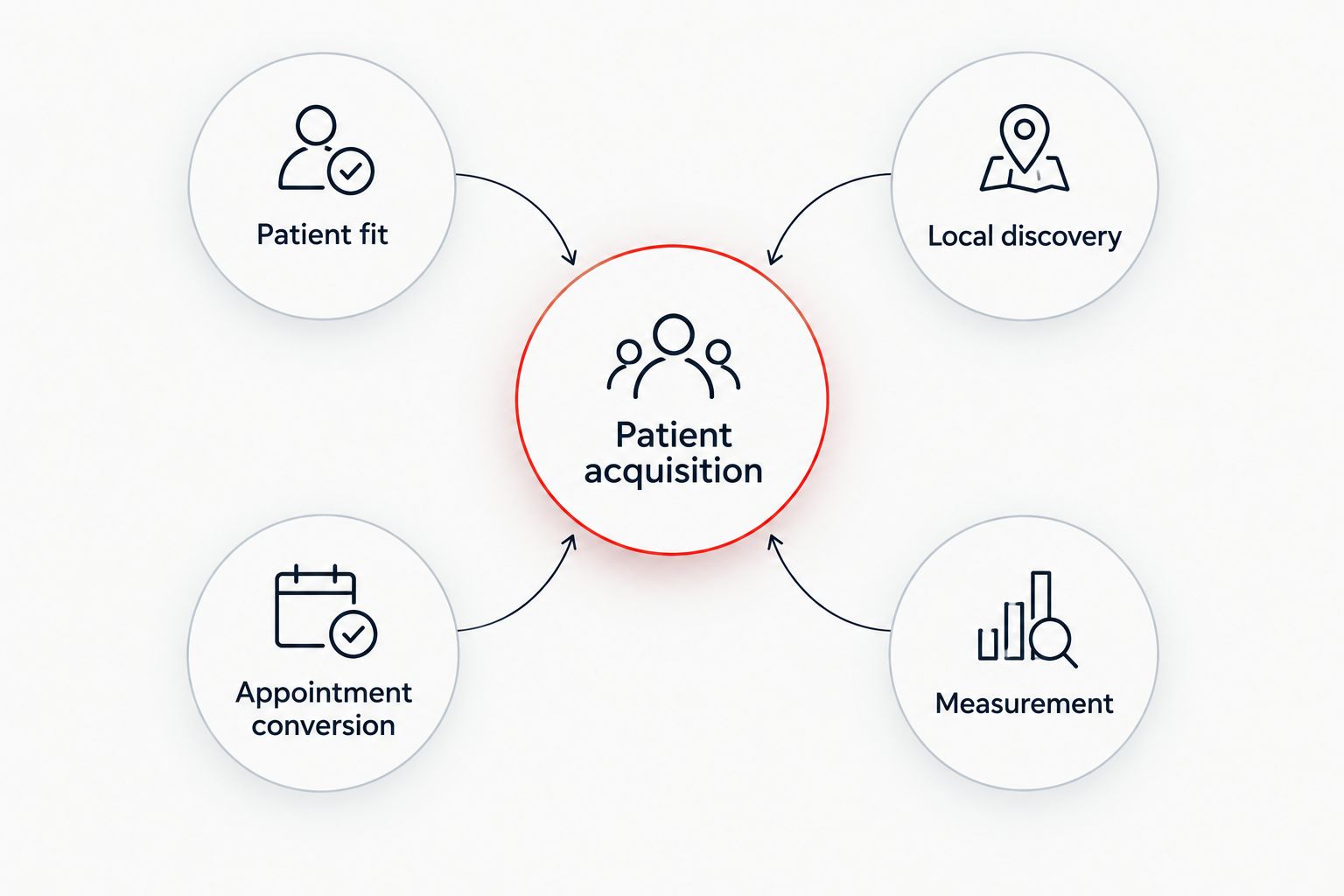 Marketing leadership connects discovery and appointment handling instead of managing them as unrelated tasks.
Why the impact of fractional leadership varies
The title alone does not determine the outcome. Evaluate these factors before hiring:
- Decision authority. Define which marketing decisions the fractional CMO owns and which require practice-owner approval.
- Execution capacity. Identify who will update pages, manage campaigns, produce content, and implement approved changes.
- Appointment capacity. Align promotion with the services and scheduling capacity your practice can support.
- Inquiry handling. Give the practice team a clear process for responding, following up, and recording outcomes.
- Reporting quality. Connect marketing activity to appointment outcomes while limiting access to sensitive information.
- Practice-owner involvement. Establish how service priorities, positioning, and major changes receive approval.
Use these factors as engagement requirements, not explanations after results disappoint. If the fractional CMO has responsibility without authority or implementation support, the scope needs correction before work begins.
How should you measure whether patient acquisition improves?
Agree on the definitions before comparing results. Use 3 outcome measures: qualified inquiries, booked new-patient appointments, and attended new-patient visits. These measures describe different stages; none should silently replace another.
A qualified inquiry should match criteria your practice defines, such as an appropriate service request and relevant geography. A booked appointment records a scheduling outcome. An attended visit confirms that the prospective patient reached the practice.
Keep the reporting period consistent and review the underlying records when results change. Separate new patients from existing patients requesting another appointment, and identify duplicate inquiries rather than counting each submission as a different person.
For 2026 reporting, document these definitions alongside the dashboard. The purpose is not a more elaborate report; it is a reliable basis for deciding what to continue, change, or stop.
What should the practice owner ask during a review?
Ask where the largest unresolved loss occurs between inquiry and attendance. Then ask who owns the next corrective action and what evidence will show whether it helped.
Avoid judging every channel by the same immediate outcome. A useful review distinguishes discovery activity from appointment-generating activity without allowing either to escape accountability.
What should a dental practice require before hiring?
Request a written scope that separates leadership from execution. It should identify the business objective, decision rights, deliverables, reporting responsibilities, and dependencies on your team.
Use these questions during selection:
- Which decisions will you own rather than recommend?
- Who will implement website, campaign, and content changes?
- How will you evaluate appointment handling with the practice manager?
- What records do you need, and why is each necessary?
- How will you assess existing vendors before recommending changes?
- How will priorities change if appointment capacity changes?
Look for clear answers, not a prescribed channel mix before the practice has been assessed. A proposal that immediately promises new-patient volume skips the baseline and operational questions needed to support that forecast.
Where does Carey Kidd Group fit?
Carey Kidd Group provides fractional CMO and strategic marketing consulting services for health/medical businesses and other named sectors around Raleigh, North Carolina. The published professional profile describes 20 years of new business development experience across hospitality, event planning, health/medical, fitness, and related work.
Carey Kidd Group's fractional CMO services are best suited to businesses seeking strategic marketing leadership rather than a standalone production vendor. For a dental practice, discuss the specific acquisition problem, implementation responsibilities, and relevant experience before deciding on fit.
The limitation matters: the service description does not establish a dental-specific patient-growth result. Evaluate Carey Kidd Group's fractional CMO services against the scope your practice needs, not an assumed guarantee.
Discuss your patient acquisition priorities
Clarify marketing leadership, implementation responsibilities, and accountability for your practice.
Discuss your needsCan a fractional CMO work with our current dental marketing agency?
Yes—a fractional CMO can direct an existing agency when responsibilities and decision rights are explicit. The agency can continue contracted execution while the fractional CMO sets priorities and reviews progress against practice objectives.
Avoid creating competing approval chains. Give the agency a clear decision-maker and establish how the practice owner resolves disagreements about scope or priorities.
Will a fractional CMO personally run every campaign?
No—fractional leadership does not automatically include every execution task. Advertising management, website work, content production, and internal training belong in the scope only when explicitly agreed.
Ask for responsibility by deliverable. This prevents a strategic engagement from being mistaken for a fully staffed marketing department.
Can marketing leadership solve a scheduling problem?
Marketing leadership can identify a scheduling constraint and coordinate changes with the practice manager. It cannot create clinical capacity or substitute for operational authority it has not been given.
If suitable inquiries already exceed what the practice can schedule, start with capacity and intake decisions. Increasing promotion before resolving that constraint does not address the immediate problem.
FAQ
Can a fractional CMO help my dental practice attract new patients?
Yes—a fractional CMO can connect marketing priorities, vendor execution, and appointment conversion. The practice still needs implementation support and a reliable inquiry-handling process; patient growth is not guaranteed.
What's the difference between a fractional CMO and a dental marketing agency?
A fractional CMO primarily provides strategic leadership, while an agency delivers contracted marketing work. The exact division depends on scope, so define who owns decisions, execution, and reporting.
Is a fractional CMO better than hiring an internal marketer?
A fractional CMO is the better fit when your main gap is senior marketing direction rather than ongoing internal production. An internal hire fits work that requires sustained involvement inside the practice.
How many new patients will a fractional CMO bring us?
A patient forecast requires your practice's baseline, capacity, acquisition records, and planned activity. Do not accept a fixed patient promise based only on the provider's title.
How soon will our dental practice see marketing results?
The timeline depends on the starting problem and the work required to correct it. Set milestones around implementation and appointment outcomes rather than applying one deadline to every marketing activity.
Do we need to replace our current agency?
No—hiring a fractional CMO does not require replacing your current agency. Review the agency's scope, execution quality, and accountability before deciding whether a change is necessary.
Should a fractional CMO have unrestricted access to patient information?
No—grant access according to the work, applicable privacy obligations, and appropriate agreements. Have your privacy or legal adviser review proposed data access and tracking before implementation.
What should we prepare before speaking with a fractional CMO?
Prepare your service priorities, appointment capacity, current vendor scopes, and available inquiry-to-appointment reporting. These records help distinguish a leadership problem from an execution or scheduling problem.
One last thing
Before approving more promotion in 2026, trace a real inquiry through your existing process. Confirm who received it, how the team responded, whether an appointment was booked, and whether the patient attended.
If that path cannot be reconstructed, make measurement and ownership the first assignment. Knowing where a prospective patient stops is more useful than adding another campaign without a way to judge its contribution.