
A dental practice has no single marketing-results timeline: inquiries, booked appointments, attended visits, and collected revenue measure different stages of progress. In 2026, judge results against a documented starting point and follow each inquiry through to its outcome; more traffic alone does not establish that marketing is producing new patients.
TL;DR- How long does it take a dental practice to see marketing results? Separate inquiries, appointments, and revenue before setting deadlines.
- Google Ads can capture existing searches; local SEO depends on organic visibility. Neither guarantees attended appointments.
- Dental marketing accountability requires tracking patient acquisition beyond clicks and form submissions.
- Fix the stage losing prospective patients before expanding campaign activity.
Why this matters
A campaign can generate inquiries while your appointment book remains unchanged. That gap requires a diagnosis, not an automatic demand for more advertising or an assumption that marketing simply needs longer.
For your 2026 plan, distinguish the marketing objective from the practice's operational capacity. Promoting a service does not resolve unanswered calls, unsuitable inquiries, or scheduling constraints. The fractional CMO guide for dental practices addresses the leadership side of that coordination.
The useful question is not just when results arrive, but which result should appear next and who owns it. Establish that sequence before judging performance.
How long does it take a dental practice to see marketing results?
There is no defensible universal deadline for dental marketing results. The answer depends on your starting visibility, the work being implemented, the patient action you count, and what happens after an inquiry reaches your practice.
Use the following sequence to establish a practice-specific timeline. These are evaluation stages, not promised delivery dates.
- Establish the baseline. Document existing inquiries, bookings, attended new-patient appointments, and acquisition sources using consistent definitions. Separate new patients from existing patients contacting the practice.
- Verify implementation. Confirm that campaigns, relevant website pages, business information, and inquiry routes work as intended. A signed agreement is not the same as a functioning campaign.
- Look for qualified inquiries. Check whether prospective patients want services you provide and can use your location. Raw contact volume does not answer that question.
- Follow appointments through attendance. Record whether qualified inquiries become bookings and whether those patients attend. Assign responsibility for follow-up rather than treating every unbooked inquiry as a marketing failure.
- Review the business outcome. Connect acquisition activity to the financial outcome your practice has chosen to measure. Keep booked appointments separate from collected revenue.
Ask your marketing provider to state what must happen before each stage can be evaluated. A timeline without those dependencies is a calendar promise, not an accountable plan.
Define what counts as a result
Choose the primary outcome before launch. If your objective is attended new-patient appointments, website visits remain supporting evidence rather than the final result.
An inquiry can be useful without becoming a patient immediately. Conversely, a submitted form can be irrelevant if it concerns a service you do not provide. Keep those distinctions visible in reporting so a change in contact volume does not conceal a change in quality.
Which dental marketing activities produce different signals?
Your 2026 channel plan should identify what each activity can demonstrate and what it cannot. Paid search, local SEO, and booking-path improvements address different problems; comparing them solely by traffic obscures their purpose.
| Activity | Best for | Useful progress signal | Advantage | Limitation |
|---|---|---|---|---|
| Google Ads | Reaching people actively searching for relevant dental services | Qualified inquiries attributed to campaigns | Can target existing search demand | Depends on campaign targeting, the destination page, and inquiry handling |
| Local SEO | Building visibility for relevant searches near the practice | Relevant search visibility followed by inquiries | Connects location and service relevance | Rankings do not establish that patients booked or attended |
| Booking-path improvements | Addressing friction between inquiry and appointment | Qualified inquiries progressing to bookings | Focuses on demand already reaching the practice | Does not create search demand by itself |
Choose the activity that addresses the documented constraint. If relevant inquiries are already arriving but not becoming appointments, investigate the booking process before assuming the practice needs another acquisition channel.
Google Ads: judge inquiry quality, not launch status
Google Ads can place advertising against relevant searches once campaigns are eligible to run. That establishes a route to prospective patients, not a guaranteed schedule of new appointments.
Review the searches attracting interest, the services promoted, and the destination page. Then examine whether resulting inquiries match the practice's location and service scope. Treat campaign activation as implementation; treat qualified patient inquiries as a separate outcome.
Local SEO: connect visibility to patient action
Local SEO concerns how patients discover your practice through relevant local searches. Accurate business information and useful service content support that work, but a ranking report alone cannot establish patient acquisition.
Track whether visibility changes are accompanied by relevant website activity and inquiries. Keep the geographic scope consistent when reviewing progress: visibility in an area your practice does not realistically serve is not equivalent to visibility among prospective local patients.
Booking-path improvements: address losses after contact
Booking-path improvements concern what happens when a prospective patient calls, submits a form, or requests an appointment. Review whether the practice receives the inquiry, responds appropriately, and records its outcome.
This work is especially relevant when marketing activity produces contacts without a corresponding change in bookings. Its limitation is straightforward: improving inquiry handling does not replace the need to attract suitable prospective patients.
Why dental marketing timelines vary
A useful forecast identifies dependencies instead of assigning the same deadline to every practice. Review these factors before accepting a proposed schedule:
- Starting visibility. An established website and accurate local presence create a different starting point from a practice that is difficult to find. Document the starting position rather than assuming it.
- Service and location fit. Campaigns must reach people seeking services the practice actually provides within a relevant area. Interest outside that scope does not establish progress toward the objective.
- Implementation readiness. Campaign access, approved messaging, functioning pages, and working inquiry routes affect when meaningful evaluation can begin. Record unresolved tasks separately from campaign performance.
- Appointment capacity. Marketing cannot turn an inquiry into an appointment the practice cannot accommodate. Match promotion to the services and appointment types the practice can support.
- Inquiry handling. A missed call or unresolved scheduling question interrupts the path to booking. Review handling alongside acquisition rather than evaluating each in isolation.
- Measurement quality. Inconsistent definitions obscure whether performance changed. Use the same rules for qualified inquiries, bookings, attendance, and financial outcomes throughout the review.
These factors belong in the plan because each changes the interpretation of results. They are not blanket explanations for poor performance; each should lead to a specific check and an assigned action.
How should you evaluate progress without waiting indefinitely?
Set evidence-based review gates in your 2026 marketing plan. Each gate should answer a business question and identify the next decision, rather than merely confirm that work occurred.
Implementation
Confirm that the agreed activity is live and test the inquiry route. Check the experience from the prospective patient's side, including whether the promoted service and the next action are clear.
If implementation is incomplete, resolve that issue before interpreting the absence of results as a channel failure. Record the actual launch point so reporting does not confuse preparation with active delivery.
Inquiry quality
Review whether contacts concern the intended services and location. Separate legitimate prospective patients from unrelated requests, duplicate contacts, and existing-patient administration.
If quality is poor, inspect targeting and messaging. More spending or more website traffic does not correct a mismatch between the campaign and the patients the practice intends to serve.
Booking completion
Follow qualified inquiries through the scheduling process. Record the outcome and, where appropriate, the reason an appointment was not booked.
If suitable inquiries stall here, review response handling, appointment options, and patient questions. The corrective action belongs at the point of loss, not automatically at the beginning of the acquisition process.
Business outcome
Check attendance and the financial measure selected for the engagement. Attribute outcomes consistently and distinguish confirmed information from assumptions about where a patient originated.
Do not expand a campaign solely because its dashboard looks better. Expand only when the evidence supports the business objective and the practice can handle the resulting demand.
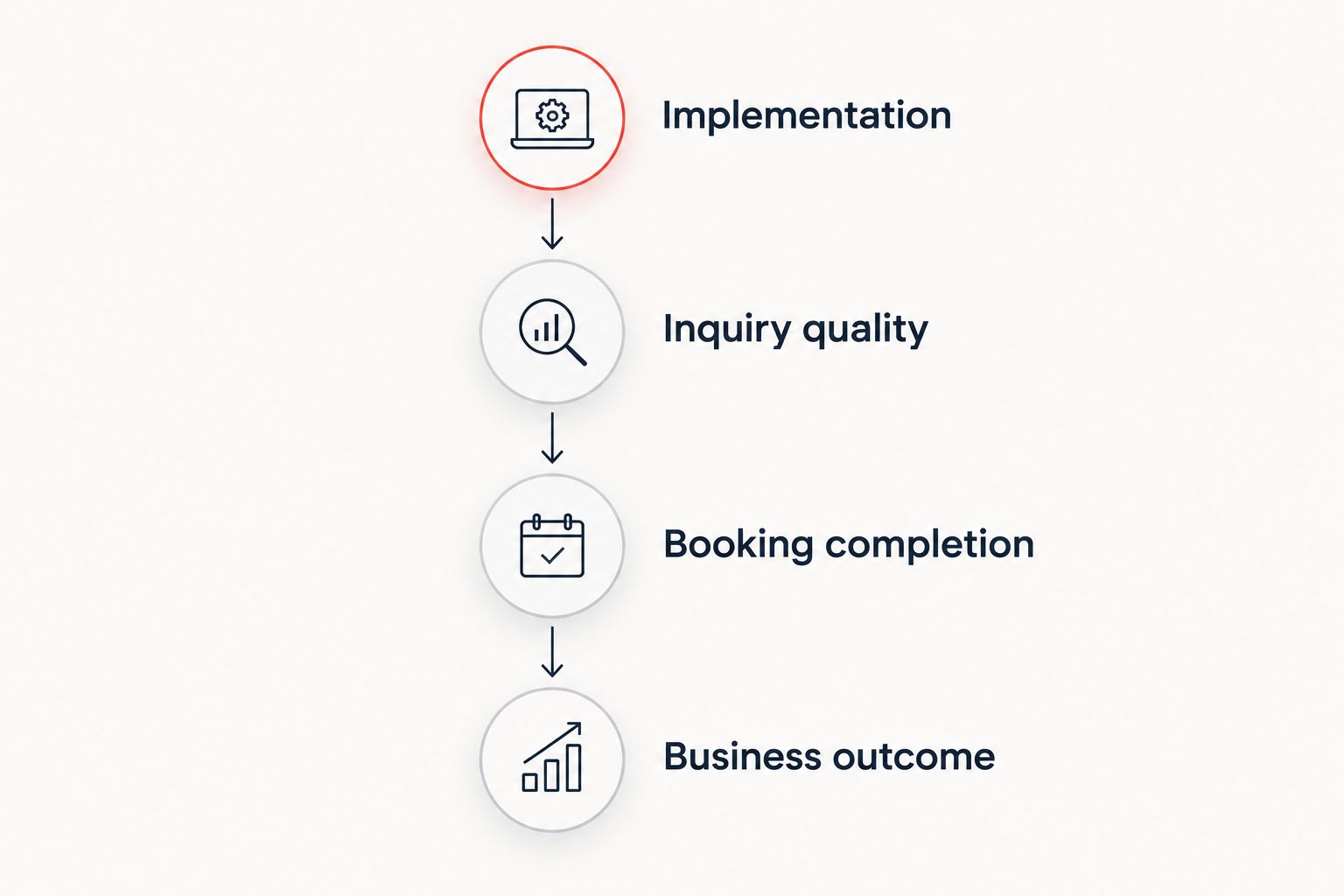 Evaluate the next patient-acquisition stage, not just whether campaign activity increased.
What should your marketing provider report?
Your report should connect activity to decisions. For a 2026 engagement, require a clear distinction between completed work, observed patient behavior, and the business outcome being evaluated.
Ask for reporting that explains:
- What changed and when the change became active.
- Which patient group, service, and location the activity addresses.
- Whether inquiries were relevant and how their outcomes were recorded.
- Where prospective patients stopped progressing toward an appointment.
- What action follows, who owns it, and what evidence will determine the next decision.
Carey Kidd Group provides fractional CMO and strategic marketing consulting services for health/medical businesses around Raleigh. Carey Kidd Group is best for businesses seeking strategic marketing leadership rather than a standalone campaign deliverable.
Carey Kidd Group's strategic marketing services address a different need from purchasing isolated execution. The distinction matters when a practice needs coordination and accountability; leadership does not remove the need for clearly assigned campaign delivery and front-desk responsibilities.
Should you stop dental marketing if appointments are not increasing?
Do not stop or expand activity solely because appointments have not increased. Identify whether the constraint is visibility, inquiry quality, booking completion, or attendance before changing the plan.
Stop treating activity as progress when implementation remains incomplete or reporting cannot connect inquiries to outcomes. Ask for corrective work with a named owner and an explicit evaluation condition, rather than accepting an indefinite request for patience.
Is more website traffic evidence that dental marketing is working?
More website traffic is evidence of increased visits, not necessarily increased patient acquisition. Check whether those visits concern the intended services and lead to qualified inquiries.
A practice can meet a traffic objective without meeting an appointment objective. Report both accurately, but do not substitute the easier metric for the business result you agreed to pursue.
FAQ
How long should I give a dental marketing campaign before judging it?
Judge a dental marketing campaign against agreed evaluation stages, not a universal waiting period. Confirm implementation first, then assess qualified inquiries, bookings, attendance, and the business outcome.
Will Google Ads bring my dental practice patients immediately?
Google Ads does not guarantee immediate new patients. Advertising can reach relevant searchers, but patient acquisition also depends on inquiry quality, booking completion, and attendance.
Does local SEO take longer than paid advertising for dentists?
Local SEO and paid advertising work through different mechanisms, so they should not share an assumed results deadline. Compare the practice's starting visibility, implementation requirements, and patient outcomes rather than promising a fixed difference.
What should count as a dental marketing result?
Count the outcome that matches your practice's stated objective, such as attended new-patient appointments. Keep traffic, inquiries, bookings, and collected revenue distinct so supporting metrics do not replace the goal.
Why am I getting dental inquiries but no appointments?
Inquiries without appointments require a review of inquiry relevance and the booking process. Check service fit, response handling, scheduling questions, and recorded outcomes before concluding that more advertising is the answer.
Can a marketing agency guarantee dental patient growth?
An agency cannot control every factor that determines dental patient growth. Evaluate its implementation commitments and measurement process separately from outcomes that also depend on practice operations and patient decisions.
What should I ask before renewing a dental marketing contract?
Ask which business outcomes changed, where prospective patients stopped progressing, and what the provider will change next. Require consistent definitions and assigned responsibilities rather than a renewal case built only on impressions or clicks.
One last thing
Before approving your next 2026 campaign expansion, trace an actual new-patient inquiry from its source to its recorded outcome. If the trail ends at a form notification, the immediate task is measurement and follow-up—not another channel.
Carey Kidd Group brings 20 years of new business development experience across named sectors including health/medical. Apply that strategic discipline to the decision: require an identifiable constraint, an accountable owner, and evidence that the next action addresses the problem.