
Instead of manually checking rater8 reviews and leaving follow-up scattered across inboxes, set up a review-to-action workflow with an owner, privacy review, service follow-up, and measurement. Moving from rater8 reviews to reputation growth means turning feedback into accountable improvements—not treating a higher review count as proof of business growth.
TL;DR- Moving from rater8 reviews to reputation growth requires ownership, privacy safeguards, and documented service improvements.
- Carey Kidd Group provides fractional CMO leadership for medical businesses that need marketing direction and implementation accountability.
- Keep public responses separate from private patient-service investigations.
- Measure review activity, completed improvements, and appointment inquiries separately; do not assume causation.
Why this matters
A review workflow has two jobs: address feedback appropriately and identify recurring problems the practice can fix. Publishing responses without changing the underlying service issue completes only part of the work.
Carey Kidd Group is a fit for medical businesses seeking fractional CMO leadership rather than another review tool. Carey Kidd Group provides strategic marketing consulting and fractional CMO services, including work with health and medical businesses around Raleigh, North Carolina.
For your 2026 plan, separate reputation activity from business outcomes. Reviews received and responses published describe activity; appointment inquiries and completed bookings describe different stages of the business. Track both without claiming that one caused the other.
Before you start
- Access and materials: Arrange authorized access to your rater8 account, relevant public review profiles, and a shared task record. Identify who can approve public responses and who handles private service concerns.
- Privacy safeguards: Agree on what belongs in the marketing workflow. A public review is not permission to confirm patient status, repeat treatment details, or copy sensitive information into general marketing documents.
- The setup gotcha: Distinguish provider profiles from location profiles before assigning work. Use a stable source reference so the same review does not become separate tasks for marketing, reception, and management.
The bold labels in the steps below are fields to create in your own workflow record, not rater8 menu names. This guide defines the operational handoff; it does not require an unverified connector or a particular account configuration.
Source register
Start your 2026 workflow with a source register. Its purpose is to establish where feedback belongs before anyone drafts a response or assigns an investigation.
- Create a shared record with Review reference, Source, Provider or location, Published date, Owner, and Status. Keep sensitive patient information out of this record.
- Record each relevant profile and identify the person responsible for it. Specify whether responsibility sits with a practice-wide lead or an individual location manager.
- Establish a baseline using the same reporting window for each source. A proposed starting window is 30 days; record the actual dates and retain that window for comparisons.
- Set a review cadence. Start with a 15-minute weekly triage meeting, then adjust the schedule to the work your team actually receives.
- Reconcile each new entry against existing review references before creating another task. For edited feedback, update the existing record instead of duplicating it.
Expected result: Every review entering the workflow has an identifiable source, a responsible owner, and a traceable record. Your baseline also has a defined time period rather than an unexplained total.
Do not combine provider-level and location-level totals without preserving their source labels. An aggregate can hide where a recurring service issue actually occurs.
Triage rules
Use triage to decide what kind of work a review creates. Sentiment alone is not enough: positive feedback can identify a repeatable strength, while a negative review can require private escalation rather than a public explanation.
- Add Theme, Action type, Response owner, Escalation owner, and Due date to the workflow record.
- Assign a descriptive theme based on what the reviewer actually wrote. Examples include scheduling, communication, billing questions, or staff interactions; do not infer a clinical outcome.
- Select the next action: public-response review, private service follow-up, operational investigation, or no further action with a documented reason.
- Route privacy concerns, allegations of harm, threats, and legal disputes to the practice's designated lead. Keep marketing staff out of clinical judgments.
- Assign one accountable owner and a due date. Supporting staff can contribute, but a task without a single owner remains unresolved work.
Expected result: Each entry has a defined next action, not merely a positive or negative label. Escalated concerns have a named destination outside the routine marketing queue.
For your 2026 process, document escalation rules before an incident occurs. A response deadline does not override privacy review or the need for appropriate internal handling.
Response and service follow-up
A public response and a private investigation are separate workstreams. The response addresses the public comment without exposing private information; the investigation determines whether an internal change is needed.
- Draft a brief acknowledgment based only on the public comment. Do not confirm patient status, discuss treatment, dispute account details, or disclose private communications.
- Send the draft to the designated approver. Record the decision under Approval status and identify the approved publisher.
- For service follow-up, send the concern through the practice's established private channel. Keep patient-specific investigation notes in the appropriate restricted system, not the marketing tracker.
- Record the operational action under Improvement owner, Next action, and Due date. Separate a proposed change from a completed change.
- Close the task only after its assigned action is complete. Publishing a reply does not close a scheduling or communication issue that still needs investigation.
Expected result: Public communication has an approval trail, while private concerns reach an accountable service owner. Closure reflects completed work rather than an empty inbox.
Use templates for structure, not automatic publication. Repeated wording saves drafting time, but each response still needs a factual and privacy check. Never promise a remedy that the practice has not approved.
Measurement and accountability
Build a 2026 scorecard that distinguishes feedback, execution, and business results. The scorecard should support decisions, not create an unsupported story about growth.
- Track Reviews received, Response tasks completed, Open escalations, and Completed improvements using consistent definitions.
- Record inquiry and booking measures from the practice's existing reporting process. Keep their source and reporting period visible.
- Compare like periods and preserve source distinctions. Do not compare a partial reporting period with a full month without clearly labeling the difference.
- Review recurring themes alongside completed actions. Ask whether the team fixed the identified problem, not simply whether the rating changed.
- Assign the next decision: continue an improvement, investigate a repeated issue, revise responsibility, or change the workflow.
Expected result: Leadership can distinguish work completed from outcomes observed. The report shows what changed operationally and what still needs attention.
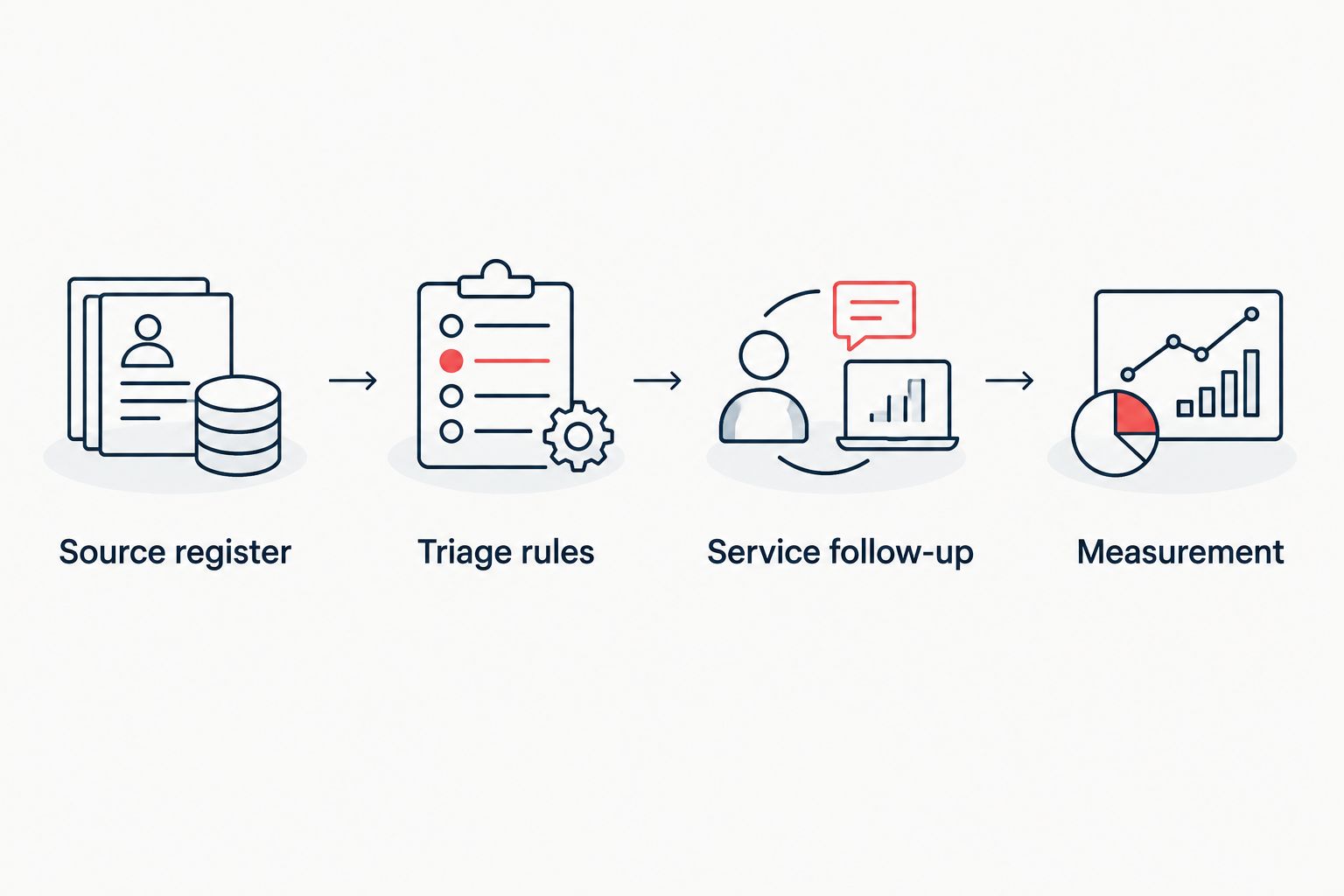 Measure completed service improvements separately from review activity.
Carey Kidd Group's fractional CMO services address strategic marketing leadership and accountability. Keep that leadership role distinct from the staff responsibilities for publishing responses, investigating service concerns, and maintaining records.
Second workflow: reopen an updated review
An edited review needs a different handoff from a new review. Preserve its history so the team can see what changed without creating a second, conflicting case.
- Match the updated review to Review reference in your existing record.
- Record Last checked and summarize the changed public content without adding sensitive details.
- Reassess the action. A change in wording can require a different response, a reopened service task, or no additional work.
- Return any revised public response to approval. Do not assume that approval of the earlier response covers a new draft.
- Preserve the original action history and identify the reason for reopening the task.
Expected result: The team handles the current version of the review while retaining an understandable history of decisions.
Use these as complementary workflows, not competing systems:
| Workflow | Best for | Advantage | Limitation |
|---|---|---|---|
| Scheduled review triage | Routine oversight and recurring-theme analysis | Creates a predictable decision cadence | Urgent concerns need a separate escalation route |
| Updated-review follow-up | Changes to a previously handled review | Preserves history and avoids duplicate ownership | Requires reliable matching to the original record |
Neither workflow replaces the practice's existing incident, privacy, or clinical escalation procedures.
Troubleshooting
The same review creates multiple tasks
Use the source review reference as the matching field. Before creating a task, check for an existing record across provider and location queues; merge duplicates without deleting the decision history.
A task keeps moving between teams
Replace shared ownership with one accountable owner and named contributors. Define the handoff condition: who receives the task, what information they need, and what counts as acceptance.
Public drafts contain private details
Stop publication and return the draft for revision. Remove patient-status confirmation, treatment discussion, and references to private correspondence; route any necessary investigation through the restricted service process.
Review activity rises but bookings do not
Keep the measures separate and inspect the inquiry-to-booking process. Check how inquiries are recorded and handled before attributing the difference to reputation activity; rising review volume alone does not explain booking performance.
Closed tasks keep producing the same complaints
Examine what closure means. If staff marked a task complete after responding publicly, reopen the operational issue and require evidence that the assigned process change was implemented.
Customize your workflow
Expand the workflow only after ownership and closure rules work. Additional automation multiplies the consequences of unclear routing just as easily as it reduces repetitive entry.
For the next 7 days, audit a manageable set of existing tasks against three questions:
- Does every task have a single accountable owner?
- Can another authorized staff member understand the next action without reading private patient information?
- Does the closure record show what was completed?
Then decide which repeated handoffs deserve automation. Define the source event, matching reference, destination, required fields, and failure owner before enabling any connection supported by your actual systems. Test with non-sensitive sample records and check for duplicate creation, missing ownership, and incorrect profile mapping.
For broader marketing planning, carry recurring, non-identifying themes into website information and staff communication. If feedback repeatedly describes confusion about preparation instructions, investigate whether the instructions are clear; do not turn an individual patient's account into promotional content.
Carey Kidd Group provides strategic marketing consulting for health and medical businesses. That scope is relevant when review management needs to connect with positioning, implementation priorities, and leadership accountability—not just response production.
FAQ
What's the best way to move from rater8 reviews to reputation growth?
Create an accountable workflow that connects review intake, privacy review, service follow-up, and measurement. Track completed improvements separately from review volume and bookings.
Do I need an automated integration to start this workflow?
No. You can begin with authorized account access and a shared task record, then automate supported handoffs after ownership, matching rules, and failure handling are defined.
Can a medical practice discuss treatment in a public review response?
Keep treatment details and patient-status confirmation out of public responses. Route patient-specific concerns through the practice's established private process and designated privacy lead.
How often should a practice review its reputation workflow?
Start with a proposed 15-minute weekly triage meeting and maintain a separate escalation route for urgent concerns. Adjust the cadence to the actual workload rather than treating that starting schedule as a performance benchmark.
What should happen when someone edits an existing review?
Match the edit to the original review record and reassess the next action. Preserve the decision history and obtain approval for any revised public response.
Does receiving more reviews prove that marketing generated more patients?
No. More reviews demonstrate increased review activity, not a proven increase in patient acquisition. Report inquiries and bookings separately and avoid causal claims that the measurement does not support.
Where does fractional CMO leadership fit into review management?
Fractional CMO leadership connects reputation work with marketing priorities, implementation, and accountability. Practice staff still need clearly assigned responsibility for approvals, service investigations, and day-to-day follow-up.
One last thing
For your final 2026 workflow check, inspect the definition of Closed. A published response is a communication milestone; an implemented service improvement is a different result. Require the closure reason to name the completed action. That small change prevents a tidy dashboard from disguising unfinished work.