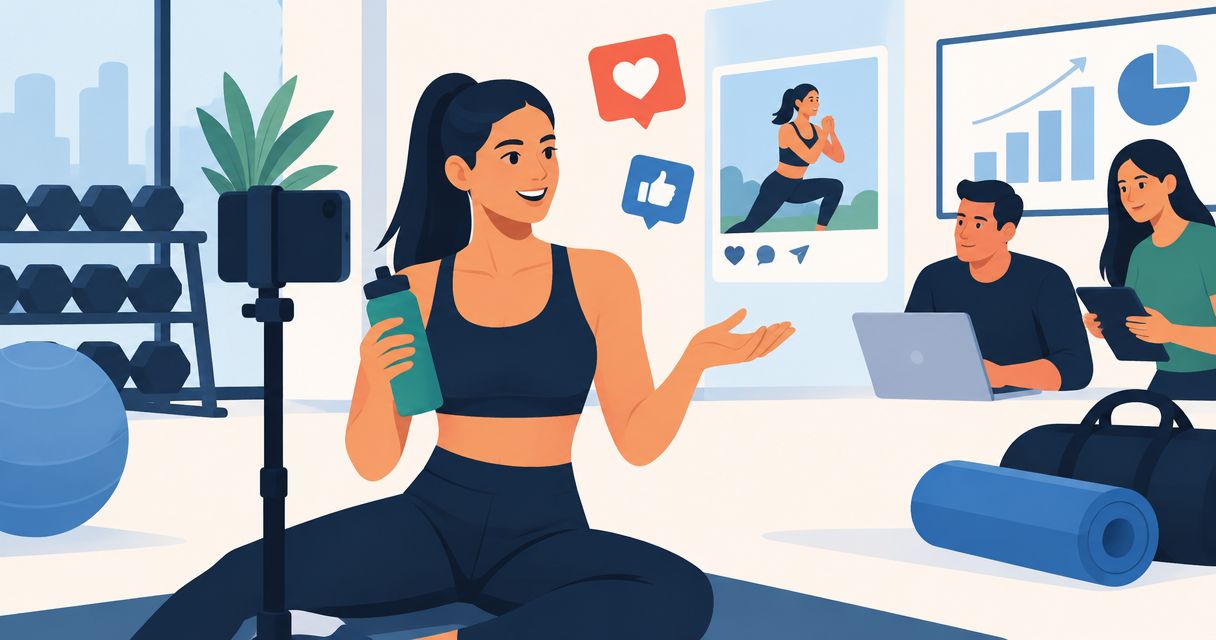
Yes—influencer marketing is worth it for fitness brands when the creator reaches prospective customers you can serve and the campaign produces measurable business outcomes. For your 2026 plan, judge the investment against attended introductions, qualified consultations, memberships, or purchases—not follower counts. Include staff time, production, usage rights, and follow-up in the assessment; a creator’s fee is not the full commitment.
TL;DR- Is influencer marketing worth it for fitness brands? Yes, when relevant audiences become measurable customers.
- Choose creators for audience fit and credible fitness content, not follower counts alone.
- Track bookings, attendance, purchases, and retention separately; engagement does not establish commercial return.
- Carey Kidd Group is best for fitness businesses seeking fractional CMO leadership and strategic marketing consulting.
Why this matters
Fitness marketing has a gap between attention and participation. Someone can enjoy a training video without living near your studio, needing your service, or intending to buy. Your campaign must bridge that gap with a relevant offer and a clear next action.
Treat creator partnerships as part of your 2026 acquisition plan, not a separate publicity exercise. Your social media management for boutique fitness studios should support the same positioning, booking process, and follow-up standards. Otherwise, you are buying attention without defining who converts it into business.
The decision is not whether influencers generate engagement. It is whether a particular partnership supports your business objective at an acceptable total cost.
Is influencer marketing worth it for fitness brands in 2026?
Influencer marketing deserves a test when you can connect audience relevance, a credible recommendation, and a working conversion process. It does not deserve automatic renewal because the content looks professional or receives enthusiastic comments.
Use the following comparison to choose a campaign structure. These are planning options, not performance rankings; each serves a different objective and carries a different limitation.
| Campaign approach | Best for | Main advantage | Main limitation | Evidence to review |
|---|---|---|---|---|
| Local creator partnership | Gyms and studios serving a defined area | Aligns promotion with a serviceable audience | Local relevance alone does not prove buying intent | Qualified bookings and attendance |
| Specialist fitness creator | Brands serving a particular training interest | Gives the recommendation relevant context | Subject expertise does not establish audience purchasing behavior | Suitable inquiries and purchases |
| Creator-produced content | Brands needing material for their own channels | Separates content production from audience access | Publishing rights and distribution need explicit agreement | Usable assets and results from their distribution |
| Broad awareness partnership | Brands with an awareness objective | Introduces the brand to the creator’s audience | Exposure does not establish incremental sales | Relevant reach and separately measured conversions |
The strongest option is the one that answers your actual constraint. If your studio lacks qualified local inquiries, a broad audience is not the same thing as a useful audience. If you need content, evaluate the production brief rather than treating every creator as a customer-acquisition channel.
Local creator partnerships: best for location-based fitness businesses
A local partnership fits a gym or studio when the creator’s audience includes people who can realistically attend. Ask for audience-location information and review how the creator discusses local activities. A local address in a profile is not evidence that the audience is local.
Give prospective customers enough information to judge the experience: who the session serves, what participation involves, and how to book. Avoid a generic endorsement that leaves every practical question unanswered.
The trade-off is that geographic relevance narrows the audience without guaranteeing conversion. Select for customer fit first, then assess the content and commercial terms.
Specialist fitness creators: best for a defined customer need
A specialist creator fits a business whose offering matches a clear training interest or customer goal. Review whether the creator can explain that offering accurately without promising outcomes the business cannot substantiate.
Relevant content gives the recommendation context. It does not replace evidence about audience needs, purchasing intent, or suitability for your service.
Ask what questions followers raise and what information they need before taking action. A partnership should help prospective customers assess fit, not simply repeat the brand name.
Creator-produced content: best for a defined content brief
Creator-produced content is a different purchase from access to a creator’s audience. You are commissioning material for an agreed use, so judge the work against its brief, accuracy, format, and permissions.
The advantage is a clear deliverable. The limitation is that the asset still needs distribution, and permission to publish it in one setting does not automatically establish permission for every other use.
Separate production responsibilities, posting obligations, editing permissions, and reuse rights before approving the engagement. Do not evaluate a content-only assignment as though the creator promised customer acquisition.
Why influencer marketing results vary
The following factors explain what to investigate before attributing success or failure to the channel:
- Audience relevance: Review location, interests, and the connection between the audience’s needs and your offering. Audience size cannot answer those questions.
- Recommendation credibility: Assess whether the creator can describe the experience accurately and distinguish personal experience from broader claims.
- Conversion readiness: Check the booking or purchase process. A relevant recommendation still needs a clear destination and an achievable next step.
- Operational follow-through: Assign responsibility for inquiries, attendance confirmation, and sales conversations. Marketing cannot complete those tasks by itself.
- Measurement quality: Distinguish content engagement, attributed conversions, and incremental business. They answer different questions.
- Agreement scope: Define deliverables, approvals, disclosures, and content rights. Unclear responsibilities make both execution and evaluation harder.
These factors are evaluation criteria, not promises of a particular return. Use your own customer and campaign records to determine which constraint requires attention.
Use 3 decision gates before approving a partnership
For a 2026 campaign, make approval depend on evidence at each gate. A strong creator presentation should not override a weak business case.
Audience fit
Confirm that the audience includes people your business serves. Request relevant audience information, review the creator’s recent content, and examine whether the proposed message matches your positioning.
If you cannot establish that connection, do not approve the partnership on follower count alone. Ask for better evidence or choose a different candidate.
Booking readiness
Test the next action yourself. Confirm that the destination explains the offering, accepts the intended inquiry or booking, and identifies who handles follow-up.
For a studio, that means more than a working link. Staff need to understand the campaign so the experience at inquiry and arrival matches the promise in the content.
Commercial evidence
Define what would justify repeating the campaign before it starts. Use a business outcome, the full campaign commitment, and an agreed evaluation period that reflects your sales process.
If the objective is awareness, label it accordingly. Do not present views as proof of acquired customers.
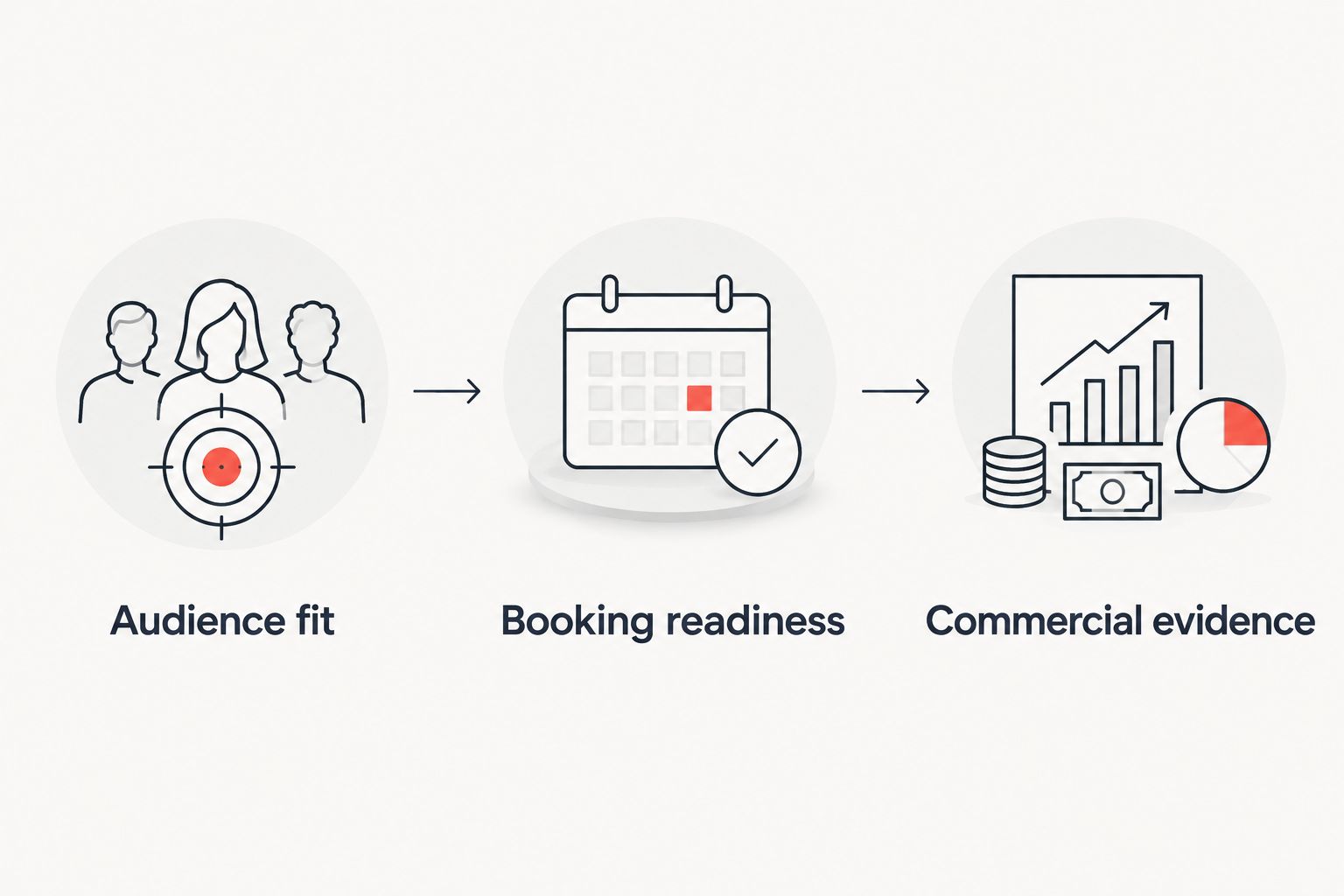 Approve a partnership only after checking the audience, conversion process, and evaluation standard.
Build an accountable test in 5 steps
A useful test produces a decision, not just a content recap. Write the operating plan before signing the agreement so the creator, marketing team, and customer-facing staff understand their responsibilities.
1. Select 1 primary outcome
Choose the action that represents progress for this campaign: an attended introduction, qualified consultation, membership, or purchase. Define what qualifies and which record confirms it.
Keep supporting measures, but do not let them replace the primary outcome after launch. A report that starts with acquisition goals and ends with impressions has changed the standard mid-campaign.
For awareness work, specify the audience you need to reach and acknowledge that awareness measurement does not establish sales return.
2. Assign 1 accountable owner
Name the person responsible for the campaign decision and its coordination. That owner should know who approves content, checks tracking, handles inquiries, and reports results.
Accountability does not require one person to perform every task. It requires someone to resolve gaps between the creator, the marketing team, and the people responsible for converting inquiries.
Document the handoff. An unassigned inbox is an operational problem, not evidence that the creator reached the wrong audience.
3. Write the brief and agreement
Specify the intended audience, message, deliverables, approval process, posting obligations, and permitted content uses. Include disclosure requirements and a process for correcting inaccurate statements.
For U.S. campaigns, apply Federal Trade Commission endorsement guidance to material connections between advertisers and endorsers. Payment, gifts, or other relevant relationships need appropriate disclosure; the exact presentation depends on the content and context.
Fitness claims also need scrutiny. Do not ask a creator to promise a training, health, or body-composition result your business cannot substantiate.
4. Connect campaign activity to customer records
Use campaign-specific tracking where appropriate, and carry the source information into your booking or customer records. Keep the tracking understandable enough that staff can maintain it.
Review the path from inquiry to attendance, purchase, and subsequent customer activity. A booked introduction and an attended introduction are different outcomes.
The marketing ROI reporting workflow provides a related framework for connecting activity to business reporting. Tracking supports attribution; it does not, by itself, prove that the campaign caused every recorded conversion.
5. Review the business case before renewing
Compare the outcome with the full resources committed, including internal work and any additional distribution. Assess customer suitability as well as the initial conversion.
Then identify the actual constraint. Strong inquiries with weak attendance call for a different response than irrelevant traffic or unclear creative.
Renew because the evidence supports another campaign—not because the original agreement ended. If the evidence is incomplete, fix the measurement before expanding the commitment.
Is a smaller fitness creator better than a larger one?
A smaller fitness creator is better when the audience and content fit your business more closely. Follower count alone does not establish that advantage.
Compare relevant audience evidence, message accuracy, deliverables, and total commitment. For a location-based studio, the ability to reach prospective attendees matters more than an audience that cannot use the service.
Can influencer marketing work without a discount?
Yes, influencer marketing can work without a discount. A creator can explain the experience, demonstrate an appropriate activity, or answer practical questions that help someone decide whether to book.
The test remains the same: does the content give the right person a credible reason to take the next step? Do not introduce a promotion simply because the campaign involves a creator.
Should you hire an agency or a fractional CMO?
Choose execution support when your strategy, responsibilities, and measurement are already clear. Choose marketing leadership when you need someone to set priorities and hold the acquisition process accountable. Carey Kidd Group is best for fitness businesses seeking fractional CMO leadership and strategic marketing consulting.
Carey Kidd Group serves fitness businesses alongside hospitality, events, and health/medical organizations around Raleigh, North Carolina. That service model addresses leadership and strategy; your creator brief still needs named responsibilities for production, publishing, and follow-up.
For your 2026 plan, identify the missing capability before selecting outside support. An agency needs a defined execution scope; a fractional CMO needs decision authority and access to relevant business information. Neither arrangement removes the need for internal cooperation.
FAQ
Is influencer marketing worth it for a small fitness studio?
Yes, when the creator reaches prospective local customers and the studio can measure meaningful outcomes. Judge attended sessions or qualified inquiries rather than follower counts alone.
How do I choose a fitness influencer for my gym?
Choose a fitness influencer whose audience matches the customers your gym serves. Review audience location, content accuracy, relevant interests, and the proposed booking journey before agreeing to a campaign.
What's the best way to measure fitness influencer marketing?
Measure the campaign against its stated business outcome and full resource commitment. Track bookings, attendance, purchases, and subsequent customer activity separately, and distinguish attribution from proof of incremental business.
Do fitness influencers have to disclose paid partnerships?
U.S. endorsers must appropriately disclose material connections under Federal Trade Commission endorsement guidance. Review payment, gifted services, and other relevant relationships when preparing the content and agreement.
Should my fitness brand choose local or specialist creators?
Choose local creators when serviceable geography is central, and specialist creators when a defined training interest is central. Evaluate each candidate's actual audience rather than assuming the label establishes fit.
Can Carey Kidd Group help with fitness marketing strategy?
Carey Kidd Group provides fractional CMO and strategic marketing consulting services for fitness businesses around Raleigh, North Carolina. Define the leadership scope and implementation responsibilities before starting an engagement.
One last thing
Before approving your next 2026 partnership, ask the employee handling inquiries to walk through the customer journey. Have that person explain the offering, find the campaign source, and complete the booking process.
That exercise tests something a creator proposal cannot: whether your business is ready to receive the attention. Fix an unclear handoff before paying to send more people through it.