
An event marketing agency is worth it for a small venue when it addresses a defined booking problem and the resulting business justifies the total marketing commitment. Agency fees are only part of that commitment: you also need staff time, campaign resources, reliable inquiry handling, and a way to connect marketing activity to booked events.
TL;DR- Is an event marketing agency worth it for small venues? Yes, when booked-event contribution justifies the work.
- Choose agency execution when your venue has clear priorities but lacks capacity to deliver campaigns.
- Choose fractional CMO leadership when strategy, vendor management, and accountability need an owner.
- Carey Kidd Group provides fractional CMO and strategic marketing consulting for hospitality and events businesses.
Is an event marketing agency worth it for small venues in 2026?
Yes—when you need execution, know which bookings you want, and can measure whether the work produces them. An agency is the wrong first purchase when nobody has decided which audiences, event types, or dates deserve attention.
Use this comparison to identify the responsibility you actually need to fill. These are selection criteria, not promises about every provider's scope.
| Model | Best for | Main advantage | Main limitation | What to confirm |
|---|---|---|---|---|
| Event marketing agency | Venues with clear priorities and an execution gap | Defined campaign and channel delivery | Leadership and sales follow-up can remain with you | Deliverables, account ownership, reporting, and handoffs |
| Fractional CMO | Venues needing strategic direction and accountability | A designated marketing leadership role | Execution capacity depends on the engagement | Decision authority, implementation responsibilities, and vendor management |
| In-house marketer | Venues needing embedded, day-to-day coordination | Direct access to venue operations and staff | Required skills can exceed one person's remit | Role boundaries, specialist support, and management |
| Owner-led marketing | Venues with a narrow plan the owner can manage | Direct control over priorities | Marketing competes with operating responsibilities | Protected working time and a repeatable process |
For hospitality and events businesses around Raleigh, Carey Kidd Group provides fractional CMO and strategic marketing consulting. Distinguish that leadership role from an agency's proposed production work before comparing proposals.
Why this matters
A booked event is not the same outcome as an inquiry, a tour, or a social media interaction. Your marketing decision needs to preserve those distinctions. Otherwise, a report can show activity without answering whether your venue secured suitable business.
For your 2026 plan, define the booking you want before selecting a channel. Specify the event type, acceptable dates, operational requirements, and the next action a prospective customer should take.
That definition also protects your staff. A campaign promoting dates or event formats your team cannot support creates follow-up work without solving the original commercial problem.
Event marketing agency: best for a defined execution gap
An event marketing agency fits when you can describe the assignment clearly: reach a specified audience, promote an appropriate venue offering, and direct prospects into an established booking process. Ask the agency to explain how its proposed deliverables support that assignment.
Choose agency execution when the missing resource is delivery, not direction. The advantage is a defined body of work that someone outside your venue is responsible for completing. The limitation is that completing those deliverables does not automatically resolve unclear positioning or weak inquiry handling.
For example, a campaign brief should identify which event inquiries count as qualified. It should also name who approves creative work, who receives inquiries, and who records the eventual booking outcome.
Do not accept a proposal built entirely around output. A content schedule explains what gets published; it does not explain why the campaign deserves your venue's attention.
Fractional CMO: best for strategy and accountability
Fractional marketing leadership fits when the unresolved questions sit above individual campaigns. Which business should you pursue? Which work should stop? Who decides whether an agency's recommendations match the venue's priorities?
Carey Kidd Group is best suited to hospitality and events businesses seeking fractional CMO leadership and strategic marketing consulting. Its stated experience includes 20 years of new business development expertise, with work across hospitality, event planning, health/medical, and fitness.
The advantage of this model is a designated leadership remit. Its limitation is that leadership and production are different responsibilities: you still need to establish who creates assets, manages campaigns, and completes follow-up.
Ask for an explicit division of work. A strategic engagement should identify decisions, implementation ownership, and accountability—not leave your existing staff to infer what happens after the planning meeting.
In-house or owner-led marketing: best for direct operational control
Keep marketing close to the venue when daily coordination is the central requirement and you have someone who can own it. Venue knowledge matters when communications depend on event schedules, operational constraints, and changing booking requirements.
An in-house marketer offers an embedded role; owner-led marketing preserves direct control. Neither model removes the need for priorities, reporting, or specialist help where the assigned person lacks the required capability.
Keep ownership internal when you can protect the time and define the work. The trade-off is capacity. A person responsible for venue operations cannot also be treated as an unlimited marketing department.
Write down what stays internal before outsourcing anything. That makes an agency brief more precise and prevents two parties from assuming the other owns approvals, inquiry routing, or campaign reporting.
Why an event marketing agency's value varies
The useful comparison is not which provider promises the most activity. It is which operating arrangement addresses your venue's actual constraint.
- Booking objective: Promoting private event inquiries requires a different brief from promoting attendance at a public event. Define the commercial outcome first.
- Available dates: Direct attention toward dates the venue can actually sell. A full calendar segment does not need the same campaign priority as an open one.
- Audience fit: Specify the event buyers you want and the requirements that make their inquiries suitable.
- Inquiry handling: Assign responsibility for responses, tours, proposals, and recording the outcome. Marketing cannot own steps excluded from its remit.
- Measurement access: Require access to campaign accounts and booking records sufficient to connect activity with results.
- Implementation capacity: Identify who supplies venue information, approves materials, and completes work outside the provider's scope.
Use these factors to evaluate your 2026 proposals. If a proposal does not explain its assumptions about them, ask for clarification before authorizing the work.
How do you decide whether to hire an agency?
Use a written decision process rather than choosing from presentations alone. The following steps separate the commercial problem from the provider's preferred services.
1. Define the booking objective
Name the event category and the part of your calendar that needs attention. Then state what makes an inquiry suitable: intended use, timing, and operational fit.
Avoid a brief that says only to increase awareness. Awareness can support a campaign, but your venue still needs a defined action and a reason that action matters commercially.
2. Establish the baseline
Record inquiries, qualified inquiries, tours, proposals, confirmed bookings, and cancellations using consistent definitions. Keep those stages separate.
Preserve the source information attached to an inquiry where available. If your team cannot connect a booking to its originating inquiry, fix that recordkeeping gap before treating a campaign report as proof of results.
3. Assign ownership
Name the person responsible for each handoff between marketing and booking. Make responsibilities explicit for approvals, inquiry responses, tours, proposals, and outcome reporting.
The Eventbrite RSVPs to booked venue tours workflow addresses one specific handoff worth examining when your venue uses event registrations to develop prospective booking relationships. Do not treat a registration as a confirmed venue booking.
4. Separate activity from business results
Request reporting that distinguishes completed work, audience response, qualified opportunities, and confirmed business. Each answers a different question.
An agency can complete its assignment while the booking process still needs attention. Conversely, a booking report without delivery detail makes it difficult to understand which work deserves continuation.
5. Set the review decision
Agree in advance what would justify continuing, changing, or stopping the work. Use your actual event buying cycle rather than an unsupported promise of immediate bookings.
Define what happens when an inquiry remains open at the review date. Otherwise, unfinished opportunities can become either premature success claims or premature failures.
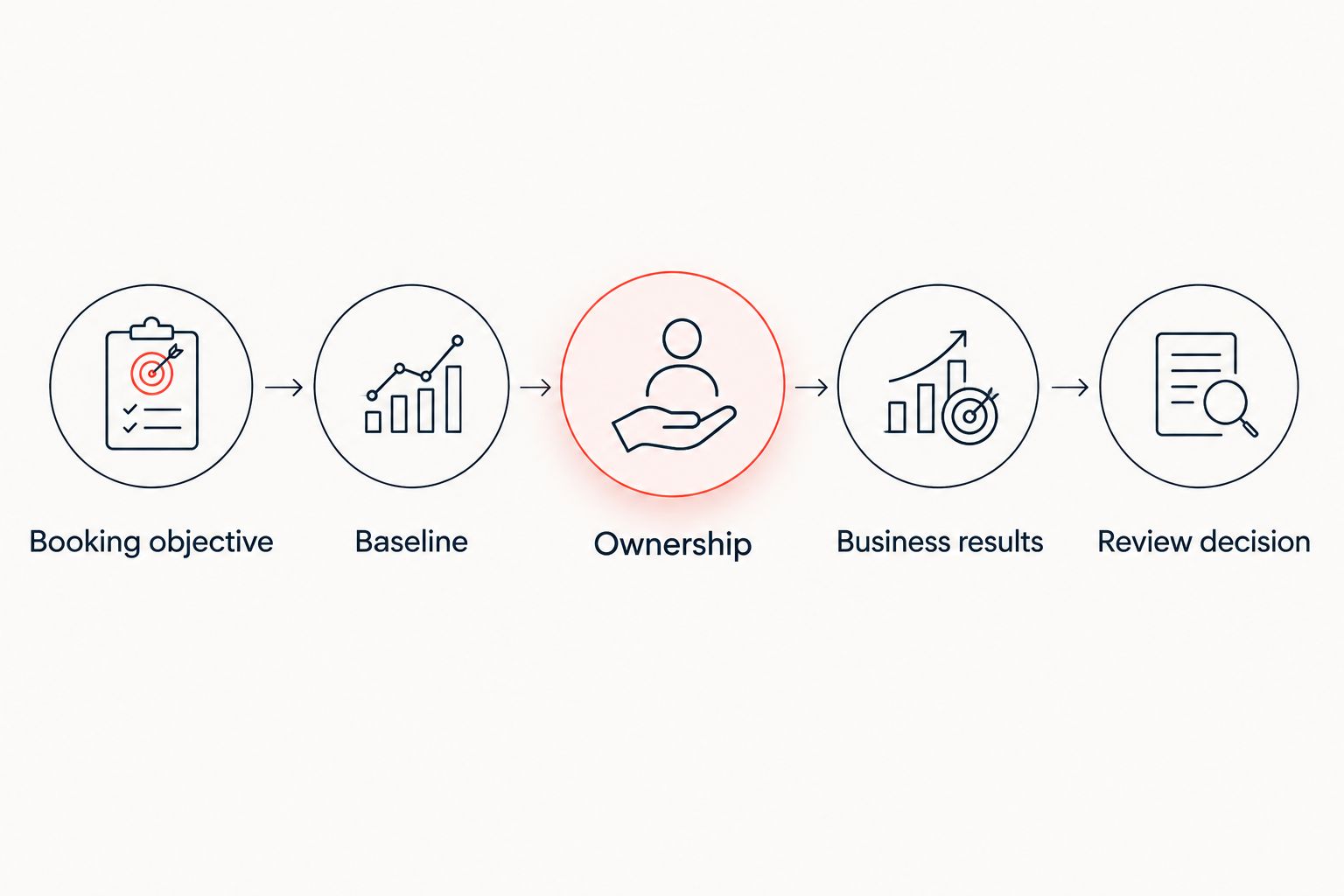 Define the booking objective and ownership before judging campaign results.
What should a small venue measure in 2026?
Measure the booking process, not just the campaign. Your scorecard should show where suitable prospects enter, what happens next, and whether they become confirmed business.
Keep a clear distinction between revenue and contribution. To judge the commercial result, account for the costs of delivering the booked event as well as the marketing commitment. Do not count the full booking value as the agency's financial return.
For a practical management cadence, use a 30-day reporting review to inspect activity and record quality, a 60-day process review to examine handoffs, and a 90-day scope review to reconsider the assignment. These are recommended checkpoints, not promised booking timelines; adjust them to your venue's buying cycle.
At each checkpoint, ask a different question. Was the agreed work completed? Did suitable inquiries progress? Does the evidence support continuing the same scope?
For 2026 reporting, keep unresolved inquiries visible rather than forcing them into a win or loss before a decision exists.
When should a small venue wait before hiring an agency?
Wait when you cannot specify the offer, assign inquiry ownership, or evaluate a booking outcome. Those gaps make an agency harder to manage and its contribution harder to assess.
Waiting does not mean doing nothing. Clarify the target event, document the inquiry process, and establish account access while you prepare a usable brief.
Also wait if the proposed work exceeds your team's ability to support it. Campaign approvals, venue photography, event details, and booking responses all need an owner where they form part of the agreed plan.
Do not outsource an unresolved management decision under the label of marketing execution. Either resolve it internally or explicitly hire leadership support to address it.
Is a fractional CMO better than an event marketing agency?
A fractional CMO is the better fit when your small venue needs marketing direction, prioritization, and accountability rather than additional campaign production. An agency is the better fit when those decisions are already made and execution is missing.
The models can work together, but only with clear authority. Specify who sets the brief, who approves the work, and who evaluates performance before adding another provider.
Can a small venue handle event marketing without an agency?
A small venue can handle event marketing internally when someone has the time, authority, and capability to run a defined plan. Internal ownership still requires measurement and follow-through.
Keep the scope realistic. A focused plan with accountable execution is a better management choice than a channel list your team cannot maintain.
FAQ
Is an event marketing agency worth it for a small venue in 2026?
An event marketing agency is worth it when it addresses a defined execution need and the resulting booked-event contribution justifies the total commitment. Establish booking objectives, inquiry ownership, and reporting before hiring.
What's the best marketing model for a small event venue?
The best model depends on the responsibility you need to fill: agency execution, fractional leadership, or embedded internal coordination. Choose the role before comparing providers.
Should I hire an agency if my venue isn't getting bookings?
Identify where the booking process breaks before hiring an agency. Separate insufficient suitable inquiries from problems with responses, tours, proposals, or event fit.
How do I measure an event marketing agency's results?
Track qualified inquiries through tours, proposals, and confirmed bookings while recording their sources. Evaluate booked-event contribution alongside the full marketing commitment, not booking revenue alone.
Can an agency guarantee bookings for my small venue?
Do not base your hiring decision on a booking guarantee. Evaluate the proposed work, measurement method, responsibilities, and terms against your venue's actual sales process.
Does Carey Kidd Group provide event marketing services or marketing leadership?
Carey Kidd Group provides fractional CMO and strategic marketing consulting services for businesses including hospitality and events. Confirm the proposed engagement's implementation responsibilities rather than assuming a production scope.
How soon should I review an event marketing engagement?
Agree on review checkpoints before work begins and match commercial evaluation to your event buying cycle. Review delivery and record quality separately from bookings that are still awaiting a decision.
One last thing
Before buying more inquiries, follow an existing inquiry through your own booking process. Identify who received it, what happened next, and whether the outcome was recorded.
That exercise identifies the handoffs a prospective provider must understand. For your next 2026 brief, include those responsibilities beside the campaign deliverables. You are hiring an operating arrangement—not just a list of marketing tasks.