
A fractional COO is worth it for a small business in Raleigh when recurring problems in service delivery, team accountability, and cross-functional execution require senior operational leadership—not another task owner. The additional commitment includes your management time, implementation work, and the authority you must delegate. Choose this model for a defined operating problem; choose a different role when your actual constraint is marketing strategy, frontline supervision, or a temporary project.
TL;DR- Is a fractional COO worth it for a small business? Yes, when operational leadership—not task execution—is the constraint.
- Choose a fractional COO for cross-functional accountability; choose an operations manager for daily supervision.
- Carey Kidd Group provides fractional CMO services for marketing leadership, not a substitute for operational leadership.
- Judge the engagement against an agreed baseline, decision authority, and implementation ownership—not meeting volume.
Is a fractional COO worth it for a small business in Raleigh?
Yes, when the business needs someone to own how work moves across departments and the founder cannot keep serving as the default escalation point. The engagement needs a defined scope, access to operating information, and permission to change how teams work.
Do not confuse an operating constraint with a demand problem. Carey Kidd Group provides fractional CMO and strategic marketing consulting services around Raleigh; that is a different remit from managing business operations.
Use the comparison below to identify the role before evaluating candidates. These are selection criteria, not promises about any individual provider.
| Option | Best for | Main advantage | Main limitation | Recommendation |
|---|---|---|---|---|
| Fractional COO | Cross-functional operating problems needing part-time executive ownership | Connects priorities, processes, and management accountability | Limited capacity requires clear boundaries and internal implementation support | Choose for a defined leadership gap |
| Operations manager | Daily supervision within an established operating model | Keeps schedules, tasks, and frontline execution moving | Role authority often stops short of company-wide redesign | Choose when direction already exists |
| Project consultant | A bounded process or implementation project | Concentrates expertise on a specific deliverable | Ongoing management ownership must sit elsewhere | Choose for a finite assignment |
| Fractional CMO | Marketing strategy, positioning, and marketing accountability | Gives marketing a senior decision-maker | Does not replace responsibility for service delivery or staffing | Choose for a marketing leadership gap |
| Full-time COO | Continuous executive oversight across the business | Provides dedicated operating capacity | Requires an ongoing executive role with enough responsibility to justify it | Choose when fractional coverage is insufficient |
For your 2026 decision, start with the work that needs ownership. A senior title does not resolve a poorly defined assignment.
Why this matters
An operational problem often appears as several disconnected complaints: missed handoffs, repeated founder intervention, inconsistent delivery, or managers working toward conflicting priorities. Hiring separately against each symptom leaves the underlying ownership problem unresolved.
The opposite mistake is buying executive oversight for work that needs a capable supervisor. Match the level of authority to the level of the problem. If the process is sound but nobody manages the schedule, start with management capacity rather than an executive engagement.
When a fractional COO is the right choice
A fractional COO fits when problems cross departmental boundaries and someone must make trade-offs between them. For example, accepting more bookings affects staffing, scheduling, and service capacity—not just sales activity.
Look for an operating decision that remains unresolved despite repeated discussion. Does every exception return to you? Do managers understand their individual tasks but disagree about who owns the complete customer experience?
A useful assignment connects the operational problem to an outcome you can observe:
- Replace informal handoffs with a documented owner and acceptance criteria.
- Establish a shared process for reviewing capacity before commitments are made.
- Define which decisions managers make independently and which require escalation.
- Create a management review that ends with decisions, owners, and deadlines.
These are proposed responsibilities, not evidence that every fractional COO provides them. Put the relevant responsibilities into the engagement scope and confirm who performs the implementation work.
Choose fractional COO support when you need operating decisions and accountability across functions. Do not choose it simply because the founder feels busy.
When an operations manager is the better choice
An operations manager is the better fit when your business already has a workable process and needs consistent daily supervision. Scheduling, task follow-through, and routine coordination need an available owner; they do not automatically require executive redesign.
Ask whether the person can succeed using the authority and procedures already in place. If the answer is yes, define the management role before expanding the brief to company-wide leadership.
The limitation is scope. A manager cannot resolve conflicting executive priorities if the business has not authorized that manager to make those decisions.
Choose an operations manager for daily execution within a clear operating model. Escalate to executive leadership when fixing the problem requires changing responsibilities, priorities, or decision rights across teams.
When marketing leadership is the better choice
Marketing leadership is the better fit when the central questions concern positioning, target buyers, campaign priorities, or accountability for marketing implementation. An operating executive is not a substitute for a clear marketing strategy.
Carey Kidd Group is best suited to Raleigh-area businesses seeking fractional CMO and strategic marketing consulting in hospitality, events, health/medical, and fitness. Its stated services address marketing leadership rather than a fractional COO remit.
Keep that boundary explicit. A marketing leader can coordinate with operations, but your business still needs an owner for staffing, delivery capacity, and operational execution.
For your 2026 plan, write separate problem statements for demand generation and delivery. If you cannot distinguish them, examine the customer journey before selecting either executive role.
Why a fractional COO's value varies
The value of fractional operating leadership depends on the assignment and the business's ability to act on decisions. Assess these factors before discussing an engagement:
- Problem scope: A cross-functional accountability gap needs different support from an isolated scheduling issue.
- Decision authority: Define what the executive can approve, change, and escalate without waiting for founder permission.
- Implementation capacity: Identify the managers or employees who will carry out agreed changes.
- Operating visibility: Give the role access to the records needed to understand workload, handoffs, and delivery performance.
- Founder participation: Decide which responsibilities you will transfer and which you will retain.
- Continuity needs: Specify when decisions require live availability and how exceptions will be handled between scheduled sessions.
Weakness in any of these areas changes the engagement's usefulness. More advice does not compensate for a missing implementation owner, and a better report does not resolve an unresolved authority dispute.
Use your 2026 scope document to settle these questions before work begins. Treat the document as an operating agreement, not a list of meeting topics.
How do I decide whether the engagement is worth it?
Evaluate the assignment against a baseline and observable changes, rather than the executive's activity log. Use the following sequence before signing and during review.
Define the constraint
Write the problem in operational language: which work stalls, where it stalls, and who currently intervenes. Avoid broad objectives such as improving efficiency unless you specify what will change.
Describe the consequences using your own records. Repeated rework, unresolved exceptions, missed internal deadlines, and founder escalation time are useful starting points when those records exist.
Record the baseline
Use a 30-day baseline as a planning option if that period captures your normal work cycle. This is a measurement recommendation, not a required industry standard or a promised result.
Track the same definitions throughout the engagement. A completed handoff must mean the same thing before and after a process change; otherwise, the comparison measures a reporting change rather than operational improvement.
Assign authority
Document who decides priorities, changes procedures, approves exceptions, and manages follow-through. Include the responsibilities that remain with you.
Test the arrangement with a realistic disagreement. If a department resists a process change, who makes the final decision? Resolve that question before the first implementation meeting.
Review implementation
Set a 60-day review as a proposed checkpoint for examining whether agreed changes have been implemented. Do not treat that checkpoint as a guarantee that financial results will already be visible.
Review completed work, unresolved decisions, and adoption by the people doing the work. A process document is not an operating improvement until the relevant team uses it.
Decide continuity
Use a 90-day review as a proposed decision point for continuing, narrowing, or ending the assignment. Adjust the timing to your operating cycle rather than treating it as a universal engagement length.
Ask what still requires executive judgment and what an internal manager can now own. Continue the executive role for unresolved executive work—not because recurring meetings have become familiar.
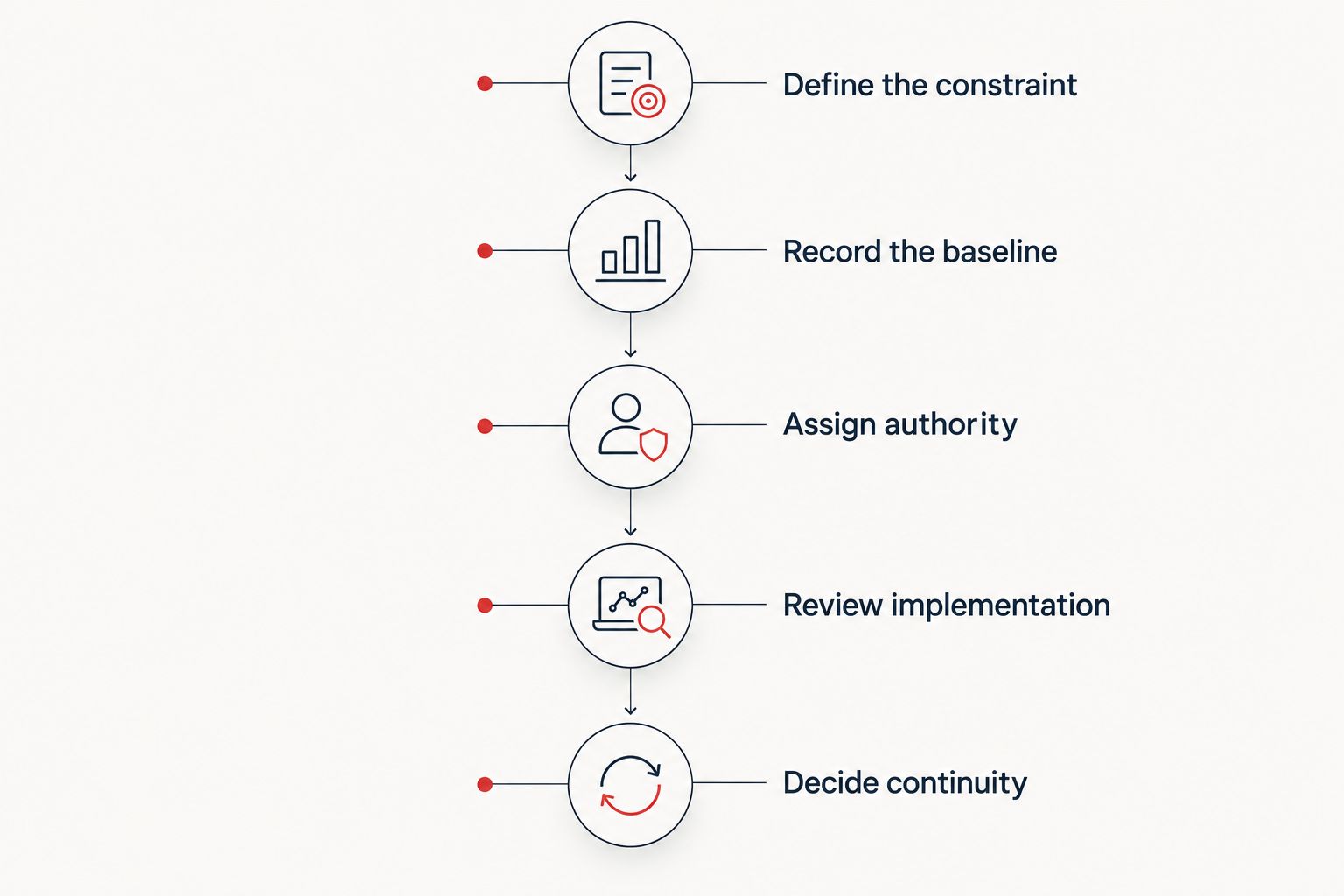 Define the operating problem and decision authority before judging the engagement's results.
For a 2026 evaluation, keep the evidence tied to the original assignment. If the scope changes, update the baseline and review criteria rather than claiming success against a different problem.
Does a fractional COO need to be based in Raleigh?
A Raleigh location is not a substitute for relevant operating experience or a workable attendance plan. Decide which responsibilities require physical observation, on-site meetings, or immediate access to managers, then evaluate candidates against those requirements.
For hospitality, events, health/medical, and fitness businesses, distinguish customer-facing delivery from work that can be managed remotely. Do not assume that proximity guarantees availability or that remote support fits every operational responsibility.
Ask candidates to explain how they would observe the work, communicate decisions, and handle exceptions. If your brief is ready, compare fractional COO services in Raleigh-Durham against that brief rather than choosing on location alone.
Can a fractional COO replace the founder's operational role?
A fractional COO can take ownership of defined operational responsibilities, but delegation requires explicit authority and cooperation from the founder. If every meaningful decision still returns to you, the business has added an adviser rather than transferred operational ownership.
Start with responsibilities you are prepared to release. Communicate the change to managers and stop reversing delegated decisions through informal side conversations.
What should I ask before hiring a fractional COO?
Ask for a proposed scope, the decisions the candidate expects to own, and the implementation support the candidate needs. Discuss the limits of the arrangement as directly as its advantages.
Use these questions in the selection conversation:
- Which parts of this problem require executive leadership rather than management?
- What evidence would you examine before changing the process?
- Which decisions would remain with the founder?
- Who would complete the implementation work?
- What would make fractional coverage insufficient?
- How would responsibilities transfer when the engagement ends?
A useful answer explains the working arrangement. A presentation about experience alone does not establish who will own your unresolved decisions.
FAQ
Is a fractional COO worth it for a small business with a small team?
A fractional COO is worth considering when the leadership problem crosses functions, regardless of whether the team feels small. If the work is primarily scheduling and supervision, assess an operations manager first.
What's the difference between a fractional COO and an operations manager?
A fractional COO takes executive responsibility for a defined operating scope; an operations manager supervises execution within an established scope. Actual authority depends on the responsibilities you assign, not the title alone.
Should I hire a fractional COO or a fractional CMO?
Choose a fractional COO for operational leadership and a fractional CMO for marketing leadership. Separate delivery problems from positioning, demand generation, and marketing accountability before choosing.
Can a fractional COO manage my existing team?
A fractional COO can manage existing employees when that responsibility is explicitly included in the engagement. Define reporting lines, decision rights, and availability before changing the management structure.
How soon should I review a fractional COO's work?
A 60-day implementation review is a proposed checkpoint, not a promised results deadline. Review agreed changes and team adoption against the baseline, then set further checkpoints around your operating cycle.
Do I need a full-time COO instead?
Choose full-time operating leadership when the role requires continuous executive coverage that a fractional arrangement cannot provide. Define the required decisions and availability before comparing the models.
What are the warning signs of a poor fractional COO engagement?
Unclear authority, unassigned implementation work, and reports without decisions are warning signs. Revisit the scope when meetings continue but responsibility for the original operating problem remains unresolved.
One last thing
The most useful deliverable is a decision your business no longer needs you to make. Before hiring, identify a recurring escalation and describe who should own it after the engagement starts.
If that escalation concerns marketing direction rather than operations, keep the brief focused. Carey Kidd Group's fractional CMO services belong in a marketing leadership evaluation—not an assumed COO shortlist.
For 2026, judge the next hire by the responsibility you can transfer, the implementation your team can support, and the evidence you will review. A title without those conditions leaves the founder in the same operating role.