
A medical practice website redesign requires a scope-based quote, not a defensible flat estimate without knowing the content, functionality, and migration work involved. For your 2026 budget, separate the website build from ongoing maintenance, software subscriptions, and marketing; a proposal that combines them makes the redesign harder to evaluate.
TL;DR- How much does it cost to redesign a medical practice website? Define content, functionality, migration, and support before comparing quotes.
- A medical website redesign and ongoing local SEO need separate scopes and accountability.
- Carey Kidd Group provides fractional CMO services for health/medical businesses; strategic leadership is distinct from website production.
- Approve the patient journey and launch requirements before approving a visual design.
Why this matters
A redesign is a business decision about how patients find your practice, understand its services, and request care. A new appearance does not resolve an unclear service offering, an unreliable appointment process, or conflicting location information.
Your website also sits inside a broader marketing budget. Use the medical practice marketing cost guide to distinguish the website project from the ongoing work of attracting and converting patient inquiries.
Compare proposals against the same written scope, not against their presentation. Otherwise, you are comparing different projects under the same label.
How much does it cost to redesign a medical practice website?
The cost depends on what you retain, replace, write, connect, and maintain. Request a proposal that separates discovery, content, design, development, migration, testing, and post-launch responsibilities.
For a 2026 proposal, ask vendors to complete the same breakdown below. An explicit exclusion is more useful than a vague promise that everything is included.
| Scope component | What the proposal should specify | What to challenge |
|---|---|---|
| Discovery | Patient audiences, business priorities, content inventory | Design starting before requirements are agreed |
| Content | Pages retained, rewritten, removed, or created | Unclear responsibility for clinical review |
| Design | Page layouts, mobile behavior, accessibility requirements | Attractive mockups without usable patient journeys |
| Development | Editing system, forms, booking connections, integrations | Features described without acceptance criteria |
| Migration | URL mapping, redirects, content transfer, measurement continuity | A launch plan that ignores existing search traffic |
| Testing | Functional checks, mobile checks, accessibility evaluation | Approval based only on appearance |
| Handover | Account ownership, training, documentation, support boundaries | Dependence on undocumented vendor access |
Ask each vendor to identify assumptions alongside deliverables. If an estimate assumes that your staff will supply finished copy, the proposal should say so before you sign.
The useful comparison is the same scope with different delivery approaches—not different scopes with similar labels.
Visual refresh: best for a sound site with presentation problems
A visual refresh keeps the underlying site structure and functionality while changing presentation. It fits a practice whose information is accurate, patient pathways work, and staff can maintain the existing system.
Its advantage is restraint: you avoid replacing elements that already serve the practice. Its limitation is equally important: changing typography, imagery, or page layouts does not repair an unsuitable editing system or a broken scheduling connection.
Before selecting a refresh, ask staff to demonstrate how they update a provider profile and change office information. Then test whether a patient can find the appropriate service and understand the next step without assistance.
Choose a refresh only when the underlying website deserves to stay. Do not use a design project to defer an operational problem.
Structural rebuild: best for confusing content and patient journeys
A structural rebuild changes how information is organized and how patients move through the site. It fits a practice where service pages overlap, navigation obscures important information, or location details are inconsistent.
The advantage is the opportunity to align content with patient questions. The trade-off is greater coordination: someone must approve the page inventory, resolve conflicting information, and review the material before launch.
Treat clinical accuracy as a defined responsibility, not a final favor from a busy provider. A writer can organize information, but your practice must assign an appropriate reviewer to approve clinical statements and service descriptions.
Choose a structural rebuild when the problem is what patients understand, not just what they see.
Functional rebuild: best for workflows that need replacement
A functional rebuild changes what the website does, including forms, scheduling connections, or content management. It fits a practice whose current system cannot support its agreed requirements.
The advantage is control over the required workflow. The limitation is dependency: external systems, permissions, and data handling require decisions beyond the designer's remit.
Do not assume that an appointment button and an integrated scheduling process represent the same work. Specify where the patient goes, what information is collected, which system receives it, and who responds.
The comparison below distinguishes the approaches. These are scope choices, not standardized packages.
| Approach | Best for | Main advantage | Main limitation |
|---|---|---|---|
| Visual refresh | A usable site with presentation problems | Retains working structure and functionality | Leaves underlying structural problems untouched |
| Structural rebuild | Confusing navigation or incomplete content | Reorganizes information around patient needs | Requires content decisions and clinical review |
| Functional rebuild | Workflows the current system cannot support | Addresses defined operational requirements | Adds integration and testing dependencies |
Why medical practice website redesign costs vary
The relevant question is not whether a practice is small or large. It is how much work the approved website requires and who is responsible for completing it.
- Content scope: Distinguish editing existing pages from researching and writing new material. Assign ownership for provider biographies, service descriptions, and patient instructions.
- Practice structure: Identify the locations, specialties, and providers the site must represent. Establish how shared information will stay consistent.
- Patient workflows: Document appointment requests, calls, portal access, and form submissions. Specify the difference between directing patients elsewhere and connecting systems.
- Search migration: Inventory existing URLs and decide what stays, moves, or disappears. Include redirects and launch checks in the scope.
- Accessibility and privacy: Define the applicable review process and responsible specialists. A design approval is not a substitute for either review.
- Post-launch ownership: Separate hosting, updates, maintenance, content changes, and marketing. Identify which responsibilities remain with your practice.
For your 2026 planning, turn these factors into decisions before requesting final proposals. Unresolved requirements should appear as open decisions, not disappear inside a broad project description.
How to request comparable redesign proposals
Use a decision sequence that moves from business requirements to delivery responsibilities. The purpose is to prevent a vendor from estimating a different website than the one your practice expects.
1. Define outcomes
State what patients need to accomplish and what the practice needs to manage. Examples include finding a relevant provider, understanding a service, requesting an appointment, and updating office information.
Avoid making appearance the only acceptance criterion. Specify the tasks the completed site must support.
2. Inventory content
List the current pages and assign each a decision: retain, revise, combine, or remove. Identify missing information separately so new writing does not become an unstated obligation.
Record which pages currently support search visibility or patient inquiries. Those pages require deliberate migration decisions, even if their design changes completely.
3. Specify workflows
Describe the route from an appointment request to staff action. Include form destinations, notification ownership, and the instructions patients receive after submitting information.
For privacy-sensitive workflows, obtain appropriate compliance and technical review. Do not ask a web designer's general assurance to carry that responsibility.
4. Assign ownership
Name the decision-maker for business priorities, clinical content, technical access, and final acceptance. Ask vendors to identify their corresponding responsibilities.
Staff review is work even when it is not a vendor deliverable. Confirm that the practice can supply the decisions and approvals the proposed schedule requires.
5. Approve acceptance
Document what must pass before launch: links, forms, mobile navigation, redirects, content approval, and access handover. Include a process for recording defects and confirming corrections.
A launch date does not prove completion. Acceptance should depend on the agreed requirements functioning as specified.
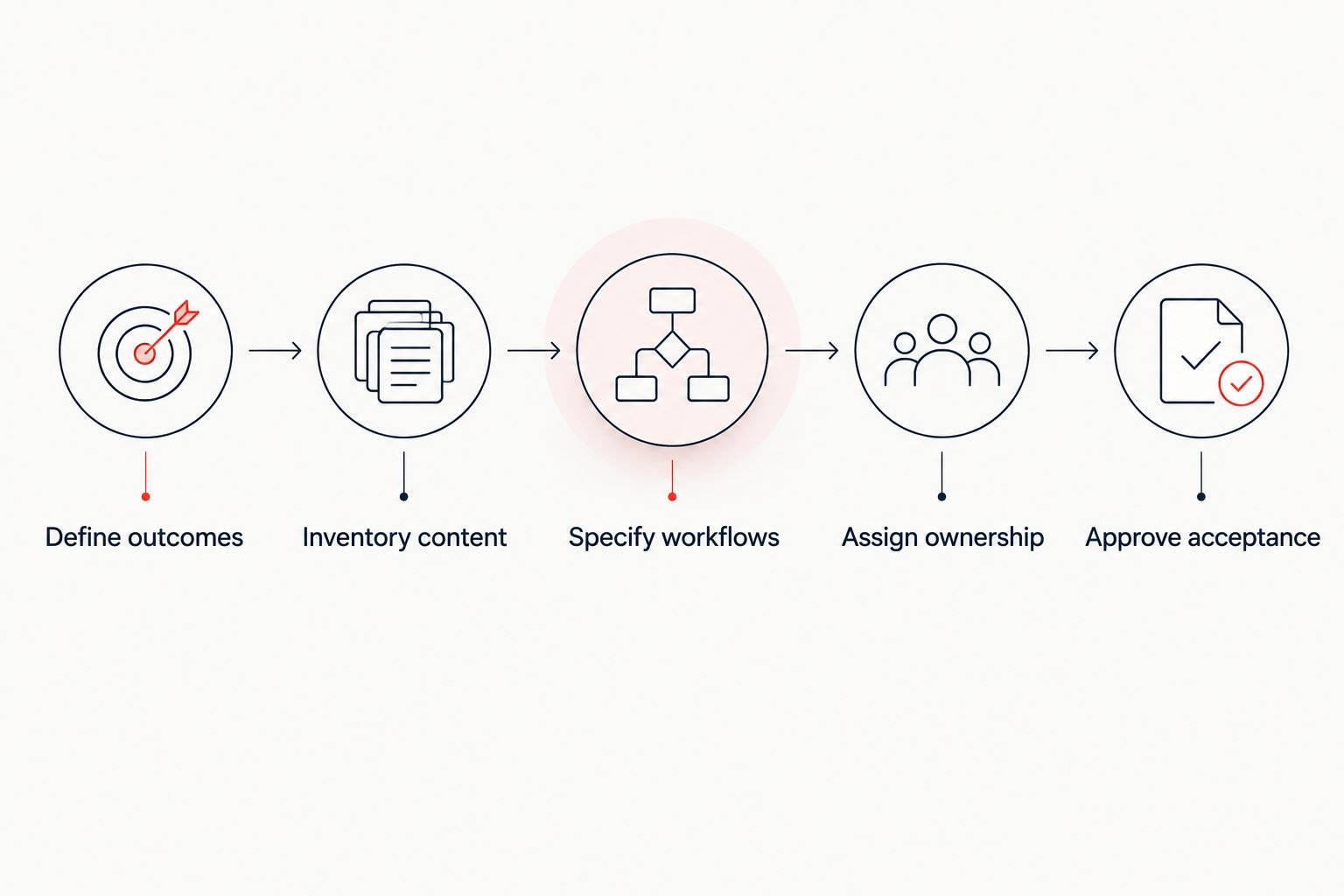 Agree on requirements and responsibilities before approving the launch.
What should ongoing website support include?
Ongoing support should have its own scope, owner, and approval process. For a 2026 agreement, distinguish keeping the website operational from changing its content or improving marketing performance.
Ask who handles software updates, backups, restoration, account administration, and technical incidents. Separately establish who publishes provider changes, revises service information, and evaluates patient inquiry performance.
A maintenance agreement is not automatically an SEO engagement. Likewise, an SEO engagement does not automatically include development work or clinical content review.
Confirm that your practice controls its domain and has the access needed to continue operating if the vendor relationship ends. Request handover documentation rather than relying on verbal assurances.
Should you redesign before investing in local SEO?
Redesign first when the existing website prevents patients from completing essential tasks or cannot support required content. Preserve useful pages and search signals during that work rather than treating the new site as an unrelated replacement.
If the website already works, establish whether the immediate problem is visibility, unclear information, or appointment handling. A redesign is not the default answer to every patient acquisition problem.
Review search performance and patient pathways before making that decision. Treat design, search visibility, and staff response as separate responsibilities that must work together.
Who should lead the website redesign?
Your practice needs a business owner for the project, not just a production vendor. That person must resolve priorities, coordinate reviewers, and make trade-offs between requested features and essential patient tasks.
Carey Kidd Group brings 20 years of new business development experience and provides fractional CMO and strategic marketing consulting services, including work with health/medical businesses around Raleigh, North Carolina. That is a marketing leadership role; do not treat it as evidence of a website production package or a particular technical capability.
Carey Kidd Group is best suited to health/medical businesses seeking fractional marketing leadership rather than a stand-alone website production service. The benefit is strategic direction; the boundary is that design, development, and technical review need explicit delivery ownership.
Review Carey Kidd Group when your unresolved issue is marketing direction and accountability. Require any engagement to define who sets strategy, who builds the site, and who approves the result.
FAQ
How much does it cost to redesign a medical practice website in 2026?
A medical practice website redesign requires a quote based on its agreed scope. Compare content, design, development, migration, testing, and support separately rather than treating unlike proposals as equivalent.
Is a website refresh enough for my medical practice?
A website refresh fits a practice whose existing structure, content, and patient workflows already work. Choose a rebuild when the underlying system or information structure needs replacement.
Does a medical website redesign include SEO?
A medical website redesign includes SEO work only when the agreement specifies it. Define migration tasks, redirects, on-page requirements, and ongoing search work separately.
Do we need new content for every page?
You do not need to rewrite every page simply because the design changes. Inventory existing content and retain accurate, useful material while revising gaps, duplication, and outdated information.
Will a redesigned website guarantee more patient appointments?
A redesigned website does not guarantee more patient appointments. Search visibility, service relevance, appointment access, and staff follow-up also affect the path from interest to a scheduled visit.
Who should approve medical website content?
Your practice should assign an appropriate clinical reviewer to approve clinical statements. The vendor agreement should distinguish writing, editing, clinical review, and publication responsibilities.
What should we ask before signing a website redesign contract?
Ask for explicit deliverables, exclusions, ownership terms, acceptance criteria, and post-launch responsibilities. Confirm who supplies content, controls accounts, manages patient-facing workflows, and corrects launch defects.
One last thing
Before authorizing a redesign, ask your team to walk through an appointment request on the current website. Follow it beyond the confirmation screen to the person responsible for responding.
That exercise separates website defects from operational defects. For your 2026 redesign, write the acceptance test before approving the design: the patient understands the next step, the request reaches its intended destination, and staff know what action to take.