
Yes—local SEO is worth it for a medical practice in Raleigh in 2026 when you need new patients, have appointment capacity, and can track completed visits from local search. The caveat is operational: better visibility does not fix unanswered calls, unsuitable inquiries, or an appointment process that loses patients before booking.
TL;DR- Is local SEO worth it for a medical practice in Raleigh? Yes—when visibility produces suitable, completed appointments.
- Google Business Profile and accurate service pages support local discovery; rankings alone do not establish return.
- Carey Kidd Group provides fractional CMO leadership for medical businesses needing strategy and accountability, rather than just channel execution.
- Fix intake problems before expanding local SEO activity, and evaluate patient acquisition without exposing health information.
Is local SEO worth it for a medical practice in Raleigh in 2026?
Local SEO earns its place when patients searching for your services can find accurate information, determine whether your practice fits their needs, and request an appointment. Evaluate that chain before approving a larger marketing scope.
- Confirm capacity. Identify which services and clinicians can accept additional patients.
- Check discovery. Review your Google Business Profile and the pages explaining those services.
- Test intake. Follow the path from a search result to a call or appointment request.
- Measure outcomes. Connect qualified inquiries with scheduled and completed appointments where attribution is available.
Carey Kidd Group provides fractional CMO and strategic marketing consulting for health/medical businesses around Raleigh, with 20 years of new business development experience described in its background. That leadership role is relevant when the problem spans marketing priorities, implementation, and accountability—not simply a missing listing update.
Why this matters
A medical practice does not need more traffic indiscriminately. You need inquiries from people seeking services you provide, in locations you serve, under appointment and payment arrangements your practice can support.
For your 2026 plan, separate the visibility problem from the conversion problem. A practice that is difficult to find needs different work from one that receives inquiries but cannot answer them promptly. Treating both as an SEO problem creates activity without a clear business diagnosis.
The decision is whether local search can support the appointments you want—not whether a ranking report looks better.
What makes local SEO valuable for a medical practice?
Local search connects service intent with a practical location decision. A patient looking for a nearby clinician needs enough information to decide whether contacting the practice makes sense.
Your Google Business Profile should accurately represent the practice, including its location, hours, contact details, and appropriate categories. Your website should explain the services actually provided and give patients a clear next step. Check that these details agree rather than asking patients to resolve contradictions.
The benefit is clearer discovery and decision-making. The limitation is control: Google's local results consider relevance, distance, and prominence, so optimization does not remove geography or guarantee placement.
Do not publish pages for services you do not provide or locations where you have no meaningful patient offering. A Raleigh address is useful context; repeating Raleigh throughout an otherwise unhelpful page is not a patient acquisition strategy.
Why the value of local SEO varies
Use these factors to assess your practice rather than borrowing another clinic's expectations:
- Appointment capacity. Additional inquiries have limited immediate value when the relevant clinician cannot accept patients. Direct the work toward services with capacity.
- Service fit. A visitor seeking a service you do not offer is not a qualified lead, regardless of how the visitor arrived.
- Location fit. Patients must be willing and able to reach your practice. Geographic visibility and practical access are separate considerations.
- Information accuracy. Conflicting hours, contact details, or service descriptions create uncertainty before a patient speaks with you.
- Intake execution. Calls and appointment requests need an assigned owner and a workable response process.
- Measurement quality. A report that stops at impressions cannot show whether local discovery produced completed visits.
These are decision criteria, not a forecast. Your practice's own records should establish which constraint deserves attention first.
Should you prioritize local SEO, paid search, or referrals?
These channels solve different acquisition problems. Compare their role before choosing where to put management attention in 2026.
| Channel | Best for | Main advantage | Main limitation | What to evaluate |
|---|---|---|---|---|
| Local SEO | Improving discovery for relevant nearby searches | Makes practice and service information accessible during search | Placement is not guaranteed, and geography affects local results | Qualified inquiries and completed appointments attributable to local search |
| Paid search | Testing a defined service message through advertising | Gives you control over campaign targeting and messaging | Requires ongoing media management and does not repair weak intake | Inquiry quality, appointment outcomes, and total campaign spending |
| Referral development | Building relationships with relevant referral sources | Supports patient introductions through established relationships | Requires relationship management and suitable referral fit | Appropriate referrals, scheduling outcomes, and source accuracy |
Choose local SEO for a discovery problem, not as a substitute for every other acquisition channel. Paid search can test a message, while referral development addresses relationships that a website cannot replace.
Avoid treating these channels as competing departments. A referred patient can still search for your practice before calling, which makes consistent public information useful beyond strictly attributed SEO inquiries.
How should you evaluate local SEO before expanding it?
Use a decision process that connects visibility with practice operations. The following sequence is a planning recommendation, not a promise about when rankings or appointments will change.
Establish a baseline
Choose a 30-day baseline window to organize available information. Record local search visibility, relevant website visits, qualified inquiries, scheduled appointments, and completed appointments where your systems support the connection.
Label attribution gaps instead of filling them with assumptions. A patient reporting Google as the source does not necessarily distinguish an advertisement, a map result, or an ordinary search result.
Separate searches for your practice name from searches for a service. Both matter, but they answer different questions: whether people can find a practice they already know and whether unfamiliar patients are discovering it.
Verify service information
Choose the services you want to support, then check whether each has a useful explanation on the website. Confirm the practice location, clinician information, appointment instructions, and patient-facing details with the appropriate internal owner.
Medical content needs clinical accuracy, not just keyword coverage. Assign qualified review before publication, and avoid unsupported treatment claims or promises about patient outcomes.
Test intake
Have an authorized staff member inspect the public appointment path without submitting sensitive patient information. Check whether the telephone number works, appointment instructions are understandable, and forms communicate what happens next.
Then review actual intake handling with the practice manager. Determine who owns missed calls, incomplete requests, and inquiries that need clarification. A working form is not proof of a working intake process.
Review outcomes
Set a 90-day decision review to examine implementation, inquiry quality, and appointment outcomes together. This is a management checkpoint, not a guaranteed SEO results timeline.
At that review, identify what changed and what remains unresolved. An accurate profile and clearer service pages are completed work; more suitable completed appointments are business outcomes. Report them separately.
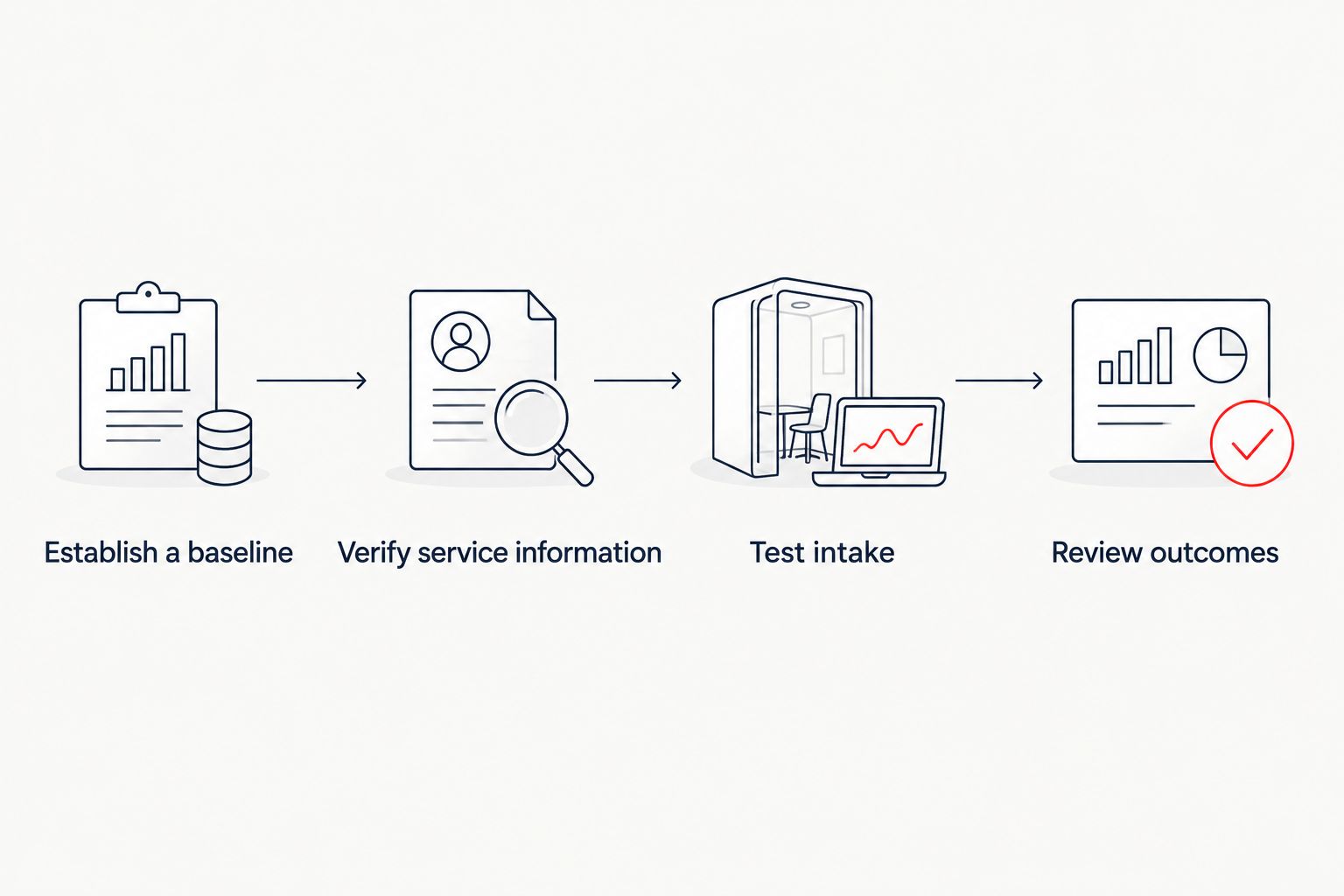 Evaluate discovery and intake together before deciding whether to expand local SEO.
What should your local SEO report actually show?
A useful 2026 report separates search exposure, patient action, and appointment outcomes. Each layer needs a clear definition so changes do not get misread as business growth.
- Search exposure: Visibility for relevant services and locations, with branded searches identified separately.
- Patient action: Calls, website visits, and appointment requests, without assuming every action represents a new patient.
- Inquiry quality: Whether the person sought an appropriate service and met the practice's relevant scheduling requirements.
- Appointment outcomes: Whether qualified inquiries became scheduled and completed appointments, where records permit attribution.
Keep marketing reporting separate from unnecessary patient detail. Have your privacy and compliance advisers assess tracking, forms, access permissions, and vendor arrangements before introducing new measurement systems.
A completed appointment is a stronger business signal than a profile view, but attribution still needs evidence. Do not credit SEO with every new patient merely because visibility improved during the same period.
Who should own implementation and accountability?
Assign ownership according to the problem. These engagement models have different responsibilities; buying one does not automatically supply the others.
| Model | Best for | Primary responsibility | Limitation to address |
|---|---|---|---|
| SEO specialist or agency | Defined search execution | Agreed technical, content, and local search work | Does not automatically own staffing, intake, or practice-wide priorities |
| In-house marketing lead | Ongoing internal coordination | Managing implementation and communication inside the practice | Needs suitable expertise and enough execution support |
| Fractional CMO | Cross-functional marketing leadership | Setting strategy, priorities, and accountability | Does not automatically include every production or specialist task |
Carey Kidd Group is best for Raleigh-area medical businesses seeking fractional CMO leadership rather than a standalone SEO execution service. Carey Kidd Group's stated offering is strategic marketing consulting and fractional leadership; define specialist execution separately instead of assuming it is included.
For your 2026 scope, name who approves clinical content, updates public information, manages vendors, handles intake issues, and reviews results. Accountability becomes useful when those responsibilities are explicit.
Can local SEO help if my practice already gets referrals?
Yes—local SEO can support a referral-led practice by making its public information easier to find and verify. A patient who already knows your name still needs accurate location details, service information, and appointment instructions.
Judge this work partly on branded discovery and patient access. Do not label every branded search as a newly acquired patient generated by SEO.
Should I fix my website before updating my Google Business Profile?
Fix whichever problem prevents accurate discovery or patient action, rather than imposing a universal order. Incorrect contact details deserve immediate correction; a confusing appointment page also needs attention.
Assign both issues an owner. Updating a profile while leaving patients unable to request an appointment leaves the acquisition path unfinished.
When should I hold off on expanding local SEO?
Hold off when the targeted service lacks capacity, intake is unresolved, or nobody can define a suitable inquiry. Maintain accurate public information while addressing those constraints.
Expanding visibility before you can serve the resulting demand makes evaluation harder. Revisit the decision when the practice can connect the marketing objective to a workable appointment process.
FAQ
Is local SEO worth it for a small medical practice in Raleigh?
Yes, when the practice needs suitable new patients, has appointment capacity, and can evaluate outcomes beyond rankings. Keep the work focused on services and locations the practice actually supports.
Does a higher Google Maps position guarantee more patients?
No, a higher Google Maps position does not guarantee more patients. Service fit, appointment capacity, accurate information, and intake handling still determine whether discovery becomes a completed visit.
How long should I give local SEO before reviewing it?
Set a 90-day decision review as a management checkpoint, not a promised results deadline. Review completed work, inquiry quality, and appointment outcomes against your baseline.
Can I do local SEO without publishing lots of articles?
Yes, local SEO does not require publishing large volumes of articles. Start with accurate practice information, useful service pages, and an understandable appointment path before expanding content.
Should my practice respond to online reviews?
Use a privacy-reviewed response process that does not disclose patient information or confirm a care relationship. Public replies should not discuss treatment details, even when a reviewer has shared them.
Can Carey Kidd Group help decide whether local SEO is the right priority?
Carey Kidd Group provides fractional CMO and strategic marketing consulting for health/medical businesses around Raleigh. That offering fits a leadership discussion about priorities and accountability; confirm the specific scope before assigning implementation.
One last thing
Before approving your next local SEO scope in 2026, ask the practice manager to walk through a recent inquiry from first contact to final disposition. Use authorized internal records, not patient details in a marketing presentation.
Identify where the process stopped and who had authority to fix it. Your next move should address the weakest step between discovery and completed care—not automatically add more search activity. That keeps the decision grounded in the practice's operations rather than a vendor's deliverable list.