
A fractional CMO has no fixed client limit; the workable number depends on the responsibilities, decision-making demands, and delivery support attached to each engagement. When hiring in 2026, assess the capacity reserved for your business—not a client count presented without scope.
TL;DR- How many clients does a fractional CMO take on at once? Scope and reserved capacity matter more than client count.
- Require named ownership for strategy, implementation, reporting, and urgent decisions before signing an engagement.
- Carey Kidd Group provides fractional CMO and strategic marketing consulting for hospitality, events, health/medical, and fitness businesses.
- Choose an engagement model that matches your leadership needs and your team's ability to execute.
How many clients does a fractional CMO take on at once?
There is no universal client count that establishes whether a fractional CMO has enough capacity for your business. A list of clients does not show how much leadership each client requires, who handles implementation, or which deadlines overlap.
Use the following comparison to understand what sits behind the number. These are ways to assess engagement scope, not standardized service tiers or claims about any provider's workload.
| Engagement scope | Best for | Capacity demand to examine | Advantage | Limitation |
|---|---|---|---|---|
| Advisory | A business with an execution leader already in place | Preparation, strategic reviews, and decision support | Keeps implementation ownership inside your business | Does not fill a day-to-day management gap |
| Embedded leadership | A business needing ongoing marketing direction | Team management, budget decisions, vendor coordination, and reporting | Connects strategy with implementation accountability | Requires recurring access and clear authority |
| Defined project | A business with a specific marketing initiative | Discovery, approvals, delivery milestones, and handover | Creates a bounded assignment | Does not automatically provide continuing leadership |
Ask about how many hours a fractional CMO works per week, but connect those hours to specific responsibilities. Scheduled meeting time alone does not describe the work required between meetings.
Why this matters
A founder needs to know whether decisions will move—not merely whether a consultant has room for another account. An engagement fails the capacity test when the proposed responsibilities exceed the attention reserved for them.
For your 2026 hiring decision, separate access from ownership. Being able to send a message is different from having a marketing leader responsible for resolving the issue, directing the team, and following through.
Carey Kidd Group brings 20 years of new business development expertise across hospitality, event planning, health/medical, fitness, and related marketing work. That experience is relevant to evaluating strategic fit; the engagement scope still needs to establish responsibility, implementation, and accountability.
Advisory engagements: assess decision support
An advisory engagement fits when your business already has someone who can turn recommendations into action. The fractional CMO helps evaluate priorities and make strategic decisions, while your team retains operational ownership.
Ask what happens before and after a strategy meeting. Who reviews the performance information? Who documents decisions? Who answers questions when the implementation team encounters a conflict?
The advantage is a defined leadership contribution without transferring every marketing responsibility. The limitation is equally clear: advice does not replace a missing manager. If nobody inside your business can assign work and resolve execution problems, an advisory scope leaves that gap intact.
A provider's client count is useful only after you understand these boundaries. Ask which decisions receive direct attention and which remain entirely with your team.
Embedded leadership: assess management responsibility
Embedded leadership fits when your business needs someone to direct marketing, not just review it. Evaluate capacity against the actual management responsibilities: setting priorities, coordinating vendors, reviewing performance, and making decisions within an agreed authority.
This model places more emphasis on continuity. Your team needs to know who approves changes, how disagreements get resolved, and what happens when a decision cannot wait until the next scheduled meeting.
Its advantage is connected ownership across strategy and implementation. Its limitation is dependence on a clear working relationship with the founder, internal team, and external partners. A leadership title without decision rights creates another approval layer rather than resolving the existing one.
Before committing, ask the candidate to explain how your business fits into the working schedule. Request a description of the responsibilities being reserved, rather than treating the number of other clients as the answer.
Defined projects: assess deadline overlap
A defined project fits when you can identify the assignment, its completion criteria, and the person who owns the handover. Examples include developing a marketing strategy or directing a particular marketing initiative; the contract must specify the actual deliverables.
Assess capacity around milestones. Discovery, stakeholder review, implementation decisions, and final approval require different kinds of attention, so a recurring meeting slot is not a complete delivery plan.
The advantage is a bounded assignment with a clear endpoint. The limitation is that project ownership does not automatically extend into ongoing team leadership or performance management.
For a 2026 project brief, state what happens after delivery. Identify who maintains the plan, who monitors implementation, and whether further leadership requires a separate agreement. This prevents a finished document from being mistaken for continuing management.
Why a fractional CMO's client capacity varies
Evaluate these factors before drawing conclusions from a provider's current roster:
- Leadership scope. Separate strategic advice from budget ownership, team management, vendor direction, and implementation oversight. Each responsibility needs an explicit owner.
- Execution support. Identify who produces campaigns, maintains systems, and completes assigned work. Do not assume the fractional CMO personally delivers every marketing activity.
- Decision complexity. Document who approves changes and which stakeholders must participate. Capacity planning should include the approval process your business actually uses.
- Concurrent deadlines. Discuss launches, events, reporting deadlines, and other known commitments. Ask how the provider handles competing demands without requesting confidential client details.
- Communication expectations. Define scheduled access, asynchronous questions, and urgent escalation. Avoid treating unrestricted access as an unstated part of the engagement.
- Business development and administration. Ask how the provider protects delivery commitments alongside other professional responsibilities. Focus on the capacity promised to your business.
These factors explain why client count is an incomplete screening measure. They also give you concrete subjects to discuss without relying on an unsupported industry average.
How to check capacity before signing
Use this sequence to evaluate a proposed engagement. Request written answers so you can compare the proposal with the responsibilities your business needs covered.
Define responsibilities
List the decisions and recurring activities that require leadership. Separate strategy, budget direction, team coordination, vendor management, and reporting rather than placing everything under a broad marketing heading.
Then identify the work that remains with you. A proposal is easier to assess when both sides can see what the engagement excludes.
Assign ownership
Give each responsibility a named owner or role. Clarify whether the fractional CMO decides, recommends, coordinates, or simply receives updates.
This distinction is particularly important when an agency or internal marketing employee already handles execution. Shared participation does not eliminate the need for a final decision-maker.
Confirm access
Agree on meeting cadence, preparation expectations, and communication channels. Ask how questions are handled between scheduled discussions and who receives an urgent request.
Do not assume a response commitment. Put the agreed expectation into the engagement terms, along with any limits that affect implementation.
Test conflicts
Discuss a relevant scenario: a campaign needs approval while another priority requires immediate attention. Ask how the candidate would identify the trade-off, communicate it, and keep work moving.
Evaluate the decision process, not a promise that conflicts will never occur. A useful answer explains escalation and accountability without disclosing another client's confidential information.
Review delivery
Specify how you will review completed work, unresolved decisions, and upcoming priorities. Capacity should be assessed through delivery against scope, not merely attendance at meetings.
Include a process for changing responsibilities. If you add work, revisit the allocation instead of allowing the engagement to expand through informal requests.
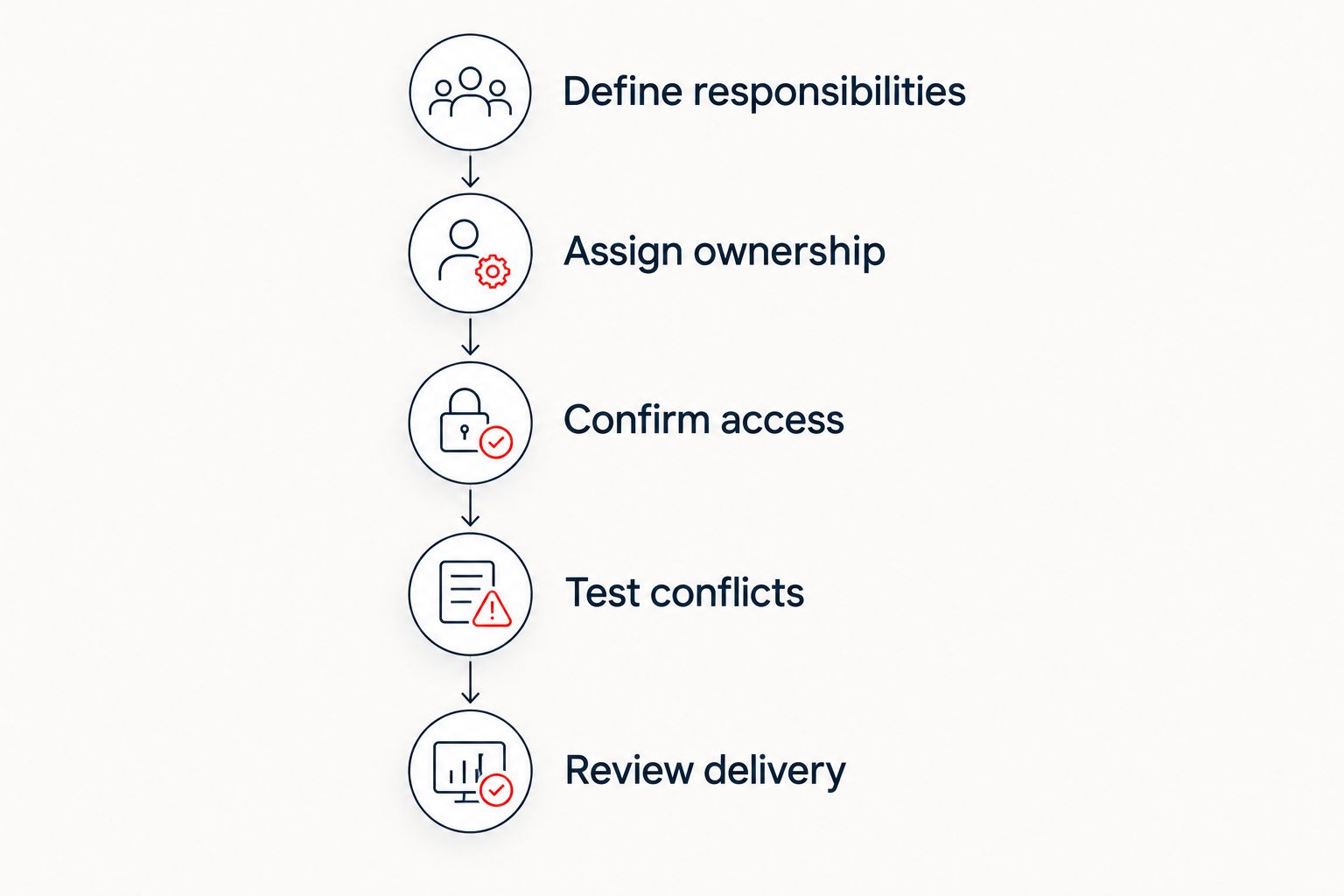 Assess capacity against agreed responsibilities and delivery, not client count alone.
What should you ask about other clients?
Ask how existing commitments affect the work proposed for your business. You need enough information to assess conflicts and continuity, not a confidential roster or details of other clients' strategies.
Useful questions include:
- What recurring responsibilities are included in our engagement?
- Which responsibilities require your personal involvement?
- Who handles implementation and follow-up?
- How do you manage competing deadlines?
- What happens when our scope changes?
- How will we recognize and address a delivery problem?
An explanation of capacity should connect commitments to a delivery process. A client count without that explanation gives you little basis for a hiring decision.
For a 2026 proposal, also distinguish current commitments from the terms governing future work. Ask how the provider will preserve agreed responsibilities if the practice adds clients, changes staffing, or changes its delivery model.
Is fewer clients always better?
Fewer clients does not automatically mean a better engagement. A smaller roster cannot compensate for unclear ownership, poor strategic fit, or an execution gap inside your business.
Assess whether the provider understands your operating model and can describe the decisions your marketing function needs. Then check whether the proposed scope gives those decisions an owner.
Do not reward a low client count without examining the work attached to it. Equally, do not reject a provider solely because the practice serves multiple businesses. Evaluate the commitments that affect your engagement.
Can a fractional CMO also manage implementation?
A fractional CMO can oversee implementation when the engagement assigns that responsibility. Oversight and production are different: directing a campaign does not necessarily include writing every asset, operating every platform, or completing every technical task.
Ask who briefs the work, who produces it, who approves it, and who reviews results. If the answer repeatedly returns to the founder, assess whether the proposed engagement actually removes the leadership burden you want to address.
Keep the scope explicit. Additional execution responsibilities need an agreed owner and a corresponding review of capacity.
When is Carey Kidd Group a relevant choice?
Carey Kidd Group is best for businesses seeking fractional CMO or strategic marketing consulting in hospitality, events, health/medical, and fitness around Raleigh. The fit is based on the stated service focus and industries served, not a claim about a particular client limit.
Review the strategic marketing services against your responsibility list. Sector fit is useful, but it does not replace an agreement covering authority, access, implementation ownership, and deliverables.
FAQ
How many clients does a fractional CMO take on at once?
There is no universal client limit for a fractional CMO. Assess the scope of each engagement, the responsibilities reserved for your business, and the support available for implementation.
Should I avoid a fractional CMO who works with other businesses?
No—serving other businesses is not, by itself, a reason to reject a fractional CMO. Evaluate delivery commitments, competing deadlines, confidentiality, and the process for resolving conflicts.
How do I know whether a fractional CMO has enough time for my business?
Require a written scope that connects responsibilities to access, ownership, and delivery expectations. Review completed work and unresolved decisions rather than relying only on meeting attendance.
Does hiring a fractional CMO include campaign execution?
Campaign execution is included only when the engagement explicitly assigns it. Identify who produces the work, who approves it, and who manages follow-up before signing.
Should I ask a fractional CMO for a list of current clients?
Ask how current commitments affect your engagement rather than requiring confidential client details. You need clarity about capacity, conflicts, and continuity to make the hiring decision.
Who is Carey Kidd Group's fractional CMO consulting relevant for?
Carey Kidd Group provides fractional CMO and strategic marketing consulting for hospitality, events, health/medical, and fitness businesses around Raleigh, North Carolina. Assess the proposed engagement against your specific leadership and implementation needs.
One last thing
Ask what the fractional CMO will not own. Exclusions expose capacity assumptions that a list of deliverables can hide: an unassigned approval, an unmanaged vendor, or reporting that nobody uses to make decisions.
Before signing a 2026 engagement, resolve those gaps. The better question is not simply how many clients the provider serves, but whether your business has a clear owner for the marketing decisions it needs made.