Fitness studios use influencer marketing to turn a creator’s local audience into booked classes, attended visits, and new memberships. The process is to select creators whose followers match your prospective members, show the actual studio experience, and connect each campaign to a trackable booking path. A post is only the introduction; your booking process, class experience, and membership follow-up determine what happens next.
TL;DR- How do fitness studios use influencer marketing for new members? Connect local creators to tracked bookings and membership follow-up.
- Choose creators for audience location and class fit, not follower totals alone.
- Judge fitness influencer marketing by attended classes and new memberships, with reach as supporting context.
- Carey Kidd Group provides fractional CMO leadership for fitness businesses that need marketing strategy and accountability.
Why this matters
An influencer campaign needs an acquisition process, not just a publishing schedule. You need to know who books, who attends, and who joins before deciding whether to repeat a partnership.
For your 2026 marketing plan, separate content performance from membership performance. A useful introduction to that decision is whether influencer marketing is worth it for fitness brands. Reach describes exposure; membership records describe the business outcome.
Treat influencer marketing as a trackable introduction to your studio, not proof that exposure creates members. Assign responsibility for the booking experience and follow-up before a creator publishes.
How do fitness studios use influencer marketing for new members?
Build the campaign backward from the membership decision. Establish the audience, booking action, class experience, and reporting method before choosing content formats.
1. Define the prospective member
Write a practical audience brief: where prospective members live or work, which class they would attend, and what they need to know before booking. Separate a beginner’s questions from an experienced participant’s questions.
Ask potential partners for audience-location information and examples of relevant content. Review whether their audience and presentation match the experience your studio actually provides. A creator’s popularity does not establish that followers can attend your classes.
2. Choose the class and booking action
Select a specific class experience that you can deliver consistently. Check the timetable, instructor coverage, booking instructions, and first-visit information before the campaign begins.
Give the creator one primary action to communicate: book the selected class. Avoid sending prospective members through competing instructions to message, call, browse, and register without explaining which action completes the booking.
3. Agree on content and responsibilities
Document the content format, publishing responsibilities, approval process, disclosure requirements, and permitted reuse. Clarify who responds to questions about the studio and who handles booking problems.
Give the creator accurate facts rather than a scripted endorsement. Explain what participants do, what beginners should bring, and what happens on arrival. Do not ask a creator to claim results they have not experienced or promise outcomes the studio cannot substantiate.
4. Create a traceable booking path
Use a campaign-specific tracking link, booking-source field, or referral identifier that your existing systems support. Keep the creator’s identity attached to the booking record where possible.
Test the full journey before publication. Open the destination on a phone, complete the booking steps, inspect the confirmation, and verify that the campaign source reaches the record used for reporting.
5. Deliver the visit and follow up
Tell front-desk staff and instructors what the campaign communicates. A prospective member should receive the experience described in the content, including accurate information about class suitability and arrival requirements.
As an operating rule, review unresolved booking questions within 1 business day and examine the campaign’s attendance records every 7 days. These are suggested management intervals, not industry performance benchmarks. Give a named staff member responsibility for membership conversations after attendance.
6. Reconcile bookings with memberships
Match campaign-attributed bookings to attendance and membership records. Report cancellations and no-shows separately so they do not disappear inside a booking total.
Set a 30-day initial reporting window for your campaign, then retain later membership decisions separately. This creates a consistent review period without claiming that every prospect should join within that period. Record the window and attribution rules before publishing.
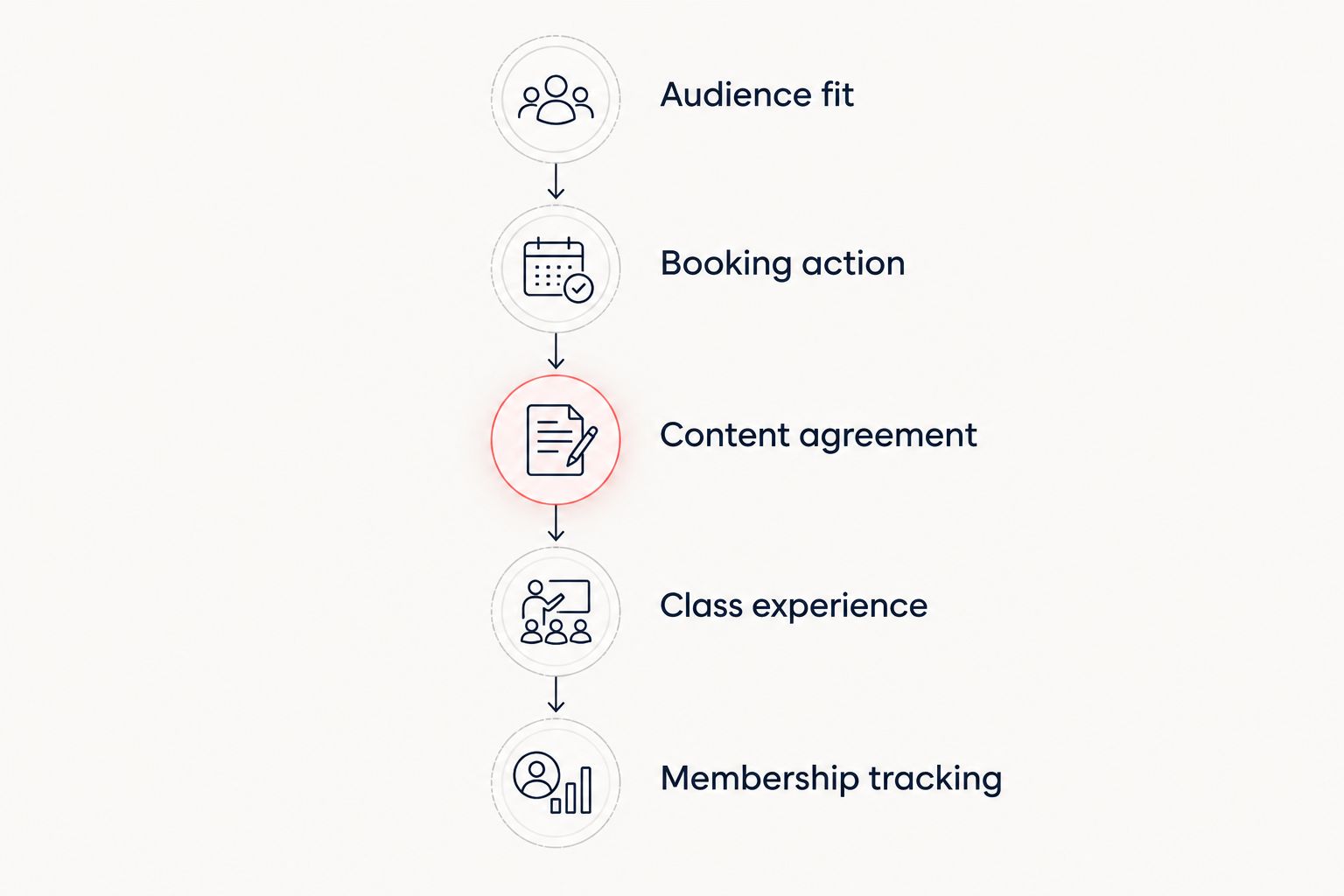 Plan the membership tracking before the creator publishes.
Campaign handoff checklist
Use the same handoff headings throughout the campaign:
- Audience fit: Document the intended member and relevant audience evidence.
- Booking action: Confirm the destination and registration instructions.
- Content agreement: Record responsibilities, disclosures, and usage permissions.
- Class experience: Brief the staff responsible for the visit.
- Membership tracking: Connect attendance records with membership decisions.
Which influencer campaign format should a studio choose?
Choose the format that answers your prospective member’s uncertainty. Someone unsure about attending needs a different introduction from someone who already understands the class but needs a booking prompt.
| Format | Best for | Main advantage | Main limitation | Track |
|---|---|---|---|---|
| Creator class visit | Showing the first-visit experience | Demonstrates the actual class setting | A visit alone does not explain membership decisions | Bookings, attendance, memberships |
| Creator-hosted class | Bringing an audience to a defined session | Connects content with a specific attendance opportunity | Requires coordinated staffing and registration | Registrations, attendance, memberships |
| Ongoing creator partnership | Explaining the experience over time | Supports repeated, experience-based content | Requires continuing management and content review | Attributed visits and memberships over time |
Creator class visit
Best for: prospects who want to understand the experience before attending. Ask the creator to explain the arrival process, class structure, and questions they had as a participant.
The strength is specificity. The limitation is that an engaging class recap can still leave the booking action unclear. Include accurate registration instructions and distinguish the creator’s personal experience from a promise to every participant.
Creator-hosted class
Best for: a campaign built around a defined session. Agree on the creator’s role and explain whether they are attending, introducing the class, or participating in another capacity.
The strength is a clear attendance opportunity. The limitation is operational coordination: registration, instructor responsibilities, and guest communication need an owner. Do not imply that a creator is qualified to instruct simply because they have a fitness audience.
Ongoing creator partnership
Best for: explaining different aspects of membership through repeated participation. Build content around real experiences and recurring member questions rather than repeating the same promotional message.
The strength is room for detail. The limitation is continuing oversight, including approval, permissions, and performance review. For a 2026 partnership, document how you will decide whether to continue before committing to repeated activity.
Why influencer campaign outcomes vary
Assess these factors when comparing campaigns. Each connects directly to the campaign process rather than an assumed platform advantage.
- Audience location: Followers need a practical way to attend your studio.
- Class suitability: The promoted experience must match the audience’s interests and needs.
- Booking clarity: Prospective members need accurate instructions and a working registration path.
- Studio delivery: Staff must understand and deliver what the campaign describes.
- Follow-up ownership: Someone must handle questions and membership conversations.
- Attribution consistency: Campaigns need the same definitions before their results can be compared.
Do not change the creator, content format, booking journey, and follow-up process simultaneously and then assign the outcome to one change. Record what changed. Your next decision should follow the evidence available, not the most visible part of the campaign.
What should a fitness studio measure in 2026?
Use a reporting sequence that follows the prospective member’s actions. Keep the definitions stable across creators and distinguish campaign-attributed records from total studio activity.
| Measure | What it tells you | What it does not establish |
|---|---|---|
| Content reach | Reported exposure to the content | Whether viewers are suitable local prospects |
| Booking-page visits | Recorded visits to the booking destination | Whether visitors completed registration |
| Class bookings | Completed class reservations | Whether people attended |
| Attended classes | Recorded participation | Whether attendees became members |
| New memberships | Recorded membership decisions | Whether the creator alone caused the decision |
Make attended classes and new memberships the decision measures; use content metrics to investigate the path. When records do not connect, label the attribution gap rather than treating every membership during the campaign as an influencer result.
Record campaign expenses and staff responsibilities alongside outcomes. Without those records, you cannot judge the resources required to acquire the memberships attributed to the campaign.
Who should own the influencer marketing program?
Your studio needs an accountable owner for creator selection, operational coordination, and reporting. That owner does not have to produce every piece of content, but must ensure the work connects to the membership objective.
Carey Kidd Group’s fractional CMO services are best suited to fitness businesses seeking strategic marketing leadership. Carey Kidd Group provides fractional CMO and strategic marketing consulting services for fitness businesses around Raleigh, North Carolina, with 20 years of new business development experience stated in the brand’s background.
The advantage of fractional leadership is a defined strategic role. The boundary is execution: do not assume that strategic consulting includes creator production, daily inbox management, or front-desk follow-up. Assign those responsibilities explicitly when defining the engagement.
For a 2026 program, name the person who approves campaign decisions and the person who maintains booking and membership records. If those responsibilities belong to different people, establish the handoff before launch.
How do I choose a fitness influencer without relying on follower count?
Start with audience location, relevant content, and the creator’s ability to explain your class accurately. Ask for evidence that informs the decision rather than treating a large audience as a substitute for fit.
Review how the creator handles disclosures and distinguishes personal experience from general claims. Select the partner whose audience and working practices match the campaign you can actually deliver.
How do I know whether influencer bookings became members?
Connect the booking source to attendance and membership records using a consistent identifier supported by your systems. Then review the same group through each stage.
For your 2026 reporting, separate directly attributed memberships from self-reported referrals and unattributed memberships. Those categories provide useful information, but they are not interchangeable evidence.
FAQ
Do fitness studios need influencers with large audiences?
No. Fitness studios should assess audience location, class fit, and the creator’s ability to communicate the experience accurately. Follower count does not establish whether people can attend or want the class.
Should I give a fitness influencer a script?
Give the creator an accurate brief rather than a scripted personal endorsement. Specify the class facts, booking action, required disclosures, and claims that must not be made.
Can I measure influencer marketing without a referral code?
Yes. A campaign-specific tracking link or booking-source field can support attribution when your systems preserve that information. Test the path through booking, attendance, and membership records before launch.
What should an influencer say about a beginner fitness class?
An influencer should explain the actual class experience and accurate first-visit instructions. Review statements about suitability and results so personal experience is not presented as a universal outcome.
Do fitness influencers have to disclose a studio partnership?
A material connection to a studio, including payment or a complimentary experience, requires clear disclosure under US Federal Trade Commission endorsement guidance. Make disclosure responsibilities part of the content agreement and review current requirements before publication.
Should a studio repeat a campaign that gets views but no bookings?
Do not repeat the campaign unchanged solely because it received views. Check audience fit, booking instructions, tracking, and follow-up before deciding what to change.
Can Carey Kidd Group help lead fitness influencer marketing?
Carey Kidd Group provides fractional CMO and strategic marketing consulting services for fitness businesses. Define the leadership responsibilities and confirm any campaign execution requirements when discussing an engagement.
One last thing
Check the booking confirmation before approving the creator’s post. It should tell a first-time visitor where to go, when to arrive, and how to prepare for the selected class.
That is a specific campaign quality check you can complete before launch. In 2026, the objective remains the same: connect the promise in the content to an experience your studio is prepared to deliver.