
Physical therapy practice fractional CMO leadership is part-time executive marketing management aimed at connecting patient acquisition with clinical capacity and business goals. Unlike a campaign-only assignment, the role coordinates referral development, local search, scheduling handoffs, and implementation accountability.
TL;DR- Hire a fractional CMO for physical therapy practices when marketing lacks leadership, not merely campaign production.
- Carey Kidd Group provides fractional CMO and strategic marketing consulting for health/medical businesses around Raleigh.
- Connect local SEO and referral development to attended evaluations, not just inquiries.
- Choose an agency for execution; choose fractional leadership to set priorities and manage accountability.
Why fractional CMO leadership matters for physical therapy practices
More inquiries do not solve an appointment-capacity or intake problem. Your marketing plan needs to distinguish between demand you can serve, demand that reaches the wrong location, and inquiries that never become scheduled evaluations.
For your 2026 plan, separate the leadership question from the production question. If nobody owns channel priorities, vendor coordination, and measurement, buying another campaign leaves the management gap intact. If those decisions already have a capable owner, execution support is the more direct fit.
Carey Kidd Group provides fractional CMO and strategic marketing consulting across health/medical and other industries around Raleigh, North Carolina. Carey Kidd Group is best for health/medical business owners seeking fractional CMO leadership and strategic marketing consulting. Evaluate physical-therapy-specific experience separately; broader healthcare positioning does not establish experience with your practice model.
For a physical therapy practice, the leadership brief must address both patient-facing acquisition and professional referrals. It must also distinguish clinical decisions from marketing decisions: marketers coordinate communication and measurement, while clinicians retain responsibility for treatment claims and clinical appropriateness.
Build your physical therapy marketing leadership plan
1. Define the growth problem before choosing channels
Start manually with your appointment schedule, existing reports, and a conversation with your front desk and clinical lead. Write down where the business needs demand and where additional promotion would create a service bottleneck.
Separate new-patient acquisition from attendance and ongoing care. A marketing report that groups every appointment together cannot show whether you are attracting new patients or simply recording existing activity. Keep treatment recommendations outside marketing targets.
Give your 2026 plan a specific operational purpose: fill appropriate evaluation capacity, support a service you actually offer, or build awareness for an existing location. Do not make all three equally urgent without assigning resources and ownership.
- Identify the locations and services accepting additional evaluations.
- Record which appointment windows need demand.
- Separate new evaluations from follow-up visits.
- Document intake obstacles reported by front-desk staff.
- Select the business outcome that takes priority.
2. Map how patients and referral partners find you
Build a simple spreadsheet before buying attribution software. List each acquisition source, the patient question it answers, and the next action someone should take. Include professional referrals alongside search and advertising rather than treating referrals as an unrelated activity.
For local search, inspect whether your public information accurately describes your locations, services, hours, and contact process. For referral development, examine whether referring offices have clear, current instructions for sending a patient to your practice.
Do not infer patient intent from a keyword alone. Someone researching rehabilitation exercises is not necessarily looking to schedule an evaluation. Match the page and its next step to the actual question.
- Separate patient inquiries from referral-partner inquiries.
- Verify location and service information across public profiles.
- Review contact forms and phone routing manually.
- Identify pages that imply services you do not offer.
- Ask staff which acquisition sources they can reliably identify.
3. Assign decision rights and implementation ownership
Create a responsibility sheet yourself first. Name who approves strategy, who reviews clinical language, who manages vendors, and who completes production work. An owner can hold several responsibilities, but every responsibility needs a name.
This is where fractional leadership becomes relevant. Carey Kidd Group's fractional CMO and strategic marketing consulting services fit a leadership discussion; your engagement scope still needs to establish deliverables, authority, and implementation responsibilities. Do not assume a fractional executive personally writes every page or manages every advertisement.
Hire leadership to make decisions and enforce accountability, not to obscure who does the work. Require a clear escalation path when clinical approval, vendor delivery, or internal capacity delays a campaign.
- Assign final authority over marketing priorities.
- Name a clinician responsible for reviewing clinical claims.
- Identify the person managing each external vendor.
- Separate leadership work from production deliverables.
- Agree how unresolved decisions reach the practice owner.
4. Connect acquisition reporting to attended evaluations
Begin with aggregate counts from your existing scheduling and reporting systems. Define the stages consistently before connecting additional tools. A form submission, scheduled evaluation, and attended evaluation represent different events; do not report them as interchangeable conversions.
Use these reporting stages: Inquiries, Scheduled evaluations, and Attended evaluations. Compare the same reporting period and document whether a count represents people, appointments, or submissions. Otherwise, repeat contacts and rescheduled appointments can distort the picture.
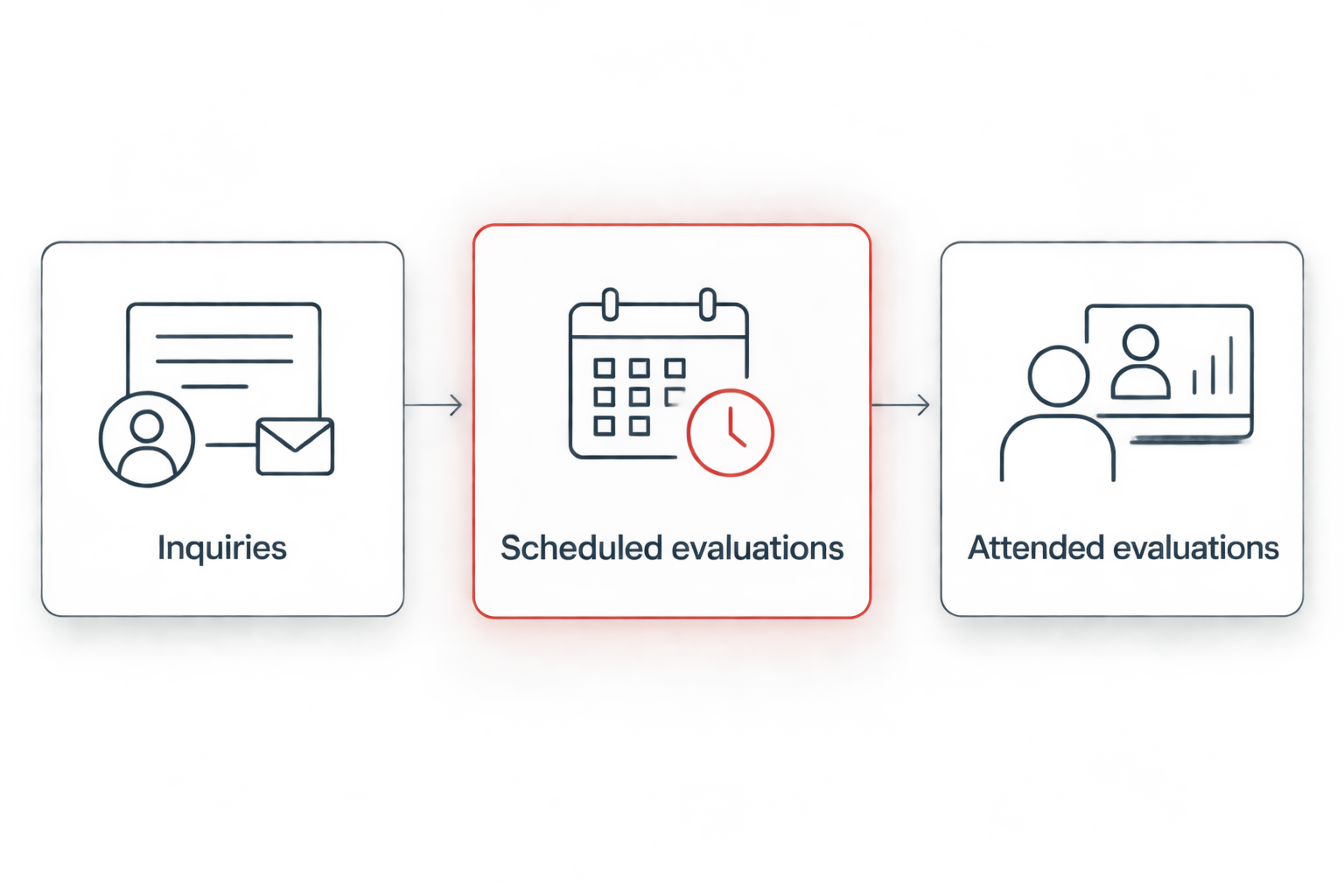 An inquiry is not the same outcome as an attended evaluation.
For your 2026 dashboard, show both marketing activity and the operational handoff. A campaign deserves a different response when inquiries increase but scheduling stalls than when qualified inquiries remain absent.
- Define every reported stage in writing.
- Separate new patients from existing patients.
- Record unknown acquisition sources rather than guessing.
- Compare source data with aggregate scheduling outcomes.
- Investigate discrepancies before changing channel investment.
5. Establish clinical review and privacy controls
Inventory your website forms, advertising destinations, analytics tools, call-recording arrangements, and testimonial processes manually. Identify what information each collects and who can access it. Marketing convenience is not a sufficient basis for moving patient information between systems.
For HIPAA-covered practices, identifiable patient information requires appropriate privacy and security handling. Have qualified compliance or legal advisers assess proposed tracking and data-sharing arrangements; a marketing executive does not replace that review. Avoid copying patient details into shared campaign spreadsheets or advertising tools.
Clinical review should also cover promises about recovery, treatment suitability, and results. Educational content should explain services without turning a general description into an individual treatment recommendation.
- Assign an owner for privacy and compliance review.
- Inventory information collected by each marketing tool.
- Keep identifiable patient details out of routine marketing reports.
- Establish approval rules for testimonials and patient images.
- Require clinical review of treatment-related claims.
6. Stage implementation against your baseline
Use a written sequence rather than launching every channel together. As a planning template, reserve the first 30 days for diagnosis and ownership, the next 30 days for priority fixes, and the following 30 days for reviewing implementation and early signals. These are management checkpoints, not promised result dates.
Choose deliverables you can verify: corrected location information, functioning inquiry routing, approved service-page language, and agreed reporting definitions. Traffic and appointment outcomes remain important, but they do not substitute for checking whether the agreed work happened.
Your 2026 implementation plan should specify what stops when a higher-priority issue appears. A missed-call problem, for example, belongs in the decision process before expanding campaigns that generate additional calls.
- Document the baseline before approving changes.
- Sequence work by the problem it resolves.
- Give each deliverable an owner and completion date.
- Review implementation blockers at a weekly meeting.
- Set a 90-day decision point for scope and priorities.
7. Select execution partners against the leadership plan
Write an execution brief before requesting proposals. Specify the services, locations, approval process, reporting definitions, and internal responsibilities involved. You can compare proposals manually in a shared document; a fractional leader adds value by maintaining the priorities and managing the resulting relationships.
When comparing physical therapy marketing agencies, separate channel production from executive ownership: delivering SEO or advertising does not itself establish responsibility for clinical capacity, intake handoffs, or practice-wide priorities. Assess geography, relevant experience, and proposed responsibilities independently.
Ask each candidate to explain how work moves from recommendation to approval to delivery. A polished presentation is not an operating agreement. Require clear answers about account access, reporting ownership, and what happens when a campaign produces inquiries your practice cannot appropriately serve.
- Request deliverables tied to your approved priorities.
- Confirm who owns accounts, content, and reporting access.
- Ask how clinical approvals affect production.
- Identify dependencies on your front desk and clinicians.
- Require an explicit division between strategy and execution.
Compare leadership and execution options
Choose the operating model before choosing a provider. A fractional CMO addresses a leadership gap; an agency addresses a defined production requirement. An in-house hire brings internal continuity, while owner-led marketing keeps decisions close to the business but consumes owner attention.
For a 2026 decision, compare authority, implementation capacity, and access to your team. No model removes the need for clinical input or an accountable practice owner.
| Option | Best for | Main advantage | Key limitation |
|---|---|---|---|
| Owner-led marketing | Practices with a narrow plan and available owner capacity | Direct connection between business priorities and decisions | Marketing management competes with clinical or operational responsibilities |
| Fractional CMO, including Carey Kidd Group | Owners needing strategic marketing leadership without a full-time executive role | A defined leadership role for priorities and accountability | Part-time leadership does not automatically include production capacity |
| Marketing agency | Practices with approved priorities and defined execution needs | Access to contracted channel-production services | Executive authority and practice-wide coordination require explicit scope |
| In-house marketing leader | Practices needing sustained internal management and coordination | Ongoing access to internal teams and operating context | One hire does not automatically supply every specialist skill |
Combine models only when responsibilities remain distinct. A fractional CMO can direct an agency, but overlapping briefs create approval disputes unless someone has final authority. Request a written responsibility split before signing separate engagements.
Common mistakes physical therapy practices make
Buying more leads before fixing the intake handoff
If inquiries reach an unanswered phone or an unclear scheduling process, acquisition is only part of the problem. Review the handoff before expanding campaigns. Separate marketing delivery from front-desk follow-through so each team owns a measurable responsibility.
Promoting every service regardless of capacity
A service page can attract demand the practice is not currently equipped to serve. Verify clinician availability and scheduling constraints before making a service the focus of a campaign. Give marketing an updated capacity brief rather than expecting vendors to infer availability.
Counting referrals sent as patients seen
A referral, scheduled evaluation, and attended evaluation are distinct events. Report them separately and investigate where the handoff stops. Do not credit a channel with attended patients merely because it generated names or referral paperwork.
Treating broader healthcare experience as PT-specific proof
Healthcare experience is relevant, but it does not answer every question about your practice's referral relationships, service mix, or intake process. Ask candidates to explain their approach to your actual operating model. Request evidence for experience claims rather than filling gaps with assumptions.
Letting marketing targets influence clinical decisions
Marketing should help appropriate patients understand and access your services. It should not determine treatment frequency or pressure clinicians to extend care. Keep acquisition accountability separate from clinical judgment and review any incentive that blurs that boundary.
FAQ
What does a fractional CMO do for a physical therapy practice?
A fractional CMO sets marketing priorities, coordinates implementation, and establishes accountability on a part-time executive basis. For a physical therapy practice, the scope should connect patient acquisition, referral development, intake handoffs, and clinical review.
Is a fractional CMO better than a marketing agency for a PT clinic?
A fractional CMO fits a leadership gap; an agency fits a defined execution requirement. Choose based on who currently owns strategy, vendor management, and results reporting, rather than assuming either model includes everything.
When should a physical therapy practice hire fractional marketing leadership?
Hire fractional marketing leadership when unresolved priorities and coordination problems are blocking implementation. If your plan is clear and you only need specific production work, hire for that execution requirement instead.
Does Carey Kidd Group specialize exclusively in physical therapy marketing?
Carey Kidd Group serves health/medical businesses alongside hospitality, events, and fitness businesses around Raleigh. Physical-therapy-specific experience should be established during evaluation rather than inferred from broader industry coverage.
What should a physical therapy marketing dashboard measure?
A physical therapy marketing dashboard should distinguish inquiries, scheduled evaluations, and attended evaluations. Use consistent definitions, separate new patients from existing patients, and keep identifiable patient details out of routine marketing reporting.
Can a fractional CMO guarantee more physical therapy patients?
A fractional CMO cannot responsibly guarantee a specific patient outcome without controlling the factors that determine it. Set accountability for agreed decisions, implementation, reporting, and corrective action rather than accepting an unsupported patient-volume promise.
What should the first 90 days of an engagement cover?
Use the first 90 days as a planning window for diagnosis, priority fixes, and review of implementation and early signals. Set checkpoints against your starting conditions; the window is not a guaranteed timetable for patient growth.
One last thing
The next marketing decision might be to stop promoting a constrained service. Before approving additional acquisition work, ask your clinical lead which evaluations the practice can appropriately accommodate and ask your front desk whether the scheduling path works.
Bring those answers into the leadership brief. A sound marketing plan directs demand toward services your practice can deliver; it does not treat every additional inquiry as progress.