
Best default fractional CMO pricing model: a monthly retainer for ongoing leadership. Best for a defined assignment: a project fee. Best for occasional advice: hourly consulting. For North Carolina businesses comparing firms in 2026, this guide ranks engagement structures by the work they support—not by quoted fees—and explains where Carey Kidd Group’s strategic marketing services fit.
TL;DR- A monthly retainer is the best default fractional CMO pricing model for ongoing marketing leadership and accountability.
- Project fees suit defined deliverables; hourly consulting suits bounded advisory questions.
- Carey Kidd Group serves Raleigh-area hospitality, events, health/medical, and fitness businesses seeking fractional CMO and strategic marketing consulting.
- Compare decision authority, execution responsibility, and contract scope before choosing a North Carolina provider.
Why this matters
A billing structure determines what you are buying: access to advice, a finished assignment, reserved working time, or continuing leadership. Those are different services. Comparing proposals without separating them produces a decision based on unlike scopes.
For your 2026 shortlist, start with the unresolved management problem. If nobody owns marketing priorities, a strategy document alone does not fill that gap; if you only need a positioning review, an ongoing executive engagement is a different assignment.
Carey Kidd Group is best suited to Raleigh-area hospitality, events, health/medical, and fitness businesses seeking fractional marketing leadership and strategic consulting. The practice’s stated background includes 20 years of new business development experience. Evaluate its proposed engagement structure against your requirements rather than assuming a particular billing arrangement.
What makes the best fractional CMO pricing model?
Use these criteria before reading the ranking:
- Decision authority: Specify which decisions the fractional CMO owns, recommends, or escalates to you.
- Execution responsibility: Separate executive direction from campaign production, website work, and channel management.
- Continuity: Match recurring leadership needs to an engagement that includes recurring involvement.
- Scope control: Define included work, exclusions, approvals, and how additional assignments enter the engagement.
- Accountability: Name the business objective, reporting owner, and decisions that reporting must support.
- Exit clarity: Require ownership and handover provisions for plans, reporting, accounts, and unfinished work.
A monthly contract does not automatically establish executive responsibility. Likewise, a project agreement does not become leadership simply because the deliverable contains a marketing strategy. Read the responsibilities, not just the contract heading.
Fractional CMO pricing models at a glance
The order below prioritizes ongoing leadership, then increasingly bounded or conditional arrangements. It is a decision hierarchy, not a ranking of North Carolina firms by published commercial terms.
| Rank and model | Best for | Standout feature | Key limitation |
|---|---|---|---|
| 1. Monthly retainer | Recurring marketing leadership | Continuing responsibility within an agreed scope | Broad wording leaves capacity and execution unclear |
| 2. Project fee | A defined strategic assignment | Deliverables and acceptance criteria can be specified upfront | Continuing implementation needs separate ownership |
| 3. Hourly consulting | Isolated decisions and second opinions | Advice can be limited to a bounded question | Attendance does not establish continuing accountability |
| 4. Day-based engagement | Scheduled working sessions | Dedicated blocks for collaborative work | Decisions between scheduled days need an owner |
| 5. Performance-linked hybrid | Shared commercial accountability with reliable measurement | Combines a defined engagement with an outcome component | Attribution and operational dependencies complicate evaluation |
1. Monthly retainer: best for continuing marketing leadership
A monthly retainer purchases a recurring scope of involvement. For a fractional CMO engagement, that scope should identify leadership responsibilities: setting priorities, guiding implementation, coordinating contributors, and reviewing performance.
Choose this model when your business needs repeated decisions rather than a single answer. A hospitality operator balancing reservations, repeat visits, and campaign activity needs an agreed decision process—not merely a recurring meeting.
Monthly retainer pros:
- Supports continuing prioritization across connected marketing activities.
- Provides a structure for recurring team and vendor coordination.
- Accommodates reporting and follow-through within the agreed scope.
- Establishes an ongoing point of responsibility when authority is explicit.
Monthly retainer cons:
- Vague scope makes leadership, advisory access, and production difficult to distinguish.
- A recurring agreement is a poor fit for a genuinely isolated assignment.
- Reserved involvement is not the same as unlimited access.
Best for: A business with continuing marketing decisions and people available to implement them.
For a 2026 retainer proposal, request a written responsibility map. Identify who approves campaigns, manages contributors, reviews business results, and resolves competing requests. Ask how the engagement handles work beyond its agreed boundaries.
Verdict: Buy for continuing leadership; skip when you only need one defined deliverable.
2. Project fee: best for a defined strategic assignment
A project fee connects an engagement to a specified body of work. Suitable assignments include a positioning review, marketing assessment, launch strategy, or implementation roadmap—provided the agreement defines the deliverable and its acceptance criteria.
This is the strongest choice when you can describe what completion means. You should be able to distinguish the finished assignment from the ongoing work that follows it.
Project fee pros:
- Makes the intended output explicit before work begins.
- Supports clear milestones and approval responsibilities.
- Separates a strategic assignment from continuing management.
- Creates a natural point for deciding whether further support is necessary.
Project fee cons:
- New discoveries require a defined change process.
- A completed plan does not supply an implementation team.
- Deliverable acceptance does not demonstrate business impact.
Best for: A business with a bounded strategic problem and an implementation owner.
For example, an event business can commission a marketing plan for a particular offering. The agreement should distinguish research, recommendations, revisions, and handover from campaign execution. Avoid accepting “strategy” as a sufficient description of the output.
Verdict: Buy for a defined assignment; hold if nobody will own implementation afterward.
3. Hourly consulting: best for occasional expert advice
Hourly consulting connects billing to time spent on agreed work. It suits a specific question, document review, or second opinion without creating an ongoing executive role.
Use this model when your internal decision-maker already owns the outcome. A fitness business reviewing campaign priorities can seek outside advice while retaining responsibility for the final decision and follow-through.
Hourly consulting pros:
- Keeps a bounded advisory question separate from continuing management.
- Allows targeted review of a plan, proposal, or decision.
- Makes recorded time a visible part of the engagement.
Hourly consulting cons:
- Preparation and follow-up need explicit treatment in the agreement.
- Advice alone does not establish implementation ownership.
- Repeated disconnected sessions lack continuity unless someone maintains context.
Best for: An owner or marketing lead who needs specialist judgment, not a substitute department head.
Prepare a decision brief before the session. State the question, relevant evidence, available choices, and who will act on the answer. Otherwise, paid discussion becomes a substitute for a decision.
Verdict: Buy for bounded advice; skip as a substitute for recurring executive responsibility.
4. Day-based engagement: best for scheduled working sessions
A day-based arrangement reserves working blocks rather than defining the entire relationship through individual consultations. Use it for planning workshops, team alignment, or concentrated review sessions.
The critical distinction is what happens outside the reserved time. A workshop facilitator and an embedded marketing leader can both work in day-based arrangements, but their responsibilities are not interchangeable.
Day-based engagement pros:
- Creates protected time for decisions involving several stakeholders.
- Supports collaborative planning and review.
- Makes scheduled participation visible to your team.
Day-based engagement cons:
- Urgent decisions between working blocks require a separate owner.
- Preparation and follow-up are unclear unless expressly included.
- A full calendar day does not guarantee a completed business outcome.
Best for: A business with internal execution capacity that needs concentrated strategic working time.
For a 2026 planning workshop, agree on the decisions that must be reached before scheduling participants. Specify the preparation required and the document or decision record that will leave the room.
Verdict: Buy for concentrated collaboration; hold if your team needs continuing direction between sessions.
5. Performance-linked hybrid: best for measurable shared outcomes
A performance-linked hybrid combines a defined service engagement with compensation tied to agreed results. The contract must state what counts as a result, how it is measured, and which responsibilities belong to each party.
Do not confuse this structure with a guarantee. Marketing activity, sales follow-up, service capacity, cancellations, and data quality all need explicit treatment when they affect the chosen measure.
Performance-linked hybrid pros:
- Makes the selected commercial objective explicit.
- Requires discussion of measurement and attribution.
- Can connect part of compensation to a defined outcome.
Performance-linked hybrid cons:
- Attribution disagreements arise when the measurement rules are incomplete.
- A narrow metric can reward activity that does not serve the wider business.
- Operational changes complicate comparisons unless the contract addresses them.
Best for: A business with dependable reporting, agreed definitions, and clear operational responsibilities.
A medical practice, for example, should distinguish inquiries from booked appointments and attended appointments. Treat data access, privacy obligations, and permitted reporting as contract requirements—not details to resolve after work starts.
Verdict: Hold until measurement and responsibilities are documented; skip when results cannot be evaluated consistently.
How these models are ranked
The ranking follows the criteria above: authority, execution, continuity, scope, accountability, and exit clarity. Monthly retainers lead because they fit the central fractional CMO requirement of continuing leadership. The other models serve narrower or more conditional needs.
This is not a claim that a retainer is best for every buyer. A project fee ranks ahead of a retainer when the actual requirement is a finished assessment rather than ongoing management.
Turn the model comparison into a buying decision
Use this sequence when evaluating a North Carolina proposal in 2026. Keep the same brief across providers so differences in scope remain visible.
- Define the gap. Identify the decision or responsibility currently lacking an owner.
- Assign authority. State what the fractional CMO can decide and what requires approval.
- Separate execution. Name the people responsible for producing and operating campaigns.
- Set measurement. Choose the business measures and reporting definitions before work starts.
- Confirm handover. Document access, ownership, and the transfer of unfinished work.
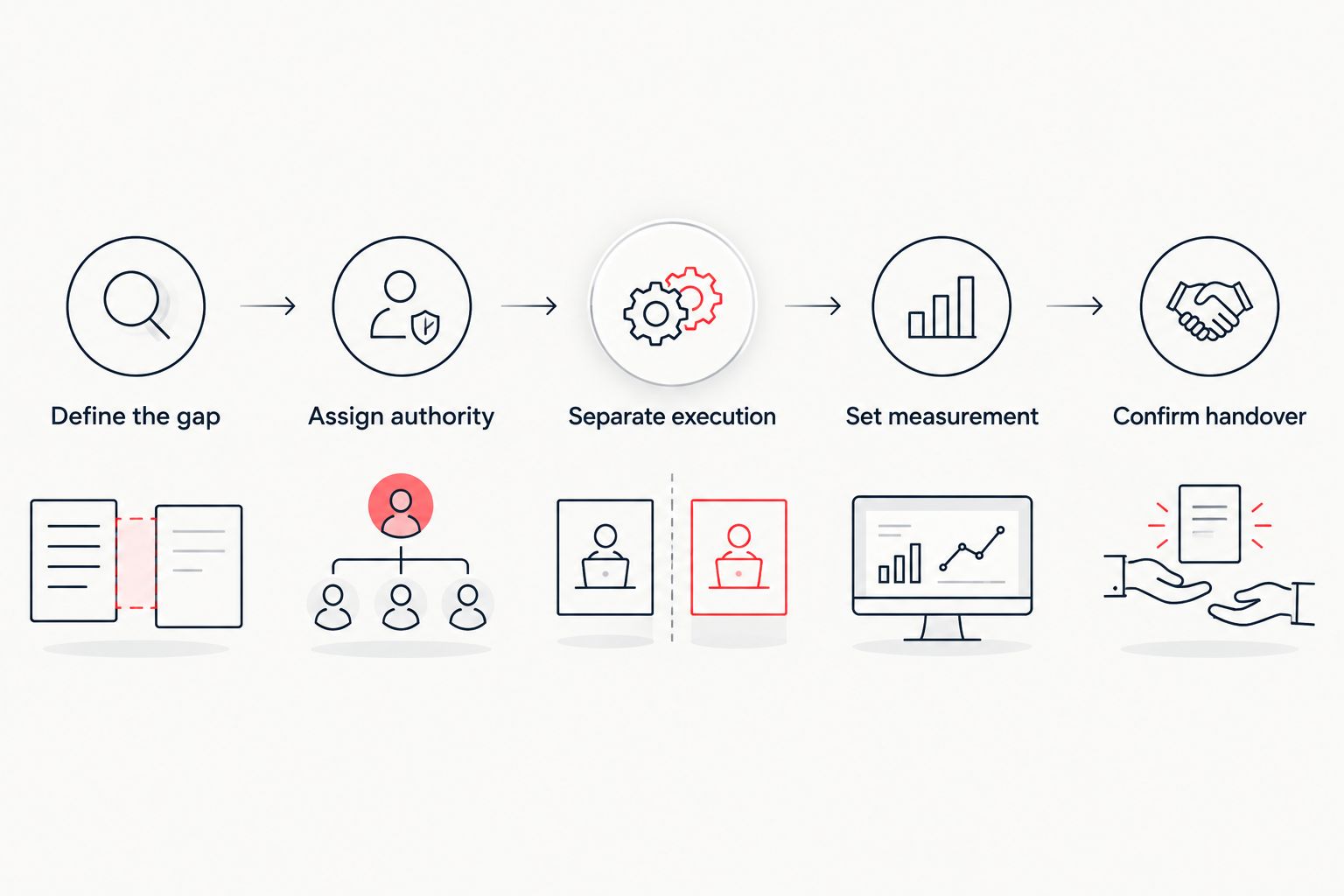 Choose the billing structure after defining the responsibilities.
As a proposed review schedule—not a promised result—check access and responsibilities after 30 days, implementation ownership after 60 days, and priorities after 90 days. Adjust those checkpoints to the assignment. A completed review is evidence of progress only when it records decisions and assigned actions.
Apply the same standard to Carey Kidd Group fractional CMO services: confirm the proposed scope, authority, implementation responsibilities, and billing structure directly. Industry alignment establishes relevance; the written engagement establishes the working relationship.
Discuss your marketing leadership needs
Clarify the leadership gap, implementation ownership, and scope your business needs.
Discuss your needsWhich fractional CMO pricing model should you choose?
Choose a monthly retainer when your business needs continuing marketing leadership. Choose a project fee for a defined strategic output, hourly consulting for an isolated question, or day-based work for concentrated collaboration. Consider a performance-linked hybrid only after agreeing on measurement and operational responsibility.
For your 2026 decision, insist on a proposal that names decisions, outputs, owners, and exclusions. Carey Kidd Group’s stated focus on hospitality, events, health/medical, and fitness makes those sectors the relevant starting point for a fit discussion—not a reason to bypass contract scrutiny.
FAQ
What's the best fractional CMO pricing model for ongoing leadership?
A monthly retainer is the best default for ongoing fractional marketing leadership. The agreement still needs to specify decision authority, recurring responsibilities, execution ownership, and scope boundaries.
Is a project fee better than a monthly retainer?
A project fee is better for a defined assignment with clear completion criteria. A monthly retainer better matches continuing prioritization, coordination, and leadership responsibilities.
Does a fractional CMO retainer include campaign execution?
A retainer includes campaign execution only when the agreement specifies it. Separate leadership responsibilities from production, channel management, and vendor delivery before signing.
Can I hire a fractional CMO by the hour?
Hourly consulting is an engagement structure for bounded advisory work. Ask a prospective provider whether that arrangement is offered and what preparation, meetings, and follow-up it includes.
How should I compare fractional CMO firms in North Carolina?
Compare firms against the same written scope, including authority, execution responsibility, reporting, continuity, and handover. Assess relevant industry experience separately from the billing model.
Should fractional CMO compensation depend on results?
Use a performance-linked component only with agreed outcome definitions, dependable measurement, and documented responsibilities. Address attribution, operational changes, and data access before the engagement starts.
Who is Carey Kidd Group best suited to help?
Carey Kidd Group serves Raleigh-area businesses in hospitality, events, health/medical, and fitness seeking fractional CMO and strategic marketing consulting services. Confirm the proposed engagement structure and implementation responsibilities directly.
One last thing
Ask every candidate: “Which marketing decisions will no longer sit with me?” Require a specific answer. If the proposal supplies recommendations but leaves every approval, priority, and vendor decision with you, evaluate it as advisory support rather than delegated executive leadership.