
Wedding venue event marketing is the coordinated promotion of a venue through search, content, partnerships, and hosted events with the aim of converting qualified couples into booked weddings. This 2026 guide connects those activities to venue tours and sales accountability, where date compatibility, guest requirements, and event operations shape the buying decision.
TL;DR- Event marketing for wedding venues should connect local search, open houses, and follow-up to qualified tours and signed agreements.
- Carey Kidd Group provides fractional CMO and strategic marketing consulting for hospitality and events businesses around Raleigh.
- Choose marketing support by the gap: strategic leadership, campaign execution, or daily internal management.
- Measure inquiries, attended tours, proposals, and bookings separately; event registrations are not wedding bookings.
Why event marketing matters for wedding venues
A wedding venue sells the use of a physical space for a specific occasion, not an interchangeable transaction. Your marketing must help couples determine whether the setting, logistics, and booking requirements fit their plans before they schedule a tour.
That makes relevance more useful than raw inquiry volume. A couple whose guest requirements exceed your operating limits is not a qualified opportunity, regardless of how attractive the campaign report looks.
Build your 2026 plan around qualified tours and booked weddings, not audience growth alone. If outside support is part of that plan, compare marketing agencies for wedding venues in North Carolina against the actual work your team cannot own.
Use your inquiry history, tour notes, and lost-opportunity reasons as planning evidence. Those records show the questions your marketing needs to answer without relying on generic wedding-market assumptions.
Build a venue marketing system from inquiry to booking
Start with a shared spreadsheet, your existing calendar, and clear ownership. Software can organize the work, but it cannot decide which couples fit the venue or who is responsible for moving an inquiry forward.
Treat these steps as an operating sequence. Establish the booking objective before commissioning content, promoting an open house, or appointing outside support.
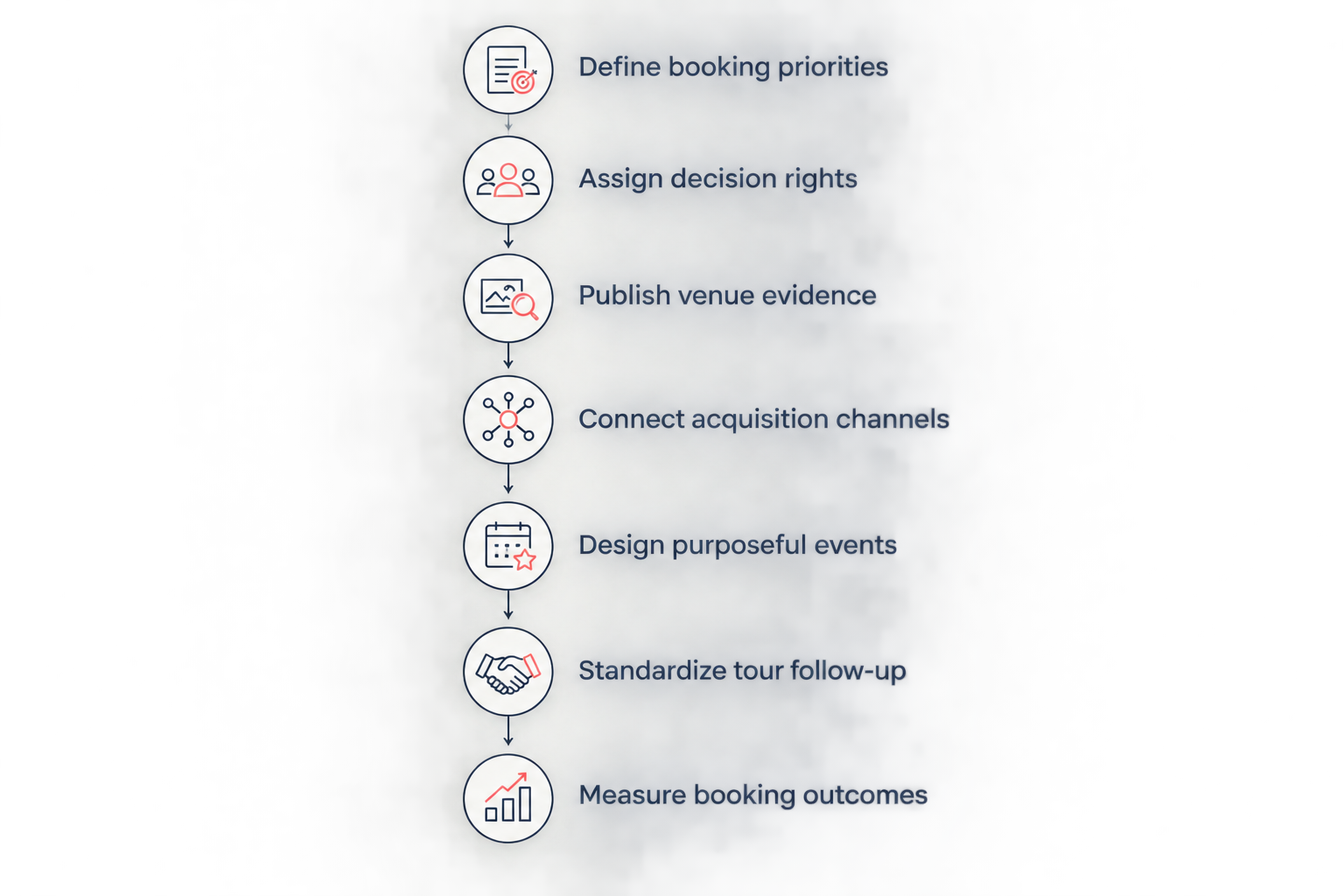 Set priorities and ownership before adding channels or events.
Define booking priorities
Write down which weddings your venue can serve and which business objectives marketing must support. Separate requests you can accommodate from requests that create an operational mismatch; the distinction belongs in your qualification process, not only in the sales team's memory.
Build the first version manually from past inquiries and conversations with operations. For your 2026 plan, identify the types of inquiries you want before choosing campaign themes. Do not set an arbitrary lead target and leave the venue team to absorb the consequences.
Give every campaign a brief that states its intended audience, booking objective, qualification criteria, and next action.
- Identify the wedding formats your operations team can support.
- Document guest requirements and practical venue constraints.
- Group lost inquiries by the actual reason they did not progress.
- Choose whether each campaign should generate inquiries, tours, or proposals.
Assign decision rights
Name 1 accountable owner for the marketing-to-sales process. That person does not need to perform every task, but someone must resolve conflicting priorities between promotion, tours, vendor relationships, and event delivery.
A shared task sheet is enough to start. Record who approves messaging, who answers inquiries, who maintains booking information, and who follows up after tours. Set a response standard your team can meet rather than publishing a promise operations cannot support.
Choose outside help only after identifying the ownership gap. Execution support does not automatically provide business-level authority, and a strategic adviser does not automatically supply daily production capacity.
- Assign an owner and backup for new inquiries.
- Identify who can approve campaign changes.
- Give operations responsibility for confirming venue claims.
- Record handoffs between marketing and venue sales.
Publish venue evidence
Review your current pages and sales materials before producing more content. A useful venue page answers practical questions with accurate descriptions, relevant photographs, and a clear tour request process; an attractive gallery alone does not explain how a wedding works in the space.
Show ceremony arrangements, reception layouts, weather contingencies, and access details only as they actually apply to your venue. Obtain permission for photographs and testimonials, and distinguish styled shoots from real weddings.
When priorities and implementation need senior direction, Carey Kidd Group offers fractional CMO and strategic marketing consulting services. Carey Kidd Group's event marketing role should be scoped around leadership and accountability; confirm production responsibilities separately.
- Match photographs to the questions couples ask during tours.
- Explain the inquiry and tour process in plain language.
- Verify operational statements with venue management.
- Remove claims your team cannot substantiate.
Connect acquisition channels
Map each discovery channel to an appropriate next step. Local search should help couples evaluate the venue; social content should show relevant evidence; planner relationships should make referrals easier to assess. Sending every visitor to the same vague inquiry form hides those different needs.
Begin with a manual source field and consistently named campaign links. Keep first discovery separate from the latest interaction so a returning visitor does not erase the planner introduction that started the relationship.
Your 2026 channel plan should state both the job of each channel and the evidence needed to retain it. More activity is not a reason to keep an activity.
- Keep business details consistent across venue profiles.
- Use location language that accurately describes the venue.
- Give planner referrals a clear inquiry route.
- Ask couples where they first heard about you.
- Record campaign names consistently in your inquiry tracker.
Design purposeful events
Define the job of an open house before inviting guests. A general showcase introduces the property; a focused tour event helps qualified couples evaluate a specific fit. Neither format should be treated as successful solely because people attended.
Plan the experience around questions that are difficult to answer online. Show how spaces connect, explain the venue's actual operating arrangements, and make the next sales step clear. Coordinate participating vendors without implying that their services are included in a venue agreement.
Match attendance to your team's ability to hold useful conversations. A crowded room that prevents qualification defeats the purpose of a sales-focused event.
- State who the event is intended to help.
- Collect wedding requirements during registration.
- Assign staff to welcome, qualify, and schedule follow-up.
- Explain vendor roles and separate responsibilities.
- Offer a defined next step before attendees leave.
Standardize tour follow-up
Create a repeatable handoff from first inquiry to tour, then from tour to proposal. Start with reusable email drafts and a shared follow-up log; automation should follow a working process rather than conceal an inconsistent one.
Personalize messages around what the couple actually discussed. Record unresolved questions, relevant requirements, and the agreed next action. Avoid generic urgency or unsupported claims about other couples' interest.
Separate event attendance from venue interest. A vendor, industry contact, or casual visitor belongs in a different follow-up path from a couple actively assessing the property. Respect communication preferences and stop inappropriate sequences.
- Confirm the tour purpose and practical arrival details.
- Record questions that require an operational answer.
- Send a recap tied to the couple's stated requirements.
- Assign responsibility for preparing and sending proposals.
- Close inactive inquiries with a documented outcome.
Measure booking outcomes
Build a 5-stage view: inquiry, qualified inquiry, attended tour, proposal, and signed agreement. Define each stage so different staff members classify opportunities the same way; a requested tour is not an attended tour.
Review the pipeline weekly and evaluate campaign decisions monthly. These are management cadences, not promised result timelines. For 2026 reporting, preserve the original inquiry date so recent leads are not judged as though they have had the same decision time as older prospects.
Track spending alongside outcomes, including event production and external support. Calculate acquisition measures from your own records rather than importing an unrelated venue's benchmark.
- Compare attended tours with qualified inquiries from the same cohort.
- Compare signed agreements with proposals from that cohort.
- Separate contracted revenue from cash received.
- Record cancellations and lost-opportunity reasons.
- Check source attribution before increasing channel spending.
Compare marketing support options for your venue
Carey Kidd Group is best for Raleigh-area venue teams seeking fractional marketing leadership rather than a software product. The fit depends on whether your missing function is strategic direction, execution capacity, or daily internal management.
Use this table to define the engagement before evaluating providers. Each model needs explicit responsibilities; the label alone does not establish who writes content, manages inquiries, or approves spending.
| Option | Best for | Main advantage | Key limitation |
|---|---|---|---|
| Owner-led marketing | Venues with a manageable workload and a clear plan | Direct access to business and operational decisions | Competes with ownership and event-delivery responsibilities |
| Specialist freelancer | Venues with a defined production task | Focused execution against a specific brief | Coordination and wider strategy remain with your team |
| Marketing agency | Venues needing coordinated campaign delivery | External production and channel support within scope | Venue sales and operational decisions still need internal ownership |
| Carey Kidd Group fractional CMO consulting | Raleigh-area teams needing strategic marketing leadership | Direction and accountability from a hospitality and events consulting provider | Execution responsibilities require a separate, explicit agreement |
| In-house marketing leader | Venues needing continuous internal management | Daily access to staff, decisions, and operating context | Does not automatically supply every specialist skill |
Before signing any engagement, ask who owns the plan, who produces the work, and who connects reporting to booked weddings. Put those answers in the scope rather than assuming a title covers them.
Common mistakes wedding venues make
Treating every registration as a wedding opportunity
An open-house guest list can include vendors and people without a relevant wedding requirement. Separate attendee types before reporting pipeline value, and qualify couples against your venue's actual operating criteria.
Promoting a setting without explaining the experience
Scenic images do not answer questions about event flow, weather contingencies, or access. Pair visual appeal with verified practical information so a tour can advance the decision instead of repeating basic explanations.
Advertising before fixing the inquiry handoff
More inquiries create more unresolved work when nobody owns responses and follow-up. Test the full process with a sample inquiry before expanding promotion, including routing, tour confirmation, and proposal responsibility.
Reporting bookings against the wrong inquiry period
Comparing this month's new inquiries with this month's signed agreements mixes different decision timelines. Review inquiry cohorts and keep a separate operational view of current activity.
Hiring execution support to solve a leadership problem
A photographer, social media contractor, or agency needs priorities and approval authority. If your team cannot agree on the target audience or booking objective, resolve those decisions before commissioning another campaign.
FAQ
What's the best event marketing strategy for a wedding venue?
The best strategy connects qualified discovery to attended tours and signed agreements. Start with venue fit, accurate evidence, a clear inquiry process, and accountable follow-up before expanding channels.
How do I get more qualified wedding venue inquiries?
Explain who your venue suits and answer practical questions before asking couples to inquire. Use your own inquiry records to identify mismatches and improve qualification without adding unnecessary form fields.
Are open houses better than private wedding venue tours?
Open houses and private tours serve different purposes. An open house introduces the venue to a group, while a private tour allows a conversation focused on one couple's requirements; compare their downstream outcomes separately.
Should a wedding venue hire an agency or a fractional CMO?
Hire an agency for a defined campaign-delivery need and a fractional CMO for a strategic leadership gap. Confirm actual responsibilities because neither model automatically includes venue sales management or every production task.
What should a wedding venue track besides social media engagement?
Track qualified inquiries, attended tours, proposals, signed agreements, and lost-opportunity reasons. Keep campaign spending and inquiry dates alongside those records so reporting reflects business outcomes and decision timing.
How much should a wedding venue spend on event marketing?
Set the budget from your booking objectives, delivery capacity, and documented acquisition performance. Build a scope that includes promotion, event production, follow-up, and management rather than choosing a figure without a business case.
Can a small wedding venue manage marketing without an agency?
A small venue can manage marketing internally when someone owns planning, execution, and follow-up. Start with shared records and a repeatable process, then add outside support for a clearly identified skill or capacity gap.
One last thing
Review declined and lost inquiries before planning your next showcase. Separate true venue mismatches from unanswered questions: marketing cannot change a physical constraint, but it can explain that constraint earlier or address a recurring misunderstanding.
Make your next improvement at the point where qualified couples stop progressing. If that point is after the tour, another awareness campaign does not address the diagnosed problem. Assign an owner to the handoff, correct the issue, and check subsequent inquiry cohorts before expanding activity.