
A marketing agency is worth it for a small wedding venue in 2026 when it addresses a defined booking problem and the additional bookings generate enough contribution to cover the work. It is not worth it when you buy more promotion without checking available dates, inquiry quality, tour follow-up, and who owns the sales process.
TL;DR- Is a marketing agency worth it for a small wedding venue? Yes, when attributable booking contribution exceeds total marketing investment.
- Choose agency execution for a defined delivery gap; choose fractional CMO leadership when priorities and accountability are unclear.
- Carey Kidd Group provides fractional CMO and strategic marketing consulting for hospitality and events businesses around Raleigh.
- Judge wedding venue marketing by qualified inquiries, completed tours, signed bookings, and contribution—not engagement alone.
Why this matters
Your venue sells dates, not an unlimited supply of interchangeable bookings. A campaign that attracts couples whose preferred dates you cannot accommodate does not solve the same problem as a campaign that fills dates you want to sell.
Before approving a 2026 marketing plan, connect promotion to a working inquiry-to-booking process. The RSVPs-to-booked-venue-tours workflow addresses a related handoff: moving interest toward an actual venue visit.
Buy help for the constraint you can identify. More reach is not a substitute for answering inquiries, arranging tours, or explaining why your venue fits a couple's plans.
Is a marketing agency worth it for a small wedding venue in 2026?
Yes—when execution is the missing capability and the booking economics support the investment. Start by separating a delivery problem from a leadership problem; they require different scopes of work.
| Operating model | Best for | Main advantage | Main limitation |
|---|---|---|---|
| Marketing agency | A venue with clear priorities but insufficient delivery capacity | Assigns defined campaign and channel work to an external team | Still needs direction, approvals, and a venue-side sales owner |
| Fractional CMO | A venue that needs strategic marketing leadership | Establishes priorities, decision-making, and accountability | Does not automatically include every implementation task |
| In-house marketing owner | A venue needing close coordination with daily operations | Keeps marketing close to tours, staff, and current venue information | Requires management, capacity, and access to specialist skills |
| Owner-led marketing | A venue with a manageable workload and a narrow plan | Keeps decisions close to the business | Competes with the owner's operational responsibilities |
These are role distinctions, not guarantees about an individual provider. Verify the actual scope before choosing a model; an agency proposal and a fractional leadership proposal can include overlapping tasks without assigning the same authority.
You do not need every model at once. Choose the smallest arrangement that gives the problem a capable owner and a measurable outcome.
When agency execution is the right purchase
An agency makes sense when you can explain what needs to happen but lack the capacity or specialist skills to deliver it. Examples include improving venue pages, managing a defined advertising campaign, or maintaining a consistent content production process.
Write the assignment around a business problem rather than a list of channels. “Generate suitable tour inquiries for available dates” gives a provider a clearer brief than “manage our social media.” It also gives you a better basis for reviewing the work.
Before signing, establish:
- Deliverables: What the provider will produce, maintain, and report.
- Approvals: Who supplies venue information and approves public claims.
- Handoffs: Who responds when a couple submits an inquiry.
- Ownership: Who controls accounts, creative files, and reporting access.
- Evaluation: What evidence will justify continuing, changing, or stopping the work.
The benefit is delivery capacity. The limitation is that the agency still needs accurate operational information and timely decisions from your business.
Best for: a venue with a clear commercial objective and an execution gap. Do not ask an execution contract to solve an undefined strategy problem.
When leadership or internal follow-through comes first
If every channel has a different objective and nobody can explain the booking target, begin with leadership. Adding campaigns to an unresolved decision-making problem creates more work to coordinate.
A fractional CMO scope should specify authority over priorities, agency management, reporting, and implementation accountability. Confirm which tasks the leader performs personally and which require your staff or another supplier.
Internal follow-through comes first when suitable couples already inquire but the venue does not consistently record their status, arrange tours, or follow up. Assign those responsibilities before purchasing additional demand.
Leadership and execution are complementary, but they are not interchangeable. Best for: fractional leadership when direction is missing; internal ownership when the inquiry-to-booking handoff is broken. Neither removes the need for someone at the venue to make decisions.
Why the value of wedding venue marketing varies
Use these factors to assess your own venue rather than borrowing another business's marketing budget:
- Sellable dates: Define which dates and event types the campaign should support. Exclude dates the venue cannot accommodate.
- Booking contribution: Assess what remains after costs directly attributable to delivering an event, not just the headline contract value.
- Inquiry fit: Specify the location, guest requirements, event format, and date flexibility that make an inquiry relevant.
- Sales follow-through: Assign responsibility for replies, tours, proposals, and recording outcomes.
- Existing execution capacity: Separate work your team can complete from work that needs outside skills or time.
- Measurement quality: Connect campaign activity to inquiry records and signed bookings before treating results as proof of value.
These factors also define the brief. If you cannot describe the dates you want to sell or the inquiries you want to attract, resolve those questions before approving creative work.
How should you decide whether to hire an agency?
Make the decision in a sequence that moves from the booking problem to the purchase. Do not start with a provider's package and work backward to a justification.
- Booking gap: Identify the dates or event opportunities you want marketing to support. Separate a demand problem from a capacity constraint.
- Sales handoff: Review what happens after an inquiry arrives. Assign an owner for replies, tours, and proposal follow-up.
- Contribution check: Establish how you will compare additional booking contribution with the total marketing investment.
- Scope choice: Decide whether the missing capability is execution, leadership, or internal follow-through.
- Review rules: Agree what evidence will support continuation, revision, or cancellation before work begins.
This sequence makes the purchase easier to manage. Each step answers a question the next step depends on, instead of treating marketing as a separate activity from venue operations.
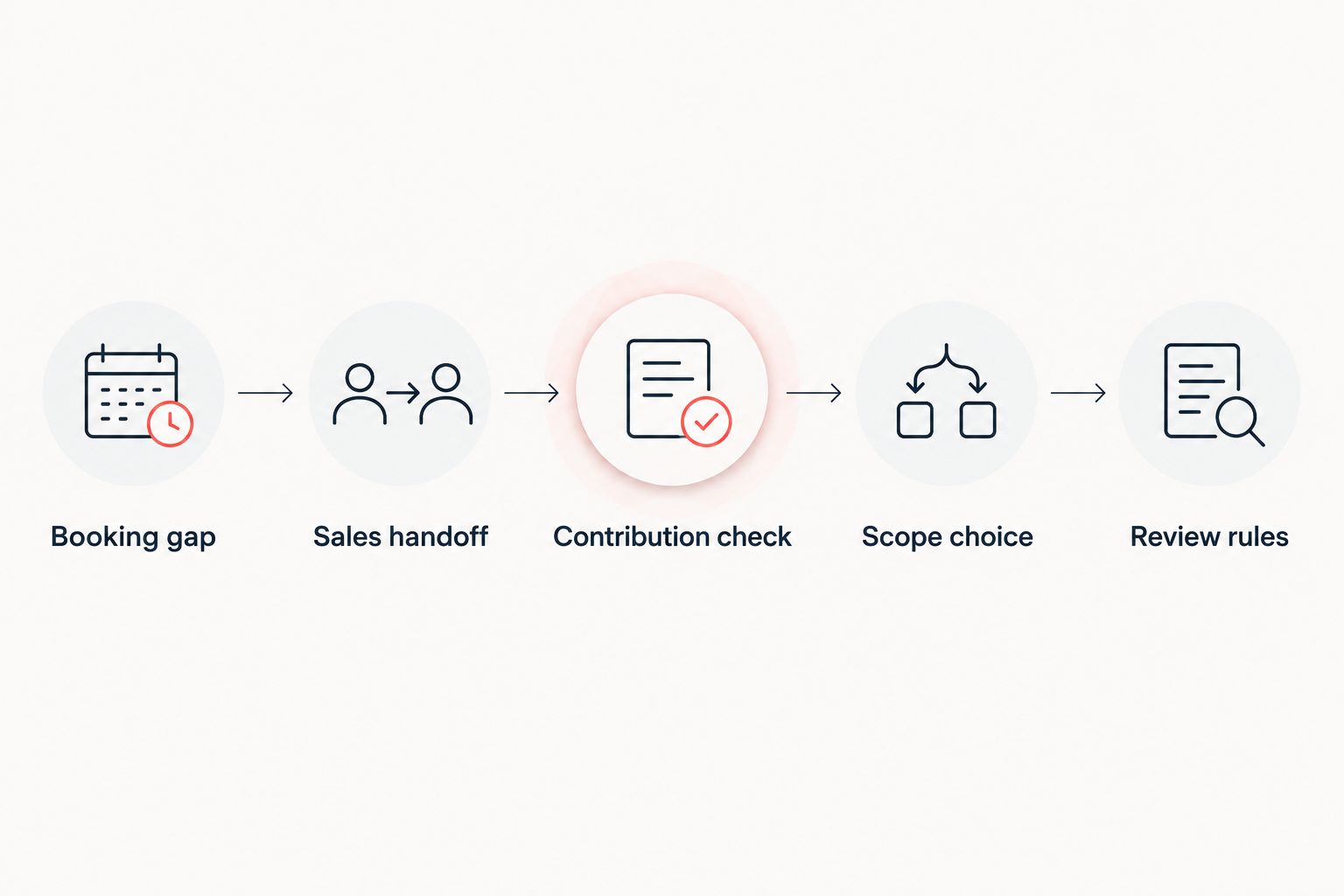 Define the booking problem and sales ownership before choosing a marketing scope.
How do you measure whether the agency is paying off?
For your 2026 review, follow the path from inquiry to signed booking and then assess contribution. Campaign metrics explain activity; they do not establish financial value by themselves.
Keep a shared record of the inquiry source, requested date, suitability, tour status, proposal status, booking outcome, and reason for losing the opportunity. Use consistent definitions so the venue and provider do not report different versions of the same pipeline.
Qualified inquiries
Define qualification before the campaign starts. A couple whose requirements do not match the venue should not count as a successful inquiry simply because they submitted a form.
Review unsuitable inquiries for patterns. Use those findings to change targeting, venue information, or the inquiry form—not merely to increase the reported lead total.
Completed tours and signed bookings
Record scheduled tours separately from completed tours. Then connect completed tours to proposals and signed bookings, so a weak handoff remains visible.
Keep inquiry dates and event dates distinct. Otherwise, bookings for a future season can become confused with revenue from events delivered during the reporting period.
Additional booking contribution
Assess the contribution associated with additional bookings against the full marketing investment, including work outside the agency's fee. Do not use total venue revenue as evidence that a particular campaign worked.
Attribution requires judgment when couples encounter several sources. Record both tracked sources and what couples say influenced them, and distinguish observed results from assumptions about what would have happened without the campaign.
What should you ask before signing an agency agreement?
Ask the provider to explain the proposed work using your booking process. A persuasive presentation is not a substitute for a clear operating agreement.
Useful questions include:
- Which booking problem does this scope address?
- What does the venue need to supply before work can start?
- Who handles inquiries and tour follow-up?
- Which deliverables are included, and which require separate approval?
- Who owns the accounts and materials when the agreement ends?
- What happens when inquiries increase but bookings do not?
Ask how the provider distinguishes its responsibilities from yours. A clear boundary is more useful than a broad promise to “handle marketing.” Put that boundary in writing so both sides can identify where a problem needs attention.
For a 2026 agreement, tie reviews to completed work and observable pipeline changes rather than an unsupported promise of a particular booking result. Your venue's starting position belongs in the evaluation.
Where fractional CMO support fits
Carey Kidd Group is best for hospitality and events businesses seeking fractional marketing leadership rather than an agency-only execution arrangement. The service distinction matters: strategic direction and accountability are different purchases from a channel-specific production scope.
Carey Kidd Group brings 20 years of new business development experience across named sectors including hospitality, event planning, health/medical, and fitness. The business provides fractional CMO and strategic marketing consulting services around Raleigh, North Carolina; review the strategic marketing services against the responsibilities your venue needs covered.
The advantage is a leadership-oriented option when priorities and coordination need an owner. The limitation is equally important: do not assume a leadership engagement includes daily posting, advertising production, website development, or inquiry handling unless those tasks appear in the agreed scope.
Use the same evaluation standard for any provider in 2026. Match the assignment to a business problem, identify who performs the work, and establish how the venue will judge progress.
Should you hire an agency if most bookings come from referrals?
Referrals alone do not settle the decision. Examine whether referrals fill the dates and event opportunities you want, and whether another channel has a defined job to do.
If referrals already support your commercial goals, avoid adding a broad agency scope without a specific reason. Protect what works and address the remaining gap directly.
Should you stop marketing when your preferred dates are booked?
Booked preferred dates change the campaign brief; they do not automatically justify either continuing or stopping all activity. Decide whether the objective is now other dates, a future booking period, or maintaining useful venue information.
Remove messages that imply unavailable dates can be booked. Keep campaign objectives aligned with what the venue can actually sell.
FAQ
Is a marketing agency worth it for a small wedding venue?
A marketing agency is worth it when it addresses a defined execution gap and additional booking contribution exceeds the full marketing investment. Check date availability, inquiry quality, and sales follow-through before hiring.
What's better for a wedding venue: an agency or a fractional CMO?
An agency fits a defined execution need; a fractional CMO fits a marketing leadership need. Choose based on the missing responsibility, and verify the actual scope rather than relying on the title.
How do I know whether my venue needs more leads or better follow-up?
Review suitable inquiries through completed tours, proposals, and signed bookings. If existing inquiries are not consistently handled or recorded, fix the handoff before increasing demand.
Can a wedding venue agency guarantee more bookings?
Do not treat a booking guarantee as a substitute for evidence and a clear scope. Bookings also depend on date availability, suitability, tours, proposals, and the venue's sales decisions.
Should I judge venue marketing by followers and website visits?
Followers and website visits describe activity, not booking value. Connect marketing to qualified inquiries, completed tours, signed bookings, and contribution.
Does hiring an agency mean I can stop managing marketing?
Hiring an agency does not remove the venue's responsibilities for accurate information, approvals, and sales follow-through. Assign a venue-side owner and document the division of work.
Does Carey Kidd Group provide wedding venue marketing execution?
Carey Kidd Group provides fractional CMO and strategic marketing consulting services for hospitality and events businesses, among other sectors. Confirm the specific implementation responsibilities in a proposed engagement rather than assuming an execution package is included.
One last thing
Your most useful pre-hire document is a list of dates and event opportunities you want to sell, paired with the person responsible for converting each inquiry. It gives marketing a commercial destination and prevents an attractive activity report from becoming the objective.
For 2026, approve the assignment before approving the agency. If the provider cannot explain the booking problem, the handoff, and the evidence of progress, narrow the scope before committing.